
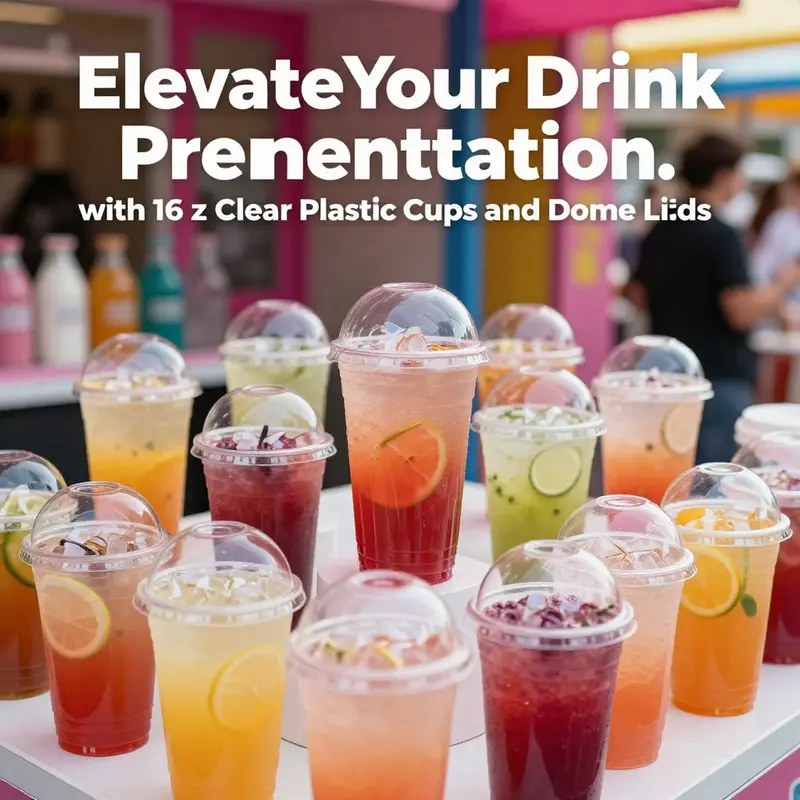
In the competitive landscape of the beverage industry, the presentation and practicality of drinkware can significantly influence customer satisfaction and business success. 16 oz clear plastic cups with dome lids not only provide an elegant display for beverages but also ensure convenience and efficiency for food service operators. This article delves into the design specifications of these cups, their diverse applications across various industries, eco-friendly alternatives, and current market trends. Each chapter aims to equip bubble tea shops, restaurants, food trucks, event planners, and corporate procurement teams with valuable insights to enhance their service offerings and operations.
Clarity, Confidence, and Craft: A Deep Dive into the Design and Materials of 16 oz Clear Cups with Dome Lids

The 16 oz clear plastic cup with a dome lid sits at the crossroads of form and function in the world of beverage presentation. It is a deceptively simple vessel that must strike a balance between visual appeal, user experience, and operational reliability. When a drink is poured into a transparent cup, the observer reads not just color and texture but also freshness, temperature, and even the level of care a brand or event places in its packaging. The material choice—most commonly PET, with the lid often sharing the same resin family—underpins this perception. PET, or polyethylene terephthalate, is revered for its exceptional clarity and its ability to resist the yellowing that can accompany long exposure to light and air. This clarity matters as much as any label or logo, because the drink itself becomes part of the product’s narrative. A bright latte with a delicate crema, a layered smoothie with vibrant hues, or a sparkling tea with iridescent ice all rely on clear optics to communicate quality to the consumer. The dome lid, which creates a generous visual window above the rim, extends this narrative by giving the drink room to breathe—foam, whipped toppings, or a ribbon of garnish can sit comfortably within the confines of the dome without risking a spill during transit or handling. The combination of a transparent cup and a translucent lid offers a unifying aesthetic that supports a wide range of beverages while also delivering practical benefits for busy service environments.
From a design perspective, the standard 16 oz capacity—approximately 473 ml—has become a default for many operators who serve everything from robust coffee drinks to fruit-forward blends. This volume is not arbitrary; it is calibrated to accommodate typical beverage yields at a convenient size point for single-serve consumption and quick service. The straight rim of the cup plays a subtle but essential role in stability and usability. It provides a clean, predictable edge for pouring and sealing, reducing the risk of splashes and leakage during handling. The dome lid itself is engineered to offer a snug, secure fit that minimizes the chance of leakage when the cup is tipped, carried, or stacked. The lid’s geometry must also leave ample clearance for foamy toppings or thick beverages, so customers do not experience resistance when opening or drinking through a small opening. In many designs, there is a central access feature—a hole or a vent—that allows controlled sipping for thicker drinks or for those who prefer to pour a first mouthful without removing the entire lid. This feature, often referred to in the trade as a dasher capability, makes the cup adaptable for a wider spectrum of products, from milkshakes to yogurt-based desserts, while maintaining a clean, spill-resistant barrier when sealed.
Material compatibility and safety are foundational to the product’s performance. PET is celebrated for its clarity, but it also must be food-grade and BPA-free to meet modern regulatory expectations. The choice of PET for both cup and lid supports a consistent visual and tactile experience, yielding a cohesive look on the shelf or at the display. The preference for PET on the lid, in particular, helps ensure that condensation behaves predictably. When a dome lid is paired with a flat lid for added protection against condensation or toppings, the user gains the flexibility to adapt the packaging to a specific serving scenario. The flat lid can act as a secondary shield, minimizing drips on clothing or surfaces and providing an extra layer of insulation for cold drinks during outdoor events or long commutes. In contexts where hot beverages are offered, the materials and seal design must tolerate the temperature range without softening or compromising the integrity of the seal. This is where the industry standard of BPA-free, food-grade plastics becomes not just a regulatory checkbox but a practical guarantee of performance during busy service periods.
A deeper look at the design features reveals a craft that extends beyond raw materials to manufacturability and end-use versatility. Injection-molded PET cups are manufactured to tight tolerances, ensuring consistent wall thickness and a uniform diameter at the rim. This uniformity is critical for reliable stacking and for the compatibility of a broad array of lids and accessories. The dome lid is engineered to snap onto the cup with a reassuring click, indicating a secure seal while still allowing for easy reopening by both staff and customers. The seam between cup and lid is designed to resist leaks even when the cup is jostled during transport in a crowded tray line or a bag with other shopping items. The fit also matters for condensation management. A well-sealed dome lid keeps moisture contained, reducing the risk of condensation droplets forming on the outer surface that could obscure the drink’s appearance or dampen packaging materials. The coupling of the dome lid with a potential flat lid option broadens this protective envelope, providing a two-step mechanism for containment that supports a variety of environmental conditions, from air-conditioned interiors to sunlit outdoor venues.
Beyond the raw materials and sealing dynamics lies a dimension of customization that is essential to business branding and consumer recognition. The cup’s transparency offers a natural canvas for branding through printed graphics, logos, or color accents. The industry-standard approach allows for logo printing with multiple colors—up to six, in many cases—on the exterior surface. This level of customization is particularly valuable for events, promotions, or seasonal campaigns where the packaging itself acts as a moving advertisement. The ability to print on the cup, combined with the dome lid’s consistent visual profile, creates a cohesive package that can reinforce a brand’s identity from the moment a guest notices it on a display to the last sip in a takeaway bag. To keep the design aligned with sustainability goals, some suppliers highlight the option of plant-based PLA options with compostable credentials. In this landscape, a business can weigh the tradeoffs between the robust physical performance and lower cost of standard PET against the eco-friendly rhetoric and potential end-of-life benefits offered by biodegradable alternatives. While PLA-based cups and domes may carry certifications indicating compostability, they address a different life cycle stage than PET and must be evaluated against local waste-management infrastructure and consumer behavior. In this decision space, the best choice turns on the intended use, desired shelf life, and the operating context—catering at a festival, a coffee shop, or a hospitality event—where the interplay of clarity, seal integrity, and branding becomes a tangible driver of customer perception.
The topic of safety and standards cannot be separated from everyday performance expectations. In practical terms, a cup that is labeled as BPA-free and food-grade provides reassurance to both operators and customers that the container will not impart unwanted tastes or harmful substances to the beverage. This is particularly important when beverages stay in the cup for extended periods, when the drink might be consumed hot, or when the cup holds acidic or caffeinated formulations that can interact with packaging materials. The durability aspect—leak resistance, impact resistance, and the ability to withstand the weight of a topped beverage without distorting the cup walls—also shapes a venue’s throughput and customer satisfaction. Operators rely on consistent performance to minimize waste, protect staff from spills, and maintain the cleanliness of service areas. The dome lid’s design contributes to this reliability by offering a controlled, predictable experience for customers who are pouring, sipping, or slurping through a straw. The compatibility with standard straw diameters further simplifies the ecosystem around the cup, letting beverage developers, retailers, and event organizers choose straws and accessories that fit snugly without compromising the seal.
From a sustainability standpoint, the packaging ecosystem presents a spectrum of choices. PET cups, favored for clarity and cost efficiency, are typically recyclable where local streams support such efforts. For brands that pursue a more aggressive environmental narrative, plant-based plastics certified as compostable under certain conditions offer an appealing if nuanced alternative. It is important to acknowledge that compostability is not an automatic solution; it requires industrial composting facilities equipped to handle these materials and a consumer base that understands proper disposal. In practice, durability, cost, and performance often push PET to the forefront for 16 oz beverage cups with dome lids, especially in high-volume operations where breakage, leakage, and quality control are constant considerations. Still, the growing demand for sustainable packaging keeps the PLA pathway in the conversation, as a complement for menus that emphasize eco-friendliness or for venues that have access to appropriate composting infrastructure. The decision is ultimately a balance between the product’s visual promise, the user experience, and the life-cycle footprint that a brand wants to communicate to its customers.
In sum, the design and material specifications of 16 oz clear cups with dome lids reflect a thoughtful synthesis of optics, physics, and human factors. The choice of PET for both cup and lid ensures clarity and strength, while the dome design provides ample interior space for toppings and foams and a secure seal that supports reliable transport. The straight-rim geometry supports stable stacking and predictable pouring, and the optional dasher or secondary lid configurations extend the system’s versatility for different beverage formats. Customization options enable brands to translate identity onto the packaging, while safety and regulatory considerations reassure stakeholders about food-contact integrity. As you explore suppliers and product lines, consider how these elements align with your service model, your beverage portfolio, and your sustainability goals. A single packaging decision can influence not just the drink’s presentation but also the precision of preparation, the efficiency of service, and the clarity with which a brand communicates its values to customers. For a broader view of related packaging categories and to explore how these cups fit within a wider ecosystem of disposable drinkware, you can browse the Plastic Cups category. Plastic Cups category.
External reference: For a general overview of the material properties and food-contact considerations associated with PET, see https://en.wikipedia.org/wiki/Polyethylene_terephthalate
Clear, Sealed, and Streamlined: The Integral Role of 16 oz Clear Cups with Dome Lids Across Industries
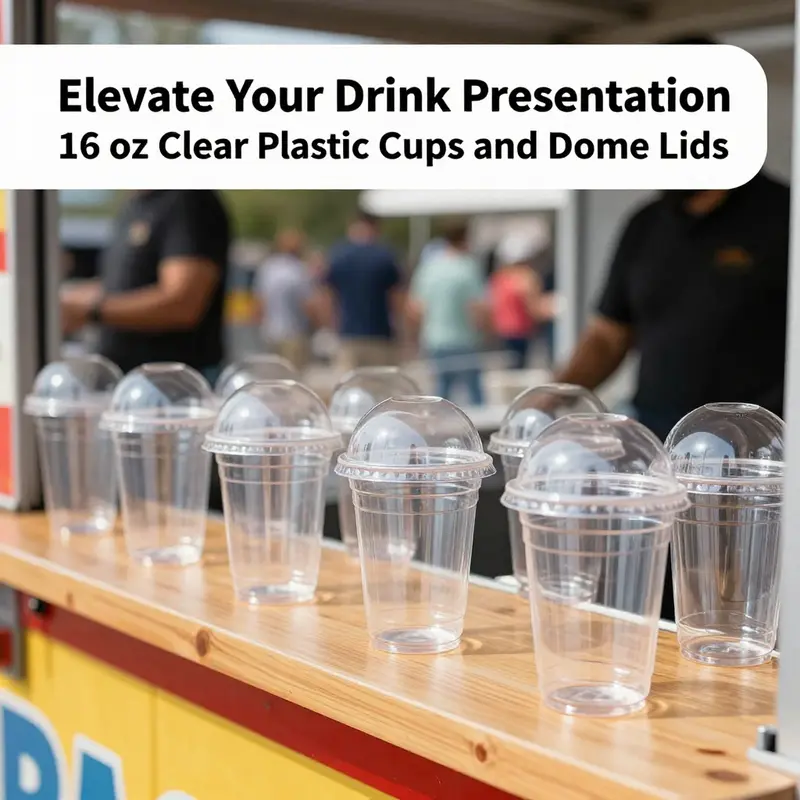
The 16 oz clear plastic cup with a dome lid is more than a simple vessel for beverages; it is a design that blends visibility, containment, and transport efficiency into a single, adaptable tool for service providers across a spectrum of settings. In practice, this combination unlocks a quiet but powerful set of capabilities. The transparency of the cup invites the eye to linger on the drink’s color, texture, and layers, inviting an anticipatory moment before the first sip. The dome lid, with its secure seal, translates that moment of anticipation into a reliable experience of spill resistance and freshness as the beverage moves from the counter to the customer’s hand, across the bustling floor of a café, through a crowded event corridor, or along a delivery route that must respect time, temperature, and presentation. This isn’t merely about ergonomics or aesthetics; it is about a system that supports speed, consistency, and brand storytelling in environments where everything is moving fast and the stakes of a spill or a leaky lid are high. Among the most active arenas for these cups are fast food and quick-service restaurants, where takeout and drive-thru demand containers that can withstand hurried handling without compromising drink integrity. The 16 oz size hits a sweet spot for a standard coffee, smoothie, or iced beverage, while the dome lid accommodates whipped toppings, foams, or layered textures that might otherwise escape a flatter opening. In practice, the lid’s raised profile allows room for a thick straw or spoon, enabling users to stir, sample, and sip without removing the lid entirely. This is especially valuable for drinks that are layered or contain particulates, such as espresso confections, blended fruit blends, or yogurt-based beverages. The strength of PET and related plastics used for these cups means a combination of clarity and durability that resists cracking when stacked or dropped, a common risk in busy pickup lanes or during courier transport. The visual appeal—seeing the beverage itself rather than a dull interior wall—also reinforces perceived quality, which in turn can support premium pricing or enhanced brand perception during quick exchanges. In catering and event management, where logistics are scaled for volume, the 16 oz dome-lid cup becomes a workhorse for weddings, corporate gatherings, outdoor picnics, and festivals. Its design supports high-volume service without compromising hygienic standards or transport safety. Dome lids make it easier to seal in a beverage’s aromas and chill, while ensuring the drink remains stable in gusts of wind or uneven surfaces as staff move from kitchen to buffet, bar to seated areas, or shuttle buses. The stacking characteristics of the cups are not incidental; they enable compact loading into crates, totes, or back-of-house storage that must be rapidly deployed in crowded venues. For beverage stations at large events, the ability to pre-fill safely, cap with a dome lid, and hand out a clean, resealable unit reduces the risk of contamination and spillage during service. The lid often comes with a straw hole that keeps a drink hygienic and easy to transport, which is important when guests move through mingling spaces or outdoor environments where condensation can otherwise dampen the experience or create a slippery mess. In these settings, operators appreciate that a standard 16 oz size offers predictable costs and consistent inventory, which helps with budgeting, forecasting, and the smooth coordination of multiple service points. Retail drink counters and beverage bars are another important frontier for these cups. From protein shakes and cold-pressed juices to specialty coffee and tea beverages, the combination of clarity and containment supports a seamless consumer journey. A clear cup allows customers to identify at a glance the drink’s hue and any added toppings or layers, a visual cue that helps with upselling and cross-merchandising—appealing to the shopper who is drawn to vivid color contrasts, the swirl of a layered drink, or the visible presence of real ingredients. The dome lid, in combination with the cup’s uniform rim, protects the beverage during pouring, leveling, and serving while also enabling a straightforward stacking and restocking process behind the counter. In many retail environments, vendors leverage customization options such as logo printing to reinforce branding on a highly visible surface. The ability to print up to several colors on the label area or lid region adds a layer of marketing impact without requiring a separate sleeve or rigid packaging; this reduces waste and complexity while supporting brand recognition as customers move along a line or queue. The compatibility of these cups with different lid styles—flat lids for condensation control in certain contexts or domed options for an enhanced beverage showcase—means operators can tailor their vessels to the precise demands of each beverage type and service style. The result is a flexible, scalable system that aligns with varying service speeds, portion control, and consumer expectations across channels. Sustainability considerations have risen to prominence in recent years, and the conversation around 16 oz clear cups with dome lids reflects a broader shift in materials science, supply chain choices, and consumer values. PET remains widely used because it delivers clarity, strength, and cost efficiency, making it a reliable option for high-volume operations. Yet, the industry is increasingly exploring alternatives that align with environmental goals, including plant-based options such as PLA (polylactic acid) that are certified to meet compostability standards under industrial conditions. Biodegradable or compostable variants respond to the demand for more sustainable packaging without sacrificing performance in terms of insulation, leak resistance, or optical clarity. For businesses aiming to minimize environmental impact, the decision matrix now weighs not only price and performance but also end-of-life considerations, supplier transparency, and circular economy pathways. In this light, dome-lidded cups with compostable statements can be positioned as part of a broader sustainability strategy that includes recycling programs, waste reduction during service, and partnerships with providers who support industrial composting streams. It is important to acknowledge that while these options exist, standard PET versions remain prevalent in many markets due to compatibility with existing equipment, broad availability, and established logistics networks. The choice often comes down to balancing total cost of ownership with brand promise and long-term environmental commitments, a calculus that businesses continuously reassess as new materials and processing technologies emerge. Customization plays a pivotal role in maximizing the impact of 16 oz dome-lidded cups. The ability to print logos or branding elements on the cup surface or lid increases visibility where it matters most—at the point of purchase, during transit, and in social media posts that capture a moment of refreshment. Customization can be scaled from basic one-color logos to more intricate multi-color designs, enabling brands to communicate personality and quality at a glance. Even small touches, such as the shape of the dome lid to accommodate thicker beverages or the rigidity of the cup wall to resist deformation when stacked, contribute to a more reliable customer experience and reduced operational friction. For companies that rely on quick repalletizing and restocking, standardizing 16 oz dome-lidded cups across outlets can simplify training, inventory management, and ordering practices. The broader supply ecosystem—encompassing manufacturers, distributors, and raw-material producers—offers a spectrum of options for sizes, lid geometries, and compatibility with customization workflows. This integrated approach to design, production, and service is what makes the 16 oz clear cup with a dome lid a versatile backbone for beverage programs across fast-paced foodservice environments, catering operations, and consumer-facing beverage destinations. The conversation around these cups is not static. Suppliers continue to refine materials, add lids with improved sealing mechanisms, and explore coatings or barrier layers that extend shelf life and protect against moisture or grease ingress. The practical implications are evident in daily operations: fewer spills, fewer damaged cups, cleaner presentation on trays and counters, and a more controlled pouring experience when customers choose to mix toppings or layered textures. For operators who evaluate procurement decisions in real time, the ability to source a reliable supply of 16 oz cups with compatible lids—along with optional logo printing and OEM/ODM services—can translate into smoother production runs, more consistent customer experiences, and a stronger alignment between packaging choices and brand identity. The pathway from concept to consumer is not a single step but a chain of decisions: material selection, lid design, stacking and transport performance, customization, sustainability, and total cost of ownership. When these elements converge, the dome-lidded 16 oz cup becomes a practical embodiment of service excellence and brand storytelling in motion, a small but essential link in the chain that connects product quality with customer satisfaction and repeat visits. For readers seeking concrete examples of supply and ordering dynamics, industry catalogs and supplier listings offer practical roadmaps. They illustrate how a standard 16 oz clear cup with a dome lid can be integrated into a broader packaging and drinkware strategy, including the decision points around lid-hole configurations, spouts, and compatibility with various beverage types. The emphasis remains on durability, hygiene, and ease of use, with an eye toward sustainability and customization that reinforces a brand’s value proposition. In sum, these cups are not mere containers; they are catalysts that help convert a beverage into an experience—one that travels reliably from bench to bucket, from counter to customer, all while preserving the beverage’s integrity and the brand’s promise. To explore related product categories and related offerings, you can browse the disposable drinkware section that houses a range of dome-lidded options and compatible accessories, which provides a cohesive view of how these vessels fit into a broader packaging strategy. For a deeper dive into practical sourcing and customization, see the disposable drinkware category on the site. disposable drinkware External resource for further context on materials and market trends can be consulted here: https://www.alibaba.com/product-detail/Fuling-PET-CUP-16-oz-Clear-Plastic_1600527938478.html?
Clear, Convenient, and Conscientious: Rethinking 16 oz Clear Plastic Cups with Dome Lids for a Sustainable Service

The rise of 16 oz clear plastic cups with dome lids marks a shift in how beverage service engineers balance visibility, practicality, and responsibility. These cups, typically made from PET, offer remarkable clarity that helps drinks shine—from dark roasts to vibrant smoothies. The dome lid, designed to preserve freshness while reducing the chance of spills during transit, completes a system built for grab-and-go and dine-in service alike. Yet as operators gauge performance against cost and customer expectations, sustainability rises to a new prominence. The conversation is no longer solely about whether a cup is sturdy enough to hold a hot latte or a cold bubble tea. It now includes how a cup can participate in a circular economy, how it can be certified for responsible disposal, and how brands can tell a credible story without compromising usability. The practical realities of operating with dome lids reinforce this balance. A sealed lid reduces leakage during transport and minimizes exposure to air, which helps maintain drink quality for longer periods. It also means fewer messy returns and less waste in carryout scenarios. The container and lid together become a single packaging system whose environmental profile is judged not only by the material it is made from but also by how well that system can be recovered, recycled, or composted at end of life. In this light, every choice—from the base material to the presence of a central hole or spout in a dasher option to the possibility of a flat secondary lid—carries weight in the sustainability equation. This is not a debate about a single material or a single feature; it is a nuanced consideration of how design, supply chain, consumer behavior, and policy intersect to shape waste, energy use, and resource recovery. A key frame for this discussion is the certification landscape that signals a manufacturer’s commitment to responsible disposal and to safe, food-grade performance. Certifications such as BPI indicate compostability under industrial conditions, a standard that recognizes the realities of waste management infrastructure and the realities of modern hospitality. They are not a universal guarantee of end-of-life outcomes in every locale, but they do offer a credible signal that a product can be responsibly managed where industrial composting facilities exist. This signaling is important because it helps brands make credible claims about sustainability without overreaching into promises that may not hold in every municipal or regional setting. Consumers are increasingly savvy and will look for transparent indicators that a product aligns with broader environmental goals. They want to see that a cup can be both functional for a busy service and part of a sustainable story that a business can stand behind. In practical terms, this means that a supplier will often emphasize the PET material’s recyclability and safety for a wide range of beverages, along with the option to print logos and branding in multiple colors. The possibility of customization speaks to a larger trend: packaging as a signal of a brand’s values. When a cup carries a conspicuous message about recycling, composting, or reduced plastic use, it becomes a touchpoint in the consumer’s decision process. It is not merely a container; it is a platform for communicating a company’s commitment to sustainability. For operators, this translates into a choice matrix. PET cups are widely recognized for their clear appearance and reliable performance, especially with cold beverages. They can be used in environments where customers expect a clean, hygienic presentation and a straightforward disposal path. While PET is highly recyclable in many communities, the reality of end-of-life outcomes varies with local infrastructure, market demand for recycled PET, and consumer participation in recycling programs. This variability makes the sustainability conversation more about system optimization than about a single material. In regions with robust recycling streams, PET cups can contribute meaningfully to resource recovery. In places that cultivate industrial composting for PLA or other bio-based options, compostable cups may present an appealing alternative, provided they are properly directed to industrial facilities. The field is nuanced: not all compostable cups behave the same in all settings, and not all PET cups are equally accepted by recycling streams. The decision to use a compostable cup or a recyclable PET cup thus hinges on a business’s capabilities and the local waste ecosystem. It is not enough to boast a green veneer; the chain of custody for the packaging must be credible and traceable. In this sense, the literature on sustainability often emphasizes the lifecycle approach. It looks at raw material extraction, production energy, transport emissions, performance during use, and end-of-life management. A lifecycle view invites a careful comparison of tradeoffs. For hot beverages, certain PET formulations may require more protective handling to avoid warping, while some plant-based options prioritize a compostable route that depends on specialized facilities. The balancing act becomes clearer when brands consider customer expectations. In today’s market, consumers want clarity—literally and figuratively. Clarity comes from the material’s optical properties, which determine how drink colors and textures appear in the cup. It also refers to the packaging’s narrative: is the cup easy to recycle, is the lid designed to minimize spillage, and can the business share a credible sustainability story without overpromising outcomes? The dome lid itself plays a role in this narrative. A domed design can reduce condensation and prevent toppings from spilling when people carry drinks in bags or pockets. For beverages that are thick or layered, some lid configurations include a central hole or a small spout, enabling controlled pouring without removing the entire lid. This combination of lid and cup fosters a hygienic and mess-free experience, an important advantage in busy settings. At the same time, these lid designs can influence how the system is disposed of or diverted to recycling streams. A lid designed for stacking and safe separation during recycling can contribute to better recovery rates. In practice, many suppliers describe their offerings in terms of safety, recyclability, and compatibility with multiple lid types. They emphasize that the cups are food-grade and BPA-free, a point that is increasingly expected by consumers and regulators. They often point to the flexibility of customization, offering multi-color logo printing up to six colors, which gives brands a chance to align the packaging with sustainability messaging and to reinforce green commitments on every cup, thereby turning packaging into a visible statement rather than a generic carrier. A broader implication of this trend is how packaging choices shape operational efficiency and customer perception. When a cup and lid system minimizes spills, it reduces waste by lowering the likelihood of beverage loss during transport and handling. At the same time, a design that is easy to recycle or compost supports staff efficiency in trash separation, a factor that can influence store-wide waste reduction targets. The decision to pursue recycled content, certified compostability, or a combination of both often hinges on a careful assessment of the local waste stream, the capital investment required for sorting and processing, and the expectations of customers who insist on environmental accountability. For businesses interested in exploration rather than conclusion, the path forward can be navigated with educational material and supplier partnerships that clarify what each option means in practice. To see where a broader spectrum of disposable drinkware fits into a sustainability strategy, readers can explore the category that houses these products and related items, which provides a practical lens on how different packaging components align with environmental goals. Disposable Drinkware category. This resource helps connect the dots between cups, lids, and the broader ecosystem of one-time-use beverage packaging, highlighting how a brand can curate a complete package that communicates care for people and planet alike. For businesses that want a tangible sense of supply chain options, an external catalog offers concrete examples of available configurations, including domed lids and central-spout variants that work with a 16 oz cup in a range of settings. While market dynamics vary by region, the underlying principles remain consistent: choose materials and designs that maximize recyclability or compostability, minimize energy and water use in production, and enable straightforward end-of-life management for customers who want to contribute to a cleaner environment. The result is a packaging solution that is not only functional and visually appealing but also aligned with credible sustainability aspirations. The balance is delicate and ongoing. It requires continual assessment of new materials, evolving waste-management capabilities, and transparent communication with customers about what happens after they discard the cup and lid. By emphasizing certifications, recyclability metrics, and real-world end-of-life options, the industry can offer products that perform on the bar, in the drive-thru, and in the marketplace while still supporting a more sustainable future for packaging. External resources can provide up-to-date information on certification criteria, regional composting availability, and evolving recycling standards, helping brands calibrate their strategies over time. For a practical external reference that illuminates current sourcing and material options, consult the following catalog: https://www.alibaba.com/product-detail/Fuling-PET-CUP-16-oz-Clear-Plastic_1600378592304.html?spm=a2700.galleryofferlist.normal.1.4c9a1e9bXvDfTt&productId=1600378592304
Clear Ambition: Reading the Market Pulse of 16 oz Dome-Lidded Cups in a Shifting Beverage Economy
The 16 oz clear plastic cup with a dome lid has become less a simple vessel and more a measure of how modern beverage service visualizes value. In a market where presentation competes with practicality, these cups perform at the intersection of clarity, durability, and convenience. Their transparency is not merely an aesthetic; it is a strategic decision to let the beverage speak for itself. In cafes, dessert shops, and mobile setups alike, the ability to peek through a pristine crystal of plastic and see a layered latte, a glossy smoothie, or a granular pearl tea is a subtle cue that reinforces quality. The dome lid adds another layer of reliability, a sealed cap on the experience that reduces spill risk during transport and makes outdoor service as feasible as indoor service. The combination has become a familiar sight in an omnichannel beverage ecosystem, where customers may order at a counter, pick up at a drive-thru, or receive a catered cup at an event, and expect a consistent, spill-free experience from the first grip to the last sip.
Consumer expectations have quietly shifted the economics around these cups. Clarity remains a primary value proposition for PET-based containers, which preserve the visual appeal of the beverage while resisting shattering under typical handling. Yet the drive toward sustainability has begun to refract through the same market lens. Biodegradable and compostable options, notably those derived from plant-based feedstocks like corn starch, have moved from niche offerings to components of a broader environmental strategy. The presence of certifications, such as those that speak to industrial compostability, has become a marker of credibility for brands seeking green positioning. At the same time, these move toward greener materials must balance other demands: cost and performance. In many cases, PET remains the default choice for routine cold beverages because it provides the right balance of strength, clarity, and cost. For beverages that ride the edge of indulgence—milkshakes, yogurt parfaits, or thick bubble teas—the dome cap design, especially when paired with a central-hole lid, is a practical tool. It enables controlled sipping without removing the lid entirely, a feature that reduces mess and protects toppings and layers while also enabling a degree of user customization at the point of service.
The design vocabulary of these cups has grown with the needs of modern commerce. A plain dome lid is often enough to prevent spills during transit, but the ecosystem has expanded to include variants with holes for sipping or pouring, and flat lids that can be paired with the dome for added protection against condensation and accidental topping spillage. This flexibility matters because it translates into a single packaging solution that can handle a wide spectrum of beverages and use cases. In a world where a single cup can carry iced coffee, a smoothie, or a delicate cold brew with a visible crema, the choice between lid configurations becomes a practical decision tied to the product experience and the logistics chain that moves it from the machine to the consumer. Branding, too, thrives within this framework. The same cup can be customized with logos or color accents, allowing brands to project identity without sacrificing the simplicity that customers expect from grab-and-go formats. The economics of customization—logo printing in multiple colors, for example—has matured to support small pilot runs and larger scale production, giving small businesses the opportunity to elevate their packaging without incurring prohibitive costs.
Within the broader market, the 16 oz dome-lid cup sits in a landscape shaped by regional regulations surrounding single-use plastics. These policies have accelerated the exploration of alternative materials and recycling programs, and they have propelled manufacturers to improve end-of-life management for their products. The push toward responsible packaging is not simply about compliance; it is about aligning product attributes with consumer values. For some brands, a shift toward plant-based PLA cups—often marketed as compostable in industrial facilities—becomes a core part of a sustainability narrative that resonates with customers who care about the footprint of their takeout. For others, the emphasis remains on PET due to its lightweight, transparent performance, and the investment in recycling streams that can process PET efficiently. The tug-of-war between these paths—biodegradable versus recyclable—has become a central theme in market strategy, not as a theoretical debate but as a practical calculus that informs pricing, supplier selection, and the speed at which new materials can be scaled to meet demand.
From a manufacturing perspective, the market benefits from a highly capable, globally integrated supply chain. Regions with large-scale, automated production facilities can deliver consistency and volume that help stabilize pricing in bulk orders. Cleanroom production environments and precision molding processes have become standard, allowing manufacturers to produce cups that maintain optical clarity and uniform wall thickness, which in turn influences product performance under cold beverage temperatures. The ability to offer OEM and ODM services, along with options for logo printing, further anchors these cups in the realm of brand-building tools. In a marketplace where a cup is often the first tangible touchpoint a consumer has with a beverage concept, being able to tailor packaging while maintaining hygienic and barrier performance is a powerful competitive differentiator. The economics of scale support not only lower per-unit costs for large buyers but also the flexibility to accommodate smaller brands seeking to test new beverage concepts without committing to long production runs.
The versatility of these cups extends across multiple channels. In traditional storefronts, they showcase the beverage’s color and texture, turning a simple order into a moment of brand storytelling. In mobile and outdoor contexts, the dome lid’s spill protection supports on-the-go consumption, a factor increasingly important to customers who live in fast-moving urban environments or attend events where space and logistics are constrained. In grocery and convenience formats, the cup is not merely a vessel but part of a display strategy—clear walls invite a consumer to choose based on visible ingredients, layering, or toppings. It is this cross-channel relevance that sustains demand and keeps the product line dynamic, even as broader packaging conventions evolve around sustainability and waste reduction.
Even with all the attention paid to sustainability, consumer convenience remains a bedrock principle. The ability to carry a ready-to-drink product without fear of leakage has become a baseline expectation for many beverage concepts. The dome lid, with its secure seal, reassures customers who want to avoid spills during transit, a reassurance that translates into higher conversion at the point of sale and more reliable carry-out experiences. In environments such as food trucks, coffee carts, and campus dining facilities, where the pace of service matters, a well-designed cup-and-lid system can shave seconds off service times while preserving the integrity of toppings and the presentation of the beverage. For establishments that emphasize presentation, the clarity of the cup enables the beverage’s appearance to maximize impact, even at a distance. A layered smoothie or a coffee drink with a crema top can communicate premium quality simply through visual appeal, which reinforces the perceived value at the moment of purchase.
These dynamics also influence branding strategies and category development. A brand can leverage the flexibility of customization to create a signature cup that becomes a recognizable cue among consumers. The process typically involves choosing the lid type that best matches the drink profile, aligning the cup’s clarity with the beverage’s visual composition, and coordinating with a design team to ensure the logo, color palette, and messaging are readable at a glance. The end result is packaging that works as hard as the beverage itself, turning a disposable product into a small, portable ambassador for the brand. For buyers evaluating options, a practical path is to explore a range of configurations—clear, pourable PET cups with different lid options and potential substitutions to PLA-based alternatives—while maintaining a strict eye on total cost of ownership, including material, printing, and end-of-life considerations. In this sense, the market’s growth is not merely about more cups being sold; it is about smarter packaging choices that align with consumer expectations, store operations, and sustainability goals.
To connect the practical with the perceptual, consider the role of the product in customer experience journeys. Customers often decide on a beverage concept well before they choose a flavor or an add-on. The cup, with its lid, is part of that decision-making moment. A cup that presents the drink without distraction reinforces the impression of freshness and care, while a lid that fits snugly without warping in the hand conveys reliability. When a brand orchestrates this experience across multiple touchpoints—online menus, in-store displays, drive-through efficiency, and post-purchase moments—the packaging becomes a coherent extension of the product proposition. A simple, well-executed cup with a dome lid thus contributes to a consistent brand narrative across channels, which in turn supports long-term customer loyalty and repeat business.
For readers exploring this topic further, the packaging category pages offer a concise gateway to related formats and materials. See the Plastic Cups category for a broader view of the family and how various lid configurations harmonize with different cup sizes. This interconnected approach helps brands and retailers evaluate options in a way that preserves both the beverage’s integrity and the unit’s role in the customer experience. In a market where the speed and style of service matter as much as the drink itself, the 16 oz dome-lid cup remains a practical, scalable instrument in the modern beverage toolkit.
External resource: https://www.alibaba.com/product-detail/16-oz-customized-plastic-cups-with-lids1600245985784.html?src=productDetail&spm=a2700.productdetail.0.0.3b1e3c92ZkNlUa
Final thoughts
Choosing the right drinkware can have profound effects on both presentation and functionality in the beverage service sector. 16 oz clear plastic cups with dome lids epitomize the balance of aesthetics and practicality, enhancing customer experience while meeting operational demands. As we navigate the path towards sustainable practices, it’s essential to consider eco-friendly alternatives alongside traditional offerings. With insights garnered throughout this article, it’s clear that investing in high-quality, versatile cup solutions can significantly benefit bubble tea shops, restaurants, and all purveyors of beverages. Stay ahead in this competitive market by understanding the full potential of these indispensable products.