
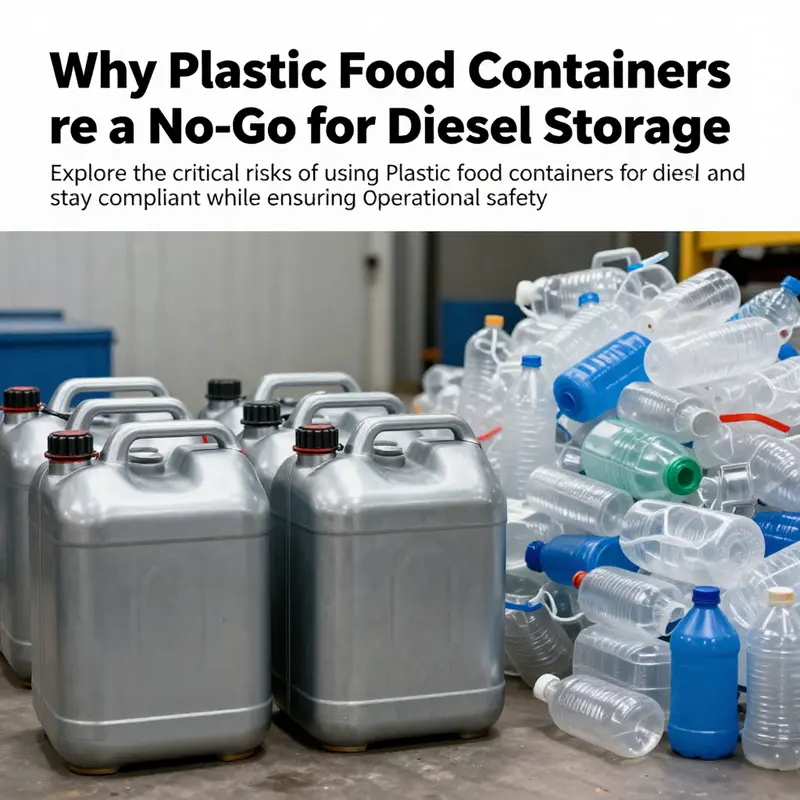
For businesses in the food and beverage industry, ensuring safe and compliant operations is paramount. While it may seem convenient to repurpose plastic food containers for diesel storage, the potential hazards involved can jeopardize both health and operational integrity. This article unpacks the dangers associated with using plastic food containers for diesel, touching on chemical interactions, static electricity hazards, fuel contamination, leakage issues, and regulatory compliance. Each chapter dissects these issues, shedding light on why investing in proper diesel storage solutions not only protects your equipment but also safeguards your business’s reputation.
When Plastics Meet Diesel: The Hidden Chemical Dangers of Storing Fuel in Food Containers
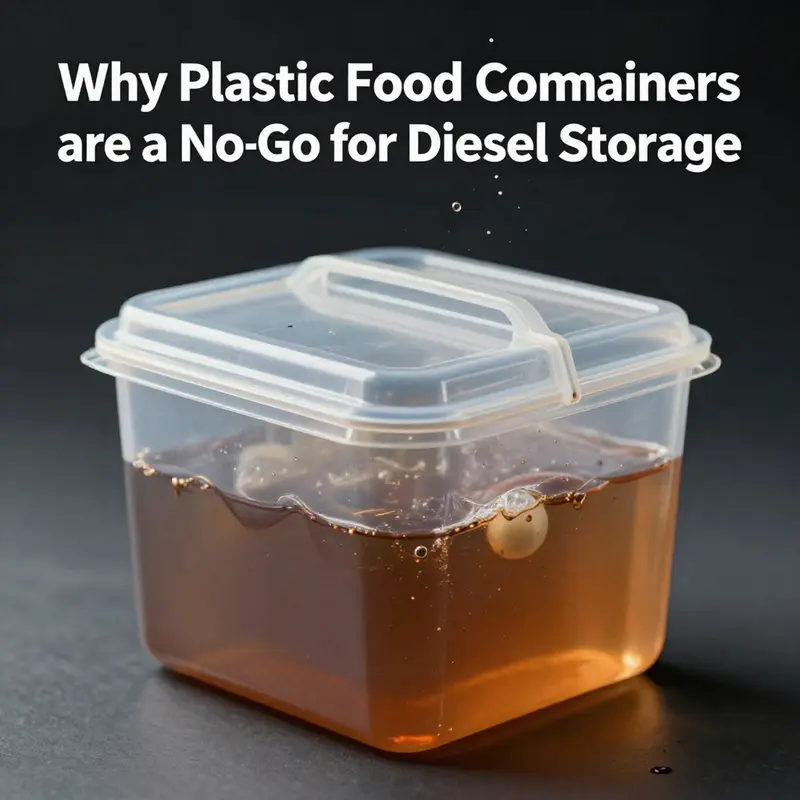
The idea of repurposing a familiar, convenient plastic food container to hold diesel can feel like a pragmatic shortcut in a pinch. Yet the chemistry of petroleum-based fuels and the design intent of consumer food packaging are almost always at cross-purposes. Diesel is a complex mixture of hydrocarbons, including aromatic compounds and solvents that can aggressively interact with common plastics. Containers fashioned for food storage are engineered for water resistance, light weight, and consumer safety in contact with edible products, not for long-term exposure to fuels. When diesel sits in such containers, a cascade of chemical interactions begins. The polymer chains that make up plastics like polyethylene and polypropylene are vulnerable to solvating effects from hydrocarbons. Over days and weeks, the fuels can cause the plastic to swell, soften, or crack. In some cases, the plastic can even begin to dissolve at the surface, releasing not only the fuel but residues into the fuel. This degradation is not a minor concern; it directly affects the integrity of the container and the quality of the diesel. The most troubling aspect is the leaching of additives that were included in the plastic during manufacture. Substances such as certain plasticizers, stabilizers, and heat- and UV- stabilizers can migrate into the diesel. While the precise composition of a given batch of plastic may vary, the pattern is well-supported: exposure to diesel can mobilize additives that would otherwise remain sequestered within the polymer matrix. In particular, some additives linked to hormonal disruption in humans could migrate during storage, raising concerns about chronic exposure if such fuels are handled or used without proper precautions. The long-term implications extend beyond the container; they touch the engine that uses the diesel. The presence of unfamiliar organic compounds arising from plastic leachates can alter fuel properties in subtle but consequential ways. Diesel engines rely on a precise balance of lubricity, chemical stability, and combustion characteristics. Even small amounts of foreign organics—introduced by leached additives—can modify the acid value of the fuel, increase the tendency for gum formation, or alter the surface chemistry of fuel injectors. The practical upshot can be more than just a tough start on a cold morning. The engine’s fuel system, particularly injectors and pumps, is optimized for a specific hydrocarbon profile. When altered by contaminants or leachates, wear patterns can accelerate, filtration burdens can rise, and maintenance costs can climb. There is a documented pattern whereby storage in ill-suited containers leads to an unfamiliar gel or sediment formation in diesel, a sign of changing molecular interactions that can impede flow and inflame injector timing irregularities. In some experimental observations, the gel content in diesel has surged by as much as three hundred percent after as little as nine days in non-approved packaging. That kind of alteration does not just change fuel color or odor; it changes its viscosity and chemical reactivity, potentially upsetting the delicate combustion dynamics within modern engines. The acid value of the stored fuel can rise as the container’s surface chemistry shifts under hydrocarbon exposure, creating an environment that promotes corrosion in metal components of the fuel system. Corrosion in the feed lines, injectors, or pump surfaces can snowball into reduced efficiency, unexpected shutdowns, or increased emissions. These phenomena—surface degradation, additive leaching, and altered fuel properties—are not theoretical abstractions. They reflect a convergence of materials science and automotive engineering where the compatibility of container materials with hydrocarbon fuels is a foundational safety and performance issue. This is why, from both a safety and a regulatory perspective, plastic food containers are not suitable for holding diesel, even for short-term storage. The risk is not merely the potential for a leak; it is the combination of chemical migration, fuel quality degradation, and the destabilization of engine components that rely on predictable fuel behavior. The implications extend to storage practices as well. Plastic containers, particularly those with rough interiors or imperfect seal surfaces, can harbor micro-debris and particulate matter. If such residues find their way into diesel, they can clog filters and accelerate injector wear. Even when a container appears to be intact, microcracks or defects formed during handling can become pathways for contamination or leakage under pressure during transport. The perceptible risks are compounded by the fact that many plastic food containers are not designed to be hermetically sealed against vapors, let alone hydrocarbons. Permeability rates that might be negligible for water or simple beverages become significant when confronted with the more aggressive chemistry of diesel. Static electricity adds another layer of hazard. Plastics do not conduct electricity, so static can build up during pouring and movement of diesel, particularly in dry environments or in low-humidity storage. A sudden discharge could ignite a flammable atmosphere if vapors are present, especially in enclosed spaces with poor ventilation. The combination of static risk, potential leaks, and altered fuel chemistry represents a convergence of safety concerns that makes the use of food-grade plastic containers for diesel a recipe for avoidable peril. These considerations are not merely theoretical; regulatory frameworks increasingly reflect the need for dedicated containers designed to withstand hydrocarbon exposure. In many jurisdictions, storage of hazardous liquids has become tightly bound to the use of approved containers that are explicitly designed for fuels. The rationale is straightforward: approved containers employ materials and wall thicknesses that are tested for hydrocarbon resistance, exhibit predictable permeability, and meet safety requirements for venting, labeling, and handling. The regulatory landscape has evolved to emphasize not only the chemical compatibility but also the lifecycle and environmental risks associated with improper storage. The implication for any practitioner or hobbyist is unambiguous: do not rely on plastic food containers for fuel storage. When the need arises to store diesel, choose a container that has been specifically tested and approved for hydrocarbons. The aim is to minimize any opportunity for chemical interaction that could degrade the fuel or compromise the engine. Engine wear, contaminated fuel, and the risk of ignition are not acceptable trade-offs for the sake of convenience. In balancing the practical realities of risk management, it becomes clear that the most responsible approach is to employ containers designed for fuels, typically materials such as high-density polyethylene (HDPE) or other chemically resistant synthetics, used within the manufacturer’s specified temperature and pressure ranges. An understated but crucial element in this discussion is the visibility and traceability of fuel storage. Using food-grade containers complicates labeling, dating, and inspection procedures. Diesel, stored in a container not designed for hydrocarbons, may gradually lose its quality within a few days, especially if exposed to heat, sunlight, or fluctuating humidity. When quality degrades, the risk extends beyond the storage unit to the fuel system itself, jeopardizing the reliability of the vehicle or equipment intended to rely on that diesel. The broader implications of this practice extend into safety culture and regulatory compliance. For safety professionals, shop managers, or individuals handling fuels in variable environments, the lesson is consistent: the cost of cutting corners on container selection is paid in safety margins and engine integrity. The preference for properly approved fuel containers is not merely a compliance matter; it is a core element of fuel maintenance philosophy. In situations where a quick solution seems tempting, the traditional, responsible path is to invest in containers designed to resist hydrocarbon exposure, with durable seals and clear labeling that communicates the correct contents and handling precautions. If one wants to illustrate a practical takeaway, consider the following: the chemistry of diesel and the architectural intent of plastic food packaging are largely incompatible. A container that has safeguarded a wide range of food products under benign conditions is not automatically suitable for handling a volatile, solvent-rich hydrocarbon. The incompatibility is not only about the plastic itself but about the ecosystem that surrounds the container—caps that may outgas, seals that may degrade, and the interior surface that can trap particulates. The cumulative effect is a higher likelihood of fuel degradation, site contamination, and compromised engine performance. For those who may still question the necessity of precise storage standards, it is worth reflecting on the regulatory message. Health and environmental authorities emphasize that risk minimization requires sticking to approved storage solutions. This is not about fear of regulation but about practical risk reduction: avoiding contaminant sources, ensuring consistent fuel properties, and maintaining the integrity of engines and the environments in which they operate. To connect this discussion with broader safe-practice resources, consider exploring case examples and guidance on chemical compatibility and safe storage practices in reputable regulatory literature. In the end, the simplest, most reliable conclusion is that plastic food containers are not substitutes for fuel-approved storage solutions. If a task demands storing diesel, the prudent choice is to select containers that have undergone hydrocarbon-specific testing and certification, and to adhere strictly to the manufacturer’s usage guidelines. Acknowledging the realities of material science does not diminish practicality, it sharpens it. It ensures that the fuel you store retains its quality and that the engine designed to run on that fuel remains protected from avoidable failure. It also aligns with a broader safety ethic: prevent contamination, prevent ignition sources, and minimize environmental risk by using containers that are explicitly designed for hazardous liquids rather than repurposed consumer packaging. For readers seeking practical direction on safe packaging options that avoid the risks described, you can consult resources that discuss approved fuel storage and packaging materials, including examples of safe, compliant alternatives such as certain metal or hydrocarbon-resistant polymer containers. As a concluding note, the most important insight is that the cost of convenience is paid in fuel integrity, engine health, and safety margins. Keeping plastic food containers away from diesel is not a cosmetic preference but a fundamental precaution rooted in chemistry, engineering, and regulatory prudence. Internal link for further exploration of safe storage packaging alternatives: disposable-26oz kraft paper soup cup with lid take-away packaging. External resource for deeper technical background on plastic leaching and hydrocarbon compatibility: https://www.epa.gov/chemical-research/chemical-leaching-plastics
When Insulation Ignites: How Static Electricity Turns Plastic Food Containers into Diesel Hazards
When Insulation Ignites: Static Risks of Storing Diesel in Plastic Food Containers
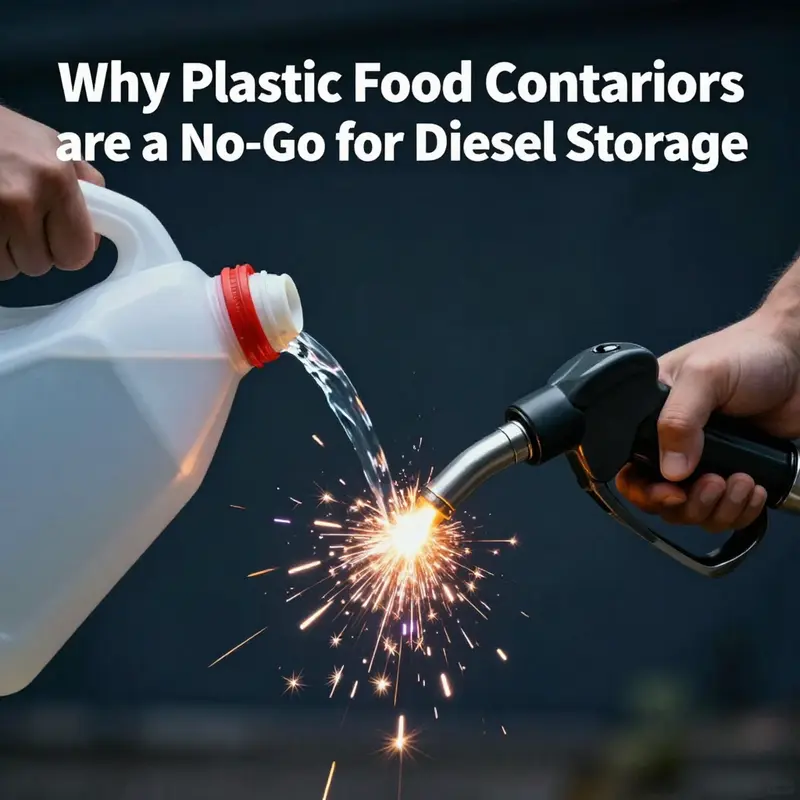
Storing diesel in a container designed for salads or leftovers may seem harmless. However, the insulating nature of ordinary plastic food containers changes simple handling into a high-risk activity. Plastic does not allow electrical charges to bleed away. During pouring, sloshing, or filling, friction between diesel and the plastic surface generates electrostatic charge. That charge accumulates on the container walls and on moving liquid. When the stored charge finds a path to discharge, it can produce a spark. If a flammable vapor pocket exists in the headspace, that spark can ignite it.
The physical mechanism is straightforward and unforgiving. Diesel flowing past a plastic wall rubs electrons free. Small droplets, turbulent streams, and narrow necks increase friction. A dry environment slows natural charge dissipation through humidity. Over minutes or hours, charges build until local electric fields exceed the breakdown strength of the air or of the material itself. The discharge types observed in research describe how energy escapes: localized spark discharges that jump gaps, brush discharges that spread across insulating surfaces, corona that ionizes nearby air, and surface discharges that travel along the container. Each can produce enough energy to ignite a combustible mixture when conditions allow.
A key point often missed is that diesel has a higher flash point than many fuels. That fact can lull people into complacency. Diesel vapors are less likely to form at normal temperatures compared with gasoline. Yet they still form in the container headspace, especially when fuel is warmed, agitated, or sprayed. Spray and mist create fine droplets with large surface area. Those droplets can coexist with air and create flammable mixtures at temperatures and concentrations that a single spark can ignite. Diesel in a perforated or poorly sealed plastic vessel can also emit vapors that concentrate in enclosed spaces, increasing risk.
Plastic food containers were never engineered for handling flammable liquids. They lack features that reduce electrostatic risk. Approved fuel containers are often metallic or made from conductive polymers with additives or coatings that allow controlled dissipation of charge. They include bonding points or are explicitly designed to be grounded while filling. Food containers rarely have those properties. Their thin walls, molded seams, and ribbed or textured interiors can create localized charge hotspots. Those hotspots can concentrate electric fields and become initiation points for discharges.
Practical handling behaviors further magnify danger. Fast pouring increases triboelectric charging. Pouring through a narrow opening raises fluid shear and friction. Shaking, stirring, or transferring diesel between plastic food containers raises the frequency of charge events. A person may touch the container or nearby metal and create a discharge path through their body. Static can leap to tools, buckles, or metal fittings; a spark from any of these points can find a vapor pocket and ignite it. Since plastic does not ground, the only way to safely manage charge is to rely on external bonding or conductive paths. Regular household containers offer none of these safeguards.
Environmental conditions matter. Low humidity increases static buildup because water molecules in the air provide a natural leakage path for charge. Cold, dry weather and indoor heated environments are therefore more hazardous. Dust and particulate on the container surface can alter charging behavior and help carry charge across gaps. Contamination from residues exacerbates unpredictability. A plastic bowl used previously for food will typically have oils, crumbs, or detergents trapped in seams. These residues change surface conductivity and can mask developing hazards until a discharge occurs.
Beyond ignition risk, static events can damage equipment. A sudden discharge inside a container can rupture lids or create micro-fractures in brittle plastics. A damaged container can leak diesel and spread contamination. A leak near ignition sources, such as hot engines or electrical equipment, multiplies the hazard. Diesel spills also present environmental and cleanup challenges, and using non-approved containers can complicate liability and insurance claims.
Mitigation measures used in proper fuel handling show why food containers are unsuitable. Safe practice requires conductive or grounded containers, slow filling to limit charge generation, bonding lines to equalize potential between containers and transfer equipment, and using conductive hoses and nozzles. Some storage systems introduce antistatic additives to fuel or use specially formulated liners. Fuel standards and codes mandate these controls because static risks are real and well documented. Ordinary food packaging lacks each of these features.
Even when a plastic container appears intact, permeability is a hidden problem. Diesel can diffuse into polymers, swelling the material and changing electrical properties. Over time, that can increase the container’s ability to hold charge and raise the likelihood of sudden discharge. Manufacturers of approved fuel containers select materials for stability under hydrocarbon exposure and for predictable electrostatic behavior. A single-use food bowl or take-away tub was not designed for this environment.
Human factors compound the danger. People often store diesel in food containers out of convenience. A container that looks clean invites reuse. Visual inspection cannot reveal trapped charge or molecular degradation. Because the container’s label or design suggests food safety, handlers may assume the container is harmless for other liquids. This assumption is dangerous: food-grade polymers are judged safe for food contact, not for contact with hydrocarbons or for managing static electricity.
Regulatory frameworks reflect this technical reality. Newer standards require specific container types and grounding practices for hazardous liquids. Using improvised storage violates those rules. Non-compliant storage can expose individuals and businesses to fines, voided coverage, and increased liability if an incident occurs. Beyond legal consequences, incidents from static ignition lead to casualties, property loss, and environmental harm.
If the scenario demands temporary storage of diesel, choose alternatives that address static directly. Use containers rated for hydrocarbon storage. Ensure they have conductive properties or bonding points. Fill slowly and keep containers bonded to the receiving tank during transfer. Avoid transferring in dry, enclosed spaces. Maintain adequate ventilation to prevent vapor accumulation. Clean spills immediately with appropriate absorbents. Train anyone handling fuels to understand how insulation and charge accumulation create ignition sources.
For readers seeking to visualize what should not be used, consult an example disposable food container listing to see typical designs and materials people often repurpose. That visual contrast clarifies why these items are unsuitable for fuel storage.
The core message is simple and stark: insulation plus hydrocarbons equals risk. Plastic food containers trap charge. They do not provide reliable pathways for dissipation. They were not designed for bonded filling or grounding. When flammable vapors form, a single electrostatic spark can start a fire or explosion. Avoid improvisation. Use containers and procedures designed for fuel. The controls are not complex, but they are essential. Follow them to keep people safe, engines intact, and environments protected.
Further reading on the mechanisms of static ignition with plastic containers is available from the referenced research paper below.
https://www.researchgate.net/publication/380451275Staticignitionhazardswithplasticcontainers
A Fragile Shelf Life: Contamination, Safety, and Compliance When Diesel Meets Plastic Food Containers
Diesel stored in plastic food containers looks like a simple, even clever, shortcut in busy workshops or makeshift setups. A clean, familiar container sitting on a workbench can feel harmless enough, especially when the containers are the same ones used to hold edible liquids or sauces. Yet the practice hides a cascade of chemical, safety, and regulatory risks that ripple through engine health, environmental safety, and even the legal framework that governs hazardous liquids. The heart of the issue is chemistry and engineering: food-grade plastics are engineered to keep foods fresh and safe for human consumption, not to preserve a volatile, hydrocarbon fuel under a variety of conditions. When diesel is placed inside these containers, even those made from polymers that seem resistant to many liquids can begin a slow, often invisible, exchange with the fuel. The result is not simply a compromised container; it is fuel that veers away from its intended quality and a system that becomes incrementally more vulnerable to failure. This is not a matter of preference but of probability—probability that contaminants will leach, that surfaces will permit slow permeation, and that safety mechanisms designed for dedicated fuel storage will be bypassed by improvised practices.
One of the most striking and specific concerns centers on how these containers interact with diesel chemically. Food containers are manufactured with additives and resins calibrated for contact with food, not for contact with petroleum-based fuels. Diesel is not a gentle guest; it is a complex mixture containing hydrocarbons and sometimes additives that alter its behavior. In this mismatch, the plastic can degrade over time. The clinical word for what happens is not always intuitive, but the consequence is. As the plastic matrix breaks down or restructures under the influence of fuel exposure, it may begin to shed components into the fuel itself. Plasticizers and other additives, once thought inert in consumer-use contexts, can migrate into diesel, contaminating the fuel with foreign substances. The engine’s fuel system—injectors, pumps, seals—depends on a delicate balance of chemistry and precision. Contaminants carried by leached plasticizers can alter ignition characteristics, change lubricity, and accelerate wear on metal surfaces that were not designed to handle foreign compounds. In some experiments reported in related research, the presence of contaminants in plastics used for fuel storage has coincided with measurable shifts in diesel properties, a reality that translates into unpredictable engine response, reduced efficiency, and, in worst cases, accelerated component degradation. The upshot is simple: even if a container is made from a polymer that seems resilient, the food-grade formulation is misaligned with the demands of diesel storage. The fuel is not just sitting passively inside; it is negotiating with the container every moment, a negotiation that can tilt toward contamination as days pass.
Another layer of risk revolves around the permeation of hydrocarbons through the container walls. HDPE, a common choice for many plastic bottles and jugs, is more resistant to hydrocarbons than some other plastics, but it is not a perfect barrier. Over time, diesel can migrate through the polymer matrix and into the surrounding environment, or water the container is stored in, and the fuel inside can suffer from gradual loss of volatile components. Permeation is not just a theoretical concern; it translates into practical hazards such as fuel loss, volatile emissions, or contamination of adjacent materials. For anyone who assumes a sealed, labeled container on a shelf is essentially hermetic, the reality is more nuanced. The rate of permeation depends on temperature, exposure duration, the exact polymer formulation, and even the presence of additives in the diesel. The result is a double jeopardy: the container can gradually lose fuel mass while simultaneously introducing trace contaminants into the fuel, creating a cycle of quality degradation that might not be evident at the first glance.
A third, equally critical issue concerns safety and the lack of built-in protective features that are standard in purpose-built fuel storage containers. Food-grade containers rarely include flame arrestors, secure self-closing caps, built-in vents, or robust locking mechanisms. These features are not cosmetic; they are essential safety barriers for flammable liquids. When plastic food containers are repurposed for storing diesel, the risk of fire, explosion, or hazardous release increases substantially. Static electricity adds another dimension to this hazard. Plastics, by their nature, are insulators. When diesel is poured or transferred, friction and flow can generate static charges. In a workshop or a garage, where ignition sources may exist or where vapor buildup can accumulate, those static charges can discharge and become an ignition source. The absence of proper vents and pressure-relief mechanisms in non-approved containers compounds the risk, creating a scenario where even a minor mishandling event escalates into a potentially dangerous incident.
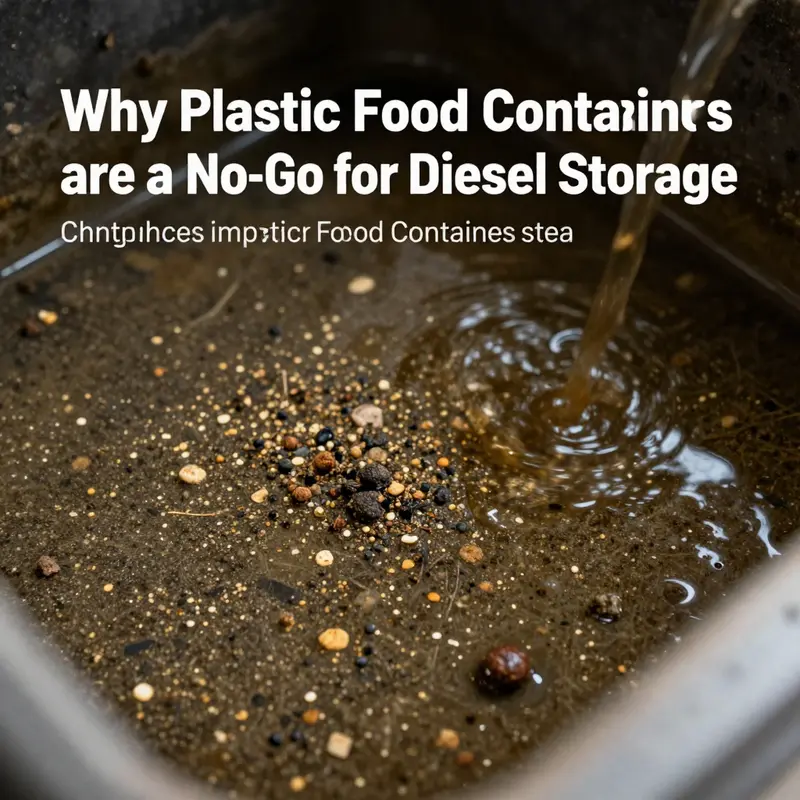
Perilous outcomes do not end with immediate safety threats. The integrity of the fuel itself can be compromised, setting up a chain reaction that affects engine cleanliness and performance. The rough, often imperfect inner surfaces of food containers can harbor particulates and residues from prior contents. These particulates can end up in the fuel stream, where they challenge filtration systems and can contribute to deposits, clogged filters, or abrasive wear on fuel injectors and pumps. Even small amounts of particulates, if introduced consistently over time, can undermine the precision with which modern engines meter fuel. The cumulative effect is not merely reduced efficiency; it can take the form of inconsistent fuel delivery, increased maintenance, and, in dire cases, noticeable engine hesitation or misfiring. All of this arises from a practice that seems, on the surface, a simple and cost-effective shortcut but, in practice, places a fuel system at risk and multiplies the effort required to maintain engine health.
The regulatory angle rounds out the picture with a sobering emphasis on compliance. In many jurisdictions, the storage and handling of hazardous liquids are governed by standards that assume the use of containers designed to meet exact safety criteria. While informal, improvised storage may seem harmless in a short timeframe, it can quickly cross a line into non-compliance as conditions change. International and national standards are continuously refined to reflect new understandings of risk, and the adoption of approved containers for flammable liquids—containers tested for strength, leak resistance, and venting behavior—are a central pillar of those standards. In some regulatory frameworks, specific references indicate the need for containers that have undergone formal testing and certification for fuel storage. The overarching principle is clear: the use of non-approved plastics for diesel not only heightens safety risks but directly challenges regulatory expectations designed to prevent accidents, environmental harm, and public health issues. When a container is used outside its intended purpose, the risk of failure under pressure or impact increases, and the liability for mishandling compounds quickly.
To anchor this discussion in concrete practice, consider the practical consequences of using food-grade plastic containers for diesel. The chemical incompatibility described above precipitates a chain reaction that touches the entire storage and handling process. The fuel quality can degrade due to leached additives, which in turn affects combustion efficiency, emission characteristics, and engine wear patterns. The structural limitations of non-fuel-specific containers raise the probability of leaks, ruptures, or spills during routine handling. The absence of safety features raises the chance of ignition, especially in environments where static electricity can accumulate. The lack of regulatory compliance introduces the potential for penalties, insurance complications, or liability in the event of an incident. Each of these consequences compounds the others, creating a cumulative risk profile that makes the practice not just ill-advised but potentially dangerous.
From a practical standpoint, the message is straightforward: always use only containers specifically designed and labeled for fuel storage. This is not merely a precaution but a foundational safety and quality control measure. Purpose-built fuel containers incorporate material formulations suitable for hydrocarbon fuels, optimized wall thickness to reduce permeation, and engineered caps and vents to manage pressure and venting. They are designed to be compatible with fuel system materials and to minimize the risk of contaminant migration. They also align with regulatory expectations for hazardous liquids, incorporating labeling, leak resistance, and impact resistance that generic food-grade containers simply cannot guarantee. By choosing containers with proven performance under the conditions in which fuel is stored and transferred, users reduce the likelihood of contamination, degradation, and safety incidents. This decision supports not just engine reliability but the broader imperative of responsible fuel handling, where minimization of risk extends to operators, bystanders, and the environment.
In the broader narrative of fuel stewardship, the choice of container is a nontrivial element of safety culture. The habit of repurposing readily available plastic food containers offers a superficially convenient solution, but it also reveals a gap between everyday practicality and the stringent demands of safe fuel storage. The practice is easy to rationalize in a moment of urgency, yet the long-term costs—contamination, mechanical wear, spill potential, and regulatory exposure—outweigh any temporary convenience. The chapter of this discussion that follows the initial observations of chemical compatibility and safety gaps is reinforced by the broader consensus in expert communities: storage containers for diesel must be purpose-built, certified, and maintained in a way that preserves fuel quality and protects people and property. The balance between practicality and safety tilts decisively toward the latter when the fuel in question powers vehicles, machines, and critical infrastructure. This is not a marginal issue but a central aspect of responsible fuel management that deserves careful attention in both small workshops and larger operational settings.
For practitioners seeking a concrete, actionable reminder of how to break the cycle of improvised storage, consider the value of integrating simple, well-established practices into daily workflows. Avoid repurposing any container that has not been certified for fuel. Use only metal or specially designed plastic fuel drums and jerrycans that meet recognized standards. Ensure lids seal securely and include appropriate venting where required. Maintain physical integrity through regular inspection for cracks, warping, or signs of permeation. Label containers clearly with contents and the date of first fill. Keep fuel away from heat sources, open flames, and sparks, and ensure that transfers occur only with approved equipment and grounded procedures to minimize static buildup. In environments where the air may be rich in hydrocarbon vapors, even more stringent controls are warranted, including spill containment measures and readily accessible fire extinguishing equipment. This approach transforms a tempting shortcut into a robust, defensible safety protocol that protects engines, people, and the environment alike.
Within this frame of caution, a practical bridge to further context can be found in related packaging resources that underscore the central idea: container design matters. While those resources focus on packaging for foods and consumer products, the underlying principle—materials, surface finishes, additives, and structural integrity—translates directly to the fuel domain. For readers who want to see a tangible example of how packaging materials are specified and documented for safety and performance, a representative example of disposable packaging that emphasizes material choices and design considerations can be explored through a related resource: Disposable Kraft Paper Takeaway Boxes with Clear Lid. This link illustrates how packaging decisions hinge on material properties, coatings, and processing that collectively determine performance under practical use. While it does not replace fuel-specific standards, it helps illuminate why material compatibility is not just a theoretical concern but a tangible factor in product safety and reliability across domains.
Ultimately, the essential takeaway is that diesel deserves respect as a hazardous liquid with specific handling and storage requirements. The temptation to repurpose familiar containers must be resisted in favor of designs that have been tested and certified to withstand the chemical realities of hydrocarbon fuels. The consequences of ignoring those realities—contaminated fuel, degraded engine components, unsafe handling practices, and regulatory exposure—recover a heavy cost not only in money but in reliability and safety. The chapter we have traced here highlights the interwoven lines of chemistry, engineering, and governance that define responsible fuel storage. It calls for a straightforward, disciplined approach: treat diesel storage as a safety-critical activity, insist on approved containers, and embed best practices in every handling step. Doing so is not about fear or rigidity; it is about preserving the integrity of fuel systems, protecting workers, and honoring the standards that keep communities safe from the risks associated with flammable liquids.
External resource for further context on regulatory standards and safe handling can be found here: https://www.phmsa.dot.gov/hazmat/standards
Cracks at the Seal: The Hidden Leakage Hazard of Plastic Food Containers in Diesel Storage
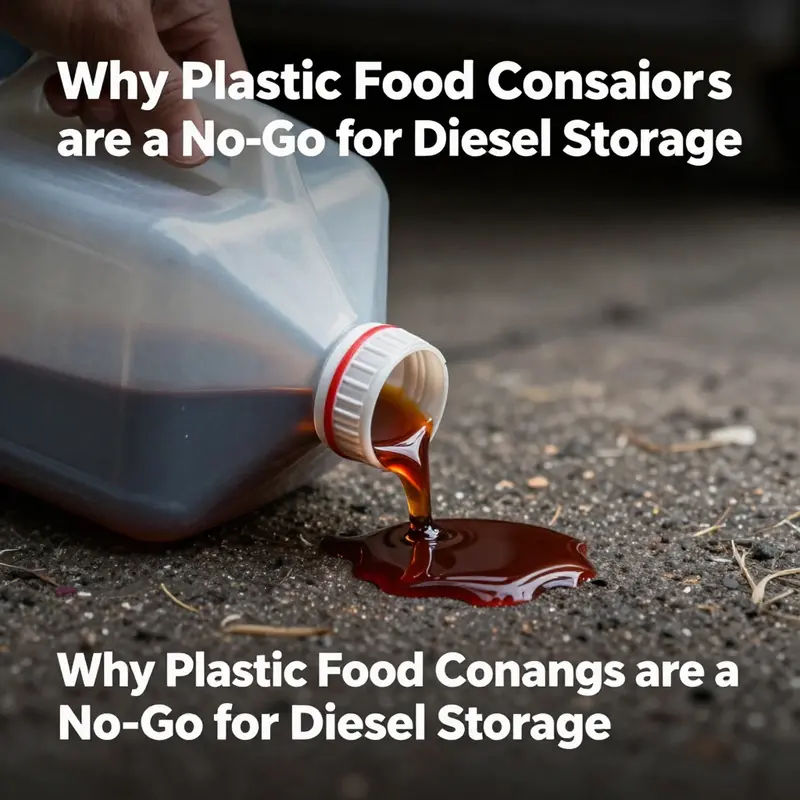
A container is more than a convenient shell for holding fuel; in diesel storage it becomes a critical line of defense between a hazardous chemistry and the environment, a line that is frequently tested and often breached by the very materials designed for everyday convenience. The temptation to reuse readily available plastic food containers for storing diesel is understandable—these vessels are ubiquitous, inexpensive, and lightweight. Yet their appeal hides a chain of material interactions and physical vulnerabilities that can turn a simple, portable fuel supply into a source of steady leakage, contamination, and risk. The leakage problem does not arise from a single dramatic rupture but from an ongoing, cumulative process in which diesel, a complex hydrocarbon blend, gradually penetrates, softens, and stresses containers that were never intended for long-term exposure to fuel. In practice, most consumer-grade plastic containers are constructed from polymers such as polyethylene (PE) and polypropylene (PP). These materials offer commendable performance for food storage under normal conditions, but they are not chemically engineered to resist the relentless assault of hydrocarbon fuels. Diesel’s molecules are small enough and reactive enough to migrate into the polymer matrix over time. As the stored fuel sits in a warm, sunlit environment—say the trunk of a car in the summer, or a sunlit cabinet—diffusion accelerates. The result is not an instantaneous leak but a gradual permeation that weakens the container’s structural integrity. The softened polymer may develop microfractures or form a network of tiny voids through which more diesel can seep. In the worst scenarios, these micro-damages coalesce into visible leaks, or they compromise the container’s ability to keep fuel inside, even when the cap is screwed tight. The problem intensifies when containers age. Aging is hastened by heat and exposure to light, causing the plastic to become more brittle or, paradoxically, more malleable at the inner surfaces. Either condition reduces the container’s resistance to deformation under pressure and handling. The outer shell may still feel sound, but the inner surface could have developed a roughness that encourages fuel seepage and debris retention. The practical reality is that a seemingly intact plastic bottle can, over days to weeks, become a conduit for diesel leakage in the presence of heat and mechanical stress. The leakage pathway often tracks to the area where the cap seals against the body of the container. Here, many consumer containers rely on rubber or silicone gaskets. While these materials perform adequately for food liquids in their intended applications, diesel is more aggressive. In contact with diesel, gaskets can swell, harden, or even break down, losing the elasticity needed to maintain a watertight and vapour-tight seal. A leaky seal means not only visible drips but also the emission of volatile hydrocarbon vapours. In an unvented, static-prone plastic container, this vapour buildup becomes a risk factor for ignition if an electrostatic spark occurs while pouring or transferring the fuel. Plastics in themselves do not conduct electricity, so they can become reservoirs for static charge, especially when handled with dry hands or in dry environments. The act of pouring creates friction, and with the seal compromised, even a small spark can ignite the plume of hydrocarbon vapours released from a leaky cap or from small seepages at the seam. Such scenarios are not merely theoretical; they reflect a real safety concern tied to the basic properties of the materials involved and the physics of static electricity in non-conductive containers. The danger of leakage is not limited to the container’s contents. Diesel stored in non-approved vessels, especially when reused from food-grade packaging, presents a cascade of environmental and safety hazards. Permeability is not a fixed property—it changes with temperature, duration of storage, and the level of mechanical agitation the container experiences during transport or handling. When diesel breaches micro-defects in a plastic container, it can migrate into surrounding materials, including any labeling or adhesives that form part of the container’s construction. This secondary contamination can complicate attempts to recover spilled fuel and creates additional environmental cleanup hazards. The leaked fuel also poses a risk to surrounding surfaces and soils, where it can act as a pollutant and potentially contaminate groundwater if improper containment occurs. The regulatory framework surrounding the storage and transport of hazardous liquids places clear expectations on the containers used. International and national guidelines emphasize the need for approved, purpose-built containers that demonstrate resistance to chemical attack, mechanical integrity, proper venting where required, and static control provisions. The absence of these features in a plastic food container elevates the risk from a simple leak to a potentially catastrophic event, especially in scenarios involving transport in vehicles or bulk handling in workplaces where diesel is regularly moved. In addition to the material and seal-related leakage pathways, the markers of a leakage-prone storage setup are telling. A faint, persistent diesel odor emanating from a container that should not be releasing vapours is a red flag. Visible staining around the cap, the shoulder, or the seams indicates seepage or wicking, suggesting that the container is no longer fit for purpose. Even if the container seems to withstand initial use, the cumulative risk over time must be acknowledged. The literature and safety guidelines converge on a principle: reuse and improvised storage are not benign practices when hazardous liquids are involved. A plastic food container is designed for one function—holding food for short periods under controlled conditions. When diesel is added to that equation, the container’s original design assumptions are violated, and the risk of leakage becomes a structural inevitability rather than a rare accident. The implications of leakage are not purely technical. Leakage translates into real-world consequences—costly environmental cleanup, risk of fire, and potential harm to people who handle or transact with the container. The internal environment of a vehicle, a storage room, or a roadside storage area becomes a micro-luelled hazard zone where vapours accumulate, lids loosen, and seals fail. The practical effect is a diminution of safety margins that industries and individuals rely on for safe fuel handling. The responsible response to this leakage risk is not merely to tighten lids more firmly or to hope for better plastics; it is to recognize that certain materials and configurations simply are not compatible with diesel storage over any meaningful duration. One pathway toward safer practice is to adopt containers designed specifically for fuels. These are typically metal or high-strength composite vessels that have been tested for chemical compatibility, mechanical resilience, and static control features. They come with secure, purpose-built caps and gaskets that maintain a tight seal even under temperature fluctuations and physical handling. They also incorporate design features such as anti-static components or grounding provisions that reduce the risk of ignition in environments where vapours are present. The broader safety culture around fuel storage is anchored in regulatory expectations. Standards and guidelines increasingly emphasize the use of approved containers for hazardous liquids, with explicit restrictions on using consumer packaging not intended for fuel storage. The emphasis is not on restrictive compliance alone but on practical risk mitigation: preventing leaks at the source, ensuring robust containment during transport, and reducing the likelihood of ignition by addressing static electricity and chemical compatibility upfront. There is an evidentiary basis for these standards. For instance, studies and authoritative guidelines indicate that diesel stored in inappropriate plastic containers can experience accelerated degradation and contamination, with consequences including increased acid value and corrosion risks to engine components such as fuel pumps and injectors. These engine-system risks underscore an important truth: leakage is more than a spill; it is a signal of chemical incompatibility, material fatigue, and compromised safety that can ultimately impair engine performance. The human factor in this equation cannot be overlooked. Improper storage often arises from convenience, haste, or a lack of awareness about the longer-term implications of fuel storage. Education about the limitations of plastic food containers for storing diesel is essential. It helps individuals recognize when a simple reuse is no longer feasible and points them toward safer alternatives. It also calls attention to the importance of labeling, storage conditions, and routine checks that reduce the likelihood of unnoticed leakage. In terms of actionable guidance, the path forward begins with a commitment to using containers that meet the intended purpose and safety standards. This means selecting metal or reinforced composite containers that are designed to withstand hydrocarbon exposure, are built to resist static and impact, and carry clear compliance documentation. It also means securing diesel storage away from heat sources, in well-ventilated spaces, and with secondary containment to catch any leak before it reaches the environment. Regular inspection becomes a routine rather than a rare precaution: look for changes in cap seals, swelling or hardening of gaskets, discoloration along seams, or any evidence of seepage on the container surface. If such signs appear, the container should be retired from service and replaced with an approved unit. The broader narrative about leakage from plastic food containers for diesel, then, is not merely about a poor material choice. It is a case study in how the everyday improvisations we rely on can collide with the strict safety demands of hazardous liquids. It is a reminder that convenience should never eclipse safety, and that the integrity of the container is a first-order determinant of how safely a flammable liquid can be stored and handled. For readers seeking more formal guidance on container safety and spill prevention, see the FAO’s container guidelines, which offer comprehensive considerations on material compatibility, spill management, and end-of-life handling for chemical containers. These resources underpin the argument that non-designated containers are not a viable option for storing fuels, and they reinforce the principle that safe storage starts with the right material, the right seals, and the right level of regulatory compliance. As with many safety issues, the leakage risk associated with plastic food containers for diesel is a matter of proportion and foresight: small compromises in the wrong place can scale into large, costly problems. The practical takeaway is clear. If diesel storage is a routine activity, the container must be purpose-built for fuels, with verified chemical resistance, robust sealing, and appropriate anti-static or grounding features. The days of relying on everyday food packaging for petrol-like fuels are over, not because the containers are insufficiently handy, but because the safety, environmental, and engine-protection implications of such a choice are simply too great to overlook. Internal linking note: for a closely related discussion on container categories and safety considerations in packaging contexts, see the related resource on disposable kraft paper take-away boxes. This reference helps readers understand how container design varies with purpose, and why a container’s intended use matters for safety and performance. disposable kraft paper take-away box. External reference: for a broader regulatory and standards context, refer to the FAO guidelines on containers, chemical spills, and waste management at https://www.fao.org/3/cb1795en/cb1795en.pdf.
null
null
Final thoughts
Understanding the risks associated with using plastic food containers for diesel is critical for any business involved in fuel management. From chemical interactions and safety hazards to fuel quality concerns and regulatory compliance, all aspects outline the necessity for proper storage solutions. Transitioning to approved metal containers not only safeguards your operations but also protects your reputation. Invest in safety and quality storage today to ensure your business runs smoothly without unexpected disruptions.