
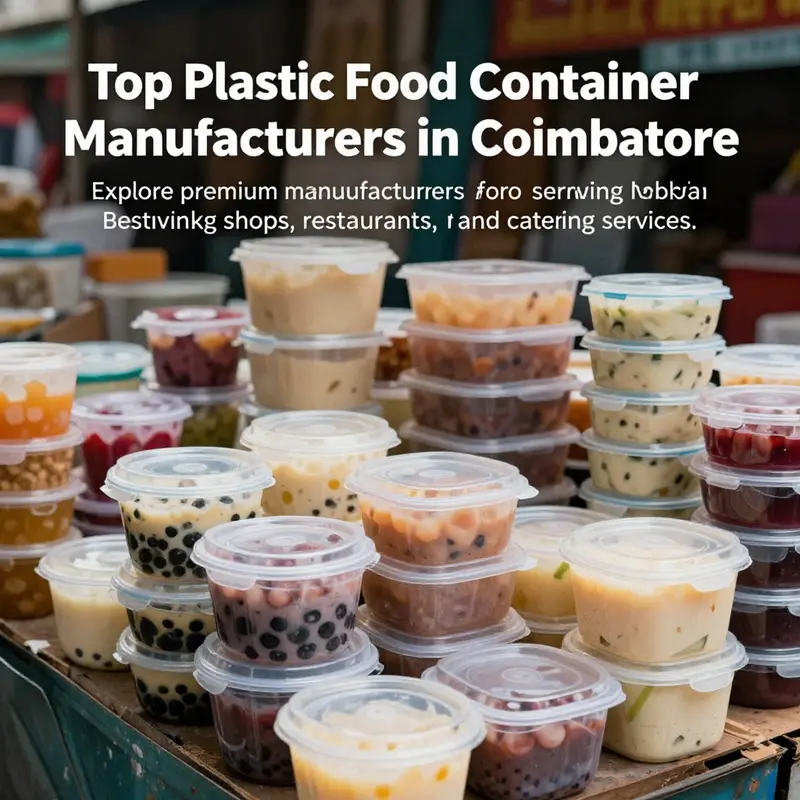
Coimbatore is not only known for its industrial prowess but also for its vibrant plastic food container manufacturing landscape. This city holds numerous manufacturers that cater specifically to the increasing demand for high-quality, food-grade packaging solutions. Whether you run a bubble tea shop, a bustling restaurant, or a food truck, understanding the offerings of local manufacturers can significantly enhance your business efficiency. The following chapters elaborate on key players like 4 M Plaastech, gauge the contributions of small and medium enterprises, delve into integrated packaging solutions, and shed light on the challenges and opportunities within Coimbatore’s plastic food container industry.
From Coimbatore’s Workshops to Global Kitchens: 4 M Plaastech and the Local Reality of Plastic Food Container Manufacturing
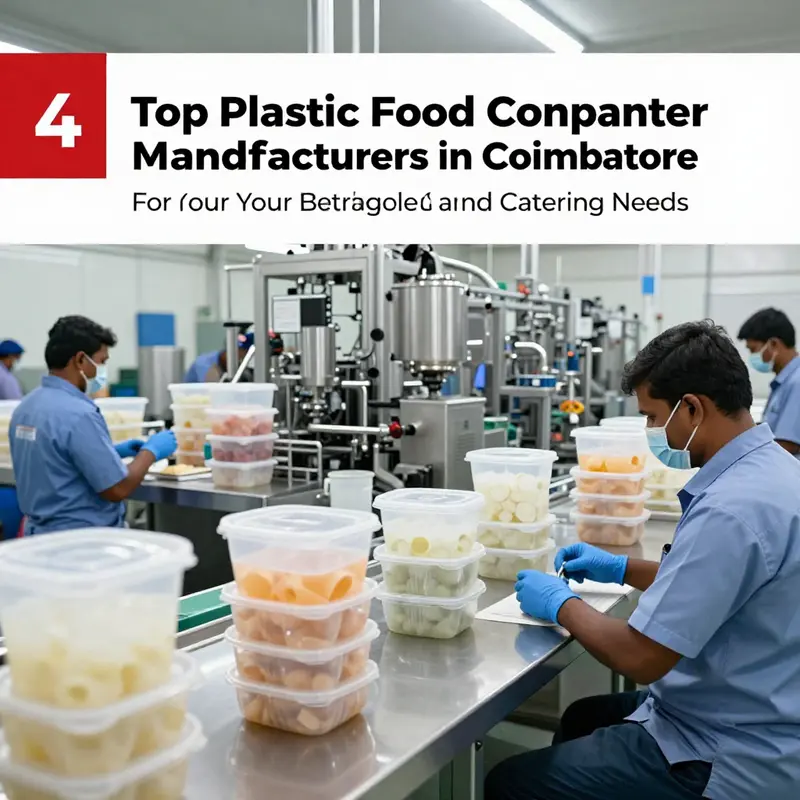
Coimbatore sits at the crossroads of tradition and rapid industrialization, a city where small, purpose-built workshops mingle with larger scale facilities to form a dense ecosystem around plastic processing. In this setting, a company like 4 M Plaastech stands out not merely for its product variety, but for how it embodies the region’s approach to packaging: practical, hygienic, and responsive to the everyday needs of a bustling food service sector. The manufacturer’s focus on plastic food containers and disposable ware aligns with a city that supplies a vibrant array of catering outfits, street-food vendors, and growing retail brands that demand packaging solutions that are reliable, safe, and easy to use. In many ways, 4 M Plaastech exemplifies how a local player can become a linchpin in a broader supply chain that stretches from neighborhood eateries to mid-size distributors and food brands with ambitions that cross district lines and, gradually, state boundaries.
The core proposition that defines 4 M Plaastech is straightforward: a portfolio tuned for food-grade use that can withstand the rigors of everyday service, from hot curries to cold beverages. A typical catalog item—the 500 ml rectangular food container in white—speaks to a practical design philosophy. The shape maximizes packing efficiency, the color maintains a clean appearance during service, and the plastic used is selected with hygiene as a primary criterion. Such containers are the bread and butter of catering and ready-to-eat packing, where speed of service and ease of disposal meet the need for dependable containment during delivery or takeout. Alongside these rectangular containers, the company produces disposable food ware and milkshake cups, which are staples in a city where street stalls and casual dining are temporal neighbors to more formal eateries. The material choices reflect an emphasis on food safety and stability across a range of temperatures, ensuring that hot meals do not warp or leak and that cold beverages retain their form and flavor until consumption.
A distinctive thread running through the local manufacturing scene is the attention to hygiene and safety standards. The Coimbatore cluster benefits from a steady flow of engineers, technicians, and quality-control professionals who understand the peculiarities of Indian food service: rapid turnover, high throughput at peak times, and the need for packaging that can travel through busy delivery networks without compromising safety. 4 M Plaastech positions itself within this context by offering products that are designed to perform in the heat of a busy kitchen and the travel conditions of a delivery route, while also accommodating the finer points of regulatory compliance that matter to customers who manage multiple outlets or operate in regulated segments of the market. In practice, this means selecting food-grade plastics, implementing straightforward, repeatable production processes, and maintaining consistent dimensions so that containers stack neatly with lids and other components. It is a practical commitment that resonates with local buyers who value reliability as much as price.
Sustainability threads through the conversation about local manufacturing as well. The industry in Coimbatore has increasingly embraced the idea that packaging should be compatible with circular economy practices where possible. 4 M Plaastech has shown a willingness to explore recyclable and biodegradable options for certain product lines, acknowledging that many customers want to minimize waste if it can be done without compromising performance. In a city where waste management is a live issue, the prospect of offering containers that can be recycled or disposed of responsibly adds a layer of appeal to customers who are balancing cost against environmental considerations. The emphasis on sustainable options does not exist in isolation; it ties into how the company markets its products to hospitality groups that are cultivating green credentials and how retailers seek packaging that can support eco-friendly branding without sacrificing functionality. The conversation about sustainability thus becomes a practical negotiation between performance, cost, and environmental outcomes, a negotiation that local manufacturers navigate daily as they adapt to evolving customer expectations.
The breadth of the product line also reveals the way the Coimbatore ecosystem works with its customers. Local small and medium-sized plastic processing enterprises form a dense network of injection molding and extrusion specialists who collaborate with packaging manufacturers to deliver customized solutions. For many food brands, this means the ability to request small batches with fast turnarounds—a capability that is essential in a city where new restaurant concepts and pop-up formats frequently appear and disappear in rapid cycles. In this environment, speed, flexibility, and the capacity to adjust molds or modify container dimensions in response to a brand’s evolving packaging needs become valuable assets. The same ecosystem that enables rapid customization also supports more standardized offerings, ensuring consistency for buyers who require predictable performance across large-volume orders.
Nevertheless, the local landscape is not entirely domestic in its character. When processing capability or regulatory specificity demands it, many companies in the region factor in global supply chains for high-specification or export-grade products. FDA-compliant or ISO 22000-certified containers, for instance, often require materials, testing protocols, and documentation that extend beyond what is typically demanded for everyday catering use. In such cases, sourcing from international suppliers can provide scalability and uniform quality, ensuring that a brand seeking to launch or expand internationally faces fewer supply-side bottlenecks. This reality does not negate the importance of the local base; instead, it positions Coimbatore as a region that develops its strengths locally while maintaining access to global capabilities when the market requires them. The interplay between local agility and global scale is a defining feature of how packaging manufacturing in this part of Tamil Nadu evolves.
Within this broader framework, integrated packaging solutions providers emerge as another pillar of the local economy. Some manufacturers go beyond simply producing the containers and extend their offerings into a more comprehensive suite of services, including label printing, stacking design optimization, and logistics packaging strategies. For a modern food retailer or a growing catering brand, these integrated solutions can streamline procurement and shorten the path from concept to shelf or service counter. The value rests in harmonizing the physical container with the branding, labeling, and packaging logistics that enable efficient distribution. In a market where speed to market matters as much as the final consumer experience, such integrations can be decisive for firms trying to scale without losing control over quality or cost.
The relevance of the 4 M Plaastech model to the broader article topic—plastic food containers manufacturers in Coimbatore—comes from a combination of product focus, regional expertise, and a pragmatic approach to sustainability and partnership. The company’s identified product suite, including 500 ml rectangular containers, disposable ware, and milkshake cups, demonstrates how a local manufacturer can remain deeply aligned with the needs of food service and retail customers in a high-velocity urban environment. The Coimbatore ecosystem is well-suited to producing such items at scale while also offering the customization options that many local brands demand. Consumers in the city and nearby districts are increasingly sensitive to the performance and safety standards of what they purchase for daily consumption, and this creates a steady demand for containers that are both affordable and reliable.
What keeps the narrative cohesive is the way 4 M Plaastech sits at the intersection of local capability and the broader packaging supply chain. The company represents a model in which a regional manufacturer can fulfill a substantial portion of local demand without sacrificing quality or the capacity to grow. It also serves as a bridge between micro-level production decisions—such as the choice of a particular resin, a specific wall thickness, or a lid design—and macro-level considerations, such as regulatory compliance, environmental impact, and the ability to coordinate with label printers or logistics partners. In this sense, the Coimbatore packaging cluster’s appeal is not solely about cheap, readily available containers; it is about a networked approach to packaging that integrates product design, manufacturing discipline, and service-oriented collaboration with customers. That collaboration is often facilitated by the presence of integrated packaging solutions providers who can tailor a final packaging package for a brand that wants consistency across a coastal or national distribution network.
From a consumer-facing perspective, the existence of robust local manufacturing reinforces the accessibility of packaging solutions for a wide spectrum of food providers. For neighborhood cafés and street-food vendors, the assurance that containers exist locally, with predictable lead times and shorter logistics chains, translates into smoother operations and better service for the end customer. For mid-sized brands, the ability to lean on a local partner for both standard containers and customized options can reduce risk in supply continuity, particularly in a market characterized by seasonal demand spikes and the frequent introduction of new menu items. The value proposition thus extends beyond the container itself; it encompasses a reliable, responsive supply chain that supports a brand’s growth story in a competitive market where packaging quality and reliability are part of the product experience.
In acknowledging the broader industry context, it is useful to reflect on the global landscape of plastic container manufacturing. While local players like 4 M Plaastech anchor the story in Coimbatore, a wider view highlights the range of materials, designs, and certifications that define modern packaging. Innovations in recyclable and biodegradable materials, improvements in barrier properties for food compatibility, and the development of lighter, stronger plastics all influence how a local manufacturer plans its product roadmap. The global perspective reminds us that local success is often underpinned by exposure to larger trends—both in terms of consumer expectations and in the standards that govern packaging manufacture and testing. For readers seeking a wider frame, a comprehensive overview of top plastic containers manufacturers in 2024 provides context for how local players fit into a global ecosystem that is continually evolving due to regulatory shifts, sustainability pressures, and the drive toward more efficient supply chains. See the landscape overview linked in the external resource for a broader sense of scale and ambition in the industry.
Within the specific context of Coimbatore and its surrounding regions, the chapter of 4 M Plaastech underscores a broader truth: successful packaging manufacturing in this part of southern India hinges on a combination of targeted product focus, responsive customization, and a pragmatic approach to sustainability and standards. The city’s manufacturing ethos—where small, agile units complement larger facilities and where collaboration across the value chain is common—helps explain why the local market can meet most routine packaging needs with strong local supply. Yet, the same ecosystem also accommodates the realities of global supply chains for high-specification, export-ready products, illustrating a flexible, adaptive approach rather than a rigid, single-path strategy. This adaptability is what keeps Coimbatore at the heart of India’s packaging conversation, enabling a steady flow of containers that support the daily operations of countless food businesses while inviting continued innovation and collaboration within the cluster.
For readers who want to explore related packaging categories or decorative and functional add-ons that complement containers, the local market offers a breadth of options. The packaging network in Coimbatore frequently connects container manufacturing with related supplies such as labeling, wrapping, and supportive materials, enabling a brand to source a cohesive boxed or packaged presentation from a single, trusted partner. The ease of access to such integrated services helps explain why many local food brands prefer working with a supplier who can offer both the container and the packaging ecosystem around it, rather than chasing multiple suppliers across different regions. This approach reduces risk, accelerates time-to-market, and fosters a more predictable cost structure—an especially valuable advantage in a competitive urban landscape where margins can be tight and the demand for rapid turnover is high.
In closing, the case of 4 M Plaastech within Coimbatore’s plastic container manufacturing scene illustrates a pragmatic model: a local specialist delivering consistent, safe, and convenient packaging solutions tuned for India’s dynamic food economy. It also highlights how the city’s manufacturing environment—the interplay of SMEs, integrated packaging services, and selective engagement with global supply chains—creates an ecosystem that can adapt to evolving consumer preferences while sustaining growth. As brands in and beyond Coimbatore navigate the shifting sands of sustainability, regulation, and consumer demand, the local manufacturing base demonstrates that high-quality plastic food containers can be produced efficiently at scale, with a clear focus on hygiene, reliability, and responsible materials. For readers seeking further depth into the global context of the industry and where local players fit within it, the external overview offers a broader frame for understanding trends that will shape packaging choices in the years ahead, from materials science to certifications and supply chain resilience. And for those who want to explore related packaging categories within the local ecosystem, a quick reference to the plastic packaging section of the local supplier network can provide a sense of how container design aligns with the broader packaging strategy a brand may pursue: plastic-packaging category.
Shaping Everyday Packages: The Vital Role of Coimbatore’s Local Plastic Food Container SMEs
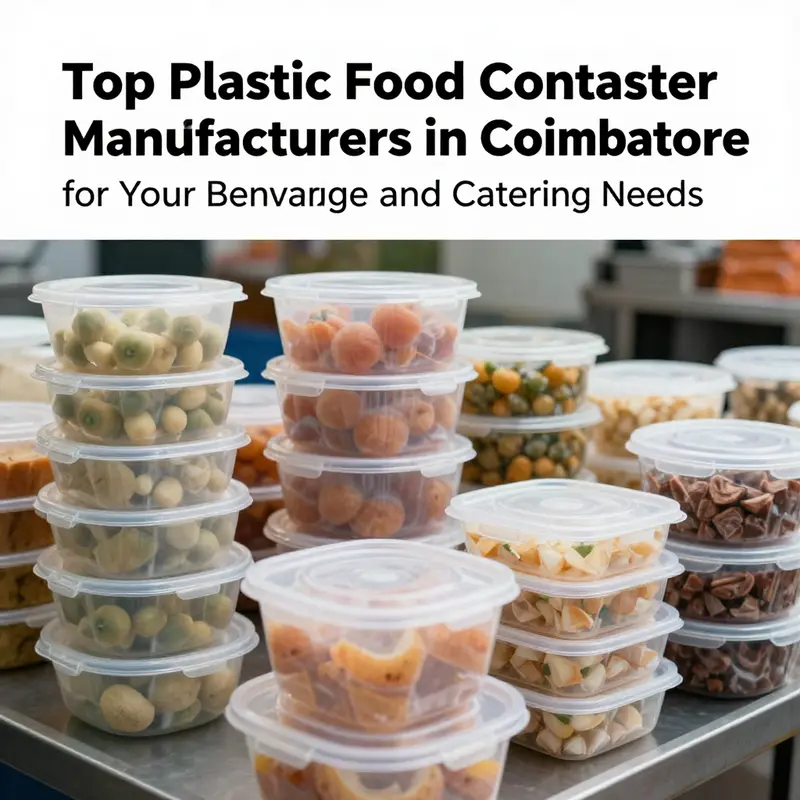
Coimbatore, an industrial city where the hum of machines blends with a long-standing craft ethos, has become a living workshop for plastic food container manufacturers. The ecosystem is not dominated by a few distant giants; instead, it thrives on a dense network of small and medium enterprises that work at the pace of local demand and the tempo of regional supply. In this landscape, plastic containers are more than mere packaging. They are reliable conduits that preserve the freshness of a curry, the warmth of a roadside snack, the snap of a crisp salad, and the neatness of a takeout meal that travels from kitchen to customer without compromising safety. The significance of these local SMEs is not only in their ability to supply affordable, hygienic solutions but also in how they knit together the regional food culture with the logistics of modern retail and home consumption. The story is anchored in proximity: to raw materials from nearby suppliers, to a broad market of caterers, street vendors, mid-sized restaurants, and households that increasingly demand consistent quality, quick delivery, and customization without paying a premium. When a kitchen needs a stack of square containers with vented lids, or a batch of disposable cups that can carry hot beverages for a long afternoon market, it is the local SME’s responsiveness that matters as much as the price tag. Proximity translates into shorter lead times, smoother communication, and the practical flexibility that is often hardest to achieve in larger, more centralized manufacturing networks. A great strength of Coimbatore’s SME cluster lies in its ability to balance standard product lines with small-batch customization. The same facility that can manufacture a standard range of food-grade containers also engages in rapid prototyping and short-run production for local brands that want to test new packaging formats or experiment with different shapes, wall thicknesses, or sealing methods. This is not merely a matter of convenience; it is an enablement of local entrepreneurship. Food outfits, whether in a roadside stall or a boutique cafe, can iterate packaging designs in weeks rather than months. They can trial a new container shape that improves stackability on a delivery scooter or refines the lid fit to prevent leaks during monsoon season. In practical terms, this adaptability reduces waste in the supply chain by ensuring containers meet exact needs, while keeping costs accessible for small operators who may have tighter margins and tighter schedules than mass-market brands. The resulting effect is a packaging ecosystem that supports a vibrant local economy by feeding demand with supply that is responsive and affordable. This is a delicate balance to sustain, especially in a market where consumer expectations are higher than ever for cleanliness, safety, and aesthetics. Yet in Coimbatore, the SMEs are often built on a culture of reliability and hands-on problem solving. They emphasize hygienic manufacturing practices, food-grade materials, and careful handling of plastics to ensure compatibility with a broad spectrum of food items, from oily gravies to delicate fruit portions. Hygiene and safety standards are not afterthoughts but foundational criteria that shape every step of production, storage, and distribution. The emphasis on safety extends beyond the container walls. It touches the way these manufacturers select components such as liners, sealing foils, and adhesives, and it guides their engagement with customers in defining the most appropriate material choices for different therapy flavors or spice blends that can interact with packaging. In a region where catering and food service are integral to daily life, these considerations matter deeply, because packaging is the final link in the chain that preserves quality from kitchen to consumer. As a result, the local SME landscape in Coimbatore often features products that align with practical realities—containers designed for hot and cold foods, stacks that save space in small kitchens, and formats that cater to the take-home needs of families. The range may include diverse shapes and sizes, from compact single-serve cups to multi-portion takeaway containers, all produced with a shared emphasis on food-grade plastic materials, resistance to moisture, and the ability to withstand the rigors of transport. In this environment, sustainability is no luxury; it is a strategic consideration that blends with cost competitiveness. The push toward recyclable and biodegradable materials has moved from a niche concern to a practical driver of product development. Local manufacturers are investing time and resources into exploring materials that can be recycled within existing municipal streams, as well as additives and production processes that lower the environmental footprint. This transition is not uniform across all suppliers, but it is real and ongoing. It requires balancing performance with end-of-life options. For some customers, recyclable plastics provide a clear way to reduce waste, while others may seek compostable or biodegradable options for certain applications or events. The dialogue between manufacturers and clients often centers on material compatibility with different foods, shelf life, and consumer expectations regarding environmental responsibility. A key feature of the Coimbatore SME network is its capacity for integrated packaging solutions that go beyond the container itself. While many factories focus on the production of plastic food containers, there is also an emerging cohort of service-oriented providers who offer labeling, design optimization, and logistics packaging support to help modern food retailers streamline their operations. This integrated approach addresses common pain points in retail and distribution—where space, order accuracy, and branding coherence significantly impact efficiency and customer experience. The synergy between container manufacturing and packaging services helps smaller brands compete with larger players by offering a more complete, end-to-end solution. When a local restaurant chain expands into takeaway service, the combined packaging and labeling services can maintain brand consistency across all outlets and channels, while ensuring that the packaging itself promotes safe handling and application as part of the consumer experience. However, the broader picture is nuanced. For high-spec, regulated, or export-level needs—where certifications such as FDA compliance or ISO 22000 quality management are demanded—many companies still source from global supply networks. The decision to look beyond regional production is not a retreat from local capability but a strategic choice about risk, scale, and certification. Local SMEs can and do invest in quality management and process improvements, but the scale required for certain export markets and the stringent audit requirements may exceed what some local operations can sustain alone. In those cases, a hybrid approach emerges: the local ecosystem handles the bulk of domestic demand with agility and cost discipline, while global suppliers support niche, high-spec, or large-volume orders where certification and uniformity across continents are essential. This pragmatic balance reflects a mature understanding of global supply chains, where proximity matters for everyday needs, but scale and certification matter for specific markets. The Coimbatore cluster thus embodies a broader industry pattern: a strong base of SMEs that deliver local value—fast, affordable, and adaptable—paired with selective access to globally certified capabilities when required. The result is a region that can meet most common packaging needs with speed and reliability, while maintaining the flexibility to pursue international opportunities when the business case aligns with strategic goals. Consumers of packaging in the region—whether small eateries, caterers, or household buyers—benefit from this dual capacity. They enjoy accessible products that perform well in daily use and can be tailored to particular occasions or dietary considerations. They also gain from a packaging culture that is increasingly conscious of its environmental impact and its responsibility to the city’s air quality and waste management goals. The local SMEs’ approach to sustainability often encompasses more than material choices. It includes process improvements that reduce energy usage, optimize water consumption, and minimize waste in the factory itself. In some facilities, lean manufacturing principles shape the flow of raw materials through the plant, helping to lower the total cost of ownership for clients and the carbon footprint of each container. At the same time, the ecosystem recognizes the importance of design for recyclability. Packaging is not just about protecting food; it is about facilitating end-of-life handling in a way that works within the region’s waste streams. This means choosing materials and constructions that can be easily separated, sorted, and processed by local recycling infrastructure. The narrative of Coimbatore’s SMEs also intersects with the city’s dynamic logistics and distribution network. A cluster of family-owned operations, supported by a broader plastic processing ecosystem, can coordinate delivery to nearby towns and cities with remarkable efficiency. The advantage is a cumulative effect: shorter transport distances, fewer intermediate steps, and more predictable delivery timelines. In a sector where timing is everything—especially for the hospitality and catering industries—this reliability translates into real value on cash flow and service levels. To illustrate the practical resonance of these dynamics without naming a particular company, consider a representative local SME that emphasizes a balanced portfolio. This facility maintains a core line of standard container formats while offering customization for specific clients—shape, thickness, and lid design—within a matter of days rather than weeks. It has established relationships with regional suppliers of food-grade plastics, enabling rapid procurement of resins with consistent quality. It also maintains a small but capable team of engineers and technicians who can advise clients on packaging choices based on the type of food, expected shelf life, and handling requirements. The outcome is a packaging solution that suits the practical realities of Coimbatore’s food economy: affordable enough to serve small restaurants and street vendors, but robust enough to support casual dining chains that require uniform packaging across many locations. The story of these SMEs is also a reflection of evolving consumer expectations. People are more aware of packaging hygiene, more sensitive to waste, and more interested in how a product can be disposed of responsibly. Local manufacturers are listening to these concerns, experimenting with recyclable materials, and refining production processes to minimize waste. They are increasingly transparent about material specifications and performance attributes because brand owners and retailers want clarity about how packaging will behave under varying conditions of heat, cold, moisture, and abrasion. In many cases, this transparency helps builders of local brands articulate a packaging strategy that aligns with consumer values and regulatory expectations. The ecosystem’s potential for growth is linked to collaboration—between manufacturers, suppliers, food brands, and research institutions. Joint ventures and consortia can accelerate the adoption of higher-grade materials, more efficient manufacturing technologies, and better end-of-life solutions. The potential benefits extend beyond local markets. A well-coordinated SME cluster can serve as a testing ground for new packaging formats and sustainable concepts that, if successful, might scale through export channels or online retail channels that demand consistent, cost-effective packaging. For readers seeking a practical reference point, the broader categorical landscape of packaging resources and materials can be explored in the plastic packaging domain, which showcases the types of solutions these manufacturers might offer to clients who seek more than basic containers. plastic-packaging. This internal reference helps illustrate how local packaging choices connect to a larger ecosystem of product formats and service offerings, including labeling, design optimization, and logistics packaging support that a growing number of Coimbatore SMEs are beginning to provide. The interplay between production, customization, and service is what makes these local manufacturers an enduring feature of the city’s economy. It is also what positions Coimbatore as a possible hub for sustainable packaging in the region, as ecosystems capable of rapid iteration and high responsiveness can attract brands seeking efficient, localized solutions with a clear commitment to safety and environmental responsibility. Ultimately, the community of SMEs in Coimbatore demonstrates that packaging is not an afterthought but a strategic instrument in the food value chain. By combining practical manufacturing capabilities with flexible service offerings and a growing emphasis on recyclable materials, these local players strengthen regional food commerce, support small business growth, and contribute to a more sustainable packaging future. They teach a straightforward lesson: when packaging decisions are grounded in proximity, practicality, and purpose, the chain from kitchen to consumer becomes shorter, simpler, and more reliable. External reference: https://www.4mplaastech.com
Coimbatore: Integrated Packaging and Local-Global Collaboration for Plastic Food Containers
Coimbatore sits at the intersection of traditional manufacturing excellence and the global demand for integrated packaging. In the realm of plastic food containers, the city is evolving from a local producer base to a node in a broader packaging ecosystem. Core strengths include injection molding, extrusion, and rapid customization that serve local brands, restaurants, and retailers. Yet buyers increasingly expect end-to-end packaging solutions that combine design, material choice, labeling, printing, stacking optimization, and streamlined logistics. Integrated packaging is less about a single item and more about a resilient supply chain that can move from concept to shelf with speed and safety.
The demand pressures come from multiple fronts. The packaging must protect product quality and convey brand identity through consistent print, reliable closures, and thoughtful ergonomics. Retailers value packaging that supports efficient shelf turnover, easy handling, and durable performance across cold and hot storage. Consumers demand sustainability, and packaging must balance recyclability with cost and performance. Local manufacturers are pushing beyond fabrication to couple in-house design and rapid prototyping with access to global materials and compliant manufacturing practices.
The hybrid model leverages local proximity for design, iteration, and regional distribution while tapping international partners for large-scale production, standardized components, and advanced materials not readily available domestically. Supplier evaluation becomes essential, emphasizing on-time delivery, transparency, and responsiveness. Metrics such as on-time delivery rates above 90% and favorable reorder rates reflect reliability and product-market fit. Communication speed, with responses often within a few hours, helps keep development cycles tight.
Sustainability anchors the dialogue. The packaging mix includes food-grade resins and materials compatible with established recycling streams. Biodegradable films and moisture-resistant coatings can play roles in specific formats, provided life-cycle impacts are understood and clearly communicated to regulators and customers. Integrated packaging decisions enable precise material selection, testing across use cases, and clear documentation.
For buyers, the path starts with clear requirements and an honest assessment of internal capabilities. A staged approach, small domestic trials followed by scaled production with global partners, can balance risk and speed. Labeling, regulatory compliance, and traceability become integral, as does total cost of ownership that accounts for lead times, QA costs, returns, and potential design iterations. The result is a coherent, resilient supply chain aligned with evolving product portfolios and consumer expectations.
Within Coimbatore, a growing ecosystem of packaging service providers extends beyond container fabrication. Some firms offer label printing, packaging design for stacking, and logistics packaging, simplifying coordination and reducing handoffs. Digital enablement—procurement platforms, real-time order tracking, and transparent documentation—further strengthens reliability and agility.
External resources can provide broader context on global supplier networks and strategic sourcing. For deeper exploration of how local and international players converge to serve Coimbatore’s packaging needs, industry articles and case studies can illuminate best practices in strategic sourcing of plastic cans, closures, and related packaging components.
From Constraints to Competence: Navigating Regulations and Seizing Opportunity in Coimbatore’s Plastic Food Container Manufacturing
Coimbatore sits at the heart of India’s packaging ecosystem, where plastics processing, molding, and assembly converge with a thriving food sector. The city’s manufacturers balance speed, cost, and compliance, delivering food-grade containers to a spectrum of customers from street vendors to cafeteria operators. A dense network of injection molders and extruders, coupled with integrated packaging providers, enables rapid, customized runs and end-to-end packaging solutions that streamline distribution.
Regulatory and environmental pressures are tightening. Designers must account for material safety, waste reduction, and end-of-life management, which can require investments in testing, documentation, and process upgrades. Simultaneously, consumer demand for clarity on recyclability and sustainability pushes firms to innovate in polymer choices, labeling, and design for recyclability. Rising raw material costs compel lean manufacturing, waste reduction, and smarter sourcing.
Competition from alternatives—paper, biodegradable plastics, and bamboo composites—pushes plastic container makers to differentiate through performance, durability, and total cost of ownership. Yet the market also presents opportunities: the expansion of food delivery, QSRs, and e-commerce packaging creates steady demand for reliable, hygienic packaging. Integrated services, such as labeling, stacking design, and logistics packaging, can lower total packaging costs and shorten time-to-market, strengthening long-term customer relationships.
Looking ahead, success will hinge on training skilled personnel, investing in testing capabilities, and applying design discipline to reduce resin use without compromising safety. By partnering with local businesses and leveraging selective global capabilities for specialized components, Coimbatore’s plastics cluster can sustain growth while meeting regulatory expectations and shifting consumer preferences.
Final thoughts
Coimbatore’s plastic food container manufacturers are committed to meeting the diverse needs of businesses across the food and beverage industry. With key players like 4 M Plaastech at the forefront, alongside agile SMEs and providers of integrated packaging solutions, businesses can find the right partners to enhance their operational efficiency. Navigating the challenges and leveraging the abundant opportunities in this sector will pave the way for sustained growth, ensuring quality service delivery to consumers.