
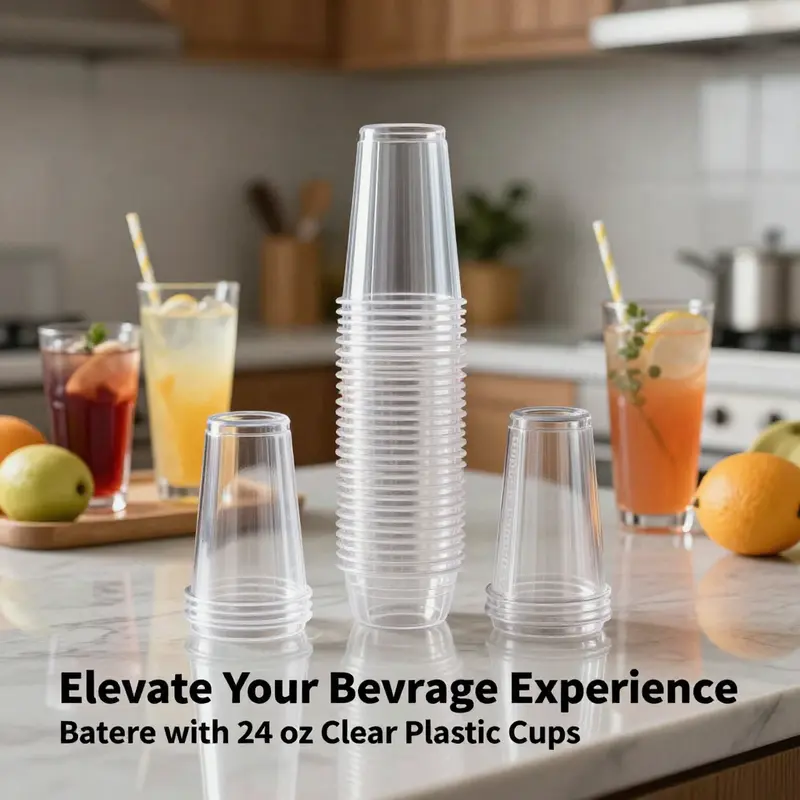
As the beverage industry continues to evolve, the choice of packaging plays a crucial role in shaping customer experiences. Clear plastic cups, particularly the 24 oz variant, stand out due to their eco-friendly options, versatility, and adaptability across various contexts. This article will explore the essential product features of 24 oz clear plastic cups, delve into commercial procurement insights for bulk purchases, discuss environmental considerations that align with contemporary values, and highlight the widespread applications in catering, events, and restaurants. Each chapter will build a comprehensive understanding of why investing in these cups is beneficial for businesses in the beverage sector.
Clear Cup Design: Form, Function, and Brand Impact

The 24-ounce clear plastic cup is more than a simple vessel. It serves as a practical canvas for beverage presentation and brand storytelling. In bustling cafes and on mobile deliveries, the cup must preserve drink integrity, reveal color and layers, and withstand transport. This design balance creates a product that is both utilitarian and visually appealing. The capacity, at roughly 700 milliliters, supports generous iced drinks while remaining compatible with standard cup holders. Material choices such as PET and PP provide clarity, rigidity, and heat tolerance, enabling both cold and hot beverages. The emphasis on safety and recyclability reflects evolving consumer expectations and regulatory pressure. Transparency drives marketing value, turning color and texture into a visual experience that enhances perceived freshness and quality. Lid and cup geometry influence leakage resistance and sipping reliability, while ergonomic finishes improve grip and condensation resistance. Branding opportunities allow logos and messages to appear in multiple colors without compromising clarity. From procurement to sustainability, the 24-ounce clear cup is a strategic element in a cohesive service system, enabling speed, consistency, and a memorable customer experience.
The lifecycle considerations extend to how cups integrate with other elements of service, from lids to sleeves and post-use disposal. The clear material communicates cleanliness and modernity, reinforcing a brand narrative at the moment the drink is handed to a customer. In procurement, bulk availability and per-unit cost dynamics drive decisions that favor standardized, scalable packaging solutions while preserving the option for customization. This balance makes the 24-ounce clear cup a practical yet expressive part of the beverage program.
From Resin to Reorder: Mapping the Global Procurement Journey of 24 oz Clear Plastic Cups

The 24 oz clear plastic cup is more than a simple vessel for beverages and desserts; it is a focal point where material science, manufacturing logistics, and brand storytelling converge. In markets that prize speed, consistency, and visual appeal, this cup becomes a canvas for how a business translates consumer demand into reliable supply. The journey from resin to reorder hinges on a tight choreography of raw-material sourcing, tooling, and process control, all calibrated to deliver clarity, durability, and compatibility with the wide range of lids and accessories that define modern take-away and self-serve experiences. In practice, this means understanding not only the cup’s capacity—well beyond a typical single-use notion of size—but also the subtle differences in temperature tolerance, transparency, and compatibility with cold, hot, or hybrid beverages. PET, the universal workhorse for these cups, offers excellent clarity and a broad temperature range, making it the default for many producers. Yet the market is increasingly comfortable with alternatives or supplements, including recyclable or even biodegradable PLA formulations, to respond to evolving consumer expectations about environmental impact. This is not just a materials debate; it is a procurement one, where a supplier’s ability to certify safety and facilitate sustainable transitions can determine whether a brand can meet its own sustainability commitments without sacrificing performance or price stability.
The capacity and dimensions of the 24 oz cup frame a wide array of use cases. It accommodates iced coffee and boba tea coursing with color and texture, fruit juices or smoothies that invite a rich visual presentation, and even larger portions of creamy desserts or puddings when the occasion calls for convenience and sharing. Some producers also offer additional sizes such as 360 ml, 500 ml, or 700 ml to enable brands to tailor servings to different channels or promotions, ensuring that the same basic platform can support a spectrum of offerings. The transparency of the cup is not merely cosmetic; it is functional for operators who rely on color, texture, and level-of-fill cues to manage inventory and customer expectations. The lid designs—flat or dome-shaped—play a substantial role in the user experience. A dome lid can enhance beverage presentation for layered drinks, while a flat lid often provides a tighter seal for transport and spill resistance. In either case, the compatibility between cup body and lid is a practical constraint that affects shelf availability, packaging efficiency, and waste management.
From a sourcing perspective, the global supply chain for these cups is heavily concentrated in a few production hubs in China, where regional ecosystems have matured into highly integrated manufacturing clusters. Guangdong, Sichuan, and Zhejiang provinces stand out for their density of resin suppliers, mold makers, and printing specialists who are often located within short distances of each other. This proximity reduces coordination complexities and lead times, creating a competitive advantage in industries with seasonal demand or promotional spikes. Guangdong, in particular, demonstrates export-readiness with port infrastructure that supports rapid containerized shipments to North American and European markets; the footprint of this region can translate into 18 to 25 days of transit time, depending on origin and destination. Zhejiang facilities, for their part, have embraced automated blow-molding technologies that significantly cut per-unit costs compared with more labor-intensive setups, illustrating how automation reshapes the economics of scale for standard packaging components like 24 oz cups. In Sichuan, multi-material processing capabilities have evolved to handle PET, PP, and even biodegradable PLA lines, positioning suppliers to better align with brands pursuing a transition to more sustainable packaging formats without sacrificing performance or reliability.
But the true test for procurement teams lies not only in where cups are made, but how well suppliers perform over time. A robust evaluation framework must look beyond unit price and minimum order quantities (MOQs) to gauge operational maturity and risk resilience. Key indicators include on-time delivery rates and reorder frequency, which together illuminate a supplier’s production planning discipline and sales-to-delivery alignment. For example, some suppliers can demonstrate a perfect record for on-time delivery, signaling rigorous production scheduling, reliable logistics, and clear communication with buyers—a capability that becomes crucial when campaigns are time-driven or tied to seasonal events. Conversely, there are suppliers with notably lower fulfillment rates, which can indicate bottlenecks in scheduling, limited capacity, or slower response to demand surges. Reorder rates supply another lens: a high repeat-buy percentage reflects satisfaction and trust, while moderate rates can hint at evolving customer relationships or intermittent performance. In this context, the procurement decision extends into a risk-management discipline where the goal is to diversify sources, codify contingency plans, and ensure continuity across multiple channels—from cafe service to large-scale events.
The regulatory and safety framework surrounding 24 oz cups is a central axis of risk management for brands that wish to avoid disruptions. Food-contact materials in the United States must meet FDA safety standards under applicable regulations, such as those governing polyolefin-based packaging. In the European Union, compliance with Regulation (EC) No 1935/2004 remains a foundational requirement. Beyond these baseline measures, the market also rewards transparency about future-proofing through certifications and the adoption of materials with reduced environmental impact. Biodegradable PLA-based options are increasingly highlighted as a pathway toward sustainability goals, provided they meet safety standards and maintain the mechanical performance required for the intended use. In practice, this means buyers should seek suppliers who can demonstrate not only current compliance but also capabilities for traceability, quality safety documentation, and environmental certifications that support a brand’s narrative around responsible packaging.
As brands seek to differentiate their offerings, customization has become a standard capability rather than a luxury. Printing logos, artwork, or brand messaging on cup bodies, and coordinating this with lid design, packaging inserts, or promotional campaigns, can elevate visibility and reinforce a consistent brand experience. From the procurement side, customization translates into MOQ considerations, lead times, and minimums for print runs, but the payoff is a higher engagement rate at the point of sale and at events where a cup serves as a moving billboard for the brand. In this context, a practical approach is to align customization with marketing calendars and channel strategy, ensuring that the introduction of a custom cup is synchronized with campaigns, menus, and seasonal beverage offerings. To support brand differentiation while maintaining efficiency, many suppliers now offer scalable customization options that fit a range of order sizes and budgets, including options for multicolor printing and compatible lid variants that help achieve a cohesive package across product lines.
For procurement teams navigating this landscape, the selection of suppliers must be anchored in a disciplined framework that balances cost with resilience and alignment to long-term sourcing goals. Platforms that facilitate supplier discovery, audits, and verification can provide decision-makers with real-time visibility into supplier capabilities, language support, and historical performance metrics such as repeat buyer rates. These tools support a more informed negotiation posture, enabling buyers to secure favorable terms without sacrificing quality or delivery reliability. At the same time, it is prudent to keep a diverse supplier base and to conduct periodic performance reviews to identify early warning signs of capacity constraints or logistics fragility. In this sense, the procurement journey for 24 oz clear plastic cups is as much about relationship management and process discipline as it is about the per-unit price that appears in the initial quote. The ability to consistently deliver on time, to support a stable reorder cadence, and to respond to sustainability expectations can provide a durable competitive edge in the beverage, foodservice, and hospitality ecosystems.
Within this broader context, teams seeking practical avenues for exploring packaging options can start by engaging in category-specific discussions and browsing curated examples that align with their brand aesthetics and operational requirements. For instance, the Plastic Cups category on our site offers a gateway to a range of standard and specialty options, enabling teams to compare features such as transparency, lid compatibility, and printing feasibility. See it here for reference: Plastic Cups category. This resource supports internal deliberations about which configurations best fit channel needs—from quick-service cafes to event-driven retail strategies—and helps frame conversations with suppliers around the most critical technical and logistical criteria.
As brands plan their next steps, they should also anchor decisions in the larger market dynamics that shape price trajectories and availability. The unit price for a bulk order can vary significantly with quantity: in some sourcing markets, 10,000 units might land in the range of a few tenths of a cent per piece, while larger volumes can push the cost below a cent per unit. The true value, however, rests in total cost of ownership, which includes freight, lead time, spoilage risk, and the potential for labeling or printing customization. Lead times are not merely a function of factory speed; they are the result of resin supply stability, tooling readiness, and the efficiency of downstream processes such as lamination or lid attachment where applicable. The most reliable suppliers typically demonstrate stable delivery performance across multiple orders and maintain a robust reorder cadence that signals durable customer trust. In contrast, suppliers with limited production run capacity may struggle to fulfill spike demand or maintain consistency during peak seasons, underscoring the importance of pre-emptive planning and demand forecasting.
For procurement professionals who want to anchor their decisions in empirical performance while also embracing innovation, there is value in benchmarking across suppliers and markets. Platforms that offer supplier audits and third-party verification can provide a more objective lens on capability and risk—complementing internal assessments that focus on alignment with corporate procurement strategy, regulatory compliance, and sustainability commitments. Language capabilities and regional support further reduce miscommunications and expedite issue resolution, which can be decisive during time-sensitive campaigns. The broader narrative here is not simply about choosing a low unit price but about building a resilient supply framework that can absorb demand variability, sustain promotional activity, and accommodate ongoing transitions toward more sustainable packaging materials.
In the spirit of practical sourcing, consider the data points that accompany supplier performance. A supplier with a spotless on-time delivery record represents a reliable partner for campaigns with tight execution windows, while a vendor with lower fulfillment metrics should prompt a closer look at capacity planning and risk mitigation strategies. Similarly, consider how restart and repeat-buy patterns reflect customer satisfaction and ongoing compatibility with your product formats. The procurement road is about sequencing: establishing the first order, evaluating performance, expanding the supplier base, and then achieving a stable reorder rhythm that aligns with annual or quarterly marketing calendars. In this orchestration, the 24 oz clear plastic cup becomes a critical instrument, not only for delivering beverages but for enabling brands to deliver a coherent customer experience across channels—from in-store pickups to outdoor festivals and corporate events.
External references and deeper data remain essential companions in this journey. For teams interested in procurement platforms that offer detailed supplier audits, third-party verification, and live performance metrics, the following external resource provides additional context on customizable and scalable packaging solutions: https://www.alibaba.com/product-detail/Custom-Logo-Frappe-Cup-Disposable-PET_1600657583248.html. This link illustrates how suppliers structure tiered pricing, customization options, and compliance documentation that can inform internal supplier selection and negotiation strategies. As the market evolves, keeping pace with regulatory development, sustainability innovations, and automation advances will help procurement teams not only secure cost-effective cups but also sustain brand integrity in a crowded and dynamic consumer landscape.
For those seeking a direct route to explore related packaging categories or to align with broader disposable tableware strategies, internal resources such as the Plastic Cups category can be a practical starting point. See the dedicated page here: Plastic Cups category. This cross-link supports readers in broadening their scope beyond the single container, encouraging a holistic view of how disposable drinkware fits into the larger ecosystem of packaging, printing, and on-the-go service. In this way, the procurement journey for 24 oz clear plastic cups becomes part of a larger narrative about how brands connect with customers through thoughtfully designed, reliable, and sustainable packaging choices.
Clear, Heavy on Convenience: The Environmental Realities of 24 oz Clear PET Cups
Clear 24 oz cups occupy a paradoxical place in modern food and beverage environments. They are prized for their transparency, which makes the color and layering of drinks visually appealing, and for their lightweight, shatter-resistant practicality. In bustling cafes, catering events, and outdoor gatherings, their very clarity sends a simple signal: hydration, refreshment, and immediacy. Yet beneath that surface lies a landscape of environmental trade-offs that demand careful attention from producers, retailers, and consumers alike. To understand the environmental considerations of these cups, one must follow their lifecycle from raw material extraction to end-of-life management, and then weigh that against evolving options for reuse, recycling, and responsible disposal. The 24 oz PET cup embodies a set of advantages—durability, visibility, compatibility with a range of beverages, and ease of transportation—that are inseparable from a set of responsibilities. The cup’s material, PET, is chosen precisely because it combines clarity with strength. It is lightweight, resistant to impact, and capable of withstanding cold or moderately warm beverages without deforming. This combination makes it a staple in the quick-service sector, where speed and presentation are critical. The same properties that make PET suitable for a takeaway cup also influence its environmental footprint. The production of PET requires energy and resources, and the cup’s relatively thin walls, while conserving material in the short term, still contribute to resource use and emissions when produced at scale. The travel from factory to storefront adds another layer of energy use, often dominated by transportation emissions. When a 24 oz PET cup is emptied and disposed of, its ultimate fate—whether it enters a recycling stream, a landfill, or an incineration system—will determine its long-term environmental impact. The practical benefits of PET cups—clarty, leak resistance, and straightforward disposal—are tangible in daily operations. They enable fast service, reduce the risk of spill during transit, and provide a visual cue that customers are receiving a clean and appealing product. The lid systems, from flat to dome-shaped, further reduce leakage during transport, a feature that is essential for takeout culture. However, the convenience must be measured against the uncertain rates of recycling, contamination challenges, and the variability of end-of-life management across regions. PET is technically recyclable in many places, a fact that early marketing often emphasized as an environmental win. In practice, though, real-world recycling rates lag far behind theoretical capacity. Contamination from beverages, residual oils, or mixing with non-recyclable streams can complicate processing. Gaps in collection infrastructure, inconsistent consumer participation, and the complexities of sorting systems all contribute to a situation where a significant portion of PET cups either ends up in landfills or is not recycled efficiently. This discrepancy between potential and performance has important implications for decision-making in hospitality and consumer goods supply chains. A key finding from a broad environmental assessment released in 2025 highlights a counterintuitive truth: reusable cups must be used at least ten times to yield a lower environmental impact than a single-use option. The emphasis on reuse is not a call to abandon disposables, but a reminder that the environmental benefits of any cup depend as much on how it is used as on what it is made from. If a 24 oz PET cup is discarded after a single use, its environmental cost can exceed that of a well-maintained reusable cup. Consumer behavior, therefore, becomes a central variable in the calculus of sustainability. This insight reframes discussions about disposables from a purely material question to a behavioral one. It invites businesses to create reuse-friendly programs, customers to participate in those programs, and communities to invest in the infrastructure that supports repeated use. It also reframes the concept of responsibility beyond the individual to a shared system of procurement, service design, and waste management. Even with this emphasis on reuse, PET’s recyclability remains a double-edged sword. While PET can be recycled, the rates in many places are hindered by contamination and inconsistent participation. The presence of cups in recycling streams can be diminished by residues from sugary drinks or oil-based toppings, which complicate processing and reduce the quality of recycled material. This reality underscores a broader truth: the value of recyclable material is not automatic. It emerges only when the entire system—collection, sorting, cleaning, and reprocessing—functions coherently. In this ecosystem, the material choice interacts with consumer habits, municipal programs, and the economics of recycling markets. The comparison with alternative materials further clarifies the landscape. Polypropylene, often used in similar applications, can offer different recycling dynamics and lower environmental footprints under certain conditions. Polylactic acid, a bioplastic derived from renewable resources, introduces another dimension. PLA can be compostable under industrial conditions, but it rarely decomposes effectively in typical landfill environments. It can also complicate recycling streams if mislabeled or mixed with conventional plastics, potentially contributing to microplastic pollution when not properly managed. In contrast, conventional PET cups persist in the environment unless they are redirected into appropriate recycling paths. The contrast is instructive. The practical benefits of PET cups are clear, but the environmental sustainability of those benefits depends on what happens after consumption. If cups end up buried in landfills, the material can persist for a long time, reducing the opportunity to reclaim energy or material value. If cups are collected and recycled, the resulting recycled PET can re-enter manufacturing streams, enabling a circular approach that reduces demand for virgin materials. Yet this circular approach hinges on a functioning system of collection and processing, as well as consumer cooperation. The value proposition for businesses, then, extends beyond product performance. It encompasses packaging design that facilitates recycling, labeling that informs proper disposal, and partnerships with suppliers who invest in end-of-life management. For brands, the message is nuanced. It is not enough to claim that a cup is recyclable; the claim must be actionable within the local waste-management landscape. Clear communication about disposal options, the availability of recycling facilities, and the estimated environmental benefits of recycling can empower customers to participate meaningfully. The design of the cup itself can contribute to sustainability. Innovations in wall thickness, cap and lid compatibility, and compatibility with automated sorting can improve recyclability. Guidelines that keep cups free of contaminants and reduce the mixing of non-recyclable materials can increase the effectiveness of recycling programs. However, the path to improvement is not purely technological. It requires systemic changes in consumer behavior and in municipal infrastructure. This is why some operators are exploring reusable programs that pair durable cups with sanitation protocols and incentive structures. When such programs are well-implemented, they can shift the environmental balance toward reuse without sacrificing the convenience that customers expect. Yet the transition must be managed carefully. Reusable systems demand reliable cleaning, efficient return logistics, and a compelling value proposition for customers. Otherwise, the risk is a paradox where the effort to reuse does not translate into meaningful environmental gains. Given these complexities, many practitioners are seeking a pragmatic middle ground. They may use 24 oz clear PET cups for occasions where vending or short-term service is essential, while simultaneously investing in robust recycling or return schemes for venues that handle large volumes. They may also consider hybrid approaches, such as double-walled insulated cups made from recyclable or compostable materials, for particular settings where both temperature control and disposal sustainability matter. In any case, it is essential to acknowledge that the benefits of clear cups extend beyond the cup alone. Clear cups contribute to consumer experience by making drinks visually appealing and easy to gauge. They facilitate quick service in high-throughput settings. They enable accurate portion control and reduce spill risk in transit when paired with secure lids. The environmental discussion, therefore, must balance the allure of clarity and convenience with the reality of waste streams. One practical takeaway is to treat packaging choices as part of a larger stewardship framework. Invite guests to participate in recycling programs, label disposal streams clearly, and work with suppliers who provide transparent information about end-of-life paths. For organizations committed to continuous improvement, every decision about a consumer-facing cup should be accompanied by a lifecycle assessment, local recycling data, and a plan for measuring the impact of changes over time. Acknowledging the trade-offs also invites a broader conversation about how society values single-use items in the age of resource constraints. It invites a rethink of whether certain contexts require disposables at all, or if alternative approaches—such as reusable systems or more advanced compostable options—could better align with environmental goals. The journey toward more sustainable outcomes for 24 oz clear PET cups is not about a single silver bullet. It is about aligning product design, consumer behavior, and waste-management infrastructure in ways that reduce environmental impact without compromising the practical needs of service. To support this alignment, audiences can explore the wider landscape of disposable drinkware and related packaging categories to locate solutions that fit their local context. For further exploration of related options, one can browse the disposable drinkware category, which gathers a range of cup and lid configurations suitable for different service models: Disposable Drinkware. Expanding the dialogue to include different materials, end-of-life pathways, and regional recycling capabilities helps illuminate the path toward more responsible choices without sacrificing the benefits that customers expect. As the research surrounding single-use versus reusable cups evolves, it becomes clear that decisions about 24 oz clear PET cups are not simply about material properties. They are about building systems that can support sustainable consumption, from the moment a drink is prepared to the moment it meets its ultimate fate. For those seeking a deeper analytical foundation, external studies provide comprehensive lifecycle assessments that quantify the trade-offs more precisely. A detailed environmental evaluation of single-use and reusable cups, published in 2025, offers nuanced comparisons and helps guide policy, business strategy, and consumer practice. This resource provides a rigorous framework for evaluating the real-world implications of cup choices and reinforces the importance of improving end-of-life management as a cornerstone of sustainability. Access that broader analysis at: https://www.sciencedirect.com/science/article/pii/S0956053X2500187X
Seeing Beyond the Sip: The 24-Ounce Clear Plastic Cup as the Backbone of Modern Drink Service

The 24-ounce clear plastic cup occupies a quiet, indispensable niche in the world of beverages. It is the everyday vessel that turns brewing into service, selling into experience, and color into perception. With a capacity around 710 milliliters, it is large enough to hold a substantial iced coffee, a generous milk tea, or a tall juice, yet light enough to be carried in one hand without fatigue. This size is widely chosen because it aligns with how people drink in real life—slowly enough to savor but quickly enough to move through a line or a crowd. It can cradle cold drinks with ice that clings to the sides for texture, or accommodate hotter beverages when paired with a suitable lid and a careful grip. Some producers offer related specifications like 360 ml, 500 ml, or 700 ml variants, but the 24 oz remains a versatile workhorse for both restaurants and events. The broad appeal of this cup lies not only in its capacity but in its ability to present beverages as a sensory experience. The cup’s translucence invites the eye to play with color, gradient, and even the way condensation clings to the surface, turning a simple liquid into a visual moment that invites a second look and a longer pause in the customer’s attention. In a marketplace crowded with choices, the 24-ounce clear cup delivers a clean, unobtrusive stage on which branding, texture, and garnish can perform without clutter. In this sense, it is less about holding a drink and more about shaping a moment of consumption, a small but meaningful part of the choreography of service.
That choreography is supported by thoughtful design and proven materials. The cups are traditionally crafted from high-clarity plastics chosen for their clarity, rigidity, and resistance to the temperature range that typical beverage service demands. The family of materials most commonly seen includes PET, PP, and PS, each offering a distinct balance of stiffness, heat tolerance, and clarity. PET cups are often favored for their transparency and strength, making them well suited for cold drinks that may ride on ice or require extended display at a counter. PP cups bring a different set of attributes, offering robust performance under varying temperatures and a pleasant, tactile grip while maintaining a crisp, clear appearance. PS cups, known for excellent rigidity and surface quality, contribute a clean, glasslike look that can elevate the perceived quality of the beverage. The choice among these materials usually hinges on price, anticipated temperature exposure, and whether the cup will be reused in some manner or disposed of after a single use.
Alongside material choices, safety certifications play a crucial role in consumer trust. Most clear 24-ounce cups intended for direct contact with beverages carry food-safety certifications such as FDA or LFGB, signaling that the product meets regulatory standards for contact with consumables. This reassurance matters just as much for hot beverages as for cold ones, because the coupling of heat with a thin plastic wall can influence both consumer comfort and the structural integrity of the cup. The possibility of heat transfer through the wall, while often minimal, is mitigated by design and material selection, ensuring that the cup remains comfortable to hold and safe to use across the life of a typical dining or catering event.
In recent years, environmental considerations have become inseparable from the conversation about disposable drinkware. The traditional single-use model faces increasing scrutiny, and manufacturers respond with two parallel strategies: improving recyclability and exploring renewable or biodegradable materials. Some 24-ounce clear cups are marketed as recyclable or made with recycled content, and a growing subset is produced from bioplastics derived from renewable resources. These eco-friendly options aim to reduce the life-cycle impact without compromising the performance that service settings require. Yet sustainability conversations also emphasize end-of-life logistics—whether a cup can be efficiently collected, sorted, and processed in a given community’s recycling stream. The result is a nuanced landscape where buyers must balance performance with environmental goals, recognizing that the most sustainable choice often depends on local recycling infrastructure and corporate commitments to circularity.
A closer look at the functional design reveals why the 24-ounce format remains so popular in high-volume operations. Many cups feature straight rims, which offer stability during pouring and ease of stacking for efficient storage and transport. The rims are crafted to be comfortable to grip, avoiding sharp edges that could detract from a consumer’s feel of the drink. A matching lid—often a flat lid or a dome lid—secures the beverage during movement and helps prevent leakage in busy environments like takeaway counters, catering trucks, or outdoor events. The dome lid, in particular, allows space for whipped toppings, fruit garnishes, or foam while preserving the drink’s presentation. For service designers, the lid choice is part function, part brand storytelling; it conveys the degree of care a vendor puts into keeping beverages contained and consumers confident as they carry their drinks through crowded spaces.
When it comes to branding and customization, the 24-ounce clear cup offers particularly attractive opportunities. The transparency provides a canvas that allows logos, labels, and color schemes to remain visually prominent rather than competing with the cup itself. Customization can range from subtle branding runs along the cup’s side to bold full-wrap prints featuring intricate graphics or seasonal campaigns. Printing on this scale has practical implications: it creates tangible touchpoints for customers and can turn a simple purchase into a promotional moment that extends beyond the drink itself. For businesses testing promotions or launching seasonal campaigns, a customized 24-ounce cup can act as a mobile billboard, enhancing recall and encouraging repeat visits. This capacity for customization intersects with economics in meaningful ways. Buyers weighing the value of branded cups against plain alternatives often consider the total cost of ownership, including the potential uplift in sales and customer loyalty generated by a memorable presentation.
From a procurement perspective, the economics of the 24-ounce clear cup are influenced by volume, lead times, and the scope of customization. Standard pricing on large-scale platforms can be as low as a few cents per unit for very large orders, with significant variations depending on quantity, material choice, and printing requirements. The minimum order quantities (MOQs) commonly range from a few thousand to tens of thousands of pieces, reflecting the realities of manufacturing and distribution at scale. For operations that run pop-up events or smaller outlets, some suppliers offer more flexible terms, including short-run production or light customization, though these options may come at a higher per-unit cost. In practical terms, a cafe or event organizer can design a packaging strategy that aligns with anticipated demand, while also considering whether the cup will serve as a vehicle for branding or simply a functional carrier for drinks. The balance between cost, performance, and branding determines whether the cup is a mere vessel or a strategic asset in a broader marketing mix.
The broader ecosystem of disposable drinkware also frames the 24-ounce cup’s role. Within the category, clear cups are often paired with lids, straws, and sleeves in a convenient, shelf-stable package that supports quick assembly and fast service. The ease of purchasing this ensemble—cups, lids, and related accessories—across a single supplier streamlines procurement for busy kitchens and event coordinators. For a wider view of the disposable drinkware landscape, readers can explore the broader category of disposable drinkware offerings online, which includes variations in shape, size, and function that complement the 24-ounce clear cup and reflect evolving consumer preferences and venue requirements. See the disposable drinkware category for more context and options.
As the market evolves, the 24-ounce clear cup is increasingly embraced not only for its practicality but for its storytelling potential. In retail settings, it helps customers gauge the beverage’s color and level at a glance, which can influence thirst and satisfaction. In the hands of baristas and catering staff, it enables a smooth, efficient workflow that blends speed with care. And in large-scale events, it contributes to a sense of uniformity and cleanliness—an invisible backbone that supports high throughput without sacrificing presentation. Yet even as the cup’s utility remains constant, the choices behind it—material, lid design, and end-of-life strategy—are what contractors, operators, and sustainability teams weigh as they plan the next season’s purchases. The cup thus serves as a microcosm of modern packaging decisions: it is a simple tool that encapsulates efficiency, consumer experience, branding, and environmental stewardship in a single, transparent form.
External considerations—logistics, supply chain reliability, and regional recycling capabilities—also influence how a venue selects and uses these cups. A well-informed buyer studies not only the cup’s physical attributes but the supplier’s service guarantees: lead times, the consistency of print quality, and the political economy of the supply chain during peak demand periods. In many cases, the attractiveness of bulk pricing is matched by a vendor’s ability to deliver on time, with accurate customization and consistent color fidelity across thousands of units. The human factor remains essential: trained staff who understand how to stack cups without cracking rims, how to seal lids for transport, and how to store inventory to preserve clarity and strength over weeks of use. In this sense, the 24-ounce clear cup is not merely a disposable item; it is a logistical tool that shapes the rhythm of service from the moment a customer places an order to the final wipe-down after a crowd has dispersed. For anyone seeking to understand the practicalities of beverage service today, the 24-ounce clear cup offers a compact, tangible case study of how form, function, and forethought intersect in everyday commerce.
External resource: https://www.plasticcupsguide.com/16-oz-clear-pet-plastic-cups-guide-performance-properties-and-types-for-industrial-applications/
Final thoughts
Investing in 24 oz clear plastic cups is not just about choosing a packaging option; it’s about enhancing customer experience while aligning with sustainability goals. Their versatility makes them an excellent choice for beverage shops, restaurants, and catering services, providing the perfect vessel for a wide array of drinks and desserts. As the demand for eco-friendly products rises, these cups position businesses to thrive in a competitive market by appealing to environmentally conscious consumers while maintaining quality and durability.