
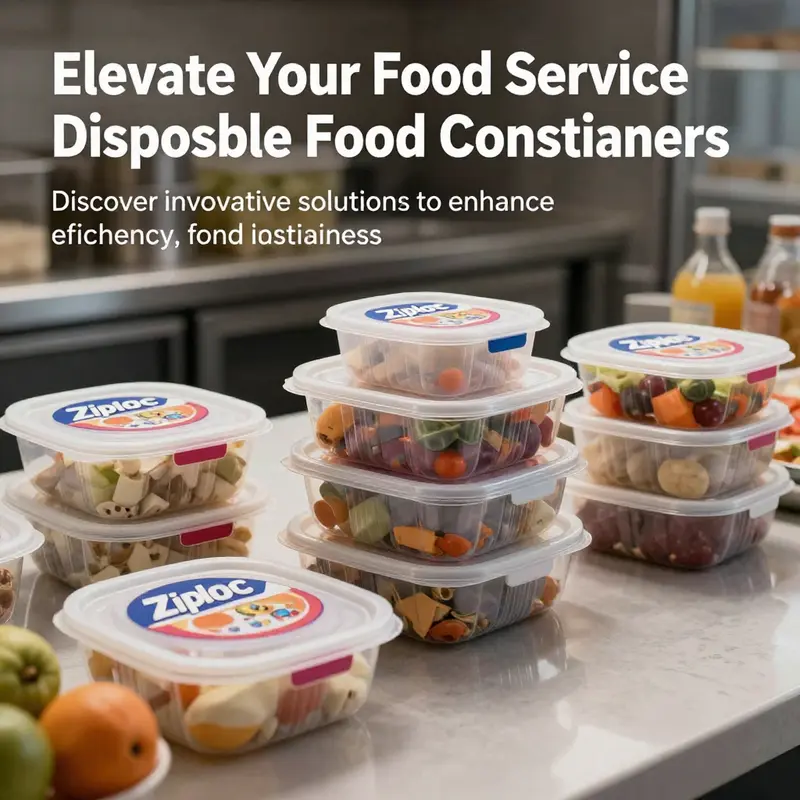
In the competitive world of food and beverage services, the choice of packaging can significantly impact your operation’s efficiency and customer satisfaction. Ziploc’s disposable food containers stand out as a top choice for bubble tea shops, restaurants, food trucks, catering services, event planners, and corporate procurement teams. With features designed to meet the diverse needs of the food industry, Ziploc containers not only ensure optimal food storage but also offer reliability and compliance with safety standards. This article will delve into the core features and innovations of Ziploc containers, explore their versatility and size options, discuss their environmental impact and reusability, and highlight the safety standards that make them a trusted choice for consumers and businesses alike.
Sealed for Freshness: The Quiet Engineering Behind Modern Disposable Food Containers

The everyday act of storing a slice of yesterday’s supper or packing a child’s lunch may seem mundane, yet it rests on a careful choreography of design, material science, and food-safety engineering. In homes and offices worldwide, the disposable food container has evolved far beyond a simple protective shell. It has become a compact system built to preserve flavor, prevent leaks, and simplify routine meals in a way that complements a fast-paced life. At the heart of this evolution lies a set of core principles that never change: a secure seal, a clear view of contents, safe materials, and a design that makes handling easy even when hands are slippery with grease or damp from condensation. When these elements work in concert, storage and transport cease to be hassles and instead become predictable steps in a routine that values freshness, convenience, and responsible use of resources.
The standout feature across the most trusted lines is the seal. The interlocking zipper, often described in consumer literature as a leakproof and airtight system, is more than a clever gimmick. It is a deliberate barrier against the two arch enemies of stored food: air and moisture. By minimizing exposure to ambient conditions, these containers slow the processes of oxidation and moisture migration that dull flavors and degrade textures. The result is a simple, practical benefit: leftovers that stay close to the original taste and texture for longer than they would in a poor seal. For families who stash portions after dinner or athletes who portion post-workout meals, the difference is measurable. Liquids stay put during transit, sauces don’t seep into the lid pockets, and the potential for cross-flavor contamination decreases substantially. This is not merely about keeping lunch from leaking; it is about preserving the integrity of each component of a meal, from the crispness of vegetables to the delicate aroma of a reheated sauce.
Beyond the seal, the design centers on ease of use and visibility. A transparent body makes it possible to identify what lies inside at a glance, reducing the need to open containers repeatedly in search of the right item. In a busy kitchen, time saved by not rummaging through a stack is time reclaimed for more meaningful daily activities. The practicality of quick identification is paired with a thoughtful approach to portioning. Features such as measurement lines etched along the sides let caregivers and home cooks alike gauge servings with a quick glance. This is especially valuable for families managing portion control or for those following recipes that require precise scaling. The combination of a transparent container and calibrated markings supports healthier eating habits by promoting awareness of portion sizes without demanding extra steps, plates, or measuring tools.
The materials chosen for disposable containers also deserve attention. The modern standard is typically a sturdy, food-safe polymer such as polypropylene (PP) or polyethylene (PE). These polymers offer a reliable balance of rigidity and resilience, enabling the container to hold up under typical kitchen conditions—from the jostling of a freezer to the microwave’s occasional hum. Importantly, contemporary formulations emphasize food safety: containers marketed for direct food contact are designed to be free from plasticizers and other potentially harmful additives. This attention to safety aligns with regulatory expectations from leading health authorities and fosters consumer confidence when meals are reheated or stored for extended periods. A growing portion of the market emphasizes BPA-free certification, reflecting a broader move toward minimizing concerns about chemical exposure from everyday plastics. The result is a family of products that can be trusted not only to perform their primary function but to do so with a conservative safety margin that respects both health and practicality.
The design language of these containers also speaks to the realities of a bustling household or workplace. Wide rims and ribbed lids appear repeatedly across the catalog because they are more than a stylistic choice; they are a tactile feature. A wide rim offers stability and a comfortable grip, even when hands are wet or coated with oil. A ribbed lid helps create a secure grip for users who are turning, snapping, or resealing with one hand. The importance of one-handed operation cannot be overstated in the context of busy mornings, school drop-offs, or meal-prep bursts where every second matters. The interlocking mechanisms themselves are engineered to deliver a dependable snap, a familiar feedback that tells the user the seal is engaged. This intuitive interaction reduces the cognitive load required to operate a container, which, in turn, lowers the risk of accidental spills or improper sealing.
Alongside sealing and handling, the ability to reheat efficiently is a recurrent theme. A growing subset of disposable containers carries microwave-safe certification, enabling users to move directly from cold storage to the microwave without the inconvenience of transferring contents to another dish. This capability is especially meaningful in today’s culture of batch cooking and meal-prep. It reduces dishwashing time and simplifies the post-lunch or post-dinner cleanup ritual. It is not merely about convenience; it is about enabling a more streamlined approach to food workflow. A microwave-friendly design also respects the integrity of the container’s seal during heating, a critical consideration given that repeated exposure to high temperatures can compromise both the material and the seal if not properly engineered. The result is a cohesive system that supports reheating as an integrated step, not a separate, messy chore.
The relationship between disposability and reuse has evolved as well. The terminology may still carry “disposable” in its name, but a substantial portion of these products is explicitly designed to be reusable across multiple cycles of storage and heating. Where permitted by the manufacturer and the material’s specifications, some models are dishwasher safe or designed to withstand refrigerator storage and microwave heating. This nuance matters for households looking to reduce waste or households that want to simplify cleanup while maintaining the convenience of single-serve portions. The language around disposability has increasingly shifted from a binary proposition—single-use versus reusable—to a more nuanced stance that recognizes the practical realities of modern life. Consumers benefit from this evolution because it offers choices that align with personal habits and environmental considerations, rather than forcing a one-size-fits-all approach.
In terms of transparency and accountability, the design philosophy also includes visibility into what the product is, how it should be used, and what it is made from. The clear design insures the user can easily assess risk factors such as whether the container shows signs of wear or material stress. Safety standards backed by regulatory oversight play a crucial role here. Manufacturers align with the FDA’s safety guidelines and related standards for food-contact materials, ensuring that the products are appropriate for direct contact with food, free from harmful plasticizers, and suitable for a variety of storage scenarios. This compliance provides peace of mind, particularly when meals are transported in bags, backpacks, or lunch boxes that travel from home to school or the office. The combined effect of rigorous safety standard compliance and transparent design cultivates consumer trust, which is fundamental to the enduring popularity of these containers in households worldwide.
Of course, the practical realities of daily life impose constraints that product designers must address. Storage is a persistent challenge: homes, offices, and schools accumulate containers in stacks, and the ability to nest or stack them efficiently matters for both space and organization. The materials’ rigidity must be balanced with a degree of flexibility to allow efficient nesting when empty. A sturdy yet lightweight construction helps prevent warping in the freezer and ensures the containers withstand the ordinary bumps and tumbles of daily use. The overall aesthetic—clear, clean lines; accessible sizes; and consistent lid geometry—contributes to a calmer kitchen environment where food storage becomes a routine that supports better meal planning rather than a source of friction.
In such a landscape, practical usage patterns reveal why these containers remain a staple. They serve a wide range of scenarios: storing cut fruits and vegetables to maintain color and texture; pre-portioning ingredients for quick assembly of meals; and enabling neat, compact transport of soups, stews, or sauces for lunch or travel. The multi-size strategy—often including compact mini sizes for snacks up to larger, generously proportioned options for family meals—ensures there is a container for nearly any portion. And because the lids and containers are designed for easy stacking, the space inside a cabinet or refrigerator becomes more organized, with each unit ready to grab in moments. The end result is a kitchen ecosystem that respects time, reduces waste, and supports healthier, more deliberate eating patterns.
To illustrate how these principles translate into real-world choices, consider a practical example that embodies the synergy of seal, material choice, and user-centered design. A kraft-paper round soup bowl with a lid, produced as a disposable but robust option, represents a different branch of the same family of products. It foregrounds environmental considerations by using renewable materials while still offering a reliable barrier against leaks and spills. Its lid, designed for secure sealing, complements the body’s rigidity to ensure that hot contents don’t compromise the seal during transport. The product’s design emphasizes easy handling and stable stacking, which matters for cafeterias, catering events, or office breakrooms where multiple meals and movements intersect. For readers curious about this category, a representative example is described in the linked product offering that showcases an eco-friendly disposable kraft soup bowl with lid. This example helps anchor the broader discussion in a tangible case, while still remaining a part of the larger family of storage and packaging solutions that share these core design traits and safety considerations. eco-friendly disposable kraft soup bowl with lid This reference highlights how the same principles play out across materials and use cases, from clear polycarbonate to kraft-paper variants that address environmental and practical needs alike.
Looking ahead, the ongoing dialogue around disposable containers will likely continue to balance performance with sustainability. While the core features—airtight sealing, clear visibility, microwave compatibility, and BPA-free safety—will remain central, engineers and designers will increasingly integrate circular economy considerations into the lifecycle of these products. That may mean a greater emphasis on recyclability, better labeling to guide end-of-life decisions, and perhaps the exploration of reusable, durable designs that blur the line between disposable and reusable in a way that respects both consumer habits and planetary boundaries. The accumulation of these refinements will shape how households, schools, offices, and events approach food storage, turning everyday meals into opportunities for better hygiene, less waste, and smarter, more efficient routines.
Framing the discussion around user experience, the smallest details—how a lid snaps with a reassuring click, how a lid rim feels when grasped with wet fingers, how the container’s transparency reveals the food’s condition without forcing an opening—play a crucial role in shaping behavior. When a product delivers a reliable seal and simple operation, people are more likely to reuse it, reheat safely, and plan meals with confidence rather than fear of spillage or waste. The integration of practical design with safety guarantees is what transforms the humble disposable container from a mere disposable asset into a trusted extendable kitchen tool. In this sense, the modern disposable container functions not only as a container but as a small, efficient system that lengthens the usability window of foods and supports the rhythms of contemporary life.
External resource for further reading on safe food-contact materials and their regulatory underpinnings can be found here: https://www.fda.gov/food-packaging-safety. Additionally, for a concrete example of an eco-friendly disposable kraft soup bowl with lid that demonstrates the same design thinking described above, refer to the internal link above. If you seek more practical variations in shape and size to suit different meals or settings, exploring the range of kraft-paper take-away packaging and related containers on the linked catalog can provide useful context and inspiration as you consider how storage design adapts to different culinary cultures and daily workflows.
Beyond the Snap: Exploring the Versatility and Size Range of Modern Disposable Food Containers

In kitchens and on picnic blankets around the world, the way we store, transport, and reheat food is shaped by a class of containers that balance ease with restraint. The best of these containers do more than hold food; they stabilize freshness, prevent leaks, and simplify the rhythms of daily life. When you consider the everyday acts of prepping a week’s meals, packing a school lunch, grabbing a snack on the go, or stowing leftovers before a busy workday, the containers you choose become quiet partners in how smoothly those tasks unfold. The range of disposables that rely on twist-and-lock lids and transparent bodies demonstrates a design ethic that values visibility, reliability, and practical durability. They are not merely containers in a drawer; they are tools that tune the tempo of modern living, enabling a seamless transition from preparation to storage to serving with minimal fuss and maximum control over flavors, moisture, and temperature. In this chapter, we explore how versatility and size options are more than a matter of convenience; they are a blueprint for efficient meal management in homes, offices, and outdoor settings alike.
At the core of these containers is a straightforward promise: keep food fresh while keeping life simple. The materials typically used—sturdy variants of polypropylene and polyethylene—are chosen for their balance of clarity, strength, and chemical stability. A transparent or near-transparent body means you can identify contents at a glance, which reduces the need for unnecessary opening and closing. That simple detail matters. Every time you open a lid, you introduce a moment where temperature can shift, aromas can mingle, and moisture can migrate. A clear design minimizes those fluctuations by making it easy to see what’s inside without exposing it to air and temperature swings. The use of transparent materials also helps with organization. When you’re managing multiple meal components, a quick glance tells you which container holds the protein, which one contains the vegetables, and which is best reserved for a dessert or fruit. This kind of visibility saves time and reduces the chance of cross-contact, a factor that matters in households cooking for family members with different dietary needs.
But visibility alone is not enough. The second pillar of these containers is a reliable sealing mechanism. A twist-and-lock lid system has become a standard for many manufacturers because it provides a straightforward user experience and a robust barrier against air and moisture. In practice, that means leftovers stay fresher longer, soups don’t spill in bags or purses, and marinating flavors don’t bleed into neighboring foods. In more specialized designs, you’ll hear nouns like Smart Snap or double-chain seals, terms that evoke precision engineering and a focus on minimizing leaks. The practical effect is that you can transport meals with confidence—whether you’re packing a week’s worth of lunches, giving a child a snack to take to school, or bringing a dish to a potluck without worrying about accidental spills. The seal is not just about keeping moisture out; it’s about preserving the intended texture and flavor of the food, which matters as much for a crisp salad as it does for a hearty stew.
The versatility of these containers is a direct function of their size range and shape options. A 9-cup large square container is a common workhorse for larger quantities, capable of holding soups, stews, and generous portions of side dishes. It is the kind of option you reach for when planning a weekly batch of meals or when you need to portion out family-size servings for gatherings. In contrast, the smaller, snack-sized varieties excel at portability and portion control, making them ideal for a single-serve breakfast oats, a portion of fruit, or a compact lunch for the office. The shape diversity—square and rectangular forms that nest and stack efficiently—supports a neat stacking system in the cabinet or freezer. Space-saving is not merely a matter of keeping a pantry tidy; it’s a practical feature that reduces energy use by enabling more efficient refrigeration and organization. When you can stack containers compactly, you can maximize the usable space in your freezer or fridge, which translates into less wasted time searching for items and more predictable meal planning.
This wide size spectrum is complemented by specialized products designed for particular workflows. Sandwich-sized containers, for example, provide a compact and efficient solution for lunch routines and small-scale catering. They are engineered to hold a sandwich or a set of compact components without crowding or pressure on the payload, which helps maintain texture and moisture balance. For households or offices that routinely prepare grab-and-go meals, these smaller formats can be the backbone of a streamlined meal-prep system. The design logic here couples capacity with practicality. A container that is too large for a given portion invites air exposure and potential waste, while one that is too small can force multiple containers for a single meal, complicating storage and retrieval. The right balance—large enough to hold the intended food with room for a proper seal, but not so large that it invites overfilling and messy spills—is a hallmark of thoughtful packaging design.
An often-overlooked advantage is the way these containers support a broader, more sustainable approach to daily living. The cultural shift toward mindful waste management has influenced consumer expectations, and the product line has responded with versions designed for reuse and durable performance. Although many of these items are labeled disposable, a substantial portion is rated for microwave heating, refrigerator storage, and dishwasher cleaning. This compatibility extends the lifecycle of the containers for many households and workplaces, making it feasible to rethink the line between “disposable” and “reusable” in everyday practice. The idea is not to upend convenience but to extend it through smarter use. Reusable variants exist that maintain a familiar ease of use while offering the chance to reduce single-use waste over time. In practice, families can adopt a hybrid approach: rely on the convenience of disposables for certain occasions, and opt for reusable versions for regular, high-volume meal-prep routines.
Safety and standards form the quiet backbone of these products as well. Every container is manufactured in accordance with safety guidelines designed to protect food contact. The materials resist staining, and the resins used are chosen to minimize leaching under typical household temperatures. The design ethos emphasizes a barrier between food and the external environment while ensuring that no hazardous additives would migrate into meals during normal use. This is especially important when you consider that temperatures can fluctuate from refrigerator cold to microwave heat, and that many families reheated portions directly in their containers. The ability to go from freezer to microwave to dishwasher without removing the contents from the container minimizes mishaps and reduces the risk of cross-contamination. In a world where food safety concerns are consistently at the forefront of consumer choices, the certainty that a container complies with recognized safety standards offers peace of mind that is as practical as it is reassuring.
The interplay between design, size, and usage scenarios creates a narrative about how households approach meals in the modern era. These containers are not just vessels; they are systems that support a lifecycle of food, from prep to preservation to portioning to plate. When you’re planning a week of meals, the ability to pre-portion and label portions becomes a powerful tool for consistency and nutrition. The clear bodies allow you to identify the contents at a glance, which reduces the temptation to over- or under-prepare and helps avoid food waste. The combination of sealing performance and visible contents can also minimize the temperature fluctuations that occur when repeatedly opening and closing a container during the day. By keeping foods sealed and visible, you preserve both quality and energy efficiency, as fewer cycles of warming and reheating can translate into lower energy use and faster meal execution.
The practical universality of these containers translates well to diverse contexts. At home, they simplify family meal planning and leftovers, while in offices they support predictable, easy-to-share lunches. For outdoor activities—picnics, camping trips, or road travel—the combination of a secure seal with a sturdy build reduces the chance of spills and ensures safe transport of liquids and semi-liquid foods. The capacity for compatible temperatures also means that a single set of containers can cover multiple roles: storage before preparation, portions for a hot meal that has been reheated, and even serving dishes at a casual gathering. The design language, rooted in the twist-and-lock concept, carries forward a familiar sense of reliability that users come to depend on, often without weighing the containers themselves as a deciding factor. Yet that reliability is precisely what makes these systems so enduring. They have earned their place in countless kitchens because they deliver predictable results across a spectrum of daily needs.
Interwoven with practical advantages is an awareness of the broader packaging ecosystem. The same principles that guide a well-sealed, clearly visible container apply to other forms of takeaway and storage packaging. You can find similar logic in disposable takeaway boxes that use clear lids and sturdy walls to present food appealingly while protecting it during transit. In fact, the same design cues that support freshness and ease of use in everyday containers resonate with the broader trend toward user-centric packaging that emphasizes ease of disposal, recyclability, and minimal environmental impact. For readers curious about related formats, there is a broader family of take-away packaging that echoes these principles in different materials and constructions. For instance, disposable kraft paper take-away boxes with clear lids illustrate how the same emphasis on visibility and secure sealing translates across different substrate choices. disposable kraft-paper take-away boxes with clear lids. This cross-pollination of ideas underscores a common objective: to make food storage and transport easier, more reliable, and less wasteful across settings.
In the end, the value of these containers rests not only in what they hold but in what their design enables. They empower people to plan meals, reduce spoilage, and move through daily routines with minimal friction. The large, the small, the square, and the rectangular all exist within a cohesive ecosystem that prioritizes a secure seal, a transparent view of contents, and compatibility with common kitchen workflows. They fit naturally into both home kitchens and professional environments where efficiency and consistency matter. The result is a storage system that feels almost invisible in its reliability—hard to notice when it works well, yet indispensable when it fails.
As you consider your own usage, notice how the choice of container shapes and sizes influences your habits. If you routinely prepare a week’s worth of lunches for family members who have different dietary needs, a spectrum of sizes helps you allocate portions without guessing. If you host gatherings often, sturdy, leak-resistant containers with generous volumes prevent last-minute scrambling for extra serving solutions. If you value sustainability, the option to choose reusable variants alongside disposables invites you to rethink waste without sacrificing convenience. The chapter’s core idea remains simple: a well-chosen set of containers in the right sizes makes everyday storage more predictable, less wasteful, and more aligned with how you actually live your days. The twist-and-lock lids, the clear bodies, and the thoughtful scale of options together form a practical toolkit that continues to evolve with how households manage food in a world that prizes efficiency and clarity.
For readers who want to explore adjacent formats that share the same design philosophy, consider the broader spectrum of disposable packaging that emphasizes ease of use, visibility, and secure sealing. The philosophy behind these containers—evidence of careful engineering, a focus on user experience, and attention to safety—translates across formats and materials. It is the same core idea, expressed in varied forms to accommodate different foods, occasions, and storage environments. The result is a versatile family of products that supports modern meal prep and storage without compromising on safety, convenience, or environmental mindfulness.
External resource: for foundational guidelines on safe food storage and handling, see the FDA’s general food safety resources at https://www.fda.gov/food
Disposable Food Containers: Environmental Footprint, Reuse Realities, and Practical Alternatives

The single-use plastic containers that many households rely on have an environmental profile that demands careful attention. These containers are typically produced from petrochemical plastics such as low-density polyethylene. The raw material comes from crude oil and natural gas. Extracting and refining those fuels consumes energy and alters landscapes. Manufacturing then adds further emissions through energy use and releases of volatile organic compounds. When a container is used once and discarded, every stage of that lifecycle contributes to environmental cost.
Beyond greenhouse gases, the waste fate of disposable plastics matters. Many of these containers are not accepted in municipal recycling streams due to contamination or resin type. Even when collected, recycling may downcycle the material into lower-value products. A large fraction still ends up in landfills or escapes into the environment. Over time, fragments can travel to water bodies, affecting wildlife and food chains. The cumulative effect of many single-use items across millions of households becomes significant.
Examining the per-use impact highlights a simple truth: repeated use reduces per-use burden. Durable alternatives designed for hundreds of cycles spread their embodied impacts over many uses. Silicone storage pouches, for example, require more energy to manufacture. High-temperature curing in production increases their initial carbon footprint. But the material’s durability and thermal stability allow long-term reuse. A well-cared-for silicone pouch can replace dozens, even hundreds, of single-use containers before it reaches end of life. Lifecycle assessments show this pattern: higher upfront impact, lower cumulative impact per use.
That comparison points to a pragmatic approach for households. Evaluate not only the raw material of a container but also how it will be used. If a disposable item is truly single-use, its lifecycle impact remains high. But if a container is robust enough to be washed and reused multiple times, the per-meal environmental cost falls. Unfortunately, labeling and messaging can confuse consumers. Products marketed as disposable sometimes survive multiple uses. Others decline rapidly when exposed to heat or repeated washing, leading to micro-damage and potential contamination.
Safety and hygiene add another layer. Plastics can degrade when exposed to heat or abrasive cleaning, creating tiny fissures that trap bacteria or leach additives. Manufacturers often specify whether a container is microwave-safe, dishwasher-safe, or suitable for freezer storage. Following those guidelines extends safe reuse. Yet, for products designed as single-use, manufacturers and health agencies typically advise against repeated reuse. That caution helps prevent foodborne illness and avoids overestimating a product’s longevity.
When aiming to reduce waste, consumers should prioritize durable, clearly reusable options. Choose materials rated for repeated heating and washing. Look for products with simple geometries that are easy to clean. Rigid containers with secure seals can serve for meal prep, leftovers, and freezing. Flexible reusable pouches are ideal for snacks and liquids. Reusable alternatives often pay back their higher embodied impact within a modest number of uses.
Practical habits multiply benefits. Empty and rinse containers before cleaning to reduce odors and stains. Use baking soda or vinegar for stubborn residues instead of harsh scrubs that could abrade surfaces. Rotate sets so items wear evenly. Inspect seals and rims for cracks or deformation; replace items once damage appears. Small steps like these prolong service life and maintain food safety.
Disposal choices matter when a container reaches end of life. Many polymer-based containers are technically recyclable, but local programs vary. Clean, dry plastics are more likely to be accepted. When recycling is unavailable, consider whether the container can be repurposed around the home—for storage of non-food items, seed starting, or craft projects—before discarding. For biodegradable or compostable alternatives, confirm whether your municipal composting accepts them. Some so-called compostable products require industrial facilities and will not break down in backyard piles.
Substituting materials is another effective strategy. Renewable-fiber packaging, such as kraft paper bowls and biodegradable pulp trays, has advanced substantially. These products often include water or oil barriers to handle wet foods. They can be industrially compostable and, in some cases, suitable for microwave heating. For meals intended for immediate consumption or one-off events, choosing compostable fiber-based containers reduces reliance on petroleum-based plastics. A practical product example is an eco-friendly kraft paper bowl with a secure lid, used widely by small food businesses for takeaway and events. Such options balance performance and lower long-term environmental burden when managed correctly; see an example of a kraft paper serving bowl for context.
Policy and infrastructure shape outcomes as much as consumer choices. Where collection and recycling systems are robust, the environmental profile of certain plastics improves. Extended producer responsibility schemes encourage manufacturers to design for recyclability and invest in takeback programs. Conversely, in regions with limited waste infrastructure, durable reuse and compostable alternatives offer clearer environmental wins. Community programs that collect and sanitize reusable containers for reuse in local food systems also show promise. The most effective interventions blend better product design, stronger policy, and informed consumer behavior.
Behavioral nudges matter. Simple defaults, like offering reusable container discounts or charging for single-use packaging, change habits quickly. Providing clear labeling about reuse potential and end-of-life options reduces confusion. Encouraging households to track how often they reuse an item makes the environmental benefits tangible. For example, a family might keep a small tally of uses for each reusable pouch. Seeing that a pouch has replaced dozens of disposables reinforces the value of the initial investment.
Cost considerations are part of the decision. Upfront price for a durable container may exceed that of a disposable pack. Yet amortized over months or years, durable items often become cheaper per use. Households should calculate break-even points: number of uses required to offset the purchase. Factor in avoided purchases of disposables and potential reductions in food waste thanks to better sealing and visibility. Sometimes, switching to a mix of reusable and compostable options fits best. Use durable containers at home, and choose compostable packaging for events or single-use needs.
A realistic road map for reducing environmental impact centers on three actions. First, reduce single-use dependence by adopting reusable containers for routine storage and transport. Second, select replacement materials appropriate to use—durable silicone or rigid containers for repeated handling; compostable fiber for single-use scenarios. Third, manage end of life responsibly by cleaning for reuse, recycling where accepted, or composting when facilities exist.
Consumers should also demand clearer information from manufacturers. Transparent labeling that states material type, expected lifespan, and recommended cleaning methods helps. Manufacturing disclosures about recycling compatibility and end-of-life pathways allow buyers to make informed choices. When collective demand favors durable, repairable, and recyclable designs, industry follows.
The environmental calculus is not simple, but it is actionable. Every household choice adds up, whether that means investing in long-lasting storage, choosing compostable fiber when suitable, or advocating for better waste systems. Small changes in habit reduce the flow of single-use plastics into landfills and ecosystems. Over time, those choices shift market offerings and policy priorities toward lower-impact solutions.
External resource: lifecycle and reuse comparison studies offer deeper evidence and practical metrics for consumers considering alternatives. For a more detailed lifecycle comparison between reusable silicone pouches and single-use plastic containers, see this analysis: https://www.sustainablelivingtoday.com/reusable-silicone-vs-ziploc-environmental-impact/
Internal reference: an example of a biodegradable kraft paper serving bowl with lids can help when choosing compostable single-use alternatives: https://cupbowlpack.com/product/senang05-eco-friendly-1000ml-noodle-soup-salad-bowl-kraft-paper-disposable-serving-bowl-with-lid-best-selling-product/
Trusted Seals: How Safety Standards Build Confidence in Ziploc Disposable Food Containers

Safety by Design: Materials, Standards, and the Case for Trust
Brands that dominate a category do so by solving core consumer worries. For food storage, safety and reliability top that list. Ziploc disposable food containers focus on both through material choices, tested sealing systems, and clear use guidance. Those choices are rooted in science. They also reflect an understanding of everyday kitchen behavior. The result is a product line that aims to remove doubt about what touches your food.
The containers are typically made from food-grade polypropylene or polyethylene. These plastics have long histories in food contact applications. They are chosen for their chemical stability. They resist cracking, staining, and warping under common home temperatures. That stability reduces the risk of chemical migration into food. Manufacturers follow regulatory rules that define what ‘‘food-grade’’ means. Those rules set limits on additives and potential contaminants. Meeting them is the baseline for trust.
Regulatory approval is central to safety claims. The United States Food and Drug Administration evaluates materials intended for direct food contact. Approval means formulations and manufacturing processes were reviewed. It does not mean unlimited use in all conditions. Instead, approval clarifies safe temperature ranges and intended uses. That technical clarity helps consumers avoid risky practices. It also provides a framework for companies to design labels and instructions.
Sealing systems are the next critical layer. A reliable seal prevents microbes and moisture from entering. It also reduces odor transfer between foods. Effective seals are designed with redundancy in mind. A double-track seal, for example, offers two separate barriers. Snap-lock lids provide audible feedback. That feedback reassures users that the container is properly closed. Good design reduces user error, which is a common source of contamination.
Manufacturers run routine tests long before products appear on shelves. Those tests include migration studies, which measure whether chemicals move from plastic into food simulants. They also include stress tests for repeated handling and temperature swings. Microbiological evaluations check how the container and seal limit bacterial growth under typical misuse scenarios. Independent labs or in-house quality teams perform these tests. Passing them provides tangible evidence for safety statements on packaging.
Trust grows when companies are transparent about limits. Clear labeling on whether a container is microwave-safe, suitable for freezing, or dishwasher-safe matters. It empowers consumers to use the product correctly. It also reduces behaviors that could degrade the container. For example, overheating a thin plastic container can warp it. That warping compromises seals and creates crevices for bacteria. Labels that set temperature and use boundaries protect both product performance and consumer health.
Many disposable containers are technically reusable within limited bounds. Some models are intended for single use. Others withstand multiple cycles in a dishwasher, fridge, or microwave. When reuse is allowed, manufacturers provide cleaning and care instructions. Following those instructions reduces the risk of cross-contamination. Clean, undamaged lids and rims form tight seals. Reusing a container that is scratched, warped, or stained increases the chance of bacterial growth and chemical migration.
A practical safety point is the difference between wear and material failure. Scratches and abrasions create rough surfaces. Those surfaces trap food particles and microbes. Over time, that trapped debris becomes harder to clean. It also shortens the useful life of the container. Discarding heavily worn containers is both practical and safe. For consumers who want reusable convenience, choosing sturdier models designed for repeated use is the better option.
The discussion of food safety often leads to questions about microwaving and leaching. Scientific tests show that migration rates rise with heat. However, tested food-grade polymers remain within regulatory limits when used as labeled. That is why manufacturer guidance is critical. Microwaving without a vent, or heating at higher-than-recommended temperatures, increases risk. Using containers that explicitly state microwave and heat limits prevents mishaps. Venting lids and using lower power settings reduce stress on the plastic.
Freezing presents fewer chemical concerns than heating, but it has its own risks. Liquids expand as they freeze. A tightly sealed container without headspace can crack or distort. A compromised seal leads to freezer burn and bacterial access when thawed. Good packaging design accounts for expansion by providing space or flexible walls. Properly labeled freezer-safe containers explicitly guide users about safe fill levels and recommended storage times.
Hygiene practices play a major role in safety. Single-use containers aim to reduce cross-contamination by limiting reuse. Reusable models require cleaning processes that remove oils and food residues. Washing with hot, soapy water or running a dishwasher cycle are effective methods. Drying thoroughly prevents the damp environment bacteria enjoy. When in doubt, inspect the container visually. If odors persist after cleaning, it is safer to replace the item.
Clear consumer education distinguishes trusted brands from the crowd. Instructional icons, short how-to guides, and packaging copy that explains limits remove ambiguity. Consumers appreciate simple rules: do not use in broilers or conventional ovens; leave space for expansion when freezing; replace when warped or scratched. These rules deliver real safety benefits.
Beyond labels and testing, third-party endorsements and certifications strengthen consumer confidence. Independent laboratory reports and regulatory clearances are tangible proofs that a product performs as claimed. Brands that make their testing visible show they welcome scrutiny. That openness reduces skepticism and invites better-informed purchases.
Sustainability concerns increasingly intersect with safety. Some consumers worry that disposable equals careless disposal. Others worry that reuse is the only responsible option. The balance between single-use hygiene and environmental impact leads to nuanced decisions. For containers intended as single-use, proper disposal and recycling guidance are important. For reusable models, clear reuse limits reduce the chance that users treat a disposable container as eternal.
Alternatives exist for consumers who prioritize renewable materials. Paper and bagasse options offer biodegradable routes. Many come with plastic lids that maintain sealing performance. When selecting alternatives, applying the same safety criteria matters. Look for food-grade claims, microwave compatibility if required, and clear disposal instructions. A useful comparison can be found when weighing food-grade reusable bowls with PP lids, which combine convenience with secure sealing. disposable food-grade reusable square salad bowls with PP lids
Misconceptions about plastics and safety persist. Headlines sometimes imply that all plastics are equally risky. In reality, polymers differ greatly in structure and suitability for food contact. Regulatory frameworks are built to reflect those differences. Understanding that nuance helps consumers make safer choices. Choosing containers with clear regulatory compliance and tested sealing performance is more effective than avoiding plastics altogether.
Practical purchasing advice follows from these facts. First, prioritize materials with explicit food-grade claims. Second, read the usage labels for microwave and freezer guidance. Third, inspect seals and lids for secure closure before first use. Fourth, when reusing, follow cleaning guidance and replace items that show wear. These habits reduce risk and maintain freshness.
Manufacturers can further build trust by communicating test results and quality procedures. Transparency about raw material sourcing, production audits, and batch testing reassures buyers. It also raises the bar across the category by creating expectations for verifiable safety.
Trust is not a single attribute. It is the product of consistent performance, clear limits, and honest communication. When containers preserve flavor, prevent leaks, and come with simple, science-backed guidance, they reduce everyday friction. That reliability becomes a reason people choose a brand again.
Regulatory links give consumers ways to dig deeper into the science. The U.S. Food and Drug Administration maintains resources about food contact materials and the safety assessments behind them. Accessing those resources can clarify technical questions and validate manufacturer claims.
Source: U.S. Food and Drug Administration – Food Contact Substances
Final thoughts
Ziploc disposable food containers provide a comprehensive solution for food and beverage businesses aiming to enhance efficiency, safety, and sustainability. Their advanced sealing technology and various size options make them an indispensable tool for any food operation, while their commitment to environmental practices and adherence to safety standards foster consumer trust. By incorporating Ziploc containers into your business, you can ensure your operations are streamlined and aligned with modern consumer values, enhancing your service quality and overall customer experience.