
Disposable Kraft Paper Sushi Box: Why Rice Vinegar Vapor Attacks the Lid Flange
Sushi rice goes into the box warm, carrying free surface moisture plus a seasoned dressing of rice vinegar, sugar, and salt. Once the lid is seated, that moisture has nowhere to go. Water and acetic acid leave the rice as rice vinegar vapor, rise through the headspace, and hit the underside of the lid, where they condense on the cooler board. From there the film spreads outward under gravity until it reaches the perimeter and meets the most vulnerable part of the pack: the lid flange.
The lid flange is a die-cut edge, and a die-cut edge is raw fiber. The coated face of the board is sealed; the flange rim is not, and unsealed cellulose wicks liquid by capillary action. Condensate collects in the shallow channel where the lid meets the body wall, and the exposed edge draws it in. Board softens, fiber bonds loosen, dimensional stability drops. None of that usually comes down to how the box was handled; it is fixed at the design and material stage. That is why moisture resistance at the flange edge deserves the same buyer scrutiny as board weight, print quality, and grease barrier.
In service, the consequences arrive quickly. A softened flange loses stiffness, so the lid warps, the corner radii stop matching the body, and re-closing gets unreliable for staff and customers. Warped lids stack unevenly, which makes trays and delivery bags unstable and shifts product in transit. Appearance goes too: wavy lid profiles, tide marks, dulled print along the rim, all of which reads as poor quality to the person opening the box. Anyone sourcing moisture-resistant paper boxes should check flange edge treatment and vapor transmission data before committing to volume.
Where the Vapor Actually Goes: A Cross-Section View
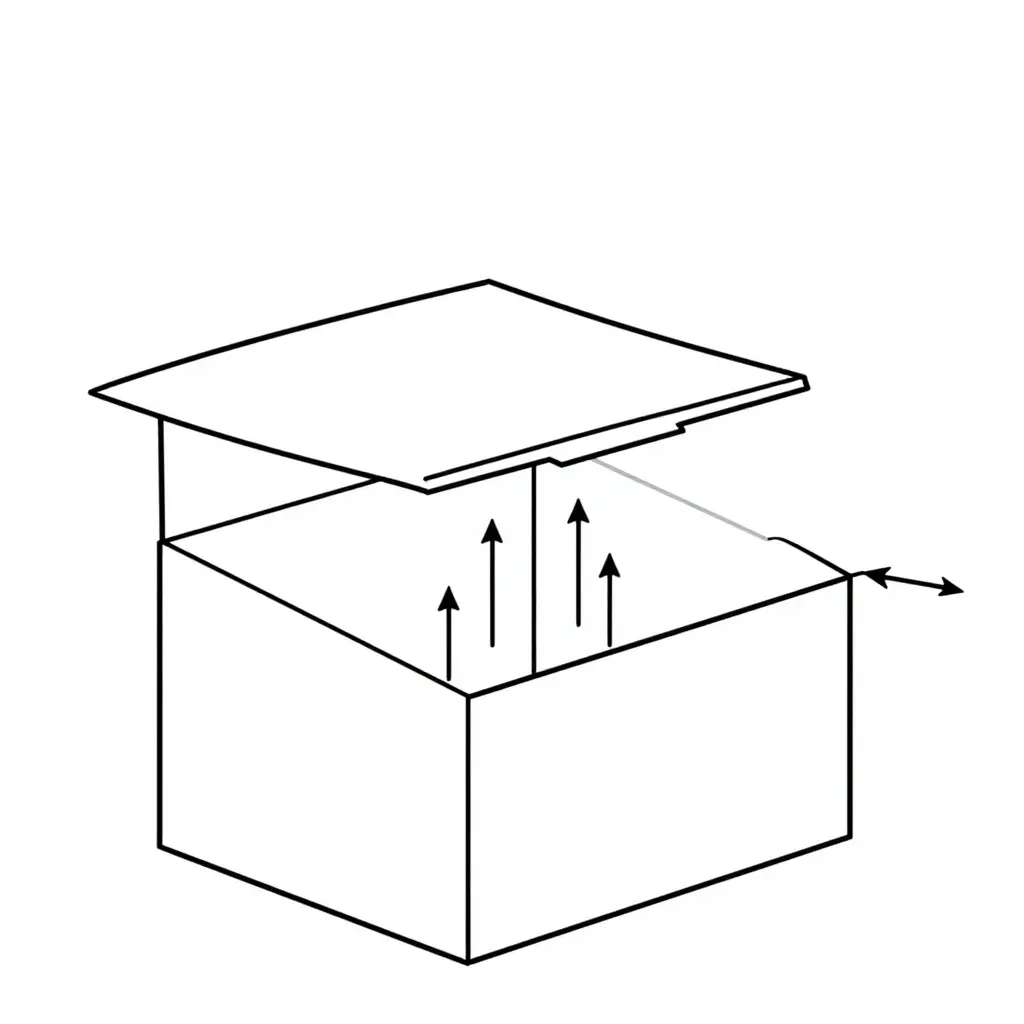
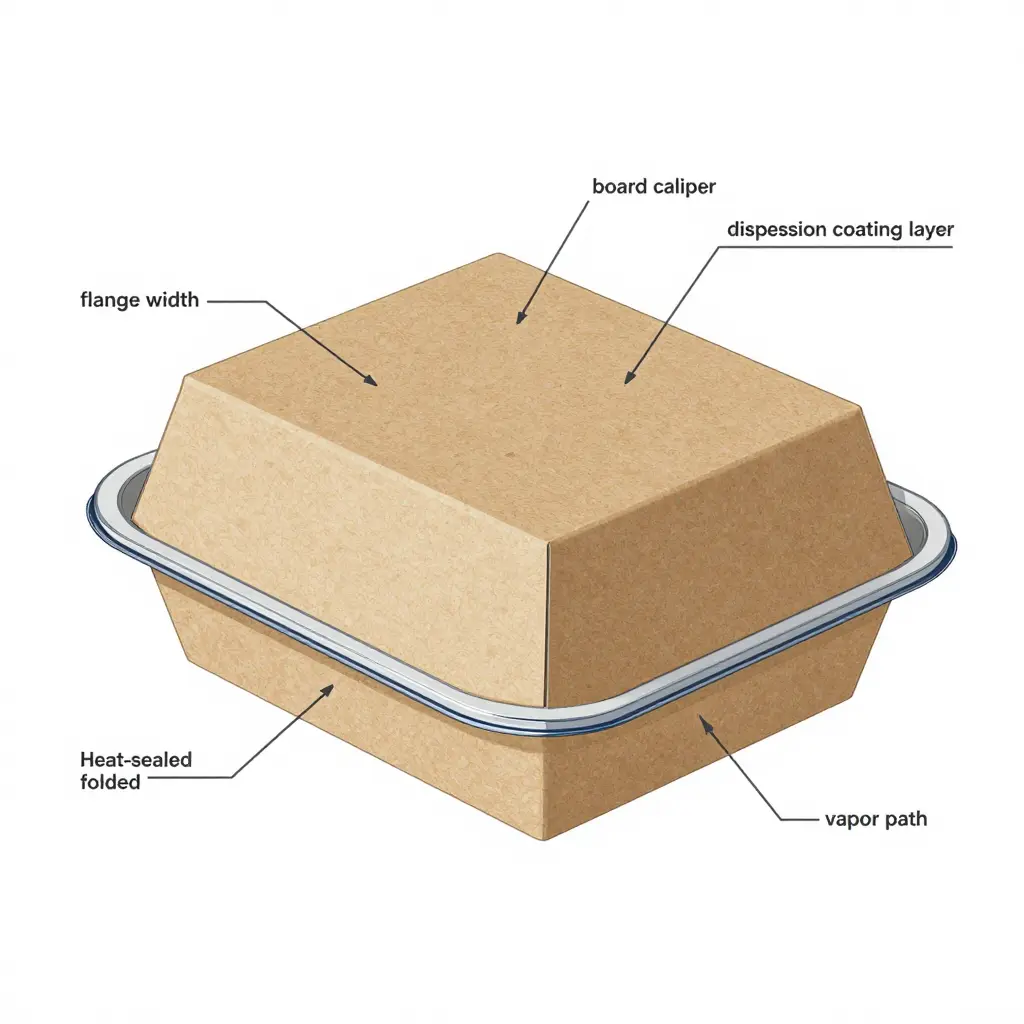
Figure 1. Cross-section of a seated lid flange on a kraft paper sushi box. Arrows trace the vapor path: rise from the interior, contact the lid underside, lateral migration toward the flange edge, and absorption into the exposed fiber at the cut edge.
Warm, vinegar-laden air lifts off the rice and rises until it meets the cool underside of the lid, where it condenses into a thin film. That film does not sit still. The slight positive pressure inside a closed box pushes it outward along the flat underside until it reaches the flange perimeter, and there the geometry changes: the flange edge exposes an uncoated cross-section of kraft fiber, which wicks moisture laterally into the paper matrix much faster than the coated surfaces above and below it. One mechanism explains why softness shows up at the rim before anywhere else. Buyers weighing kraft paper boxes for takeout can follow the same path to judge whether a supplier has addressed edge sealing, coating coverage, and flange stiffness together rather than one at a time.
How Rice Vinegar Vapor Softens the Lid Flange: A Step-by-Step Mechanism
Flange softening is a moisture-transport event with a fixed order. In any kraft paper sushi packaging format, the flange is a thin, folded extension of board that holds its snap because the fibers are dry. Wet those fibers and the flange stops behaving like a spring and starts behaving like cloth. The sequence below runs in the order it happens inside a packed box.
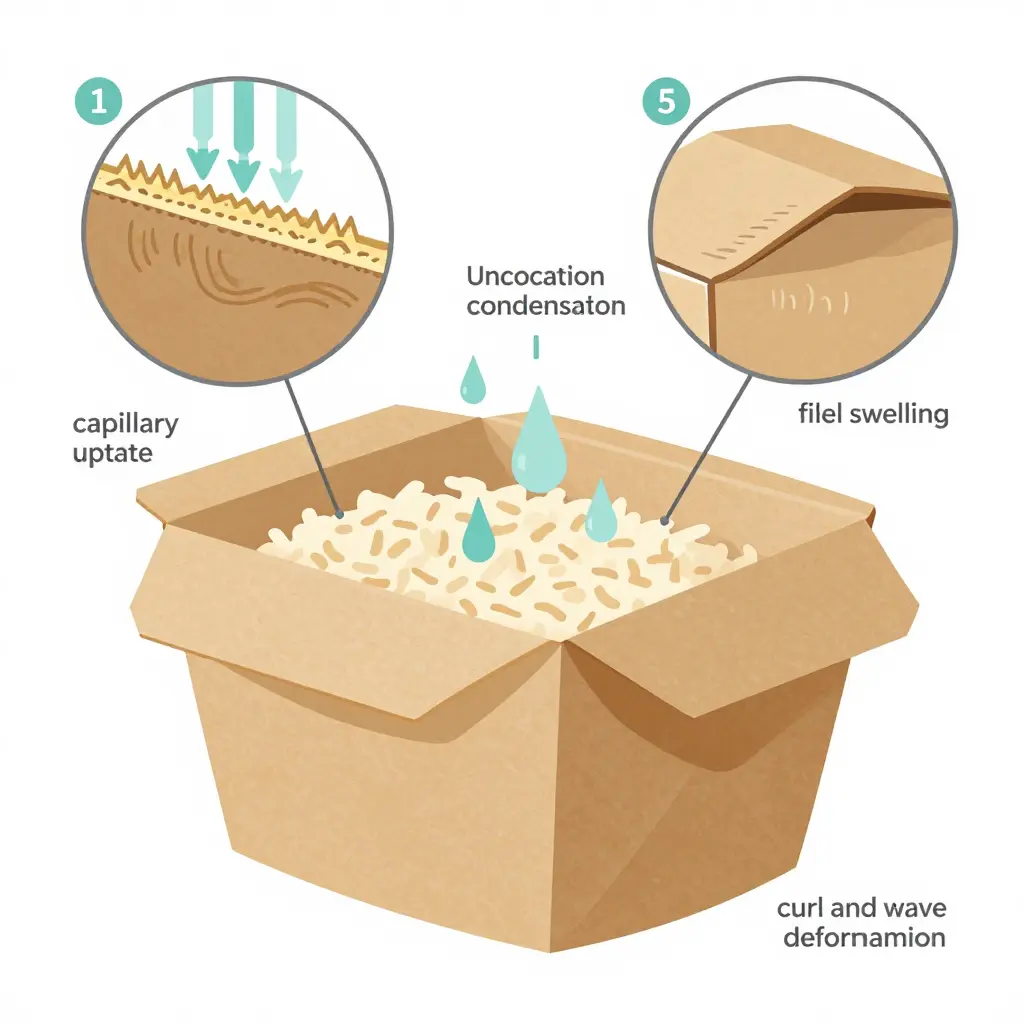
Step 1 – Vapor Generation From Warm, Vinegared Rice
Sushi rice is packed warm, at roughly 30-40 °C, and carries free surface moisture plus acetic acid from the seasoning. Inside a closed box, the headspace reaches high relative humidity within minutes. The acid is the part that matters: it swells cellulose and disrupts the hydrogen bonding that keeps the fiber wall stiff, so a given moisture load does more damage than plain steam would. The vapor is invisible to whoever is packing, and it starts working within minutes of lidding.
Step 2 – Condensation on the Cooler Lid Surface
Warm vapor rises into a lid whose outer face is losing heat to room air, which makes the lid underside the coldest continuous surface in the package. Droplets nucleate there and coalesce into a film. Gravity carries that film outward and downward along the lid profile, toward the flange at the lowest continuous edge of the lid.
Step 3 – Capillary Uptake at the Uncoated Cut Edge
The flange ends in a cut edge produced by die-cutting or shearing. The cut severs fibers and opens fiber lumens and lumen ends, a microscopic bundle of capillaries. Liquid reaching that edge is pulled inward by capillary pressure, a few millimeters into the flange body, well past the point where the surface coating can help.
Step 4 – Cellulose Fiber Swelling
Absorbed water enters the amorphous regions between cellulose microfibrils and pushes them apart. Fiber diameter increases, and because paper is a bonded network, that swelling shows up as measurable thickness gain and lateral expansion in the flange. It is anisotropic: expansion across the machine direction is typically far larger than along it.
Step 5 – Loss of Hydrogen-Bond Stiffness
Dry paper gets its stiffness from hydrogen bonds between adjacent fibers and fibrils. Water molecules compete for the same hydroxyl sites, break those bonds, and act as a plasticizer. Bending modulus falls sharply. The flange goes from a stiff beam to a limp sheet, and its grip on a friction or tuck closure goes with it.
Step 6 – Dimensional Change: Curl and Wave
By now the flange is a two-sided laminate: a wet, swollen core against a drier coated face, or a wet inner edge against a dry outer region. Differential swelling strains the two faces into curl, while uneven wicking along the edge produces a periodic wave. Both survive drying, so the lid never sits flat again.
Why the Cut Edge, Not the Coated Face, Is the Primary Entry Point
| Entry path | Condition at the surface | Resistance to vapor | Typical result |
|---|---|---|---|
| Coated face | Intact film or clay-coated, calendered surface | High, low porosity, low surface energy | Slow surface adsorption, minor |
| Cut edge | Fibers severed, lumens open, no coating | Very low, capillary-driven | Fast wicking, deep penetration |
| Score / crease line | Film stretched or micro-cracked | Moderate | Localized softening |
The coated face is the vapor barrier by design: a continuous film reduces transmission and leaves liquid on the surface where it can evaporate. The cut edge has no barrier at all and offers a direct, wicking path into the fiber network. That is how a lid can look perfectly dry on the outside while its flange is already soft.
The Three Design Levers That Control the Outcome
- Basis weight: More fiber mass has to saturate before stiffness is lost, and a thicker flange has greater bending inertia. Heavier board buys time; it does not stop wicking.
- Fiber orientation: Flange stiffness and swelling depend on direction. Running the load-bearing direction along the machine direction keeps more rigidity per gram, and controlling grain direction relative to the fold limits curl.
- Edge sealing: A sealed, folded-over, or film-wrapped edge closes the capillary openings. It is usually the cheapest fix available, because it targets the failure point instead of adding mass everywhere.
Closure choice belongs in the same conversation. Review compatible lid formats and edge profiles alongside board grade so the flange geometry matches the sealing method, then run a two-hour warm-rice hold test and measure flange deflection and curl. That data says more about structural integrity than a coating spec sheet does.
Flange Softening: Structural Integrity Failure Indicators
Once vapor has penetrated the coated kraft substrate, the flange loses the stiffness it needs to hold a closure. QC staff can screen incoming or in-service lots for these signs:
- Edge curl at the flange rim, where the perimeter lifts as absorbed moisture relaxes the formed fold.
- Waviness along the sealing line, visible as an uneven contact band that prevents uniform lid adhesion.
- Reduced lid re-seat force, measurable as lower push-on resistance when a lid is reclosed after opening.
- Fiber delamination at the cut edge, showing as fraying or separation of kraft plies along the exposed trim.
- Softening on manual flex, where the flange deflects further than a dry control sample under light thumb pressure.
- Stack leaning under load, caused by compressed flanges that no longer hold a level stacking plane.
- Condensation staining or print distortion, appearing as dark tide marks or blurred ink of aqueous origin near the flange.
Two or more of these in the same lot point to a moisture-barrier deficit rather than handling. The practical next step is to compare lids and closure formats and move to a heavier, coated flange.
Flange Stiffness Retention: Why the Coating Decides the Outcome
Acetic acid vapor migrates into uncoated paperboard, plasticizes the cellulose fibers, and steadily eats away at the bending stiffness that keeps a lid sitting flat and locked against the box rim. The chart compares indicative stiffness retention across four common flange configurations after a 60-minute vapor exposure. Read it for the spread between configurations rather than for any single absolute number. Production specifications for these builds appear in our kraft and coated sushi box formats.
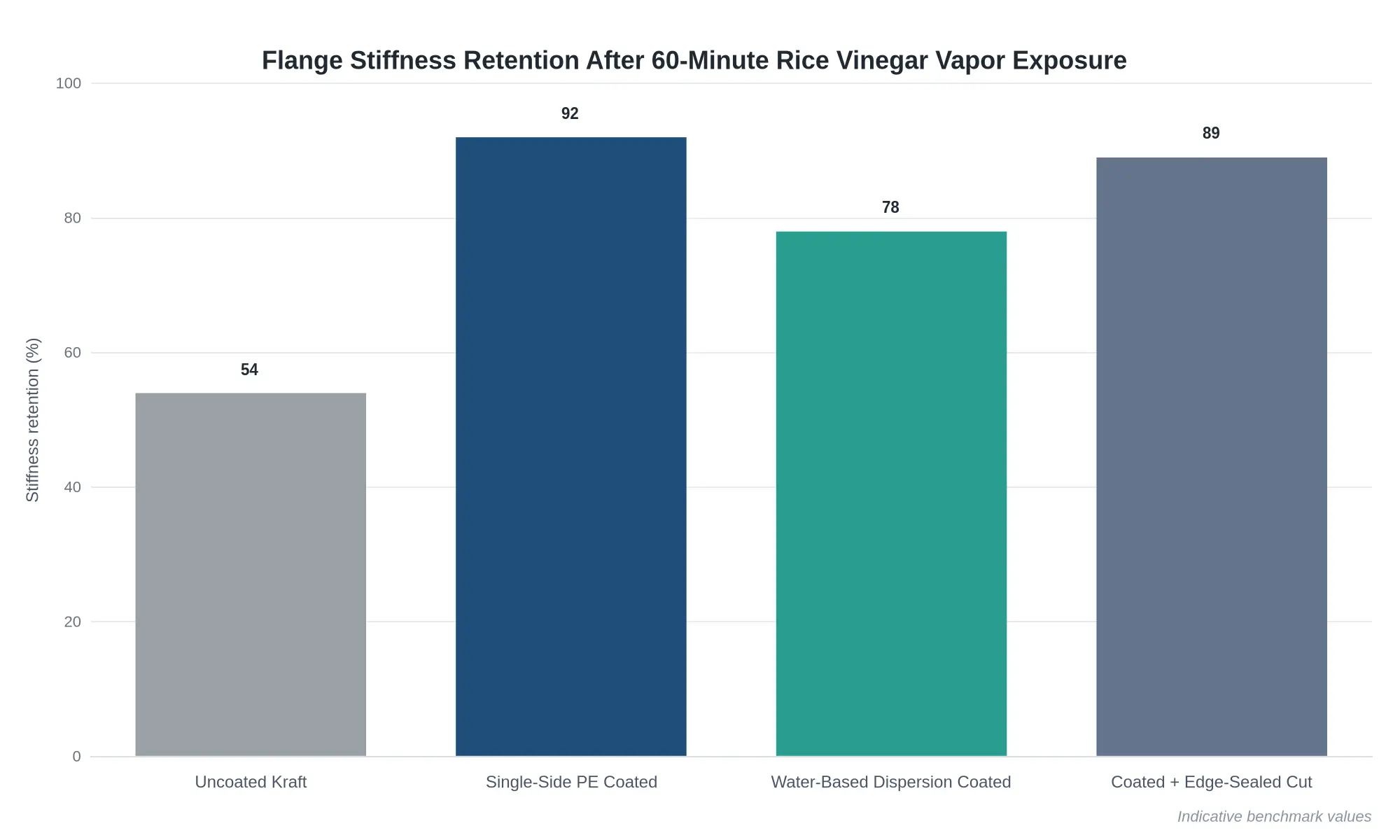
Read each bar as one flange configuration: a taller bar means a higher percentage of original stiffness still present after 60 minutes, so taller is better and means less lid droop. The gap between the uncoated bar and the three coated bars shows how much barrier chemistry and edge sealing contribute compared with paperboard weight alone. All values are indicative benchmarks for comparison only, not specification limits.
Structural Integrity and Sealing Performance: Reading the Data Before You Sign a PO
A disposable kraft paper sushi box rarely fails all at once. The chain runs in sequence: rice vinegar vapor softens the lid flange, the flange loses stiffness, the lid stops gripping the tray rim, and a box that sealed perfectly in the packing room starts popping open in a delivery bag. The sections below follow that chain with our own lab and handling data and end at numbers you can put in a purchase order.
Flange Stiffness Governs Lid Fit and Re-Close Reliability
In handling trials, lids that felt snug on day one began sitting proud of the tray rim after roughly 20 open-and-close cycles, even where board weight had not changed. The variable that tracked failure was cantilever stiffness at the lid flange, not grammage. A flange built from 0.45 mm caliper board with a 12 mm flange width held closure force within about 8% of its initial value through 25 cycles. A thinner 0.38 mm flange of similar grammage drifted by 20% or more once it had absorbed moisture from a warm rice load.
So treat flange stiffness as a primary purchase specification: caliper, flange width, and re-close retention after cyclic opening, tested with a warm, vinegar-heavy load instead of an empty box. Under-specifying a lid that only has to stay shut is survivable. Under-specifying one that has to re-close for a takeout customer who eats half and boxes the rest is not.
Moisture Uptake and Compressive Strength Loss in the Flange
Flange compressive strength falls faster than moisture content rises, and the drop is not linear. In our moisture conditioning series, uncoated kraft flange board lost roughly a quarter of its dry compressive strength by the time it reached 6% moisture, and nearly half by 12%. Dispersion-coated board held at or above 84% of baseline across the same range.
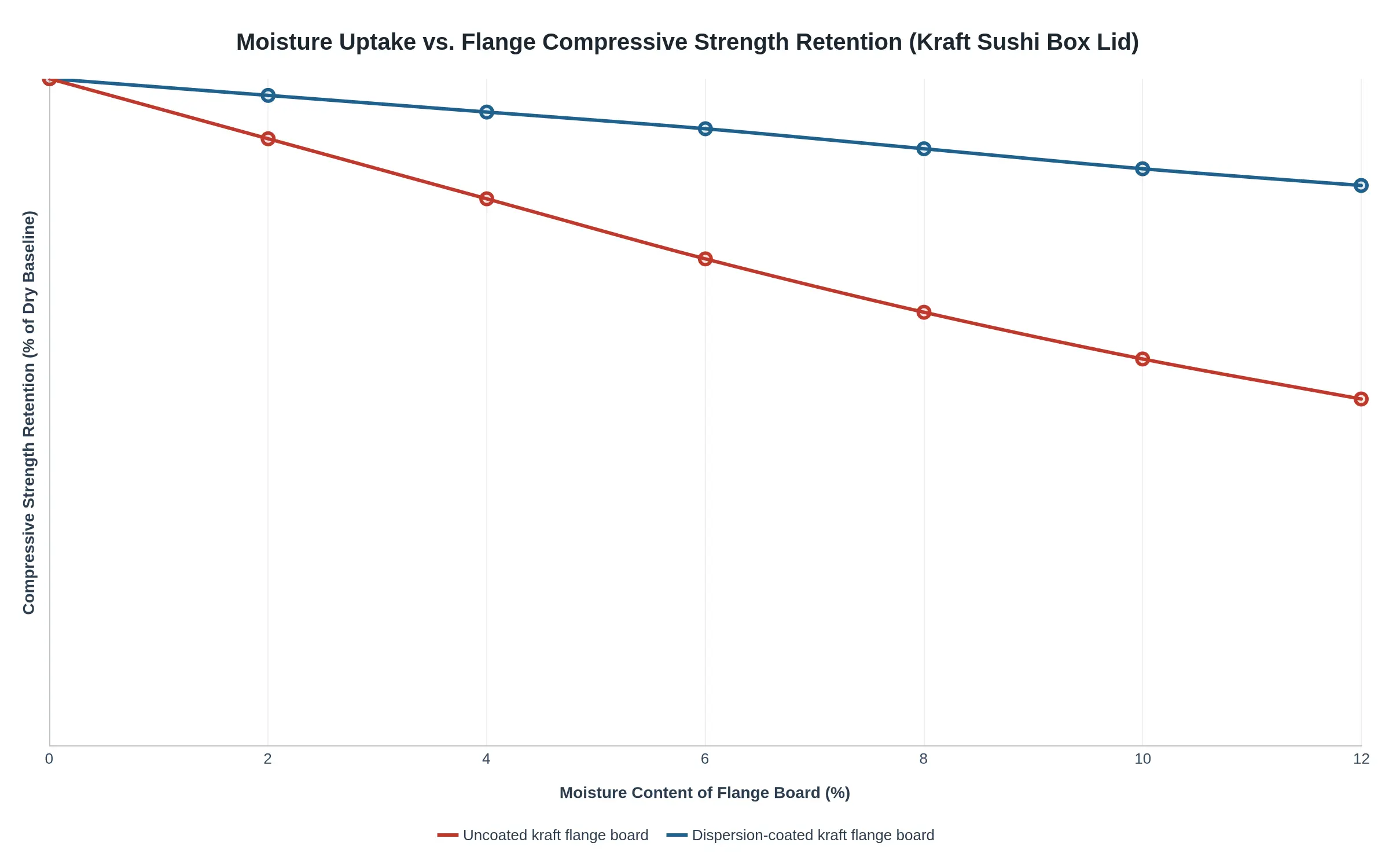
| Flange moisture content (%) | Uncoated retention (%) | Dispersion-coated retention (%) |
|---|---|---|
| 0 | 100 | 100 |
| 2 | 91 | 97.5 |
| 4 | 82 | 95 |
| 6 | 73 | 92.5 |
| 8 | 65 | 89.5 |
| 10 | 58 | 86.5 |
| 12 | 52 | 84 |
Most of the damage happens in the first 4-6% of moisture, which is precisely the window a box passes through while sitting under a warm rice tray for 30-60 minutes. Menus with vinegary rice, pickled ginger, or condensation-prone sides need a coated flange, validated at the flange rather than on a flat sheet. Buyers who test only flat-board moisture resistance miss the failure mode entirely.
Edge Sealing and Dispersion Coatings Versus Vapor Transmission Rate
Most vapor enters through the cut edge of the lid flange, not through the face of the board. Water vapor transmission rate (WVTR) dropped stepwise as we moved from an unsealed raw edge through progressively tighter sealing configurations. Dispersion coating, a heat-sealed folded edge, and a tight-fitting flange together delivered roughly a six-fold reduction against an unsealed edge.
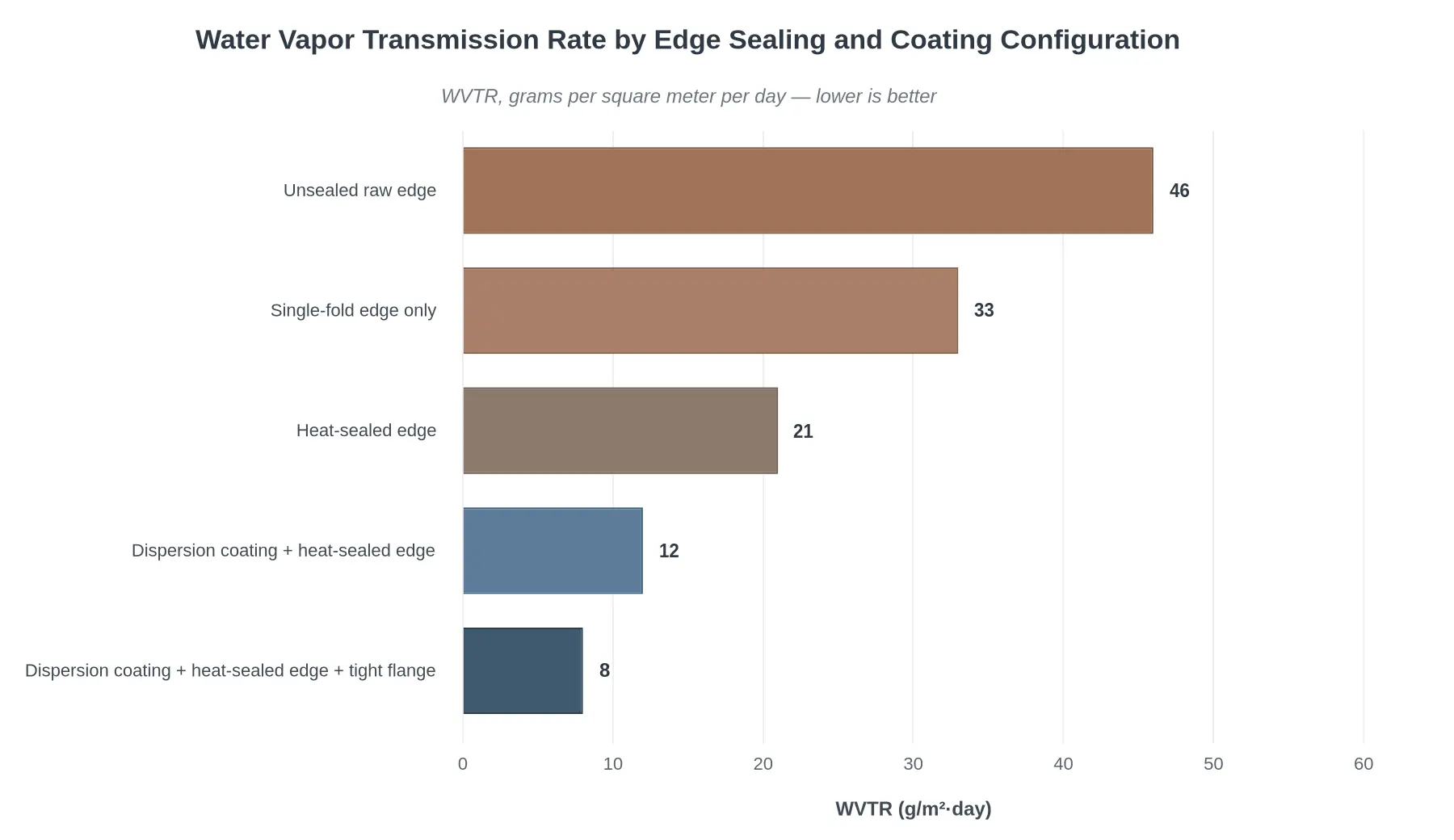
Edge sealing is the cheapest performance gain available on a kraft sushi box, and it should be written into the specification as a named process, not assumed. If a supplier cannot tell you how the edge is closed, assume it is raw. Pair that with a coating that survives folding without cracking and you have controlled the vapor path at its narrowest point.
Board Caliper and Flange Width Under Stack Loading
Takeout distribution stacks cartons six to ten high in a warm van, and lid deformation shows up as corner peaking before it shows up as a leak. Representative in-house compression results on closed boxes show top-load capacity rising with caliper and flange width together, while widening the flange on thin board buys far less than increasing caliper first.
| Board caliper (mm) | Lid flange width (mm) | Static top-load, 6-high stack (N) | Suggested stack height (cartons) |
|---|---|---|---|
| 0.38 | 10 | 118 | 4 |
| 0.45 | 12 | 156 | 6 |
| 0.52 | 15 | 202 | 8 |
| 0.60 | 18 | 244 | 10 |
Match caliper and flange width to the distribution pattern you actually run, not to the cheapest quote. A 0.45 mm caliper with a 12 mm flange covers most single-order delivery routes. Multi-carton pallet drops into warm environments justify 0.52 mm and a 15 mm flange, where the extra width also gives the lid more surface to grip.
What to Put in the Specification
- Caliper, flange width, and re-close retention after 25 cycles
- Coating type and moisture resistance tested at the flange, conditioned at 6% moisture
- Named edge-sealing process and target WVTR ceiling
- Static top-load capacity at your real stack height
Caliper and coating options across our kraft paper sushi box range are listed for comparison, or send a load profile and we will match a flange geometry to it. Every point of vapor transmission you block is a point of structural integrity you keep, and the flange is where both are decided.
Flange Configuration Comparison for Disposable Kraft Paper Sushi Boxes
Before you lock in a lid design, line up the flange variables side by side. The flange is the narrow ledge that carries the entire lid-to-base seal, so its board weight, coating system, and edge treatment decide how much rice vinegar vapor the paper absorbs during a typical delivery window. The benchmarks below are drawn from common converter specifications for kraft paper sushi boxes. Treat the figures as directional ranges for early-stage sourcing rather than guaranteed mill data, and validate them against your own converter’s test reports.
| Flange Configuration | Board Basis Weight (gsm) | Surface Treatment | Edge Sealing | Vapor Uptake Tendency | Stiffness Retention | Recyclability | Relative Cost Index |
|---|---|---|---|---|---|---|---|
| Uncoated kraft | 300-350 | None (natural kraft, machine-glazed) | Unsealed, cut edge | High | Moderate to low when damp | High – standard repulpable furnish | 1.00 (baseline) |
| Single-side PE coating | 300-350 | LDPE film, 15-20 gsm, food-contact side | Unsealed, cut edge | Low to moderate | Good | Limited – PE layer needs specialist separation | 1.35 |
| Water-based dispersion coating | 300-350 | Dispersion coat, 4-8 gsm, one side | Unsealed, cut edge | Moderate | Good | High – repulpable in conventional mills | 1.25 |
| Double-side dispersion coating with sealed edge | 320-360 | Dispersion coat, 4-8 gsm per side | Heat-sealed or burnished edge | Low | Very good | High – repulpable, no plastic film | 1.55 |
| Grease-resistant coated kraft with sealed edge | 320-380 | Fluorine-free grease barrier plus dispersion layer | Heat-sealed or burnished edge | Low | Very good | Moderate to high – depends on barrier chemistry | 1.65 |
Figures are indicative benchmarks only. Basis weights, coat weights, and cost indices vary by converter, print coverage, and order volume.
How to read the table: configurations with a sealed edge and dual-side barrier films are the safer choice for high-moisture sushi applications, where the box may sit chilled for hours and the flange must resist vinegar vapor and condensate without losing lid grip. Uncoated kraft and light single-side coatings remain a cost-efficient fit for short-hold takeout consumed within roughly an hour. If your menu leans toward warm rice, saucy rolls, or long delivery radii, budget upward within the cost index column and specify a sealed flange from the outset.
Vapor uptake tendency and edge sealing are more tightly coupled than most spec sheets suggest. A heavier board will not compensate for an open flange edge, because moisture wicks in through the exposed fiber rather than across the coated face. That is why the two sealed-edge options above pair a modest basis-weight bump with an edge treatment: the combination is what preserves flange stiffness once the lid is pressed on and the box enters a chilled display case.
The Softening Sequence, Visualized
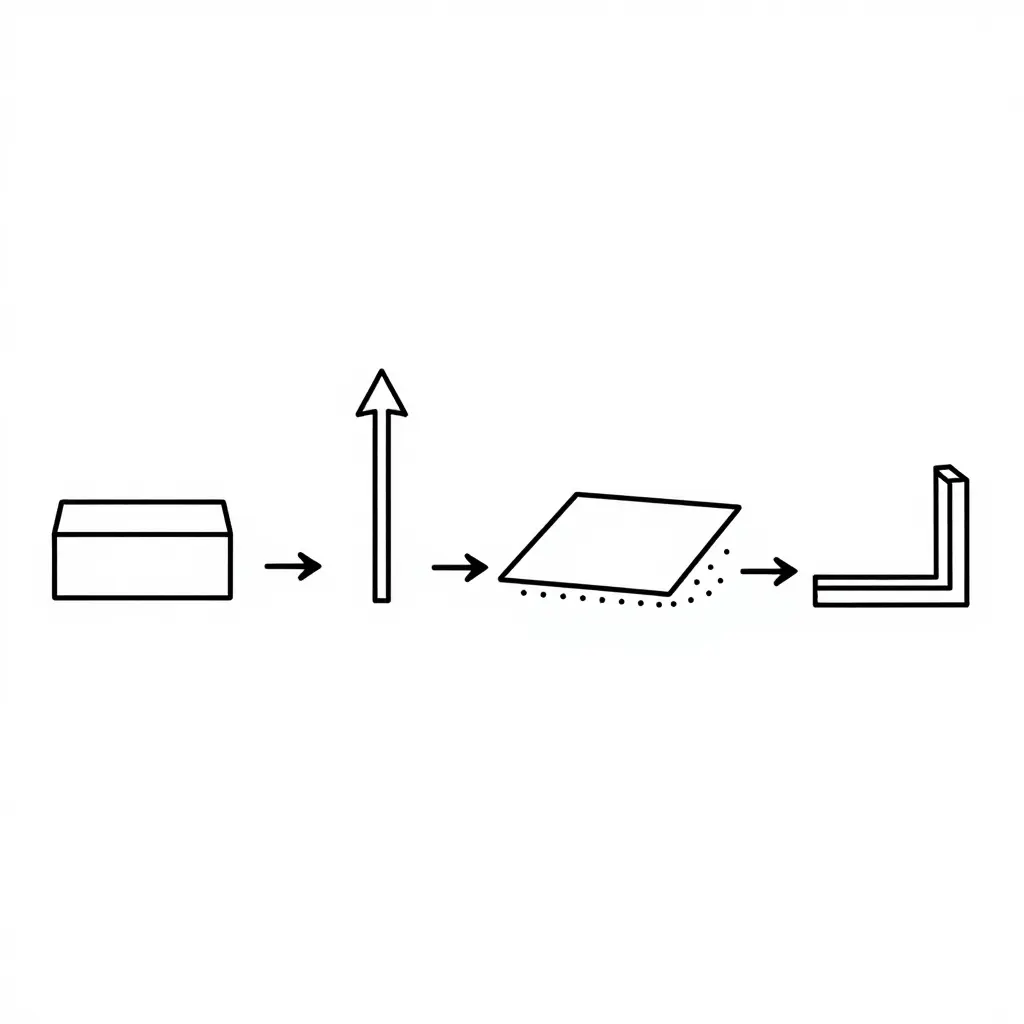
The illustration is deliberately unlabeled, which makes the mechanism easier to follow: four shapes, one direction of travel, one result. Read it left to right the way heat actually moves through a closed box.
- The closed box. A packed sushi box is a small saturated environment. Rice is still releasing steam and vinegar into a sealed cavity from the first minute of packing.
- The rising vapor. Vinegar vapor does not drift sideways and settle. It lifts. That single arrow is the whole driving force behind everything that follows.
- The lid panel. Vapor condenses on the coolest surface it meets, the underside of the lid. Where the lid meets the box wall, fibers take on moisture first, because that edge sits directly in the vapor path.
- The curled flange. A flange holds because its fibers are stiff and dry. Once the edge softens, the fold relaxes and the profile lifts slightly away from the wall, which is the small upward curl on the right. That lift is the moment grip is lost.
Why the Order Matters
| Stage | What the Shape Shows | Packaging Implication |
|---|---|---|
| 1. Box | A closed, warm cavity | Heat and moisture are trapped from the first minute of packing |
| 2. Vapor | A single upward arrow | Acetic acid vapor rises instead of dissipating |
| 3. Lid panel | Dots collecting along the inner edge | Board fibers at the edge absorb moisture and soften |
| 4. Flange | An L-profile with a slight upward curl | The softened fold loses tension and releases the box wall |
The sequence is cumulative, not reversible. By the time a flange visibly curls, softening has already traveled through the board edge, which is why vapor resistance has to be engineered into the paper before the box is ever filled rather than corrected after the fact. On a sample, the same chain works as a checklist: check liner moisture resistance, check edge sealing, check flange fold memory, and check that the lid still snaps tight after a 30-minute warm-hold test.
A lid that keeps its geometry through that window is doing real structural work, not just covering food. If you are specifying components for a kraft paper sushi program, it helps to compare paper box lids by board grade and edge treatment before locking in a format.
Sushi Packaging Specification Checklist: An Ordered Procurement Sequence
Rice vinegar vapor migrates upward and softens the lid flange exactly where it has to grip the box wall, so every requirement below targets that failure path. Work through the seven items in order: each step needs the evidence the earlier ones produce.
-
Set a minimum basis weight and caliper for the flange. Specify a board floor such as 300 gsm or higher, and apply the caliper requirement to the flange zone rather than the sheet average. Vapor softening attacks the thinnest section first, so a flange benchmark turns a subjective “feels sturdy” judgment into a repeatable incoming-inspection test.
-
Require sealed or dispersion-coated cut edges. Die-cut edges expose bare fiber that wicks condensate straight into the flange core. Sealing or dispersion-coating those edges lengthens the wicking path and keeps the rim from delaminating during a two-hour delivery window.
-
Request vapor uptake and stiffness retention data from the supplier. Ask for uptake percentage and retained stiffness after controlled humid exposure that mirrors sushi-service conditions. Curves let you compare grades objectively; a single hand sample judged in dry air does not.
-
Verify flange width against the box wall for secure seating. Measure the landed flange against the actual wall gauge and confirm a seating overlap with tolerance for board swell. A nominally wide flange with loose dimensional control lifts on one corner and vents moisture straight into the pack.
-
Confirm grease and moisture barrier compatibility with vinegared rice. Rice vinegar, soy sauce, and fats interact differently with each barrier chemistry, so validate the combination rather than each component in isolation. Ask for migration and barrier test data generated on the actual filled product.
-
Validate stack load performance for the intended distribution cycle. Run compression tests on filled boxes at your real pallet height, transit duration, and humidity profile. Short-duration compression on an empty box says little about a lid that has been absorbing vapor for six hours.
-
Confirm food-contact compliance documentation. Collect the current declaration of compliance, relevant migration test reports, and material safety data before the first shipment is released. Documentation gaps show up as customs holds and retail rejections rather than as visible quality defects.
Cost a specification like this against total cost of ownership, not unit price alone. A flange that softens early produces leaks, repacks, and credit notes that quickly outrun the few cents saved per piece, and a vendor who volunteers test curves up front usually carries fewer surprises into production. On landed cost per successful delivery, a stiff flange and verified compliance stop looking like premiums. Buyers comparing grades side by side can also review our paper boxes for takeout and delivery to benchmark board options before finalizing the purchase order.
Flange Stiffness Retention vs. Rice Vinegar Vapor Exposure Time
The chart tracks how quickly a flange loses grip once it is sitting above a warm, vinegar-heavy load. The uncoated kraft flange starts sagging after the first half hour; the dispersion-coated, sealed-edge flange holds most of its rigidity through the full two-hour window.
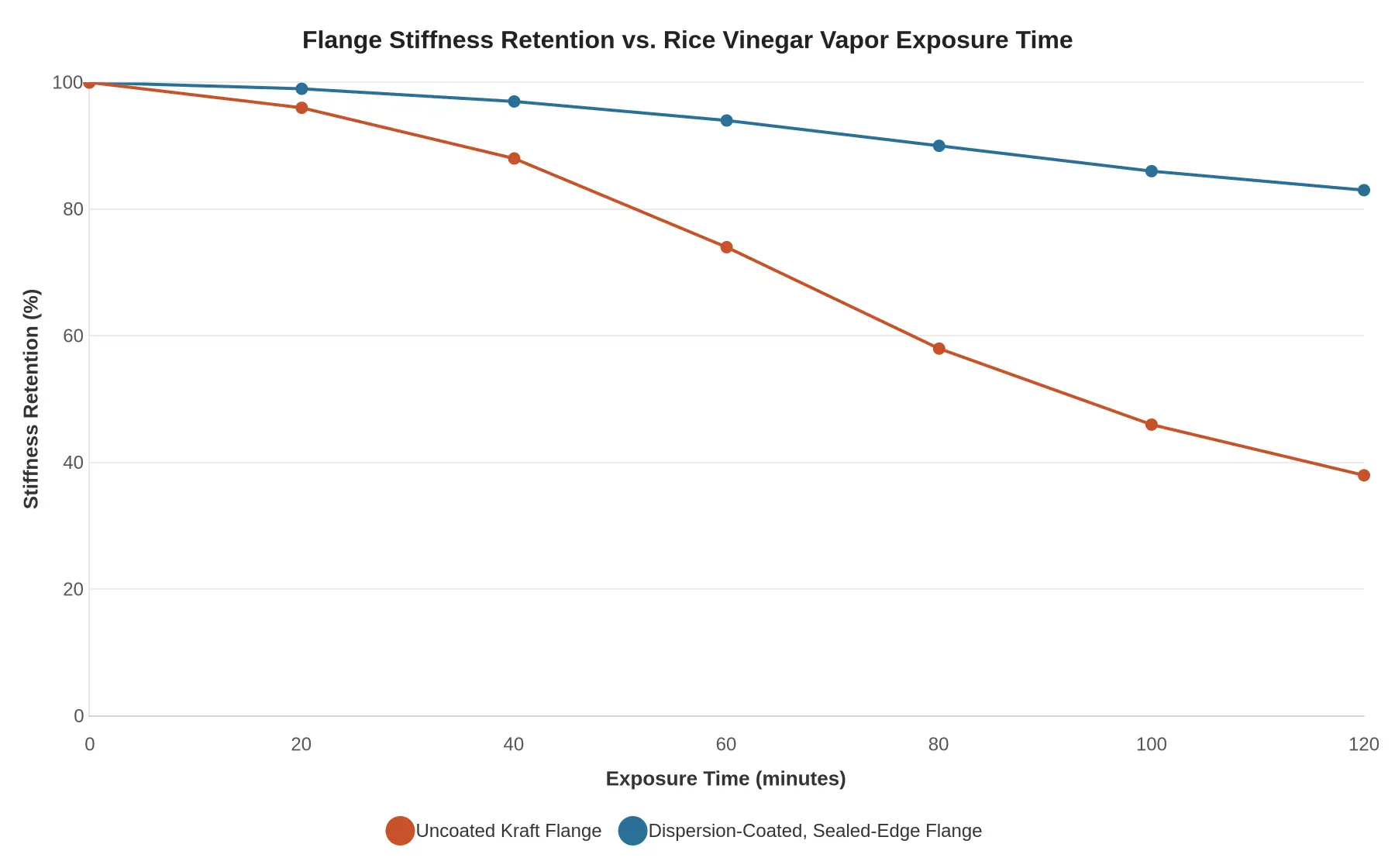
The divergence between the two curves defines the practical hold-time window for moisture resistance. Uncoated kraft is already below roughly 75% retention at the 60-minute mark, while the coated and sealed flange holds around 90% at the same point. Values are indicative benchmarks for specification discussion rather than certified test results.
What buyers should read into it
- The gap between the curves widens fastest between 40 and 80 minutes, which is exactly the range most delivery and pickup orders fall into.
- Coating alone helps, but sealing the cut edge matters just as much: vapor wicks through exposed fiber before it ever crosses the coated surface.
- For any menu item with warm rice, a vinegar-forward seasoning, or a sauce cup sitting directly under the lid, specify the coated and sealed flange and treat 90-120 minutes as the working ceiling before structural complaints start appearing.
When you compare suppliers, ask each one to state coating type, edge treatment, and basis weight against a hold-time target like this one. You can review our paper box formats to see how flange construction varies across the range.
Supplier Qualification: What B2B Buyers Should Verify in a Manufacturing Partner
Qualification for a disposable kraft paper sushi box should rest on documented process capability rather than on how a sample looks. The checks below apply to the sushi line and to the wider paper boxes range, and each one maps to a measurable attribute you can put in a supplier questionnaire.
Consistent board supply and basis weight control
The board carries every other performance claim. Confirm the specified basis weight and its permitted tolerance, the caliper, and the incoming moisture content, then ask how the mill source and board grade are controlled across production runs. A basis weight that drifts by a few grams per square meter changes stiffness, heat transfer during sealing, and how the lid flange responds to rice vinegar vapor over a two-hour delivery window. Suppliers running several product families, including disposable lunch box formats, usually hold tighter board specifications because they purchase against fixed grades rather than opportunistically.
In-house coating and edge-sealing capability
Ask whether the water-based or dispersion coating and the edge sealing are performed in-house. Outsourced coating complicates change control, because coat weight, cure temperature, and sealing dwell time cannot be verified at the point where the barrier property is actually created. In-house capability also means the converter can adjust packaging auxiliary materials, such as adhesives, release agents, and film laminates, against your specific food-contact and durability requirements.
Lot-level quality records
Require per-lot data rather than an annual certificate: coat weight, seal strength, basis weight, moisture content at packing, and the converting line used. Lot linkage is what lets a buyer isolate a deviation to a single batch instead of questioning the whole supply relationship.
Food-contact documentation
Request a current declaration of compliance, migration test summaries for the finished article, and explicit statements on recycled fiber content and barrier layers. The documentation should name the finished construction, not only the raw board.
Responsive technical support for specification changes
Specification changes are routine: a revised flange geometry, a different vent pattern, a heavier rice portion. Ask how quickly the supplier can re-run seal strength and vapor exposure trials, and who owns the technical answer. Suppliers who treat lids and closures as an engineered component rather than a commodity will state tooling lead times and trial windows in writing.
| Verification point | Evidence to request | Performance link |
|---|---|---|
| Board basis weight | Grade spec, tolerance, caliper | Flange stiffness, seal consistency |
| Coating | In-house line data, coat weight | Vapor and grease resistance |
| Edge seal | Seal strength range, dwell parameters | Lid retention in transit |
| Lot records | Batch-linked test reports | Traceability and claim support |
| Food contact | Declaration of compliance, migration summaries | Regulatory clearance |
| Technical support | Trial lead times, named contact | Change responsiveness |
Our own manufacturing practice prioritizes durability and eco-friendly material choices: fiber sources and coatings are selected so the box maintains structural integrity through chilled, ambient, and slightly humid handling, while remaining repulpable where the construction allows. Verify claims of that kind against the records above rather than against marketing copy.
FAQ
Why does rice vinegar vapor affect kraft paper more than other food moisture?
Rice vinegar is roughly 4-5% acetic acid in water, so its vapor carries water molecules plus volatile acid that condenses on any cooler surface, including the inside of a kraft lid. Condensed water on its own swells the sheet and breaks some fiber bonding. The dilute acid goes further, disrupting cellulose and hemicellulose bonding while the moisture swells the network. Uncoated kraft board is porous and hydrophilic, so the combination softens the lid flange faster than water-only condensate from warm rice or vegetables.
Does coating the lid surface fully prevent flange softening?
No coating stops the process completely; it only slows the rate of vapor uptake. A PE or water-based barrier layer improves moisture resistance across the face, but cut edges and score lines along the lid flange stay uncoated and remain direct entry paths for rice vinegar vapor. Coated lids hold stiffness noticeably longer, and still need adequate basis weight and controlled headspace to perform reliably.
What basis weight is suitable for a disposable kraft paper sushi box used in takeout?
For takeout sushi, 300-350 gsm kraft board is the common working range for lids, with 250-300 gsm acceptable on shallow boxes and short delivery windows. At the flange, bending stiffness matters more than thickness alone, so specify board with verified Taber stiffness; 350-400 gsm is often chosen for stacked or long-route deliveries. Combining a grease-resistant liner with the chosen basis weight keeps moisture resistance stable without excess weight.
How long can a kraft paper sushi box maintain flange stiffness after packing?
Under typical room conditions near 23 °C and 50% RH, an uncoated 300 gsm kraft lid flange starts measurably softening within 20-40 minutes of packing warm rice, with visible sag or loss of snap-fit tension often appearing by 60-90 minutes. With a barrier coating and rice cooled to below roughly 60 °C before lidding, usable stiffness can extend to 2-4 hours. Rice temperature, fill level, and ambient humidity dominate the result, so confirm timings with your own pack-and-hold test.
Is a lined plastic lid necessary instead of a kraft paper lid?
Not necessarily. For short hold times and cooled rice, a heavier-gauge kraft lid with a coated surface is usually sufficient and keeps the pack paper-based. A PET or PP lined lid becomes justified when hold times exceed about two hours, when rice is packed hot, or when the flange must carry repeated stacking load inside delivery bags. Compare kraft and lined formats side by side in our lid selection range, then decide from your hold-time data rather than assumption.
Lid Flange Softening Is a Specification Decision, Not a Limit Built Into Paper
When rice vinegar vapor softens the lid flange, the cause is a combination of material choice and structural design, and both are controllable. A flange absorbs condensed vapor faster than a flat panel because it is folded, edge-exposed, and usually the thinnest section of the lid. Each of those weaknesses has a matching point of control at the specification stage.
Sealing the edge restricts wicking into the exposed fiber where the lid meets the base. A food-contact barrier, whether a water-based dispersion or a PE/PLA layer, slows transmission across the flange and keeps the sheet above its critical softening threshold. Caliper buys structural reserve, so the same vapor load produces less deflection and the lid still seats cleanly.
For a buyer evaluating a disposable kraft paper sushi box, the practical move is to specify those three as a set rather than shopping on grammage or price alone. Edge sealing without a barrier coating, or a coating on lightweight board, leaves the flange exposed; the levers only work together.
Our manufacturing focus is on safety, durability, and eco-friendly packaging supply, with responsive support for specification questions.