
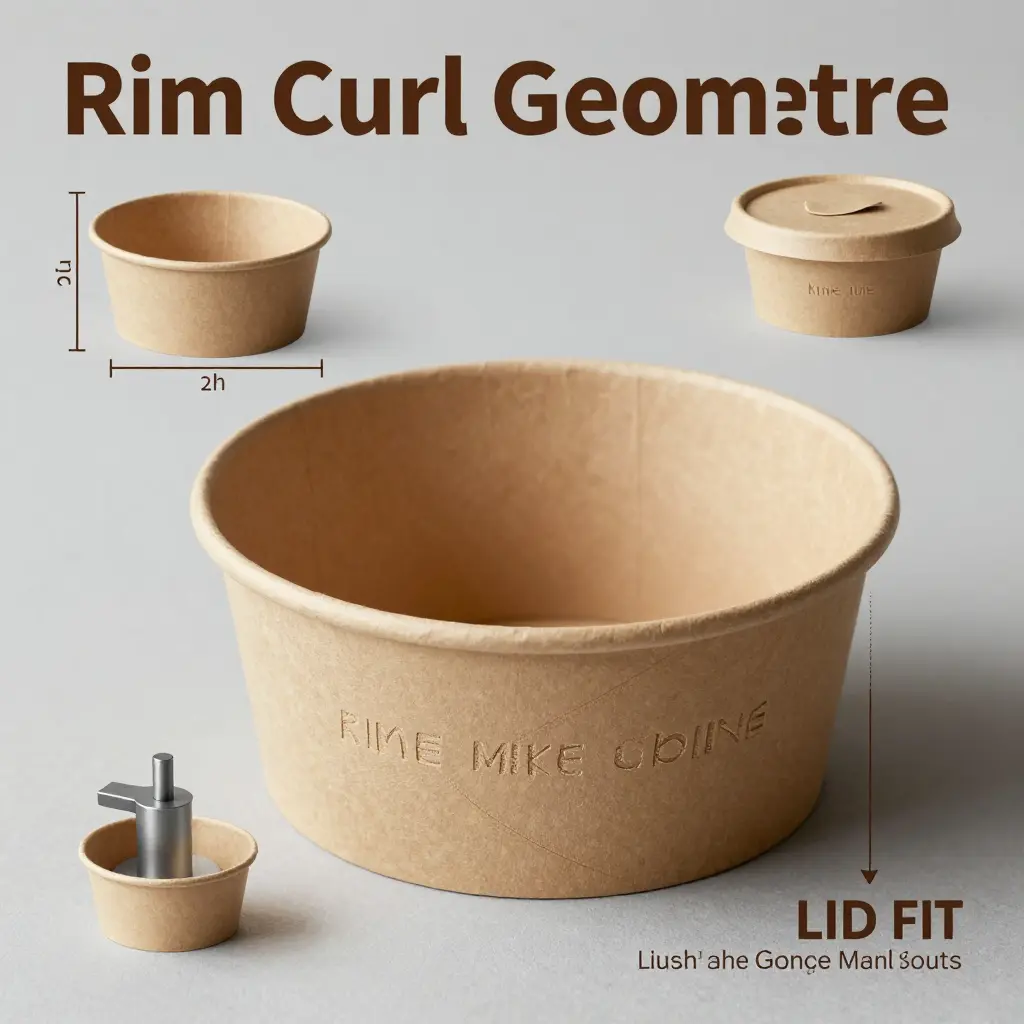
On a large paper bowl line, yield rarely dies from one dimension drifting on its own. It dies when the rim curl and the lid stop agreeing with each other. Most factories track rim curl consistency and lid fit as separate line items, but the two behave as one specification: move the curl, and the lid follows. The coupling is geometric. Lids are dimensioned against the curl rather than against the bowl body, so a drift of a few tenths of a millimetre in the curl changes the interference the lid has to overcome. The mismatch then shows up downstream as pop-off, leakage, unstable stacking, stopped lines and rework.
- Rim curl consistency: how repeatably the rolled rim is formed, with curl radius, curl height, curl thickness and curl circumference each held inside a defined band, unit to unit and lot to lot.
- Lid fit: whether a paper bowl lid seats, snaps and seals on that curl, judged by seating force, snap engagement and seal integrity after filling and lidding.
Rim Curl Geometry and Tolerance Windows
A large disposable bowl’s rim is a rolled edge: two to four paper plies plus the coating layer. Five dimensions decide whether a lid engages it: curl diameter, curl height, curl thickness (ply count plus coating caliper), curl roundness, and the radius where the curl meets the wall. All five act against the lid skirt channel at once, so one value outside its window can defeat a design that is otherwise sound.
Over-rolling causes more failures than under-rolling. Once the curl grows past its nominal outside profile it crowds the lid channel, the snap bead cannot clear the curl shoulder, and the operator feels a hard stop where the click should be. An under-rolled curl leaves radial clearance instead: the lid seats loosely, lifts under load and leaks at the seam.
Tolerance stacking decides which way that goes wrong. Curl diameter, lid channel radii, wall thickness and curl radius tolerance accumulate; skew the combined band tight and you get interference and cracked skirts, skew it loose and you get clearance, wobble and lids that will not reseal. Fit is held by window control, not by matching nominals. The dimensions we publish for our paper bowl lids show what a matched window looks like.
Rim Curl Parameters vs Lid Fit Outcome
The table anchors curl geometry to measurable lid performance. Values assume a pressed or rolled PE/PLA-coated bowl in the 150-210 mm top-diameter class, measured with a digital caliper and optical comparator at 20 +/- 2 C. Treat them as starting tolerances to negotiate with your supplier rather than universal absolutes, and note that the drawing windows below are deliberately tighter than the +/-0.25 mm band where lids stop tolerating curl drift on the chart further down.
| Parameter | Typical Specification Window | Direction of drift (failure level) | Resulting Lid Fit Failure |
|---|---|---|---|
| Curl outer diameter | Nominal bowl OD, e.g. 190.0 mm, +/-0.15 mm | Oversized (+0.30 mm and up) | Radial interference; skirt stretched over the curl; snap force spikes; stress cracking at skirt root; lid crowns instead of seating flush |
| Curl outer diameter | Nominal bowl OD, e.g. 190.0 mm, +/-0.15 mm | Undersized (-0.30 mm and up) | Radial clearance; lid skirt under-engages; low retention force; lid lifts in transit or leaks at the seam |
| Curl height | 3.0-4.5 mm; +/-0.20 mm | Low (<2.8 mm) | Reduced seal land; micro-leak path at lid panel contact |
| Curl height | 3.0-4.5 mm; +/-0.20 mm | High (>4.8 mm) | Lid panel held off rim; rocking fit; poor stacking nest |
| Curl thickness (rolled ply) | 1.2-1.8 mm; +/-0.10 mm | Thick (>1.9 mm) | Skirt cannot clear curl; partial snap; visible white stress marks |
| Curl thickness (rolled ply) | 1.2-1.8 mm; +/-0.10 mm | Thin (<1.1 mm) | Curl collapses under press force; hoop strength loss; leak at 6 o’clock |
| Curl roundness / ovality | Ovality <=0.25 mm on diameter | >0.35 mm | One-sided seating; crescent gap; cap wobble on chilled or hot fills |
| Curl seam overlap | 3.0-5.0 mm overlap; +/-0.5 mm | Low (<2.5 mm) | Curl opens at side seam; step catches lid skirt; seal breach |
| Curl seam overlap | 3.0-5.0 mm overlap; +/-0.5 mm | High (>6.0 mm) | Local bulge at seam; lid distorts on entry; uneven removal force |
| Bowl top diameter | Nominal, e.g. 190.0 mm, +/-0.20 mm | Over (+0.40 mm) | Radial interference; excessive press force; lid flange buckling |
| Bowl top diameter | Nominal, e.g. 190.0 mm, +/-0.20 mm | Under (-0.40 mm) | Radial gap; insufficient interference; lid dislodges under side load |
| Curl roll angle / profile radius | 180-240 degrees; R 1.5-2.5 mm | Profile flat or under-rolled | Skirt rides over curl instead of locking; false snap sensation |
Each row is a failure chain: the parameter drifts, the direction of the drift matters more than its absolute size, and the lid symptom names the window that was missed. When you match bowls to lids and closure options, confirm the curl OD and height windows against the lid skirt geometry drawing before tooling is approved, not after the first production run.
Curl OD and bowl top diameter also move together. A supplier quoting tight OD control but loose top-diameter control is effectively quoting nothing. Ovality is the quieter variable: a bowl can sit inside every diameter tolerance and still fail lid fit if the curl is elliptical, because the skirt needs only about 0.3 mm of local mismatch to leak.
Where Rim Curl Consistency Is Won
Curl consistency comes out of a handful of variables that drift through every production run, and operators have to hold them together:
- Forming tool condition: curl dies wear at the radius, gradually widening the curl throat.
- Curling roller pressure and alignment: skewed or under-pressured rollers create ovality and spring-back.
- Paperboard calliper variation: thicker stock resists bending and returns a larger curl diameter.
- Moisture content: dry board cracks, damp board collapses.
- Coating and lamination during heat rolling: adhesive softening and film stiffness change how the curl sets.
Tool wear is progressive, so curl diameter creeps outward across a run: accurate at start-up, marginal by mid-run, outside the lid-compatible window by the final pallets. Periodic tool inspection with first-off and last-off sampling maps the drift while it is happening, so offsets get corrected before rejects accumulate.
Machine speed stability finishes the picture. Speed surges change dwell time in the heat-rolling zone, and curl uniformity reacts immediately. Checked against your lid and closure specifications, these controls are what keep a batch stackable and sealable.
Curl Outer Diameter Deviation vs. Cumulative Production Hours
Rim curl consistency depends on how worn the tooling is, not on what the die drawing says. The chart below tracks the outer diameter deviation of a paper bowl curl, in millimetres from nominal, across a 16-hour cumulative production window. Two runs are compared: one produced continuously with no mid-run tool adjustment, and one produced with scheduled tool inspection and adjustment at fixed intervals.
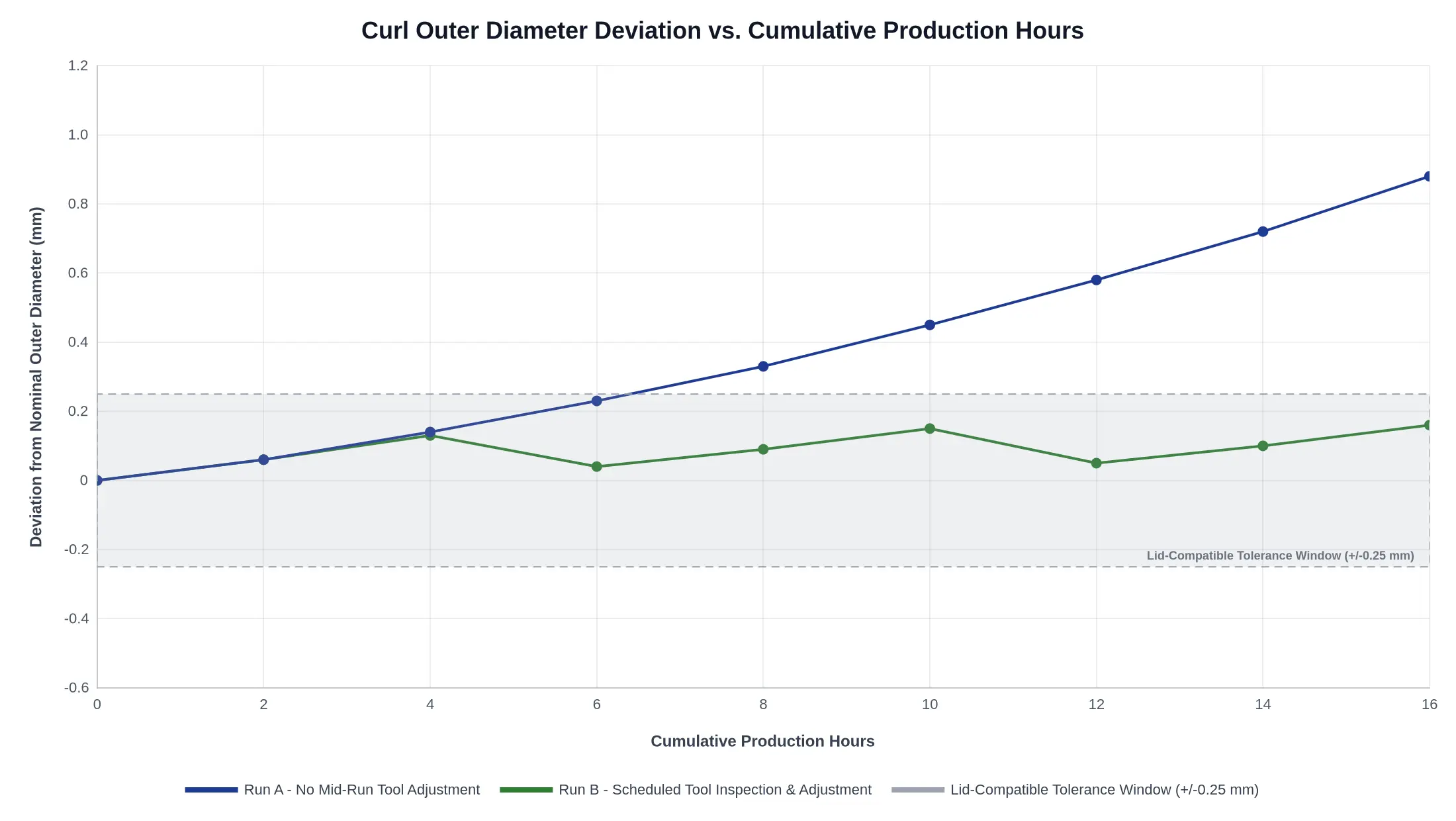
Chart: Curl Outer Diameter Deviation vs. Cumulative Production Hours. Horizontal axis, cumulative production hours; vertical axis, deviation from nominal outer diameter in mm. Legend: Run A – No Mid-Run Tool Adjustment; Run B – Scheduled Tool Inspection & Adjustment; Lid-Compatible Tolerance Window (+/-0.25 mm).
One run drifts, one run holds
The unadjusted run behaves the way worn tooling always behaves: it drifts, and the drift accelerates. From a nominal start the curl grows 0.14 mm by hour 4, 0.33 mm by hour 8, and 0.88 mm by hour 16. The lid-compatible tolerance window, drawn as the dashed band at plus or minus 0.25 mm, is breached between hours 6 and 8. Everything made after that point is a dimensional reject in waiting, even though the bowls may look perfectly acceptable on the line.
Run B never gets that far. Each scheduled inspection resets the forming geometry before accumulated wear pushes the curl out of range, and the result is a controlled sawtooth that peaks at 0.16 mm and never approaches the band edge. The purchase order is therefore only as reliable as the tool maintenance schedule standing behind it.
| Cumulative Hours | Run A Deviation (mm) | Run B Deviation (mm) | Within Lid Fit Window? (Run A / Run B) |
|---|---|---|---|
| 0 | 0.00 | 0.00 | Yes / Yes |
| 2 | 0.06 | 0.06 | Yes / Yes |
| 4 | 0.14 | 0.13 | Yes / Yes |
| 6 | 0.23 | 0.04 | Yes / Yes (adjustment) |
| 8 | 0.33 | 0.09 | No / Yes |
| 10 | 0.45 | 0.15 | No / Yes |
| 12 | 0.58 | 0.05 | No / Yes (adjustment) |
| 14 | 0.72 | 0.10 | No / Yes |
| 16 | 0.88 | 0.16 | No / Yes |
Tool wear drives a gradual, accelerating drift in curl diameter that eventually leaves the lid fit window, and only scheduled tool inspection and adjustment keeps the curl inside that window across a full production run.
For buyers auditing a supplier, this is one of the clearest process controls to ask about directly. Requests for dimensional capability data, tool change logs and in-process inspection frequency belong in the same conversation as sample approval, and they pair naturally with a review of the matching lids and closure systems that must seat against the finished rim.
Lid Fit Mechanics and Seal Performance
Lid fit begins where the lid skirt slides over the rim curl. The skirt channel depth must slightly exceed curl height, so the lid seats before the bead engages. The internal snap bead is moulded a little smaller than the curl diameter, and that radial interference compresses bead and curl together, converting elastic strain into retention force and spreading sealing pressure across the contact area.
The trade-off runs along a balance curve. A tighter snap fit raises leak resistance but increases application force and the risk of curl deformation; a looser snap applies easily yet retains weakly and invites pop-off. Neither extreme is better everywhere, and the target is a controlled interference window matched to the specified curl.
Interference is never uniform around a large bowl, because curl thickness varies around the circumference. Wide thickness bands widen the pressure spread, so consistent curl gauges keep sealing contact predictable. Buyers can check compatible lids and closures against the curl gauge they actually receive rather than against a nominal diameter.
How a Rim Curl Seats Inside a Lid Channel
Whether a lid fits is settled by four numbers, not by design opinion: curl outer diameter, curl height, lid channel depth, and the snap interference zone where the curl’s outer edge presses into the channel’s inner wall. Hold all four inside tolerance and the lid clicks down, stays down and releases at a predictable peel force. Let one drift and the failure appears on the filling line rather than in the lab.
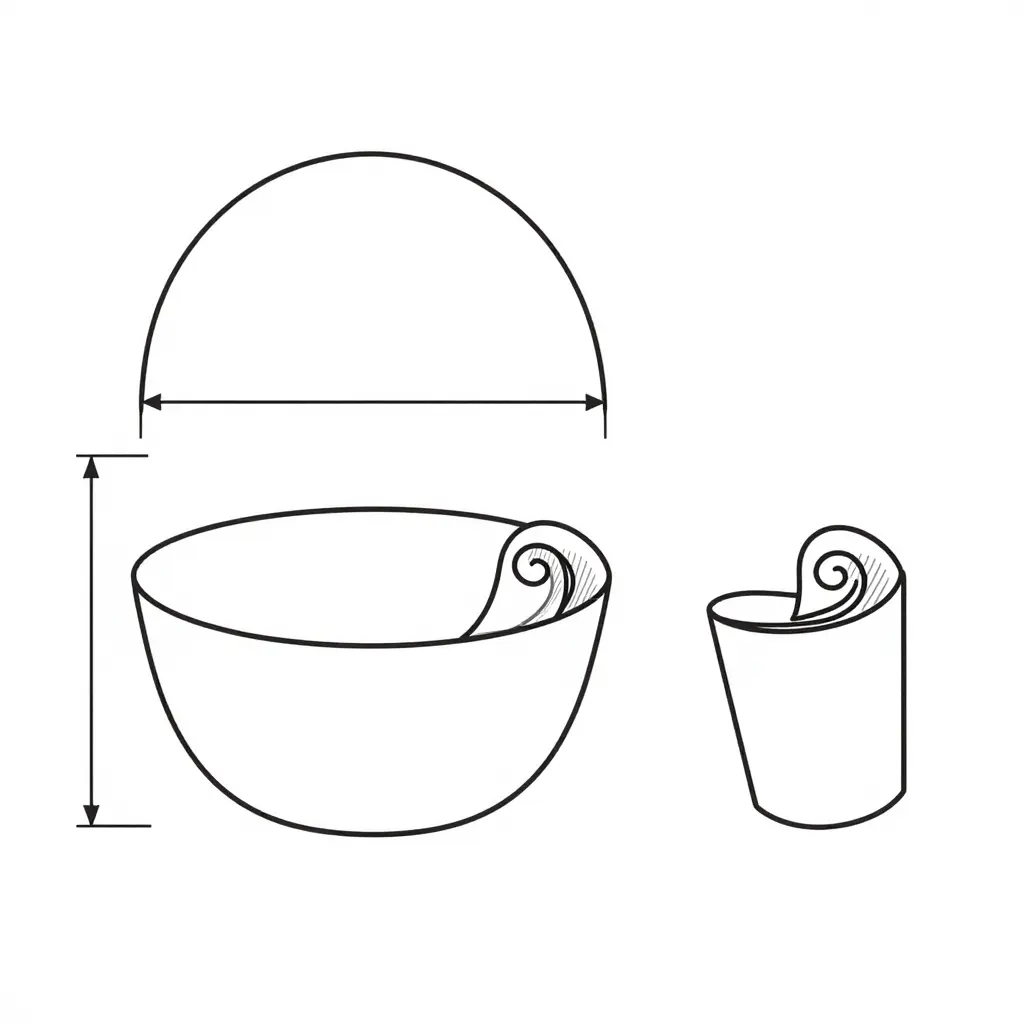
Figure: Cross-section schematic of rim curl seating in a lid skirt channel, with the snap interference region indicated, and companion views of over-rolled and under-rolled curl failure modes.
The interference region between the curl and the channel wall is the entire mechanism behind lid fit, which is why curl diameter and channel depth have to be specified together rather than independently.
Over-rolled and under-rolled curls
The smaller companion cross-section is the one to reach for when troubleshooting. On the left, an over-rolled curl exceeds the channel mouth opening: the lid crowns, will not seat flush, or splits along the skirt when force is applied. On the right, an under-rolled curl is undersized against the channel, so the lid rests loose with a visible gap; it leaks, lifts in transit, and reads as a cheap package in the customer’s hand. Both conditions usually trace back to the same process variables on the bowl-forming machine, which is why quality teams measure curl consistency as a distribution rather than an average.
For spec sheets and supplier comparisons on compatible closures, see our paper bowl lid range; matching a lid to a documented curl profile is the fastest way to clear fit complaints at case level.
Incoming Inspection Sequence for Rim Curl and Lid Fit
- Dimensional check: measure curl outer diameter and height against the drawing. This is the step that catches the bowls which would have failed to match a lid.
- Roundness/ovality: compare maximum and minimum curl diameter against the set limits. Ovality hides press-tool wear and shows up later as one-sided seating.
- Curl thickness and overlap: verify both. An overlap outside its window weakens the seal and raises leak risk.
- Visual and tactile check: look and feel for cracking, delamination or rough edges before they turn into customer complaints.
- Lid application and removal force: snap and peel sample lids inside an agreed force range; outside it, lids are either loose or hard to open.
- Seal integrity test: run a hold-and-leak check on filled samples and require zero seepage, or expect spoilage and returns.
- Post-exposure fit verification: re-test after a defined open time and temperature cycling. Fit has to survive storage, not just the end of the line.
Failure Modes and Root-Cause Mapping
Every observable lid fit failure traces back to two variable families: bowl-side rim geometry and the converting process that formed it. Curl deformation and tolerance stacking interact, so each symptom below is paired with its most probable curl cause and its most probable process cause.
| Failure state | Probable curl-related cause | Probable process cause |
|---|---|---|
| Lid not seating fully | Curl diameter oversize or out-of-round | Inconsistent rim forming-roll pressure |
| Lid seats, lifts after fill | Curl angle or height drift reducing engagement | Uneven heat and moisture uptake softening the rim |
| Leakage at the seal | Curl radius too tight, poor concentricity | Variation in coating coverage or curl lubricity |
| Lid cracking at the skirt | Excessive curl thickness or burr | Trim and curling-die wear |
| Stacking instability of lidded bowls | Curl height variation between cavities | Uneven stacking-lug pressure after curling |
Because these mechanisms overlap, a single symptom rarely identifies a single culprit. Reading lid and channel specifications next to the curl measurements makes the distinction visible, and failure analysis has to separate bowl-side curl variation from lid-side channel variation before any tooling change is authorised.
Lid Fit Defects by Root Cause Category
Once you know how a lid fails on a large paper bowl (snapping loose, seating with a visible gap, lifting under stack load), the next question is where the defect entered the process. Break lid fit defects down by root cause and the distribution comes out lopsided, pointing away from the component most buyers blame first.
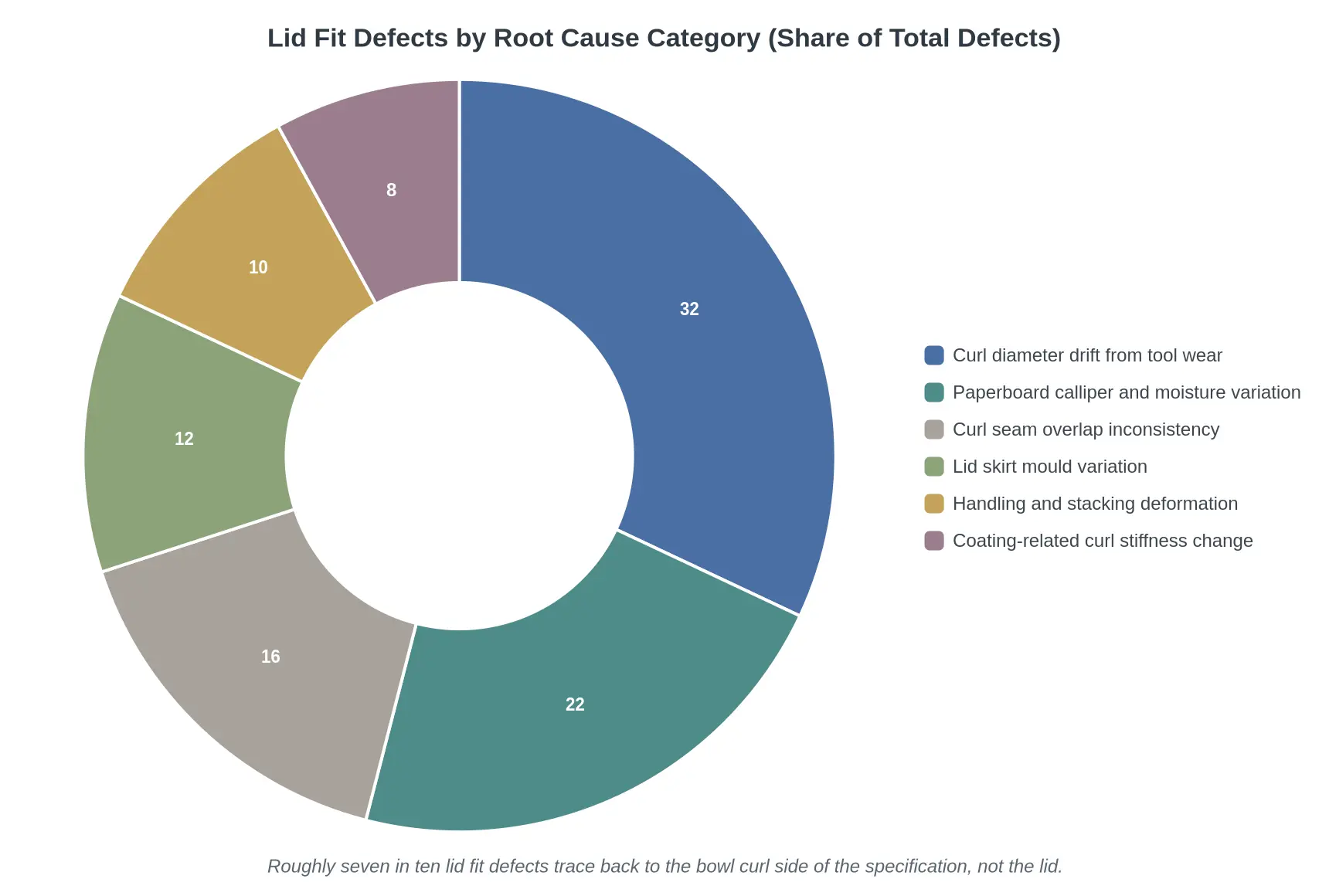
Roughly seven in ten lid fit defects originate on the bowl curl side of the specification, not on the lid itself.
What each slice contains
The chart splits observed lid fit defects across six root cause categories. Each slice is the share of total defects attributed to that cause during controlled dimensional audits of bowl-and-lid pairs:
- Curl diameter drift from tool wear (32%) – the largest single contributor. As curl tooling wears, the rim diameter creeps outside its window, and the lid either fights the curl or sits slack on it.
- Paperboard calliper and moisture variation (22%) – board that is slightly thicker, thinner, wetter or drier curls to a different final diameter even when the machine settings never change.
- Curl seam overlap inconsistency (16%) – an overlap that shifts along the seam leaves a local high spot, so a lid that seats cleanly on most of the rim catches on one arc.
- Lid skirt mould variation (12%) – cavity-to-cavity differences in the skirt height and undercut geometry of the lid itself.
- Handling and stacking deformation (10%) – ovality introduced after curling, during conveying, sleeving and palletising.
- Coating-related curl stiffness change (8%) – barrier and print coatings alter the spring-back behaviour of the rim, changing how much interference the lid actually feels.
Mapping Each Cause to Its Source
The split is useful because it says where to look first when a defect appears. Each category below is paired with the side of the specification it originates on and the earliest practical point of detection.
| Root cause category | Share of defects | Originates on | Earliest reliable detection point |
|---|---|---|---|
| Curl diameter drift from tool wear | 32% | Bowl curl | In-line diameter gauging at the rim |
| Paperboard calliper and moisture variation | 22% | Board substrate feeding the curl | Incoming board testing for calliper and moisture |
| Curl seam overlap inconsistency | 16% | Bowl curl seam | Dimensional and visual audit at the seam |
| Lid skirt mould variation | 12% | Lid | Per-cavity sampling of skirt geometry |
| Handling and stacking deformation | 10% | Post-curl logistics | Carton and pallet audit at packing |
| Coating-related curl stiffness change | 8% | Bowl curl, coating interaction | Curl stiffness and spring-back testing |
Why the Bowl Curl Side Dominates
Add the three direct curl categories together and you get 70% of all lid fit defects. Include the coating-driven stiffness change and the figure climbs to 78%. That is not an artefact of sampling. The lid is a stable injection-moulded or thermoformed part; the curl is a formed paper geometry that creeps, springs back and answers to humidity. Fit is therefore governed mostly by how tightly the curl diameter is held, not by how precisely the lid was moulded.
A common misdiagnosis follows from this. A buyer receives a pallet of loose-fitting lids, contacts the lid supplier and asks for a tighter skirt. The supplier holds its geometry, the problem survives, and weeks disappear. Measuring the bowl rim diameter first usually settles the question in an afternoon.
Turning the Split Into a Purchasing Checklist
If 70% of the risk sits on one side of the assembly, that is where specification effort belongs. When qualifying a large paper bowl supplier, ask for:
- A stated curl diameter tolerance with the process capability figure behind it, not just a nominal dimension.
- Gauge frequency and calibration records for the in-line rim measurement.
- A tool wear schedule for curl tooling, including the diameter drift limit that triggers replacement.
- Board calliper and moisture specifications measured at the point of curling, not only on receipt.
- A defined seam overlap window with the audit method used to confirm it.
- Stacking and palletising limits agreed in writing, so ovality is not introduced after the rim leaves the machine.
Pairing those numbers with a tightly toleranced lid range is the shortest route to a fit that holds up in the field rather than only on the line. Buyers comparing matching lids and closures alongside bowl specs can usually spot an incompatibility before the first pallet ships, by checking whether both sides of the specification were written to the same reference diameter.
Writing a Measurable Rim Curl and Lid Fit Specification
Write the specification against measured geometry, not nominal bowl size. A “large paper bowl” ordered as 1,000 ml tells a paper bowl factory nothing about the curl. Specify curl outer diameter and curl height with explicit upper and lower limits, plus the gauge type and datum used to measure them: for the 190.0 mm class that means +/-0.15 mm on curl diameter and a curl height of 3.0-4.5 mm held to +/-0.20 mm.
Require lid fit to be verified against the curl lot actually supplied rather than against a retained reference sample, and require lot-level sampling data with each shipment: sample size, AQL and measured values. Both parties have to use the same method and gauge. A bowl order and a lid order placed separately, with no joint lid fit specification, leave a responsibility gap: each supplier passes its own inspection while the assembly fails, and deviations fall between two contracts rather than inside one of them.
Review disposable bowl dimensions and lid specifications as reference formats for building the shared document.
FAQ: Rim Curl Consistency and Lid Fit
What tolerance should a buyer require on rim curl diameter for a large paper bowl?
For the 190.0 mm bowl class, +/-0.15 mm on curl outer diameter and +/-0.20 mm on a curl height of 3.0-4.5 mm, measured with a stated gauge. Tighter limits raise scrap rates; looser limits eat the interference the lid needs. Confirm the numbers in writing with your supplier before tooling approval.
Can a lid be matched to a bowl from a different factory with the same nominal size?
Rarely. Nominal size does not guarantee interchangeable rim curl geometry, because curl radius, curl height and paperboard thickness all come from the tooling. A lid from another factory usually needs re-testing, so compare matching lid options against the actual curl drawing before assuming compatibility.
Is curl variation caused by the paperboard or by the forming tool?
Both, with tooling dominating. Worn or misaligned curling dies create the largest swings in rim curl diameter, while inconsistent paperboard caliper and moisture add a secondary layer of variation. Control the incoming board specs and keep die maintenance on schedule if you want a stable paper bowl rim.
How is lid fit tested before bulk production?
Run a pilot lot of at least 200 bowls. Measure rim curl diameter with a laser or go/no-go gauge, then apply lids by hand and by machine, checking snap force, seal integrity and leak resistance. Record pass rates and agree the limits before mass production.
Does curl consistency change with storage time and humidity?
Yes. Paperboard absorbs moisture, so rim curl can relax or distort while cartons sit in humid warehouses. Keep storage below 60% relative humidity, stack cartons flat and use stock on rotation; otherwise lid fit tightness drifts between production batches and delivery dates.
Closing: Curl Consistency as a Procurement Specification
Lid fit is an outcome of the whole assembly. Rim curl consistency on the bowl side and channel consistency on the lid side decide whether the two parts close reliably, and neither can be specified in isolation. For procurement that reduces to three statements. Dimensional specifications should carry curl and channel tolerances as acceptance criteria, not nominal values. Qualification should test bowl and lid as a mated pair. Lot-level inspection data (curl height, roundness, channel depth) should travel with each shipment as the evidence trail.
Buyers auditing a paper bowl factory can review stackable bowl and lid ranges for mated-fit documentation. Where branded lids are used, rim curl consistency and print registration belong in one control plan. Specification discipline, applied to both components at once, is what keeps lid fit stable across lots.