
Closure Choice Decides Bread Freshness
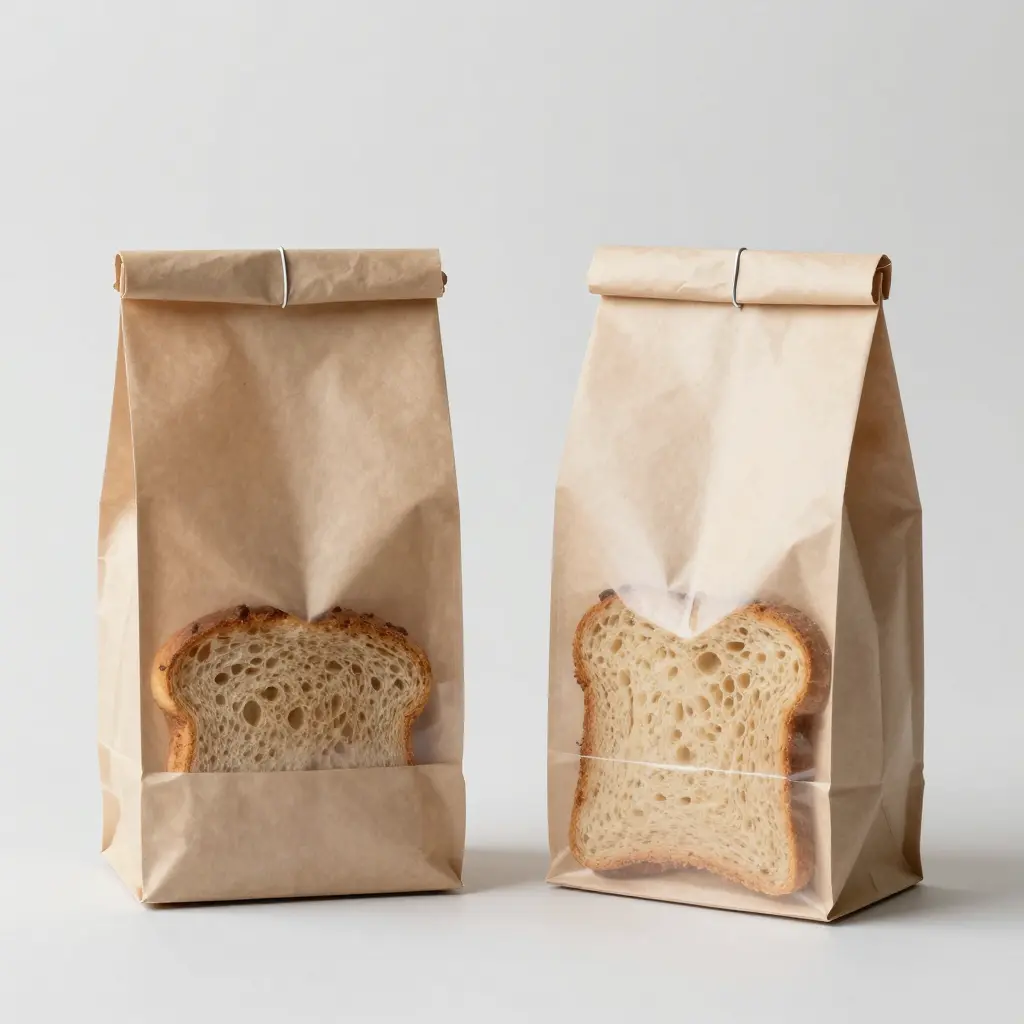
The closure on an OEM paper bread bag is one of the few shelf-life variables a bakery buyer controls directly. This guide compares the two formats most wholesale bakeries specify: the tin tie, a coated tape strip with two flexible wires bonded into the bag mouth, and the fold over, where the top of the bag is folded down on itself and sealed by the fold. A plain fold over adds no hardware; some bags add a glue strip or tape tab when the seal has to survive transport unopened.
Both formats run in large volumes through wholesale bakeries, private-label converters, and cafe suppliers, yet they behave differently once a bag leaves the line. Each sets how much air and water vapor can move through the open mouth of the bag, and that in turn affects crust texture, crumb softness, and how long a loaf stays saleable. Recipe, cooling practice, and storage conditions matter as much as the closure does; the closure is simply the part the packaging buyer decides.
Below we explain how each closure controls airflow and moisture migration, then how to match one to bread type, distribution cycle, and handling. The wider paper bag range shows the formats and printing options available. The comparison runs on six points that recur throughout: seal integrity, resealability, unit cost, line speed, print area, and shelf-life fit.
How Closure Type Affects Bread Freshness
Two failures work against a loaf at the same time. Freshly baked bread is a moisture gradient, a humid crumb inside a dry crust, and that imbalance drives what follows. Water migrates outward from crumb to crust, while the starch that gelatinized in the oven begins to retrograde, crystallizing and releasing water from its own structure. The crumb firms up and turns dull and crumbly. Some moisture loss is unavoidable; the rate at which it happens is partly under your control.
The second failure is trapped humidity. Seal a warm loaf into a barrier with no vent and the water leaving the crumb has nowhere to go. It condenses on the cool inner surface and on the bread itself, softening a crisp crust and creating the damp microclimate mold spores need. The outcome flips from dry bread to soggy or spotted bread, which is why an unvented barrier makes warm packing worse rather than better.
Paper sits between those extremes. It is a fibrous, microporous sheet rather than a film: water vapor moves through it slowly, so the inside of the bag drifts toward ambient humidity instead of being sealed off. That measured exchange is why a paper bread bag closure can work with the physics rather than against it, releasing vapor while still shielding the loaf from drafts and the dry air of a retail shelf. On custom printed bread bags, the printed surface is the visible layer and the fiber structure does the work.
The closure sets the aperture. Every fold, crimp, or tie decides how much open area remains at the mouth of the bag, and that opening acts as the throttle on vapor exchange. A loose fold leaves a wide, shifting gap that dries the exposed top of the loaf unevenly. A closure that presses the paper flat against itself narrows the pathway to a small, repeatable leak.
Repeatability matters more than maximum tightness. A closure that re-closes to the same tension every time, whether a tin tie folded along the same crease or a fold over pressed to the same line, dries the crumb at a predictable rate while still letting vapor escape. The goal is to meter moisture out, not to lock it in. Too tight and condensation pools against the crumb; too loose and the crust toughens overnight.
Specify the closure as a shelf-life decision, not a finishing detail. Match the format to your shelf-life target and to how your customers handle the bag. If you are weighing formats for a retail or wholesale line, compare paper bread bags and closure styles side by side before committing to a print run.
Tin Tie Closure: Repeatable Sealing Power
A tin tie closure is simple engineering. A strip of coated tape is folded over the mouth of the bag and bonded into the paper fold, and inside the tape run two malleable wire strips, parallel along its length. The wires bend easily and hold the bend, so the packer or shopper folds the bag mouth over, presses the tape down, and the wires hold the paper in a dead fold across the full width of the bag. An adhesive tab loses its grip once it picks up flour dust or crumbs; a tin tie can be opened and pressed shut repeatedly.
For bread freshness, the value lies in that repeatability. The seal comes out the same width every time, so the fold line does not drift the way a hand-pressed crease can. Bags that get stacked, squeezed, and rummaged through on a shelf also recover their shape instead of staying creased open. That matters for sliced loaves, where dozens of exposed crumb faces give up moisture quickly, and for multi-day retail display, where staff and customers may open the bag repeatedly before the loaf sells.
The trade-offs are real. Unit cost runs higher than a plain fold over, because you are paying for tape, wire, and an extra converting step. Machine compatibility is not universal: tin tie applicators have to be specified on the line, and retrofitting existing equipment is rarely a bolt-on change. The tape also takes print area, so brand graphics and required labeling have to be planned around the strip rather than across the full bag face. Tin tie underperforms on ultra-high-speed runs where cycle times favor adhesive or heat-sealed closures, on very crusty artisan loaves whose rigid crust fights the fold, and in recycling streams where the wire must be separated from the paper. Buyers sourcing packaging auxiliary materials should confirm tape width, wire gauge, and print specifications early, since these details decide whether a tin tie design works on both the sealing machine and the shelf. Where customers reopen a bag many times, tin tie is the stronger choice; where speed and unit cost dominate, fold over usually wins.
Fold Over Closure: Simple, Economical, Effective
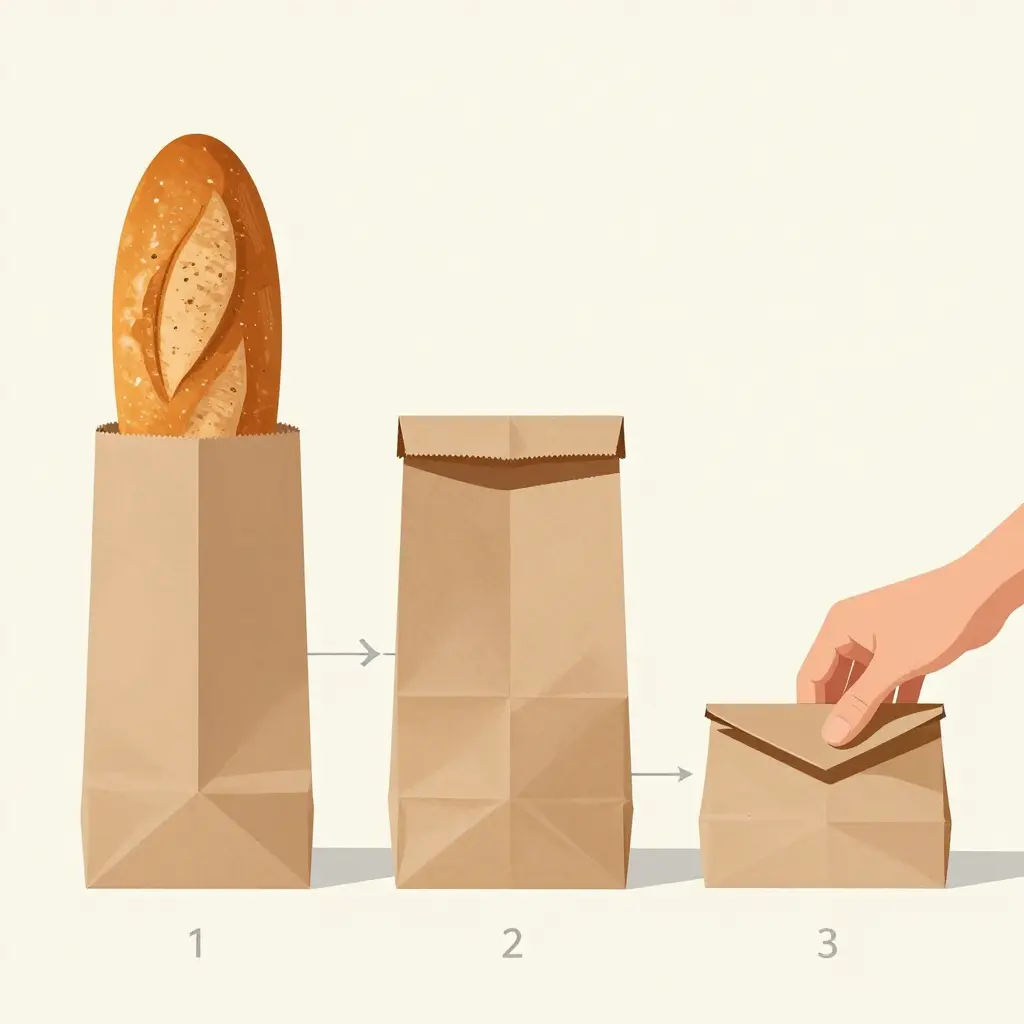
A plain fold over closure adds nothing to the bag: no glue, no wire, no extra component. The bag arrives with a flat top. The packer gathers the top edge, folds it down two or three times, and presses the crease. Some fold-over bags are supplied with a glue strip or tape tab for a permanent seal, but the standard version relies on the fold alone.
How the Seal Works
The seal is mechanical, not adhesive. Paper-on-paper friction holds each folded layer against the next, and the fold geometry adds stiffness at the crease, so the top resists springing open. A tight, sharp crease in mid-weight kraft paper gives the best hold. A loose crease gives almost none.
That is why a paper bread bag closure of this type is judged by the crease as much as by the material. Heavier paper and a well-placed dead-fold line improve grip. Thin paper with a soft fold tends to creep open within hours.
Where It Wins
- Lowest unit cost. No tin tie, no tape, no adhesive strip. The closure is the bag.
- Fast packing. One motion, one hand. No threading or twisting.
- Full print panel. The top stays flat and uninterrupted, so branding can run to the edge. Buyers sourcing printed bags can review custom packaging printing options to plan artwork around the fold line.
- Easy automation. Standard bagging lines fold and press without extra hardware.
Where It Falls Short on Freshness
Seal quality depends on operator technique: two workers on the same shift produce two different seal strengths. The fold also loosens each time the bag is opened, so reclosure weakens with use. Tall loaves and heavy loaves strain the fold and open faster.
Best-Fit Products
Fold over works best for artisan loaves sold the same day. Crusty sourdough, baguettes, and rustic boules go home within hours, so the shorter freshness window rarely matters. For multi-day shelf life or heavy sandwich loaves in bakery packaging, a tin tie usually seals more consistently.
Side-by-Side Diagram: How Each Closure Actually Seals
Comparing the mechanics settles more than comparing claims does. The schematic below puts both bag tops side by side so you can see what is actually happening when a closure is “closed.”
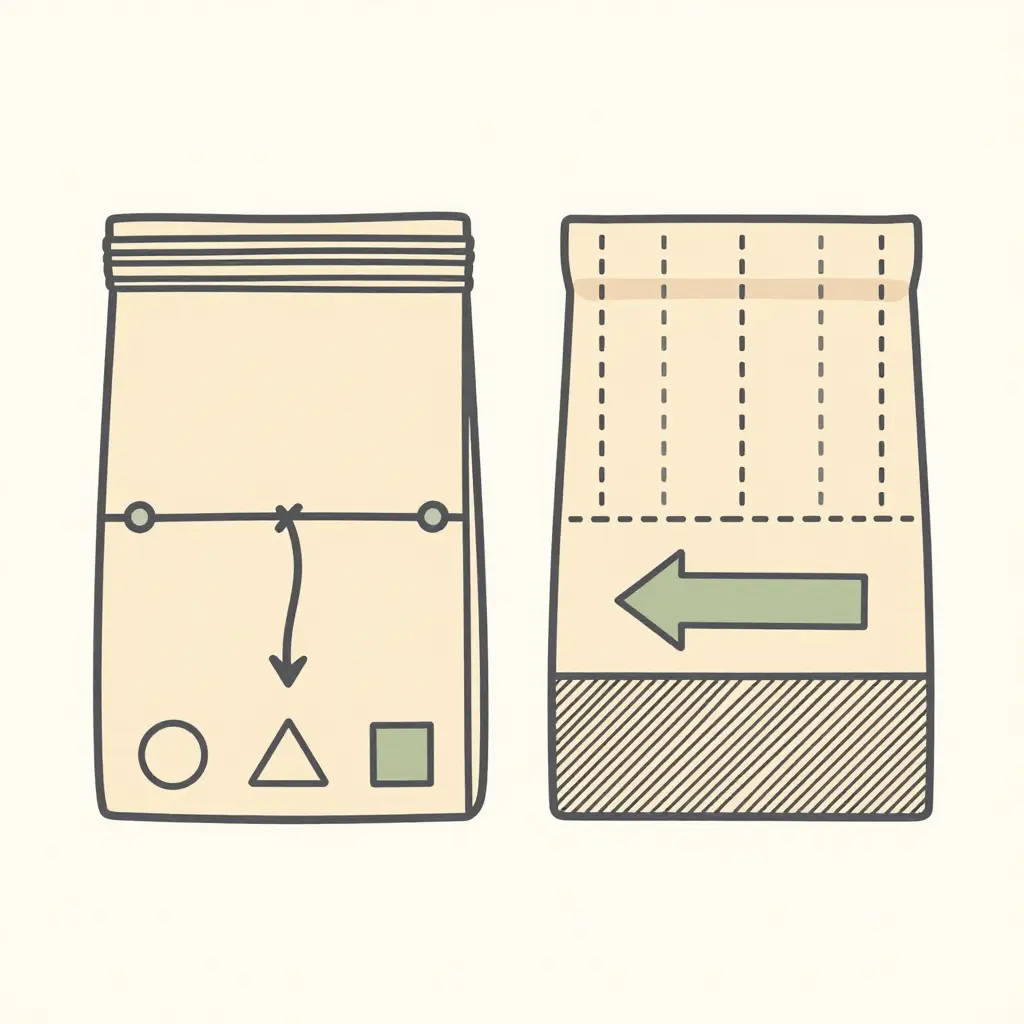
Reading the diagram: the left panel shows a tin tie bag top with the paper folded down twice, the two parallel wire strips gripping the fold, and geometric markers (circle, triangle, square) standing in for the individual paper layers. The right panel shows a fold over bag top with three stacked fold lines, the flap rotating down over itself, and a dense hatched band representing the compressed seal created at the crease.
What the two mechanisms mean for freshness
| Element | Tin Tie (left) | Fold Over (right) |
|---|---|---|
| Active sealing force | Two wire strips clamp the fold and hold it under tension | Paper compression at three fold lines holds the flap flat |
| Re-closing behavior | Repeatable, position adjustable, stays put after opening | Resets to the same crease, gradually softens with handling |
| Air exchange after opening | Moderate; the fold stays tight between uses | Higher; the flap lifts as paper relaxes |
| Best fit | Bakery counters, partial loaves, repeated open-close cycles | High-volume packing lines, single-trip retail |
The practical takeaway
A tin tie closes by tension: the wire strips keep pressure on the fold every time the bag is reopened, which is why it holds up through a day of customers and staff reaching in. A fold over closes by geometry: the crease and the compressed layers do the work, and that hold is only as good as the paper’s memory. Both work. Where shelf life depends on what happens after the first opening, the tin tie gives you more consistent control.
Whichever style you specify, confirm the fold geometry and wire gauge with your converter before committing to a print run. The custom paper bread bags range lists base stocks and closure options that pair with each mechanism.
Six Criteria for Choosing a Bread Bag Closure
Before you commit a full production run of OEM paper bread bags to a single closure style, it pays to score the tin tie closure and the fold over closure against the six criteria that determine how a bag performs on the shelf and in your customer’s kitchen.
- Seal integrity – A fold over closure presses the bag throat into a tight, nearly flat fold, so there is very little open channel for air to move through, but the quality of that seal depends on the crease and the operator. A tin tie holds a consistent width of seal through the memory of the wire; its weaknesses show at the gathered ends of the bag mouth, where the paper can leave small gaps that leak moisture slowly.
- Resealability – This is where tin tie clearly leads: the wire re-bends dozens of times, so a consumer can open, take a slice, and re-close the bag without tearing paper. Fold over closures generally deliver one clean crimp, and repeated folding softens the crease and weakens the seal.
- Unit cost – Fold over is the budget option, since it adds almost nothing beyond the paper itself and needs no wire, ribbon, or tape. Tin tie adds a hardware component plus application cost, typically a few cents per bag depending on wire gauge and ribbon width.
- Line speed and automation fit – Fold over closures run on standard bagging equipment and hand-fold stations, keeping lines fast and simple. Tin tie usually needs dedicated wire-insertion or taping equipment, or manual application, which can become the slowest station on a high-volume line.
- Print and branding area – Fold over closures give you a clean, flat band across the top that takes logos, batch codes, and “baked on” dates well. Tin tie ribbons offer only a narrow strip, so branded messaging has to live on the bag body; pair either style with reliable packaging auxiliary materials to keep closures, tapes, and labels consistent.
- Product and shelf-life fit – For fast-turnover loaves sold same-day, fold over is often enough, while tin tie suits longer-life products and bags that customers open repeatedly. Match the closure to how many handling cycles a loaf will survive, not just to how it looks on the rack.
Weigh these criteria in proportion to your real shelf life and the number of handling cycles each loaf goes through before it reaches the table. If bread sits for days and gets opened again and again, the extra cost of a tin tie closure buys measurable bread freshness; if it sells by closing time, a fold over closure delivers dependable protection for less.
| Criterion | Tin Tie Closure | Fold Over Closure |
|---|---|---|
| Sealing mechanism | Tape and wire strip folded and pressed by hand or applicator | Top panel folded down two or three times, crease pressed; optional glue strip or tape tab |
| Resealability after opening | Fully resealable, many cycles | Limited; the crease softens with repeated opening |
| Typical bread freshness window | 3-5 days after opening | 1-2 days after opening |
| Unit cost level | Higher per bag, added hardware | Lowest cost per unit |
| Packing speed and automation | Slower; hand folding or semi-auto | Fast; high-speed auto lines |
| Branding and print space | Large printable front panel plus tie area | Clean full-face panel, no hardware break |
| Recommended product types | Artisan loaves, sliced retail bread, cafe loaves | Bakery rolls, single-serve bread, short-life items |
The trade-off is straightforward: the tin tie closure buys you resealability and a premium shelf look at a higher unit cost and slower packing speed, while the fold over closure wins on throughput and price but gives up repeatable sealing once the bag is opened. If your customers reach into the same bag for days, the resealable option usually earns its keep, and our paper bags range shows which closures are stocked with which bag formats.
Which Closure Fits Your Product Mix
There is no universal winner between tin tie and fold over. The better question is which closure matches the bread you actually sell. Three decision rules cover most bakery packaging briefs.
Rule one: extended retail shelf life and repeated opening favor tin tie. If your loaves travel to grocery shelves, sit in a display rack for days, or get opened slice by slice at the kitchen counter, choose the tin tie. The paper-covered wire lets a customer fold, roll, and press the top closed after every use, so the bag re-seals instead of hanging open. That repeated closure slows moisture migration, which is the single biggest lever on bread freshness across a multi-day window.
Rule two: same-day artisan sales and lowest cost favor fold over. When bread is baked in the morning and sold by the afternoon, re-closability buys you very little. A fold over top creases flat, closes in one motion, and costs less per unit than a wired bag. Cafes, farmers-market bakeries, and sandwich shops that turn stock daily usually get a better return on a fast, low-cost closure than on hardware the customer never reuses.
Rule three: mixed product lines favor a split specification. Most bakeries do not sell one product. Put tin tie on high-margin retail loaves and long-life items, and fold over on fast-moving breads and buns. A split spec keeps your premium SKUs protected without dragging the whole program into a higher unit cost.
Volume shifts the math. Above a few thousand bags a week, hand-applied wire closures add labor you feel on the P&L, while high-speed fold over lines run inline with little touch time. Below that, tin tie application by hand is easy to absorb.
Line capability matters just as much. Check whether your existing bagger can handle wire inserts and the gusset depth a tin tie requires, and whether your glue or tape station suits a fold over flap. Our paper bread bags range lists stocked OEM paper bread bags if you want to check formats before committing to tooling.
Artwork changes the choice too. Fold over tops give custom printed bread bags a clean, uninterrupted print panel, which suits bold branding and full-bleed designs. Tin tie tops break that panel with hardware and a wire shadow, so push logos and key claims lower on the bag or use the top band deliberately. For premium gift and seasonal lines, pair your bags with rigid bakery packaging boxes to extend the shelf story.
Finally, pilot test both. Run the same recipe on the same day in both closures, store them under identical temperature and humidity, and compare crust crispness, crumb moisture, and mold onset at 24, 48, and 72 hours. Add a closing-speed trial on your line, and ask staff how each top handles in real use.
What the Numbers Show
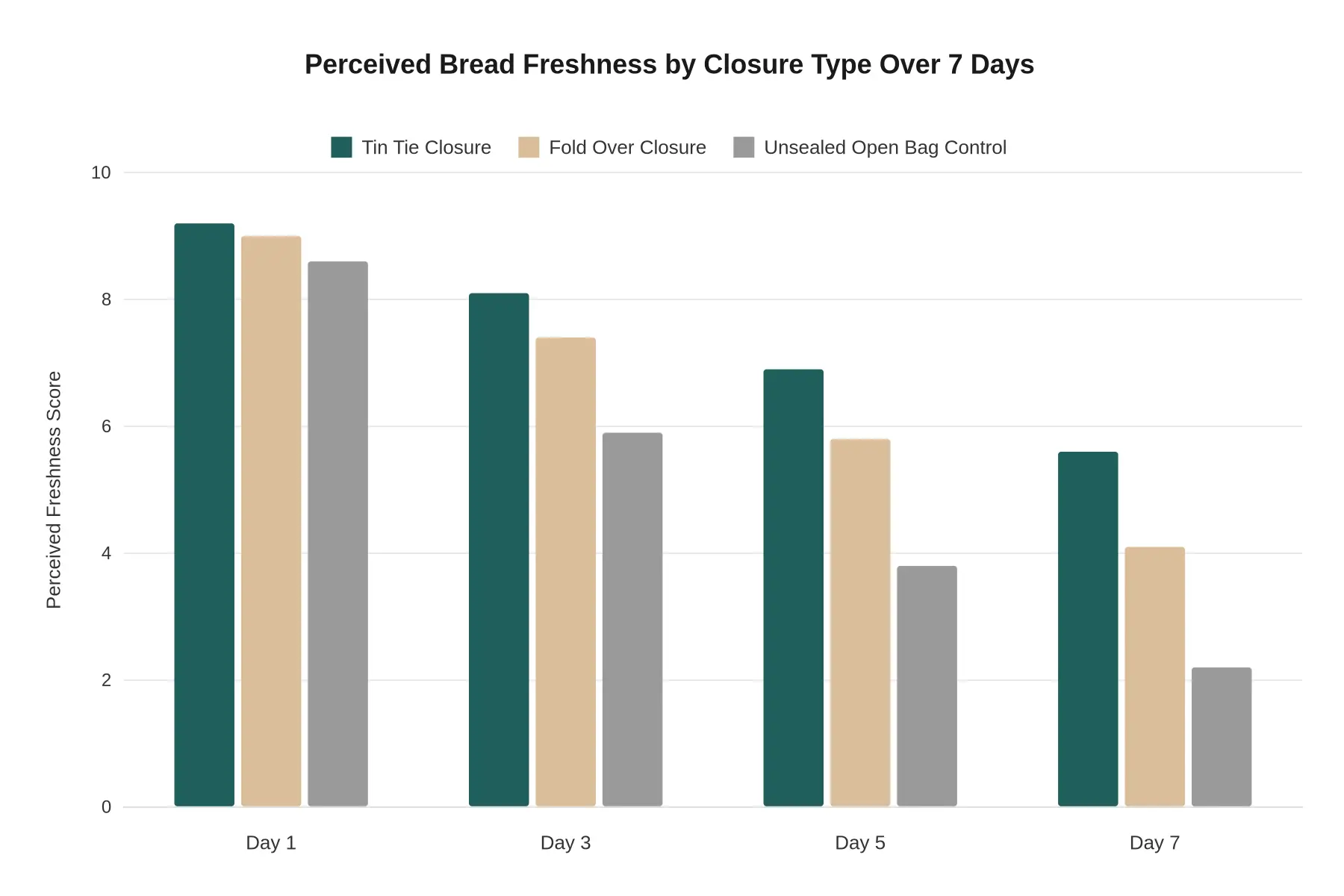
On day 1 the three options are hard to tell apart, all sitting above 8.5. The gap opens quickly. By day 5, tin tie holds a 6.9 score against 5.8 for fold over and just 3.8 for the unsealed control. By day 7, tin tie retains 5.6, fold over drops to 4.1, and the open bag falls to 2.2.
In practical terms, the tin tie buys roughly 1.1 to 1.5 extra points of perceived freshness in the second half of the week, the difference between bread that still reads as fresh and bread that reads as day-old. Scores shift with recipe, bag stock, and storage temperature, so treat the chart as directional and confirm it with your own storage test.
Frequently Asked Questions
These answers cover the five questions buyers ask most often about closure choice and bread freshness.
Does a tin tie closure keep bread fresher than a fold over closure?
In most retail cases, yes. The flexible wire strip forms a tight, repeatable seal that limits air exchange, and holding more moisture slows staling and keeps the loaf saleable for several days longer than a fold over top does.
How many times can a tin tie closure be resealed?
Dozens of times, typically for the full life of the loaf. The polyethylene-coated paper and internal wire resist creasing fatigue, so the strip keeps folding and holding without losing grip as customers open and close the bag.
Is a fold over closure airtight?
No. A fold over closure holds the bag mouth shut by folding the paper flat, and air still moves through the small gaps at the fold and through the paper itself. Airtight is not the goal with paper packaging anyway; the fold is enough for short shelf-life items where bread freshness needs only basic protection.
Which closure costs less per bag for OEM paper bread bags?
A fold over closure costs less per bag on OEM paper bread bags, usually by a noticeable margin per thousand units. It uses no wire or reinforcing tape, which trims material and assembly steps, while a tin tie closure adds hardware and extra machine time.
Can both closure types carry custom printing?
Yes. Both a tin tie closure and a fold over closure can carry custom printing on OEM paper bread bags, including brand colors, logos, and handling icons. Print artwork on the bag body and the closure strip together through our custom packaging printing services.
Final Recommendation for Buyers
The evidence points one way: tin tie closures win on repeatable sealing and multi-day bread freshness, while fold over closures win on unit cost, line speed, and print coverage. Neither option is wrong, but only one fits a given shelf-life target and a given production line, and the choice is worth making deliberately rather than by habit.
The decision works best in sequence. Start by auditing your shelf life requirements: define how many days each SKU must stay fresh on the retail shelf and in the customer’s kitchen, because that single number usually settles the closure debate on its own. Next, confirm line compatibility by checking bag throat width, closure application equipment, and cycle time, so the closure you choose actually runs at your existing speed without new tooling. Then request samples of both closure types in your real bag format, and validate them with a controlled storage test that measures crumb firmness and moisture loss across the full intended shelf life rather than a single day. Only once that data is in hand should you lock the specification, and lock it in writing across every SKU, print layout, and reorder quantity.
For OEM paper bread bags used in commercial bakery packaging, we support that process with food-safe materials, closure construction built for repeated opening, and technical service from first sample through repeat orders. You can browse our paper bag range to begin your sample request, or ask our team to review your line specifications directly.