
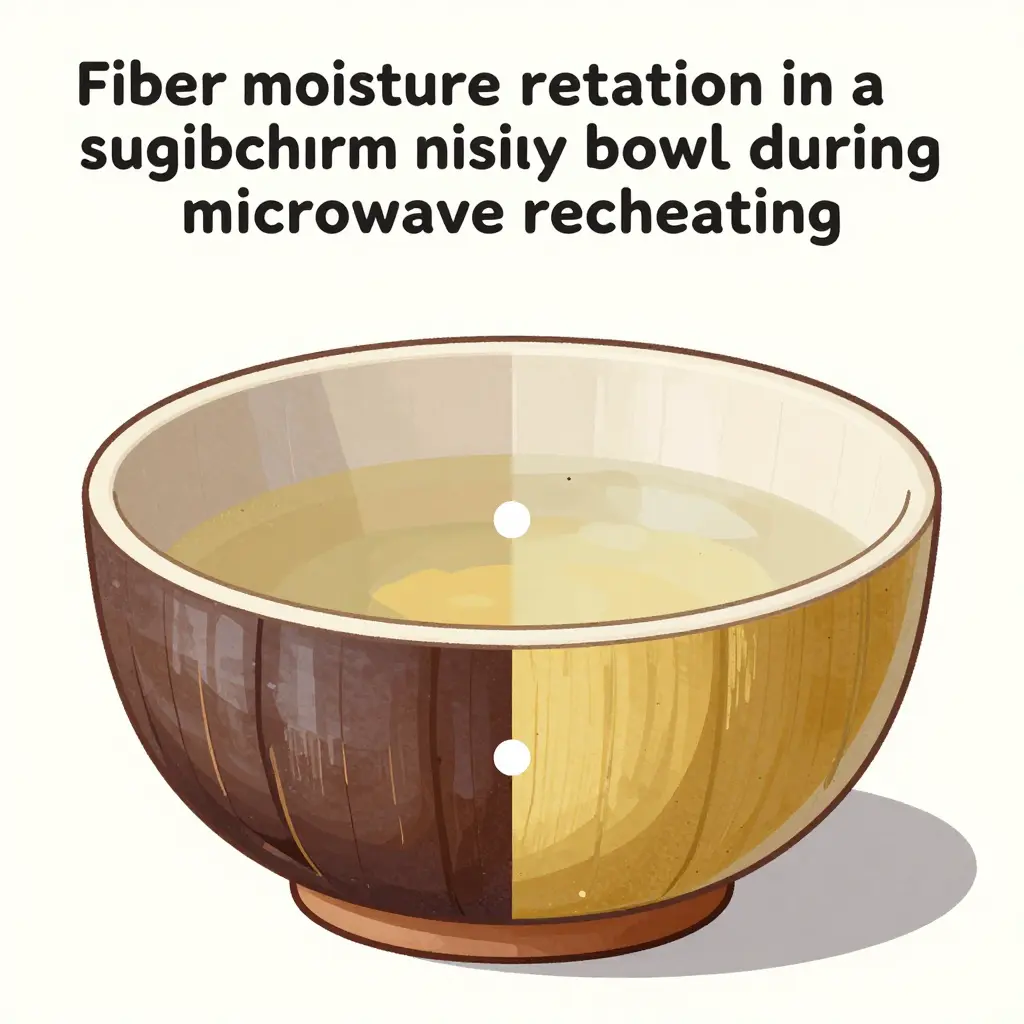
How Fiber Moisture Retention Governs Microwave Performance
Bagasse is a lignocellulosic pulp: cellulose, hemicellulose, and lignin. Its cell walls carry a high density of hydroxyl (-OH) groups, which are polar and draw water molecules into hydrogen bonds. In a bagasse bowl, most of that water sits as bound moisture inside the amorphous regions of the cellulose microfibrils rather than as free water in open pores. That bound phase is what governs how the bowl behaves in a microwave.
Water molecules are dipolar, with one positive and one negative end, so they try to line up with the alternating field of a 2.45 GHz microwave. They cannot keep pace with the field reversal, and that lag dissipates energy as heat in situ – the bowl warms from within instead of by conduction from the food.
Three material properties do most of the work here:
- Equilibrium moisture content (EMC): the stable moisture level a material holds when its internal vapor pressure balances ambient humidity.
- Plasticization: absorbed water breaks inter-chain hydrogen bonds and acts as a molecular lubricant, lowering the glass transition temperature of the hemicellulose-lignin matrix.
- Brittleness: the tendency to fracture under minimal strain, which rises sharply once bound moisture is lost.
While bound water plasticizes the matrix, polymer chains slide against one another and flexural strain at break rises, so the edges stay compliant. Let EMC fall below its threshold and stiff inter-fiber hydrogen bonds re-form, stiffness returns, and the edges become crack-prone under thermal cycling.
For a buyer comparing durable disposable bowls, EMC is a durability specification. A sugarcane bagasse bowl held near its optimal moisture range resists edge cracking through repeated 3-minute reheating cycles, which shows up later as fewer breakage claims, fewer returns, and fewer downgraded lots.
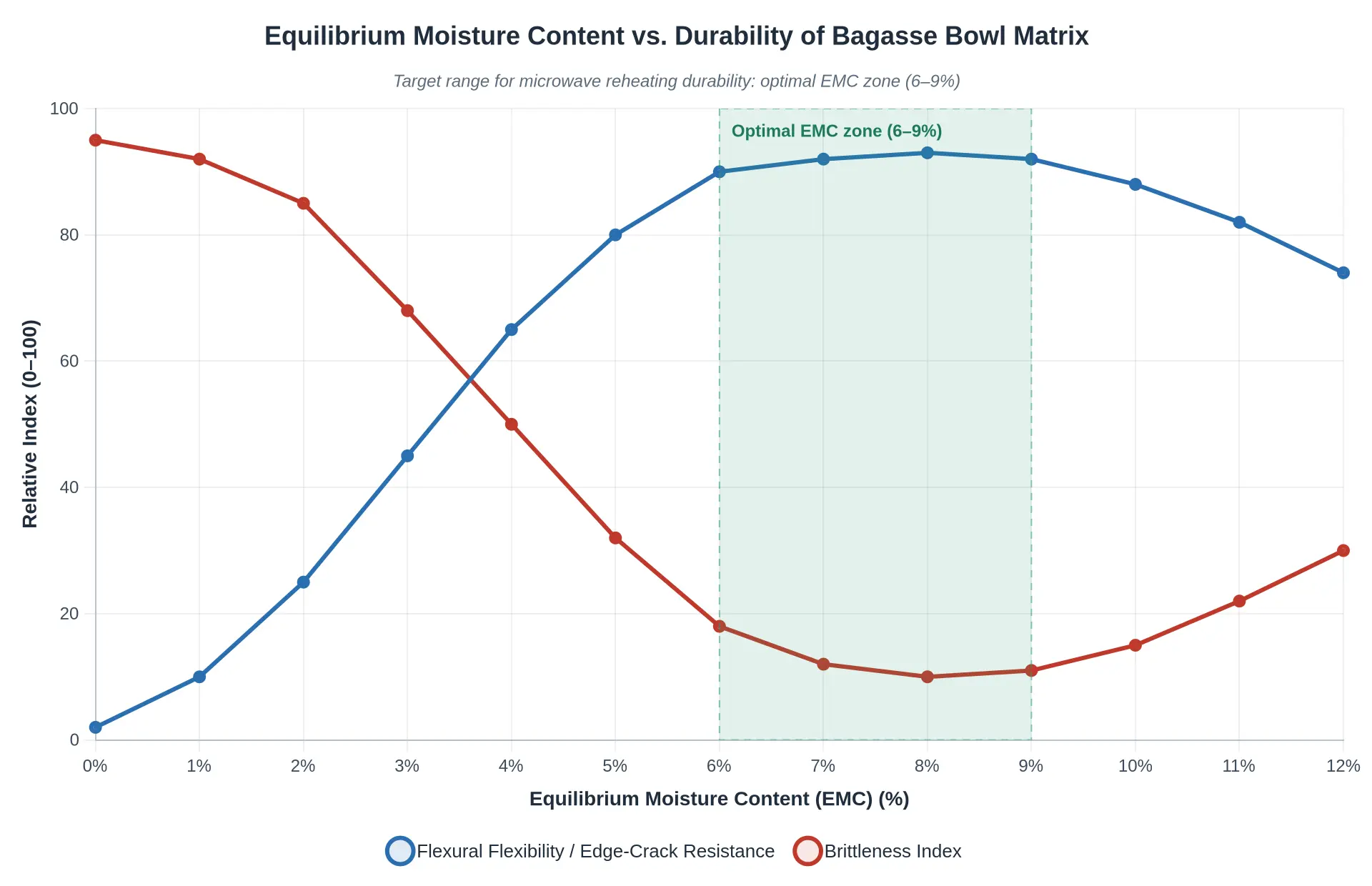
Takeaway: flexibility depends on moisture. Keep the bound water and the rim resists embrittlement; dry the fiber and microwave reheating accelerates cracking.
The cross-section schematic shows the same principle in one view. The inner wall, shaded cool blue with bound-moisture indicators, holds water inside the fiber matrix. The rim, shaded warm and crossed by diverging evaporation arrows, is where microwave energy drives moisture out fastest – and where edge cracking begins.
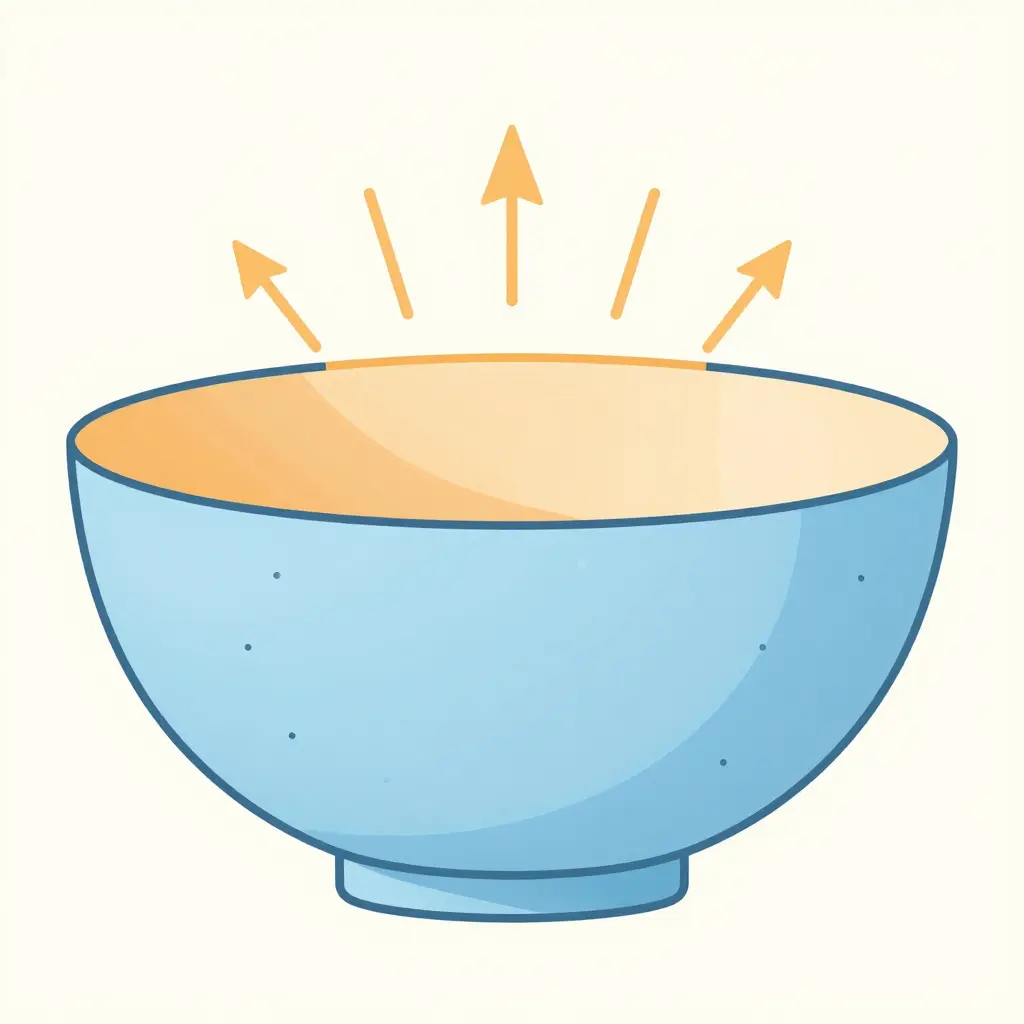
Why Edge Cracking Occurs After 3 Minutes
When a sugarcane bowl cracks at the rim during microwave reheating, the cause is moisture migration, not a molding defect. The rim is the thinnest section of the vessel wall and carries the highest surface-to-volume ratio, so it releases absorbed water far faster than the base or the sidewall. Once the microwave field drives residual moisture outward, the exposed edge dries ahead of the bulk material and its fiber matrix contracts first.
The drier rim tries to shrink while the still-moist interior holds its dimensions, putting the boundary between the two zones under tension. When that stress exceeds the local tensile strength of the compressed bagasse fibers, a fracture runs along the lip – the failure known as edge cracking. Three minutes is roughly where cumulative moisture loss at the rim crosses the failure threshold at standard reheating power; it is a typical value, not a fixed material constant.
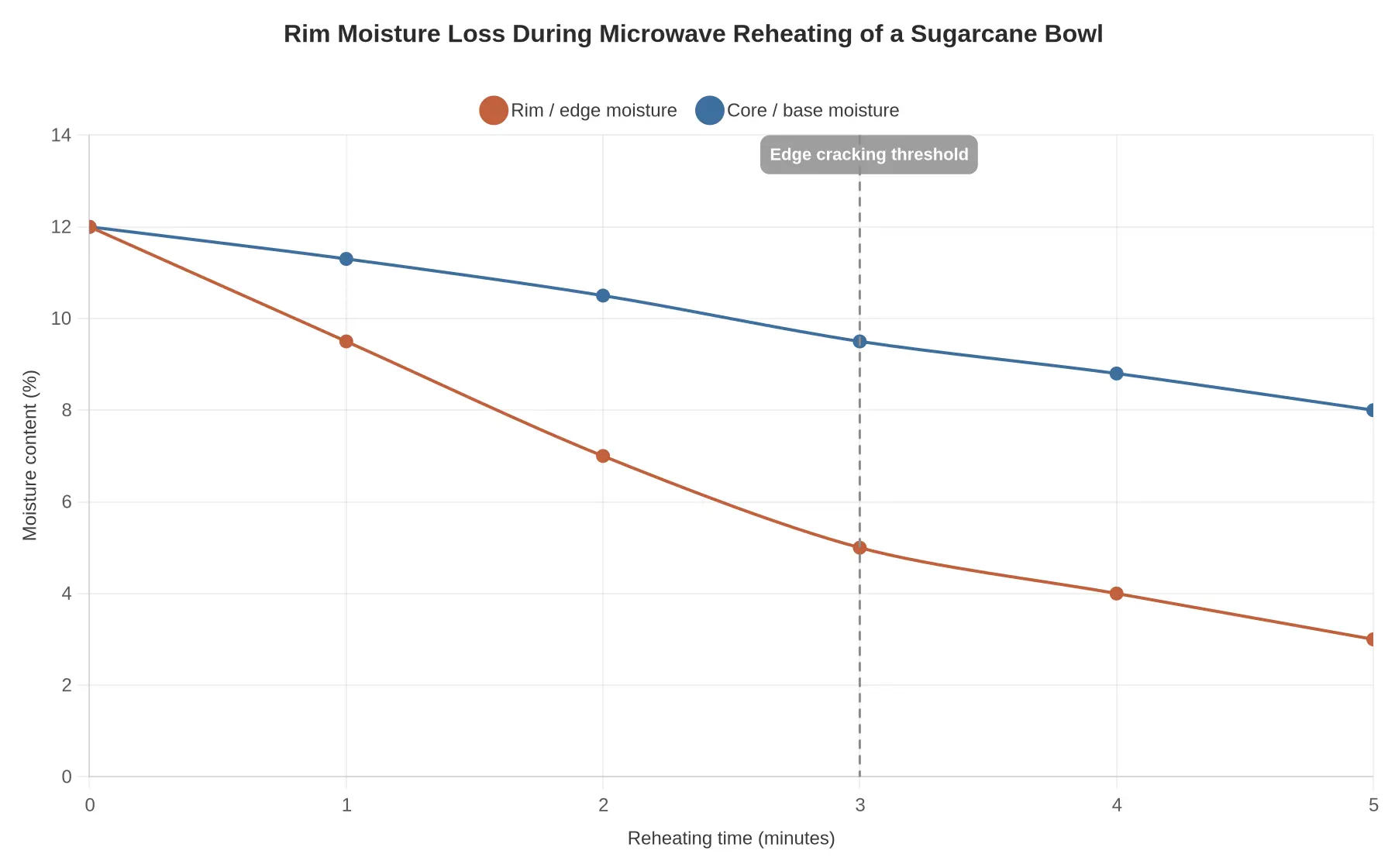
Several variables move that timeline. Thicker walls delay cracking by holding a larger moisture reservoir. Higher ambient humidity slows evaporation. Wetter food loads replenish rim moisture and extend the threshold. A fitted lid traps steam, raising surface humidity and suppressing early drying. Because these factors interact, microwave reheating performance is better specified as a range than as a fixed number – worth keeping in mind when specifying disposable bowls for consistent results.
The chain is straightforward: moisture leaves the rim, the rim shrinks against a moist core, tension builds at the boundary, and the lip cracks once reheating passes roughly three minutes.
Key Performance Variables in Sugarcane Bowl Microwave Reheating
How a bagasse bowl performs after three minutes of reheating depends on several interacting variables, not on the material alone. Each one shapes heat distribution, vapor migration, and structural stress, which is what you are comparing when you read two spec sheets side by side.
- Fiber density – tighter compression boosts rigidity but can slow steam escape from the matrix.
- Initial moisture content – the pre-conditioned water level sets how much vapor the wall generates under load.
- Wall thickness – thicker walls resist deformation yet trap heat and extend internal drying gradients.
- Rim geometry – rolled versus flat edges redirect mechanical stress and strongly influence edge cracking.
- Lamination or coating – a PLA or PE layer blocks vapor loss and reshapes fiber moisture retention.
- Food moisture load – wetter dishes release more steam that migrates straight into the fiber wall.
- Reheating duration – past the three-minute mark, cumulative drying accelerates brittleness and crack risk.
These variables rarely act in isolation. A dense, thick-walled bowl with a sealed coating may resist immediate sagging, yet the same barrier that blocks vapor loss can drive trapped moisture toward the rim, where stress concentrates during a fast reheat. A lighter, uncoated shell dries faster and may crack along the edge sooner. Validate performance data with a dependable bagasse packaging supplier who can document fiber density, moisture content, and rim tolerances before you commit to a volume order. Balancing fiber moisture retention against edge-crack resistance is a systems problem, not a single-parameter fix.
Moisture Differential vs. Temperature During Reheating
This chart tracks a sugarcane (bagasse) bowl through a five-minute reheating window on a shared relative-percentage axis: core moisture retention, rim moisture level, and internal temperature. The vertical dashed line marks the 3-minute cracking threshold, the point where the gap between the wet core and the drying rim becomes wide enough to drive edge fracture.
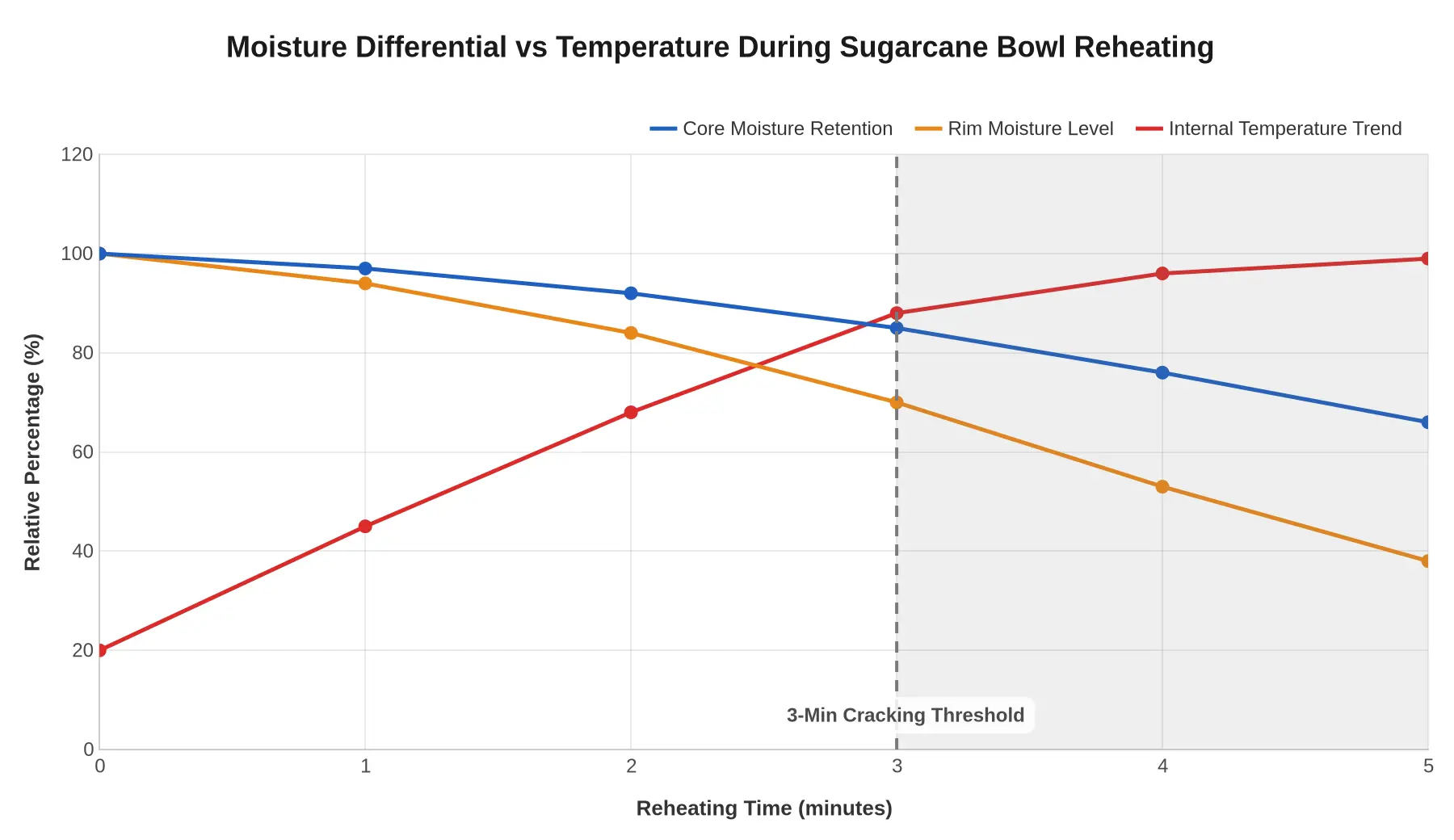
The same data in table form:
| Reheating Time | Core Moisture Retention | Rim Moisture Level | Internal Temperature Trend |
|---|---|---|---|
| 0 min | 100% | 100% | 20% |
| 1 min | 97% | 94% | 45% |
| 2 min | 92% | 84% | 68% |
| 3 min | 85% | 70% | 88% |
| 4 min | 76% | 53% | 96% |
| 5 min | 66% | 38% | 99% |
The divergence is the point. Through minute 2 the two moisture curves track closely and the bowl stays dimensionally stable. At minute 3 the rim has already shed 30% of its original moisture while the core still holds 85% – a 15-point gap. From there the gap widens sharply, because the thin rim dries and contracts faster than the dense core, and that differential is what pulls the edge apart. Temperature flattens near its ceiling by minute 4 or 5, so the cracking damage comes from moisture migration rather than raw heat alone. For buyers specifying microwave-ready formats, the rule is simple: design and label for under three minutes, or reinforce the rim geometry. Compatible disposable bowls built for short-cycle reheating show how rim construction changes this outcome.
The Three-Minute Threshold: Why It Defines Usability
Most takeout and meal-prep reheating runs between 90 seconds and 3 minutes, depending on portion weight, starting temperature, and microwave wattage. Three minutes is therefore the practical ceiling to benchmark when assessing sugarcane bowl microwave reheating, because it matches the realistic worst case in fast kitchens and delivery workflows.
At that point the material behavior changes. Bagasse fiber holds moisture inside its cellular structure, but as internal steam pressure builds, water migrates toward the rim where wall density drops. Up to three minutes, a well-formed bowl absorbs that pressure through fiber flexibility. Beyond it, moisture retention capacity saturates and the surplus energy goes into edge cracking and structural fatigue.
For foodservice operators the consequence is operational: a bowl that cracks at minute three cannot be sealed, stacked, or safely transported. Moisture retention and edge integrity track tightly across the reheating window, and both fall off steeply once the threshold is crossed. That is why microwave performance belongs in the specification rather than in afterthoughts, especially when sourcing sugarcane disposable bowls for high-volume programs.
For a sugarcane bowl, moisture retention at or beyond three minutes is the strongest single predictor of whether it is still usable after reheating.
Frequently Asked Questions: Sugarcane Bowl Microwave Reheating
Are sugarcane bowls microwave-safe?
Yes, with limits. A properly molded sugarcane bagasse bowl can be reheated in a microwave, generally for two to three minutes at medium power. Bagasse, the fibrous residue left after sugarcane juice extraction, is pressed under heat into a rigid, single-material product, so it does not need a plastic lining to be microwave-safe. That is what makes microwave-safe disposable bowls practical for takeout, catering, and meal-prep reheating. Where a supplier adds a PLA or PE coating for grease or leak resistance, that layer changes how moisture moves through the wall, so confirm the microwave rating of the coated grade. Note that “microwave-safe” describes the material grade, not an open-ended time guarantee: real-world performance still depends on wall thickness, residual moisture, and the power setting used.
Why do the rims or edges crack after about three minutes?
The rim is the thinnest, most exposed section of any sugarcane bagasse bowl, so it heats and dries faster than the base. Inside the microwave, water molecules trapped in the fiber matrix vibrate and generate steam. That moisture migrates toward the hotter rim, building internal vapor pressure while the body still holds water. After roughly three minutes the edge loses moisture faster than it can redistribute it, flexibility drops, and differential shrinkage opens hairline cracks. Edge cracking is therefore a fiber-moisture and thermal-stress phenomenon, not a defect in the material itself.
How can edge cracking be reduced through specification choices?
Buyers can control most of the risk at the specification stage. Request a heavier wall gauge and a thicker, denser rim, which slows localized drying. Specify uniform density and a controlled residual-moisture target, since both over-dry and saturated fiber crack sooner. A rolled or rounded rim distributes stress better than a sharp flat edge, and a matched lid reduces steam loss during transport and reheating. Reviewing printed or branded disposable bowl options against these parameters helps align appearance with performance.
How does moisture retention differ between thin-wall and heavy-duty bowls?
Thin-wall bowls heat quickly and shed moisture rapidly, so their rims dry and crack sooner under longer cycles. Heavy-duty bowls carry more fiber mass and absorb water more evenly; they release steam slowly, retain internal moisture longer, and hold their shape across extended reheating. For short, low-power reheats, thin-wall is efficient and economical. For soups, saucy meals, or three-minute-plus cycles, heavy-duty construction consistently wins on durability.
How should suppliers be evaluated for consistent microwave performance?
Ask for documented microwave performance testing rather than verbal assurances. Confirm moisture-content specifications, density control, and wall-thickness tolerances, then request batch-to-batch consistency data from at least two production runs. Third-party test reports and retained samples give objective comparability across vendors. A reliable supplier will also disclose recommended power levels and maximum reheat times, which is the clearest sign they understand the fiber-moisture dynamics behind edge cracking.
Procurement Guidance for Sourcing Sugarcane Bowls from China
For importers, distributors, and foodservice buyers sourcing sugarcane disposable bowls from China, the line between a bowl that survives three minutes of microwave reheating and one that fails runs through two measurable properties: fiber moisture retention and edge-crack resistance. Treat both as hard specifications, not marketing language.
Specifying Fiber Moisture Retention and Edge-Crack Resistance
In your purchase requirements, ask suppliers to declare the target fiber moisture content at the point of molding – a defined range rather than a single figure – and to explain how that moisture is preserved through pressing and drying. A bowl dried too aggressively turns brittle, while one holding balanced moisture absorbs the steam-driven stress that opens edge cracks.
Write edge-crack resistance into the spec as a pass/fail criterion tied to a defined reheating test, never as a vague quality note. Require confirmation of wall-thickness uniformity at the rim, because thin, uneven edges are where cracking begins.
Testing and Sample Criteria to Request
Before committing to volume, request pre-production samples and insist on a documented microwave protocol. Criteria worth setting:
| Requirement | What to Request | Acceptance Target |
|---|---|---|
| Fiber moisture | Certificate of analysis stating moisture content range | Consistent, supplier-defined range |
| Edge-crack resistance | 3-minute microwave reheating test with moist food | No visible cracks or delamination |
| Rim integrity | Wall-thickness measurement at the rim | Uniform within stated tolerance |
| Thermal stability | Post-reheat handling test | No warping, no leaks |
| Batch consistency | Samples from at least two production runs | Comparable performance across runs |
Balancing Cost with Microwave Performance
Cheaper bowls often reach a lower price by shortening drying time or thinning the rim – precisely the choices that reduce fiber moisture retention and invite cracking. Weigh the total cost of failure, including returned orders and customer complaints, against the lowest quote. For cold or short-hold service, a standard-weight bowl may suffice; for delivery and meal-prep operators reheating saucy dishes, a higher-moisture, reinforced-rim grade is the safer buy.
Conclusion
Fiber moisture retention is what governs whether a sugarcane bowl cracks after three minutes in the microwave. Edge-crack resistance follows from how well the fiber holds moisture through pressing and drying, not from surface finish. Buyers who specify moisture content, require a defined reheating test, and pay a modest premium for documented performance get packaging that holds up in service.
Sourcing the Right Format for Microwave Reheating
What fiber moisture and edge geometry do under three minutes of microwave exposure has direct procurement consequences. Match the material grade to the reheating profile instead of treating all bagasse formats as interchangeable. Saucy, high-moisture dishes benefit from deeper vessels with reinforced rims, which lose less internal steam and crack less at the edge; our disposable bowls are molded with consistent wall thickness to balance moisture retention against rim stiffness.
Operators who plate hot and cold components on a single tray get more uniform microwave behavior by sourcing across an integrated disposable tableware range. For portioned delivery and meal-prep programs, ventilated disposable lunch boxes release excess vapor while slowing surface dehydration. Shorter reheat cycles that prioritize structural stability over steam control are better served by rigid paper plates and bowls. And lids are a functional variable, not a decorative accessory, since they set the headspace humidity that decides whether a three-minute reheat leaves the fiber tender or the rim split.