
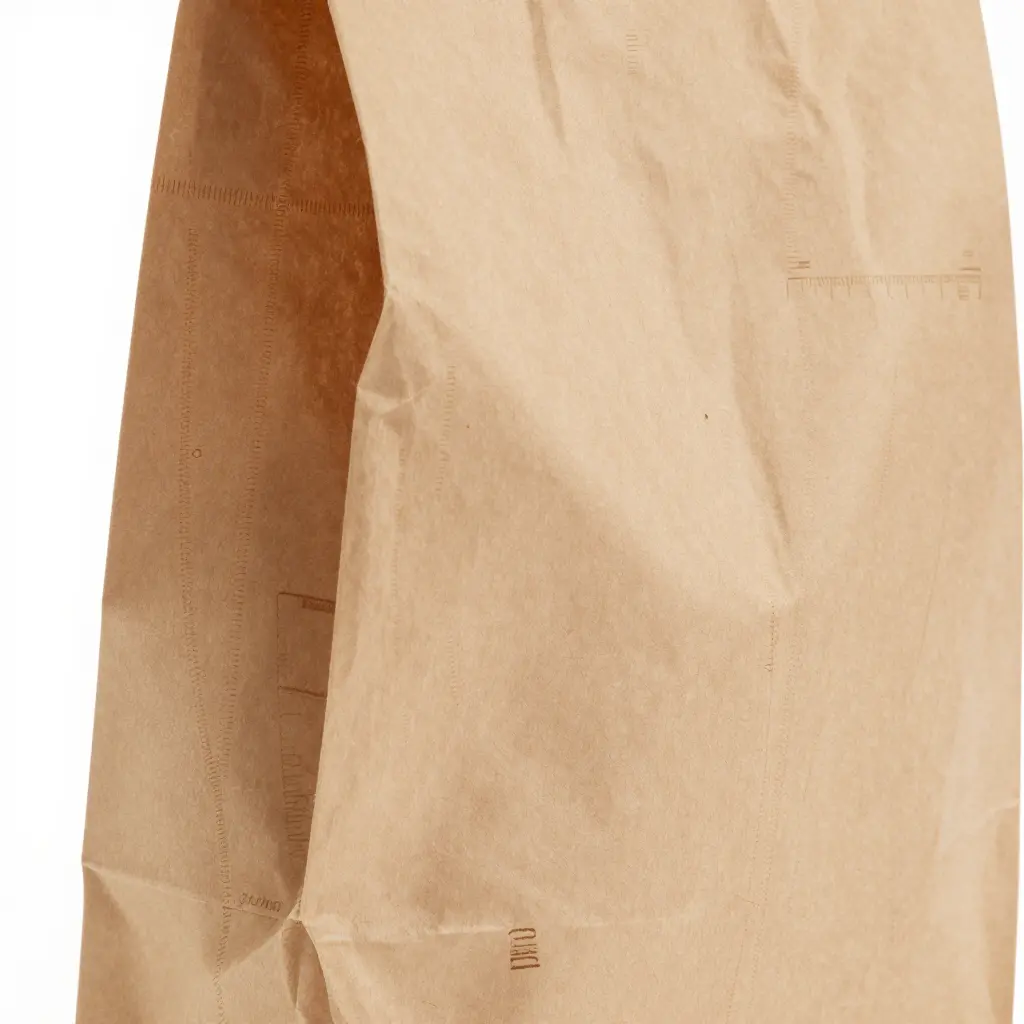
The Failure Sequence Starts at the Fold, Not the Sheet
A grease stain on a bread bag looks like a paper-weight problem, and that is usually the wrong diagnosis. In OEM bread paper bags the failure starts at the fold. Side gusset creases are pressed into the sheet by steel, and the state of that crease decides how fast oil reaches the outside of the bag – often long before the base sheet is implicated. Get the order right and you may fix a crease instead of paying for heavier paper that stains anyway.
Three things control the outcome, and they are worth checking in this order: crease geometry, the path the grease wicks along, then grammage. Treat wicking as a property of the sheet alone and you will overspecify paper to solve a folding problem.
1. Crease Geometry
Crease geometry covers the depth, width and radius of the fold line, plus the number of fold cycles the gusset has already taken. Every cycle fatigues the fibres along that line: bonds break, the sheet thins locally, and what was a continuous barrier becomes a row of gaps. A tight radius or a deep score speeds this up, and it shows under a backlight.
2. Grease Wicking Path
The wicking path is the route oil takes from the contact face, through the opened crease, to the outside of the bag. Once the crease is fatigued, capillary action draws liquid fat along the broken fibre alignment far faster than it moves through intact paper. The crease is not simply weaker paper; it is a channel.
3. Paper Grammage
Grammage is mass per unit area, measured on a sheet nobody has folded yet. It governs resistance only where the sheet is still intact. Adding weight builds barrier into the flat fields of the bag and does nothing for the crease line, because the failure there is structural rather than a shortage of fibre.
The Causal Chain, Plainly Stated
Creasing fatigues and opens the fibre structure. Grease travels that opened structure by capillary action. Grammage matters only where the sheet is unbroken.
For a specification review this means auditing crease geometry and fold count before anyone touches grammage, and checking bread paper bag specifications against the fold pattern the filling line actually runs.
Side Gusset Crease Geometry: Where a Bread Paper Bag Stops Being an Intact Sheet
A gusset is not a crease that happens to a bag; it is engineered into one. Every side gusset crease on a bread paper bag comes from a matched male/female crease blade pair that compresses, delaminates and partly ruptures the fibre network along one narrow band. Whether the bag holds grease or wicks it depends on what that band looks like.
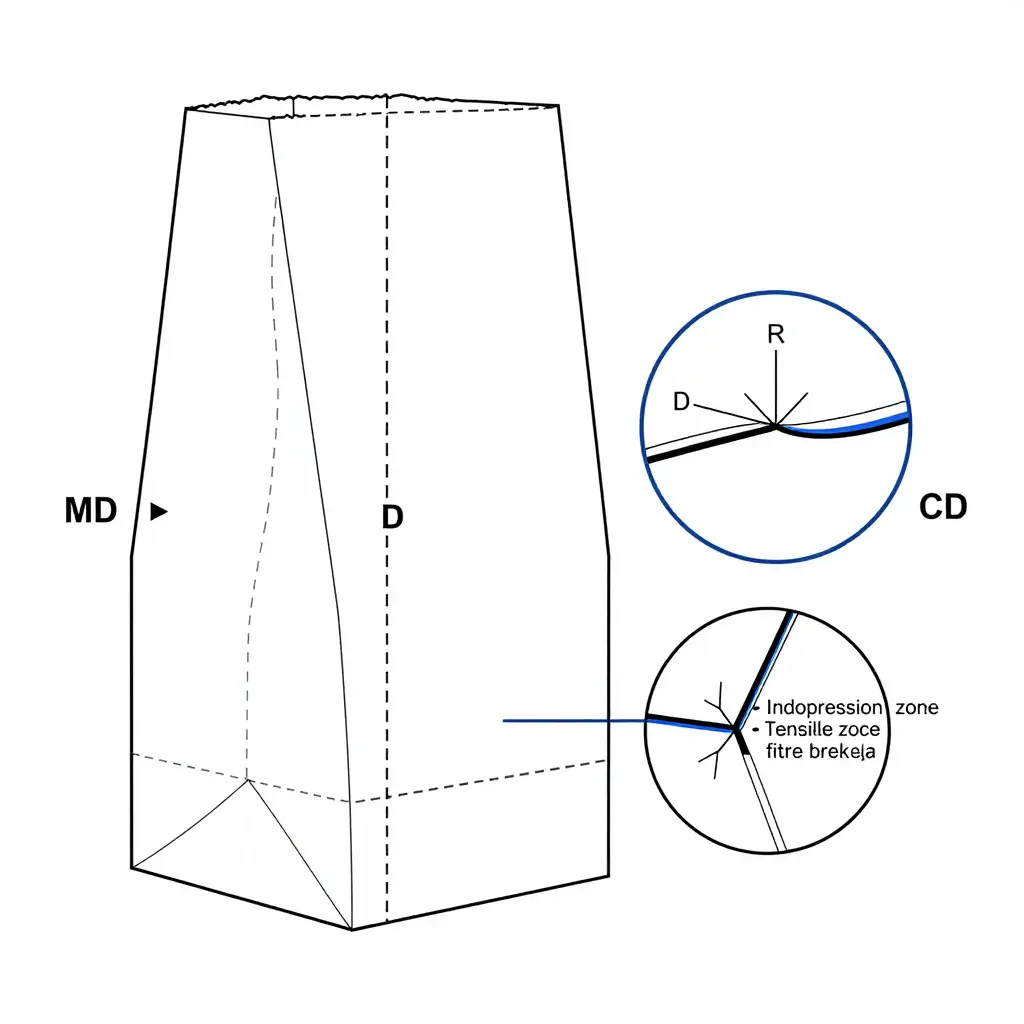
How the crease is formed
- Gusset fold lines are run on a folder-gluer using a crease matrix. The male rule presses the sheet into the female channel, and the paper yields along a line rather than a curve.
- Machine direction (MD) folding runs the fold line parallel to the paper’s dominant fibre orientation. MD creases are the most forgiving: fibres bend along their length and the sheet keeps most of its tensile strength and barrier integrity.
- Cross-direction (CD) folding runs the fold line across the fibre flow, which is exactly where side gussets get their transverse creases. Here the fibres must kink rather than bend, so CD fold lines crack sooner and wick faster at the same grammage.
Crease blade radius and depth
The crease blade geometry decides how much damage is done. A tight radius (roughly 0.3-0.6 mm) concentrates stress and gives a sharp, well-defined fold on heavy kraft, but it shears fibres on the outer face. A wider radius (0.8-1.2 mm) spreads the load and keeps more of the surface layer, though the gusset comes out softer and less crisp.
Crease depth is set as a proportion of caliper: deep enough to plasticise the fibre bond for good, shallow enough that the sheet is not cut through. Too shallow and the fold springs back, so the gusset opens during filling; too deep and you have scored a line that tears under load.
| Parameter | Under-set | Correctly set | Over-set |
|---|---|---|---|
| Crease blade radius | Soft, memory returns | Balanced fold memory | Sharp, fibre shear |
| Crease depth (vs. caliper) | Gusset springs open | Fold holds, sheet intact in bulk | Crease line weakened |
| Outer face condition | Intact, high resistance | Controlled micro-cracks | Visible cracking, wicking path |
Inner face vs. outer face: compression versus tension
Every fold has two faces, and they fail differently.
- Inner fold face (concave): the sheet is in compression. Fibres buckle and densify, the surface can burnish or polish, and local porosity drops. This face is usually the tighter, glossier side of the fold.
- Outer fold face (convex): the sheet is in tensile stress. Fibres are stretched past their elastic limit, and the outer surface – including any clay coating, starch film or PE layer – ruptures.
So fibre breakage on the outer face opens micro-channels between fibre bundles and a web of surface cracks along the fold line. Inside a band of roughly 1-2 mm around that line, effective caliper, density and barrier continuity all change, which is why a crease is a structurally altered zone rather than intact sheet. Grease moves through those channels long before it moves through a sound panel, and that is why crease quality can matter more than an extra 10-15 gsm.
How gusset depth and crease count scale the exposed crease length
Exposed crease length per bag can be approximated as:
L = n x (H + 2D)
where n is the number of creased fold lines per bag, H is bag height and D is gusset depth. Crease count dominates: doubling n (adding end creases, or a double-crease reinforcement) doubles the vulnerable length outright, while going from a 30 mm to an 80 mm gusset adds only about 28%.
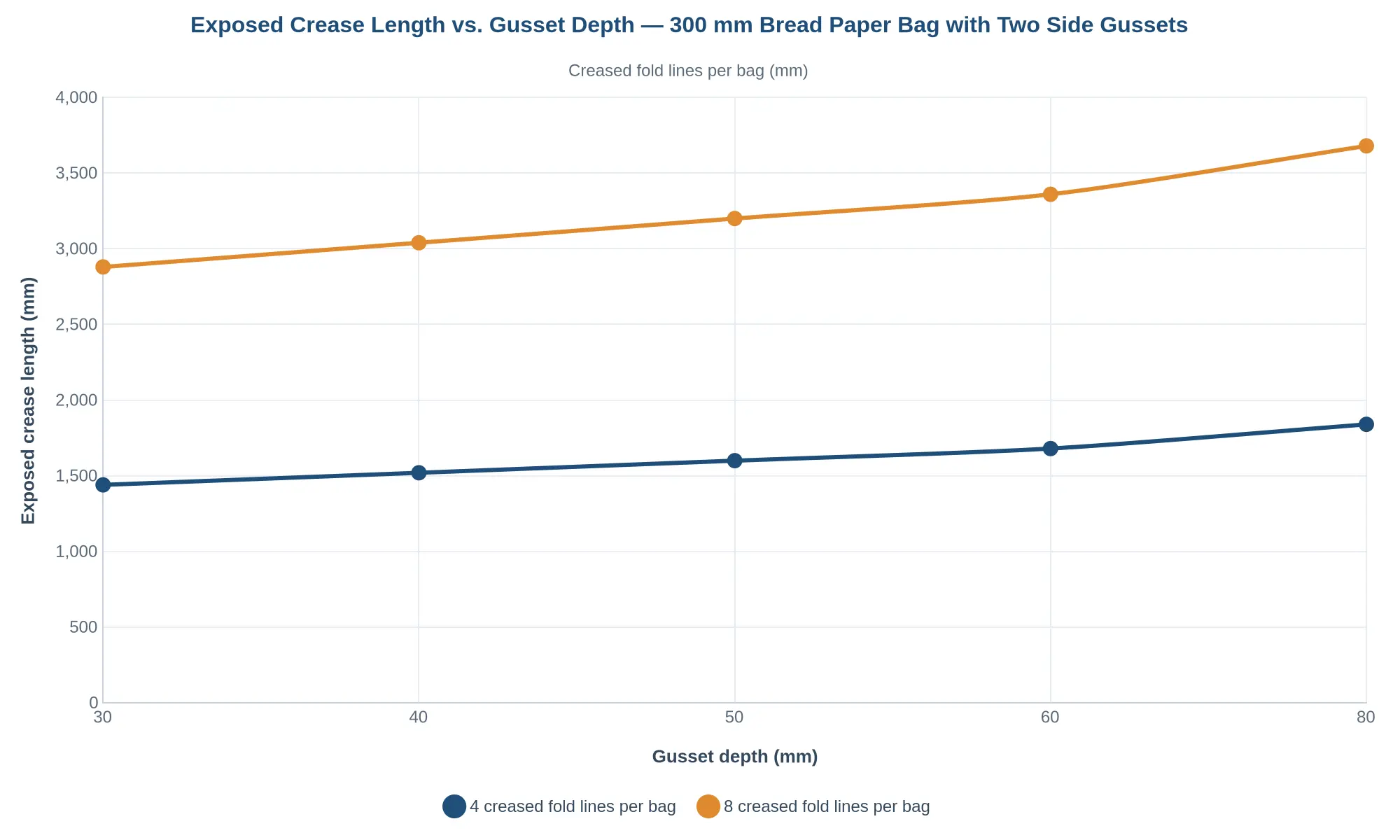
For a 300 mm bag with two side gussets:
| Gusset depth | 4 creased fold lines | 8 creased fold lines |
|---|---|---|
| 30 mm | 1,440 mm | 2,880 mm |
| 50 mm | 1,600 mm | 3,200 mm |
| 80 mm | 1,840 mm | 3,680 mm |
A 30 mm gusset with four fold lines already puts 1.44 m of altered paper into one bag. Across a production run, that is not a detail.
What to write into the purchase specification
- State fold-line orientation: MD-creased where possible, and flag any CD fold lines for extra grease testing.
- Specify crease blade radius and crease depth as tolerances, not single values, together with the caliper they are referenced to.
- Ask for a filled-bag hold test and a grease-resistance test performed across a crease, not on a flat panel.
- Confirm crease count per bag and gusset depth on the drawing, since both scale the exposed crease length directly.
When you compare constructions for a new bread line, run the same criteria over paper bag formats and gusset options before locking a grammage.
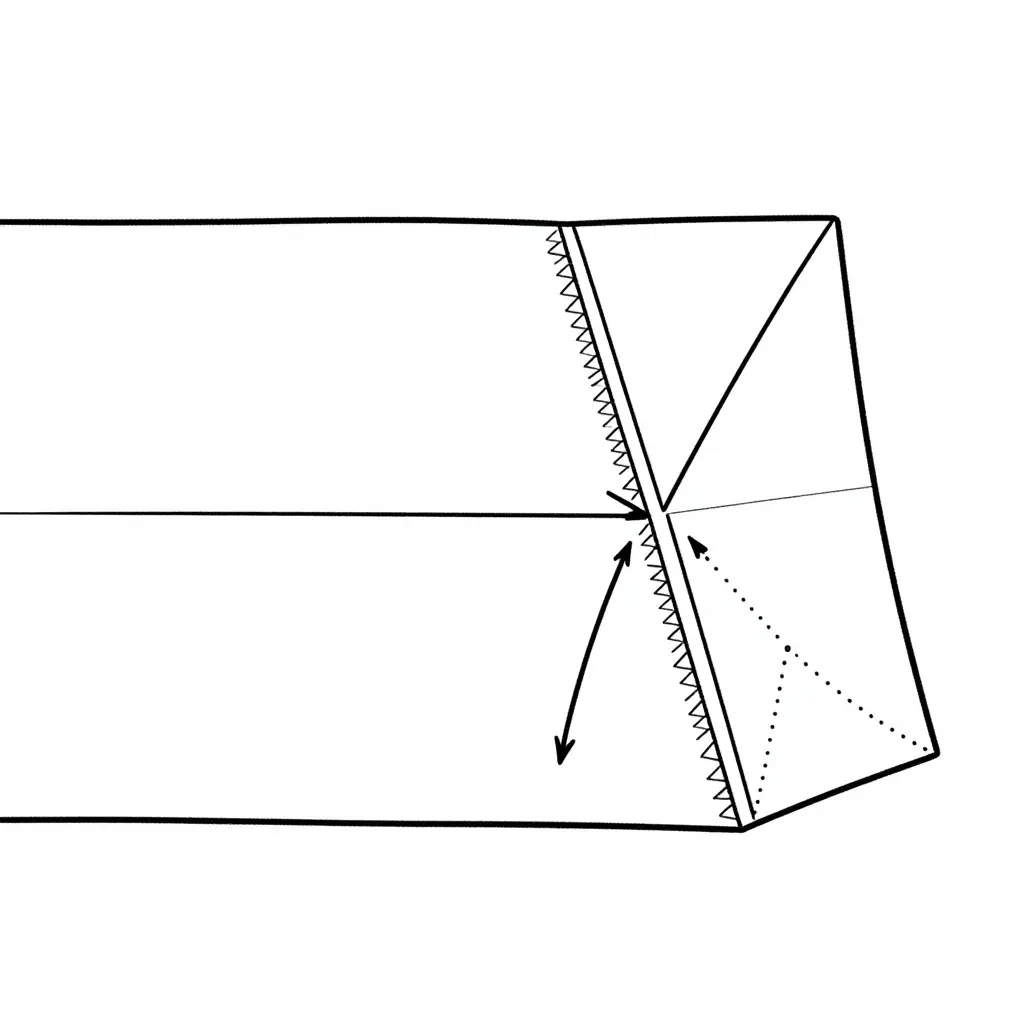
Why the Crease, Not the Grammage, Sets the First Leak
The sketch strips the bag down to the geometry that matters. Read it left to right: the flat panel of the tube, then the point where that panel turns back on itself to form the side gusset. The two fold faces meet at the crease apex, and forming treats them very differently. The inner face is compressed, its fibres crushed and slightly buckled. The outer face is stretched, its fibres pulled apart.
At the stretched outer face the fibre network opens. Micro-fissures and exposed fibre ends sit exactly where the bag touches warm bread, and the arrow cluster in the diagram marks where melted fat goes in. From there the fat does not travel across the panel; it travels along the crease line, inward through the opened structure, like a wick. The channel is continuous and narrow, so grease can cover a surprising distance before a coating ever becomes the limiting factor.
Which is why a heavier sheet does not automatically answer a leak complaint. Grammage adds bulk and puncture resistance across the panel and leaves a capillary channel made by folding exactly where it was. If the current specification is chosen on weight alone, it is worth seeing how crease count, gusset depth and fold direction interact across the bread paper bag formats range before the next order.
The Grease Wicking Mechanism: Why Creases Outrun Grammage
Grease failure in bread bags almost never starts in the middle of a panel. It starts on a fold. To specify a bag that holds its barrier, treat grease wicking as a fluid-transport problem inside a porous network rather than a coating-thickness problem. Separate the capillary flow from the mechanical damage a side gusset crease does to the fibre web, and it becomes clear why heavier paper keeps disappointing.
Capillary pressure: pore radius, surface energy and oil viscosity
Grease moves into paper because the fibre network behaves like a bundle of irregular capillaries. The driving pressure across a meniscus is:
Δp = 2γ cosθ / r
where γ is the oil’s surface tension, θ the contact angle against the fibre surface, and r the effective pore radius. The arrival time over a path length L follows the Lucas-Washburn relationship:
t = 2ηL² / (r γ cosθ)
Three variables do most of the work, and a supplier’s lab can measure each of them:
- Pore radius (r). Fine, well-bonded furnishes give small pores and high capillary pressure, but viscous drag rises as r shrinks, so transport across the sheet is slow. In uncoated kraft, effective radii in flat areas sit in the low-micron range; at a crease they can open by an order of magnitude.
- Surface energy (γ cosθ). Uncoated kraft has a critical surface tension above that of butterfat, so θ stays well below 90° and oil wets in by itself. A fluorochemical or film barrier drops surface energy below the oil’s and pushes θ past 90°, which makes Δp negative: capillary pressure then resists entry instead of driving it.
- Viscosity (η). Time scales directly with it. Cold butter is sluggish; bread leaving an oven at 70-90 °C, or a bag sitting in a warm delivery van, thins the fat and can cut wicking time by more than half.
Crease-line fibre breakage: bigger pores on a shorter road
Creasing is a controlled failure. The outer surface of the fold is strained past the elongation limit of the fibres; hydrogen bonds rupture, fibres fracture and delaminate, and the sheet never fully recovers its original density. The result is a continuous, low-tortuosity channel running the full length of the gusset.
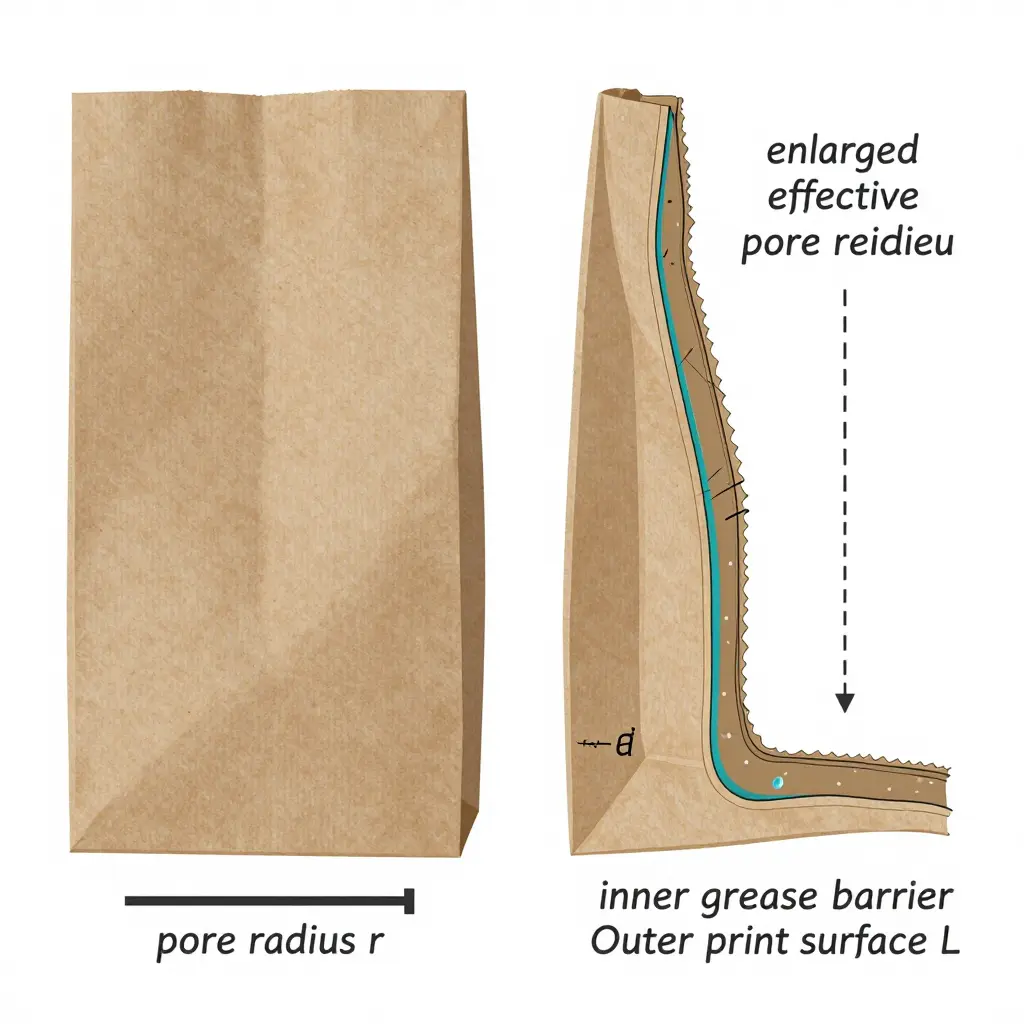
Two terms in Washburn change at once, in the same direction. The effective pore radius grows, which multiplies capillary pressure, and the wicking path shortens, because the crease is the most direct route from the product contact zone to the base seam. Fluid also finds the crease mechanically convenient: it is a groove, so gravity and product weight push grease into it. This is why the first dark line on a leaking bag usually traces a gusset fold rather than spreading evenly across a panel.
Penetration, staining and strike-through are three different failures
Buyers and QA often use these three terms interchangeably, which makes a specification impossible to enforce. They are three stages of one event, with three different test methods.
| Failure mode | What is happening in the sheet | What you observe | Indicator to specify |
|---|---|---|---|
| Grease penetration | Oil enters the fibre network and wets the structure below the surface | Faint darkening visible only against a light box | Penetration time in minutes; kit rating at the crease |
| Grease staining | The wick front reaches a surface layer and spreads laterally | Translucent dark patch growing along the fold; print looks damp | Stain area in mm² at 1 h, 4 h and 24 h |
| Full strike-through | Oil crosses the entire caliper and transfers to whatever touches the bag | Oil marks on hands, shelves, cartons or adjacent bags | Strike-through time; blotting-paper transfer test |
A bag can pass a flat-surface penetration test and still fail commercially at the staining stage, because the visible patch – not the oil load – is what a customer rejects.
Measurable indicators: kit rating, penetration time, stain area
Kit rating. The kit test (TAPPI T 559, usually run as the 3M kit test) uses a graded series of twelve solutions of castor oil, toluene and heptane. A drop goes on the surface, sits for 15 seconds, is wiped off, and the sheet is checked for darkening; the rating is the highest-numbered solution that leaves no penetration. The top of the scale is deliberately aggressive, because those solvent blends are thin enough to enter small pores. A typical uncoated kraft rates in the low single digits; a well-applied fluorochemical barrier reaches the upper range.
The catch is that kit ratings are almost always reported on flat, uncreased stock. Coatings crack at the fold too, so a sheet can lose several rating points once it has been through a gusset former. Ask for creased specimens: crease the sample, put the solution on the crease line, and rate that spot.
Penetration time. Minutes to first visible penetration and to full strike-through, at a defined oil load and temperature. For bakery work, melted butter or shortening at 60 °C on the inner face is a realistic analogue.
Stain area. Image analysis of the wick front at fixed intervals. Plotted against the square root of time, stain area gives a wicking coefficient; a steep slope means large pores, which points at crease damage rather than thin paper.
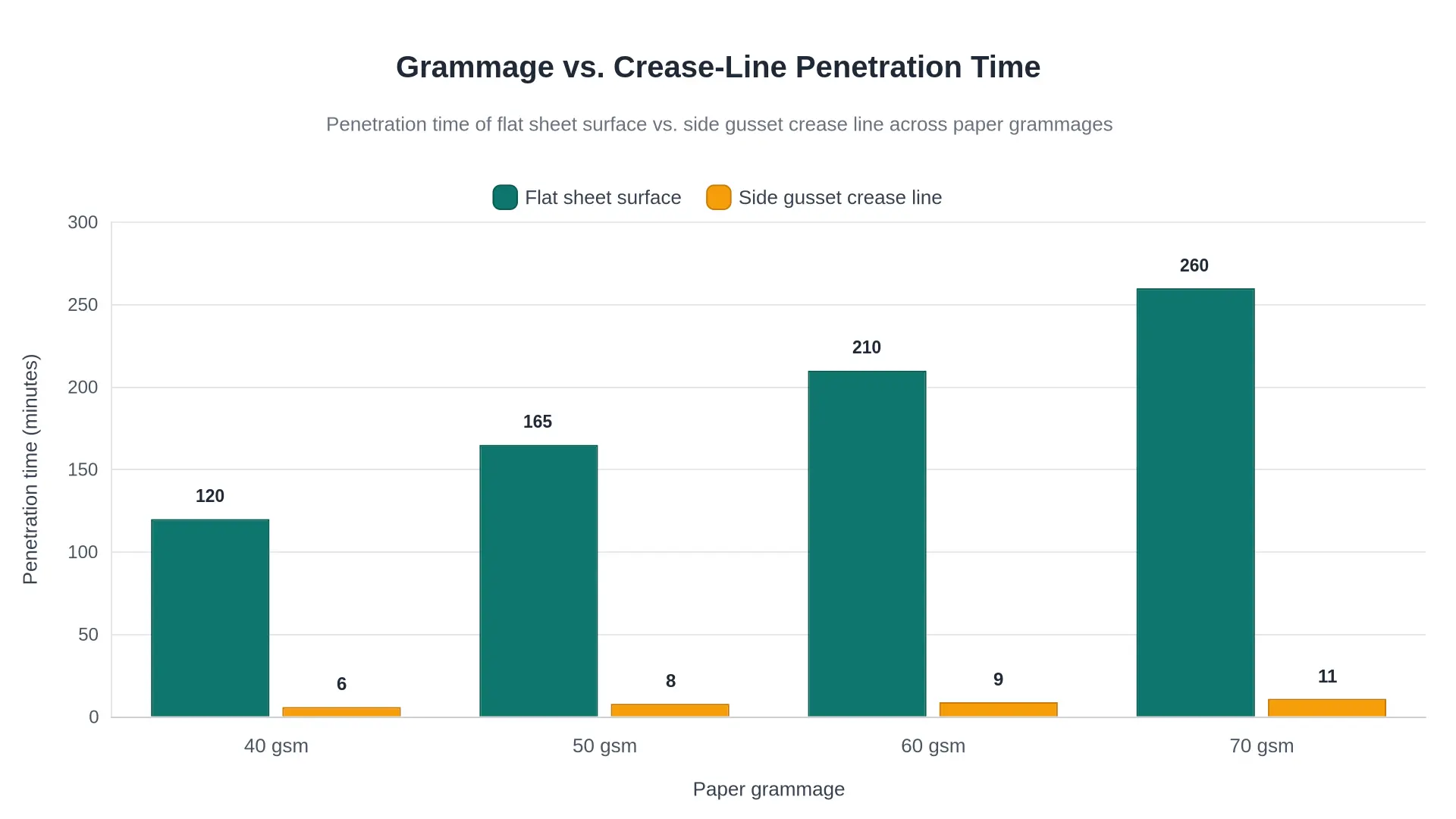
Why a grammage increase never closes the channel
Grammage adds mass to the flat panels. It does improve flat-surface kit rating and lengthen flat-area penetration time, which is why a data sheet looks reassuring. It does nothing for the crease, because crease damage is a mechanical event governed by fibre length, refining level, sheet moisture at folding, crease bar geometry, fold pressure and grain direction – none of which change when you buy a heavier sheet.
The relationship can even invert. Thicker stock has higher bending stiffness, so folding it strains the outer surface harder and can open a wider fracture than a lighter sheet on the same equipment. Mass sits in the panels; the leak sits on the line.
What actually closes the crease channel:
- Barrier placement. Put the grease-resistant layer on the inner face, where the fold is in compression, rather than the outer face where it is stretched to failure.
- Crease-friendly construction. Longer softwood fibre fractions, adequate stretch, and moisture controlled at the creaser keep fibres bridging the fold instead of snapping.
- Tooling discipline. Radiused crease bars and calibrated fold pressure reduce fracture without slowing the line.
- Better barrier chemistry. A continuous fluorochemical or film layer that survives folding beats extra mass; two-ply structures with a dedicated liner are the belt-and-braces option.
For procurement the practical move is to buy on creased-sample performance: put kit rating at the crease, penetration time at 60 °C and maximum stain area at 24 h into the purchase order, and require data from folded specimens. Suppliers who can talk about pore structure and fold strain in specifics are usually the ones whose grease-resistant paper bags survive a warm dispatch dock, not just a lab bench.
The short version: wicking is driven by pore radius, surface energy and viscosity. Creases enlarge the pores and shorten the path at the same time, so a heavier sheet only gives the oil more material to travel through. No amount of grammage seals a channel that a fold tore open.
Wicking Time: Creased vs Uncreased Areas
Before fixing a grammage, look at how fast grease actually moves. The bars below show measured penetration time for four common bread bag grades, flat sheet against the folded gusset line of the same sheet.
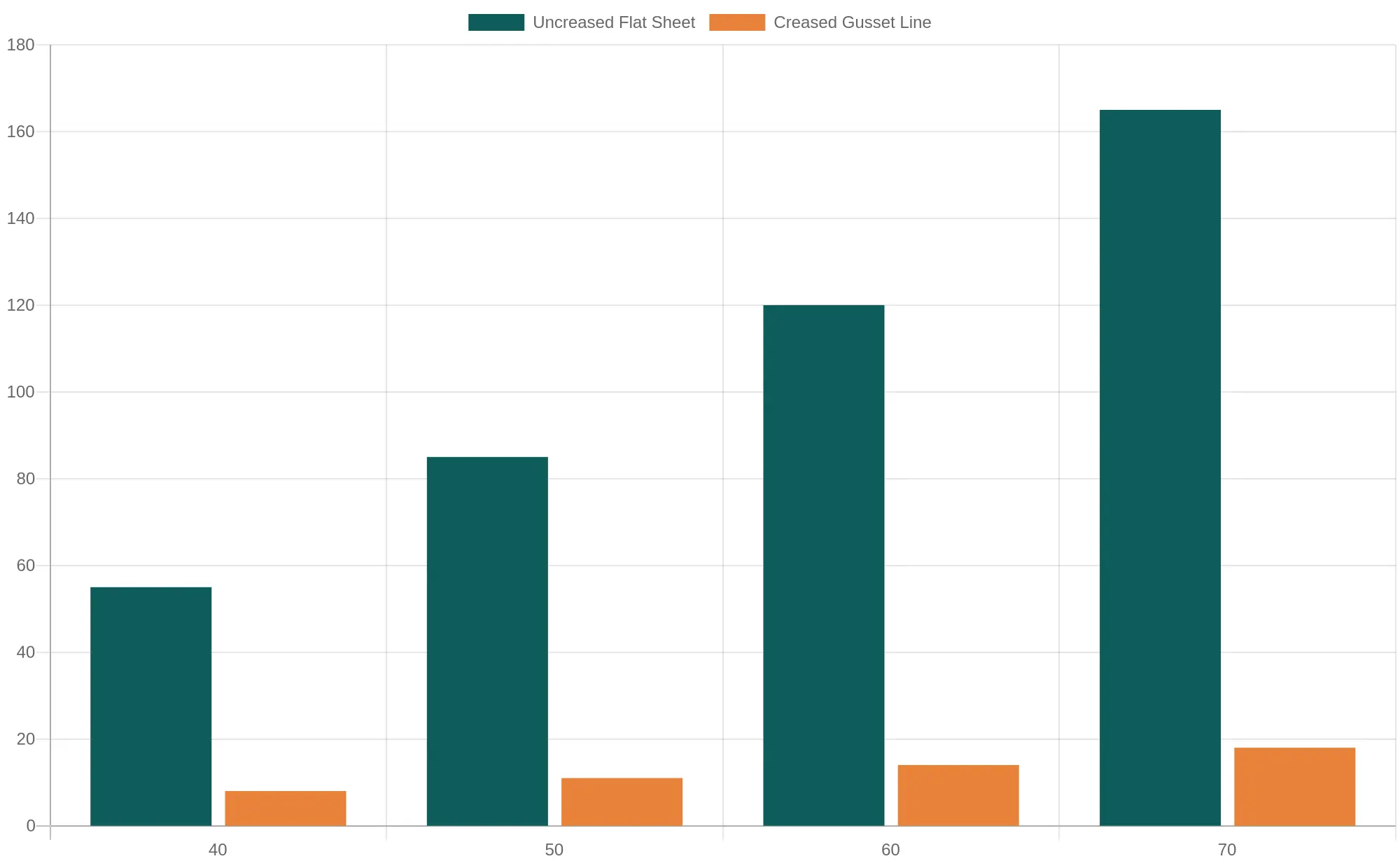
Figure 1. Measured penetration time (minutes) for uncreased flat sheet versus the creased side gusset line, by paper grammage. Takeaway: creased areas lose penetration resistance regardless of grammage – a heavy 70 gsm sheet at the crease fails far sooner than a light 40 gsm sheet in flat condition.
The Numbers Behind the Bars
| Grammage (gsm) | Uncreased Flat Sheet (min) | Creased Gusset Line (min) | Crease Retention |
|---|---|---|---|
| 40 | 55 | 8 | 15% |
| 50 | 85 | 11 | 13% |
| 60 | 120 | 14 | 12% |
| 70 | 165 | 18 | 11% |
Reading the Gap
The flat-sheet numbers climb with grammage: 55 minutes at 40 gsm, 165 at 70 gsm, roughly a threefold gain. The creased numbers barely move – every gusset sample lands between 8 and 18 minutes. The gap between the two bars widens as the paper gets heavier, which says the problem is not how much fibre you buy but what folding does to that fibre.
In practice, a bakery moving from 50 gsm to 70 gsm on a flat-panel bag will feel the extra body in the sheet, and often see no change at the gusset corners. Grease finds the crease first: the fibre structure is crushed at the fold, the barrier layer thins, micro-fissures open along the line, and oil moves through a path that grammage cannot close.
What This Means for Specification and Sourcing
- Stop buying grammage as a stand-alone guarantee. Heavier paper improves average performance, but crease integrity sets the real limit on a gusseted bag.
- Test the fold, not just the sheet. Ask your converter for penetration data measured across a creased sample; flat-sheet lab values flatter every grade, and every bag has to be folded.
- Look at crease-friendly structures. Higher stretch, better fibre bonding, or a barrier coating that survives folding will outperform a simple weight upgrade at the gusset line.
- Match the grade to the load, then engineer the crease. Very greasy or warm-filled products need both a sound base sheet and a fold that holds its barrier.
For finished constructions compared side by side, the paper bags category shows how gusset depth, sheet grade and closure style are combined in production-ready specs – a reasonable reference before renegotiating a grammage tier.
Grammage sells the sheet. The crease decides the bag.
Paper Grammage Is a Mass Spec, Not a Barrier Spec
Most bread bag briefs open with a single number: 60 gsm, 70 gsm, 80 gsm. It is the easiest figure to quote and the easiest to over-trust. Grammage tells you how much fibre is in the sheet. It does not tell you what the side gusset will do after a warm, oil-rich loaf has sat in the bag for eighteen hours.
What gsm Actually Measures
Grammage (also called substance or basis weight) is the oven-dry mass of paper per unit area, expressed in grams per square metre and tested to ISO 536 on conditioned samples, typically 23 °C and 50% relative humidity. A 70 gsm sheet carries 70 g of fibre, filler and coating across one square metre. That is all it says.
So gsm is a yield specification and a cost specification. It tells procurement how far a tonne of paper will stretch and roughly what the material in each bag costs. It says nothing about caliper, density, pore size distribution, coating continuity, surface smoothness, or how the sheet behaves under a creasing rule. Two sheets can both read 70 gsm and act like different materials on the same line.
Caliper and Apparent Density Drive Grease Behaviour
Caliper is thickness, measured to ISO 534 in micrometres. Divide grammage by caliper in microns and you get apparent density in g/cm³ – the figure that actually predicts how tightly the fibre network is packed:
- 70 gsm at 90 microns = 0.78 g/cm³ (dense, closed sheet)
- 70 gsm at 130 microns = 0.54 g/cm³ (bulky, open sheet)
Same grammage, and one sheet is 44% denser than the other. Grease does not migrate through mass, it migrates through connected voids. Capillary pressure goes as 2γcosθ divided by pore radius, so small pore throats and a long, tortuous path slow wicking sharply. That is why porosity tests (Gurley seconds, Bendtsen airflow) and a kit rating say more about barrier performance than the gsm on the mill certificate.
One caution: porosity data is an average, and wicking starts at the worst point. A sheet with an excellent average Gurley value can still leak through one pinhole or one crushed crease.
Furnish Changes Pore Structure at the Same Grammage
Furnish decides the shape of those voids, even when the scale reads identically.
| Furnish | Fibre profile | Typical caliper at 70 gsm | Apparent density | Void and defect profile | Practical behaviour |
|---|---|---|---|---|---|
| Virgin unbleached kraft, softwood | Long softwood fibres, low fines | 100 – 115 microns | 0.61 – 0.70 g/cm³ | Open but strong, few pinholes | Creases cleanly, holds coating continuity, good tear |
| Recycled, mixed recovered fibre | Shortened fibres, high fines and filler, residual contaminants | 88 – 100 microns | 0.70 – 0.80 g/cm³ | Flocculated, pinholes, shive spots | Looks closed, leaks at local weak points |
| Virgin hardwood, high bonding | Short thin fibres, heavy refining | 85 – 95 microns | 0.74 – 0.82 g/cm³ | Very dense, smooth, closed | Superb print, higher crease cracking risk |
Long softwood kraft builds a strong, slightly open network that bends without shattering. Recycled fibre brings fines that close pores on average while contaminants and flocs create isolated channels, so the sheet passes a lab porosity test and fails in a bag. Hardwood gives the best print surface and the densest, least compressible sheet, which is the least forgiving under a creasing blade.
Why 70 gsm Can Wick Faster Than 50 gsm
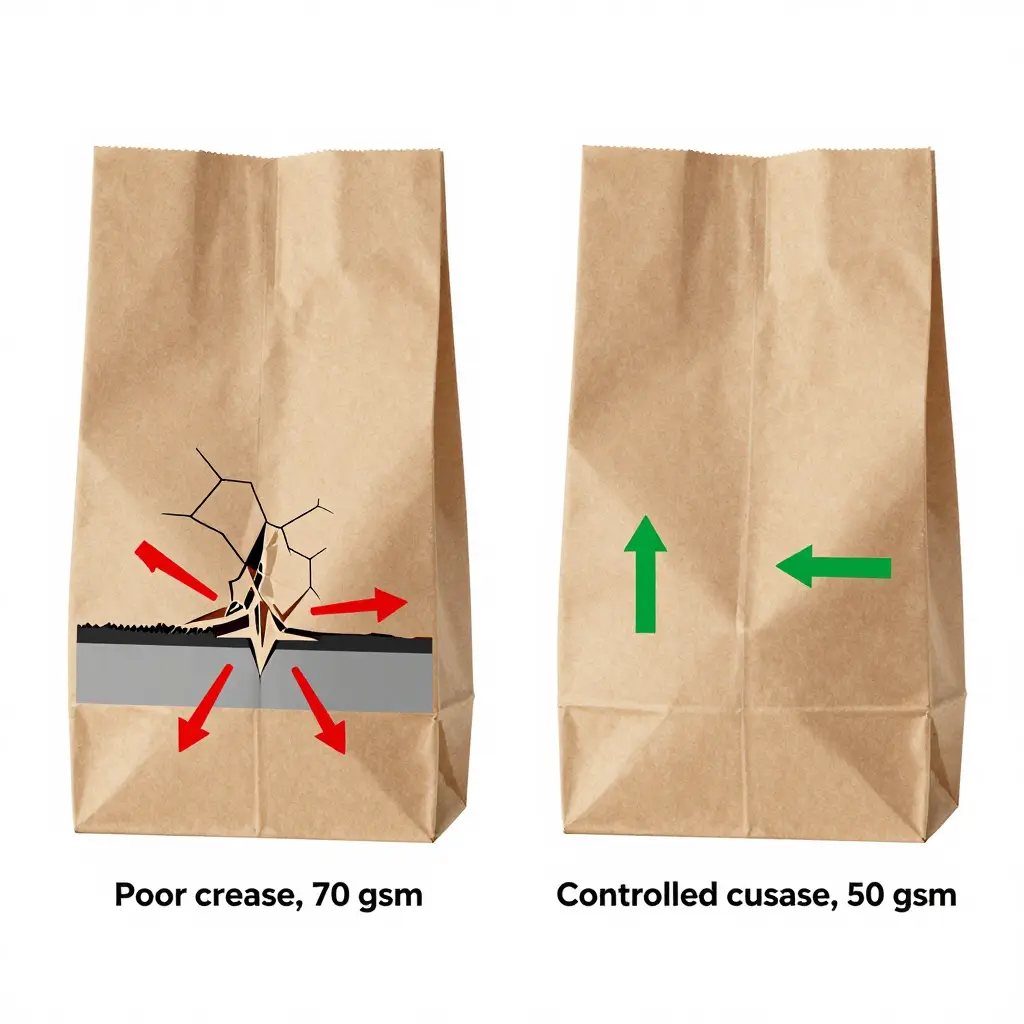
Grease rarely fails a bread bag in the middle of a panel. It fails along the side gusset crease, and crease quality is set by bending strain at the fold, roughly thickness divided by twice the crease radius. Thicker paper means more surface strain on the outside of the fold. Crease a 70 gsm sheet with a sharp blade on a worn matrix, at low moisture, and you crack the coating and break fibre bonds along a single line. That line runs the full height of the bag and works as a capillary channel.
A 50 gsm sheet with better process control does the opposite: rounded crease geometry, a matched matrix, moisture in the right window, pre-breaking, and a grease-resistant dispersion coating that stays continuous across the fold. The lighter sheet also bends with less strain, so the coating is asked to stretch less.
So the 70 gsm bag wicks faster because the extra grammage added cost without adding barrier integrity. Heavier paper does not repair a line defect. It tends to concentrate stress on one.
The Trade-Offs of Going Heavier
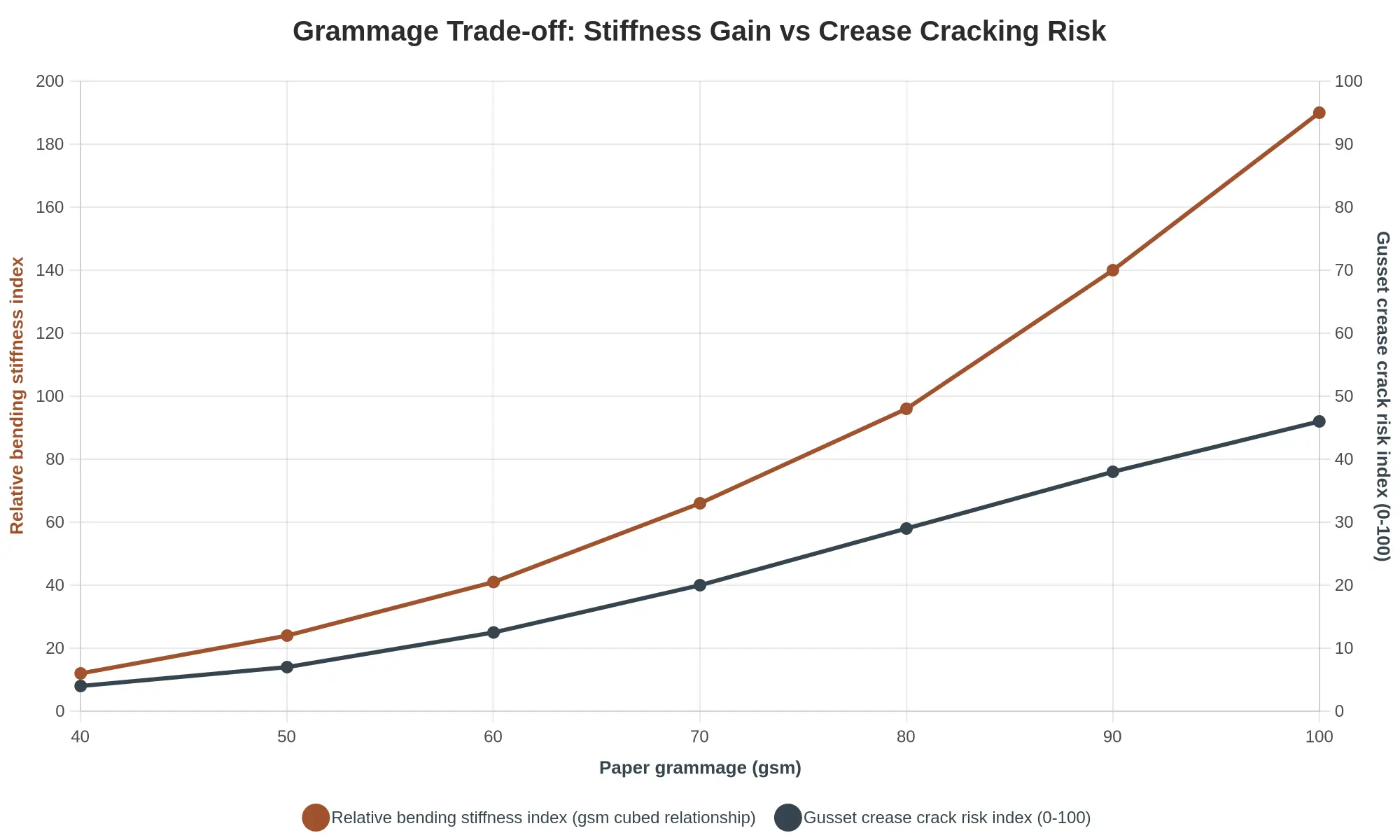
Bending stiffness rises with the cube of thickness, and at constant density thickness tracks grammage, so the curve is steep:
- 70 to 100 gsm lifts relative stiffness by roughly 2.9 times, not 1.4 times. Going from 40 to 100 gsm is more than a tenfold jump.
- Cost per bag rises close to linearly with grammage. A mid-size side gusset bag carries roughly 8 to 12 g of paper, so a 20% grammage increase is a 20% material increase per unit, plus fewer bags per tonne and heavier freight.
- Print surface gets bulkier and more open as grammage climbs in uncalibrated sheets, increasing ink absorption, mottling and dot gain, unless the mill calenders or coats to compensate.
- Foldability suffers. Higher caliper means more bending strain, more spring-back and stronger fold memory, which shows up as a bag that will not sit flat on the line.
- Gusset cracking risk climbs fastest of all, because crease strain scales with thickness while crease radii are fixed by tooling.
| Grammage band | Typical bread application | Watch out for |
|---|---|---|
| 40 – 50 gsm | Light baguettes, sandwich bread, short display | Low stiffness, tear at gusset, needs barrier treatment to earn its place |
| 55 – 70 gsm | Standard artisan loaves, sourdough | The sweet spot only if creasing and coating are controlled |
| 75 – 90 gsm | Heavy crusty loaves, brioche, focaccia | Crease cracking, cost per bag, slower forming speeds |
| 95 gsm and above | Panettone, very heavy or long-display products | Maximum crease risk, premium material cost, reduced yield |
Specify Grammage as a System, Not a Number
Buying on gsm alone is buying weight instead of performance. A specification worth writing pairs grammage with a caliper range, an apparent density target, a furnish declaration, a porosity or grease-resistance test, and a documented crease condition with a visual crack rating after folding. That combination is what keeps oil inside the bag.
If you are reviewing a bread bag construction, the OEM paper bags range shows how grammage, caliper and barrier treatment are specified together rather than one at a time, so the sheet can be matched to the loaf instead of guessed at.
Grammage vs Crease Performance: A Procurement Decision Matrix
The matrix is for shortlisting a barrier-treated grammage before a specification is locked. What matters in a side gusset bag is the barrier that survives the crease, not the one measured on a flat sheet. The bread paper bags range shows how these grades map onto real gusset formats.
| Paper grammage (gsm) | Typical caliper | Grease resistance kit rating | Creased-area penetration behaviour | Crease cracking risk | Cost per 1,000 bags index | Typical suitable bread categories |
|---|---|---|---|---|---|---|
| 40 gsm | 55-60 um | Kit 5-6 | Wicking at gusset apex within 2-4 h | High | 78 | Lean crusty rolls, baguettes, short distribution |
| 50 gsm | 70-75 um | Kit 6-8 | Creep-through along crease in 6-10 h, edge halo | High to moderate | 88 | Lean sourdough, sandwich loaves, same-day sale |
| 60 gsm | 85-90 um | Kit 8-10 | Slow creep 12-24 h, spotting under load only | Moderate | 100 | Butter croissants, brioche, milk bread |
| 70 gsm | 100-105 um | Kit 9-11 | Minimal migration over 24-48 h, no breakthrough | Low to moderate | 113 | Focaccia, laminated pastry, panettone slices |
| 80 gsm | 115-120 um | Kit 10-12 | Stable beyond 48 h, stain confined to crease line | Low | 126 | High-fat enriched loaves, pizza-style bases, long shelf life |
Note: All values are indicative engineering ranges drawn from typical barrier-treated machine-glazed and coated stocks, and they shift with coating weight, crease geometry, filling temperature and storage conditions. Confirm every candidate grade with crease-based testing, including creased kit tests, a 60 °C oven hold and a compression trial on your own gusset profile, before releasing a purchase order.
Before signing off a sample run from a new OEM bread paper bags supplier, inspect the folds rather than judging the bag by its flat panels.
- Verify crease depth and blade radius against the approved tooling drawing. A shallow crease or an over-sharp blade concentrates stress at the fold and opens micro-channels that let grease travel along your side gusset creases.
- Backlight every gusset fold line and look for fibre cracking, whitening, or a dry split. Any fissure along the fold is a wicking path, even when the flat panel beside it looks flawless.
- Run the grease spot test directly on a crease, not on a flat panel. A flat-panel result describes the paper; a crease result describes the bag that actually reaches your customer.
- Set a minimum penetration time threshold in writing – for example, no visible strike-through at 30 minutes – and reject any lot that falls short of it.
- Match gusset depth to loading weight. Deep gussets carrying heavy, warm loaves flex more at the crease and need a stronger, better-formed fold than shallow gussets on light rolls.
- Check print registration and coating continuity within a few millimetres of every fold line. Coating gaps and misregistered ink sitting right at the crease are the first places grease shows.
- Condition samples at elevated humidity, around 80% RH, before folding and re-folding them. Damp storage changes how the sheet creases, so test at the humidity your warehouse actually delivers.
Log every result on a signed sample card and keep it as the reference for each reorder. A crease that passed today is the only one worth repeating, and constructions can be compared in the paper bag range before the specification is finalised.
The Crease-First Qualification Sequence: A Four-Step Evaluation Flow
Most failed grease-barrier trials judge the flat sheet first and the folded geometry last, or not at all. Reverse the habit: qualify the crease, load it with grease, measure what penetrates, then approve the written specification. The diagram shows the order; the paragraphs below explain what each stage is actually checking.

Step 1 – Fold: Reproduce the Real Gusset Geometry
The first box is a folding action, not a measuring one. Take production-intent bag blanks and form the side gussets the way the filling line will – same crease pressure, same fold direction, same number of crease cycles at the gusset shoulder. A side gusset is not a single bend; it is a converging set of folds where four paper layers meet at a point, and that point takes the most compression and fails first. Record crease depth, crease width, fold direction and whether the blank was pre-scored. Two blanks that look identical can behave very differently here, which is why this step comes first and has to be repeatable.
Step 2 – Add Grease Load: Apply the Actual Bakery Contact Condition
With the gusset formed, apply the load the bag will genuinely see: the real product, at the real temperature, for the real contact time. A warm, butter-rich laminated dough resting against the gusset corner is a far harsher test than a room-temperature oil spot on a flat sheet. Place the load against the crease, keep the bag in its filled orientation, and hold it in the conditions of your cooling or display environment. This is where wicking starts – liquefied fat travelling along the compressed fibres inside the crease, long before anything reaches the flat panel.
Step 3 – Measure Penetration: Grade the Crease, Not Just the Sheet
Then measure. Cut the crease open, separate the plies, and assess penetration depth, stain area and edge bleed at the fold line itself, against a flat control from the same blank. Read side by side, the two numbers give the crease penalty: the barrier performance lost purely to folding. Record it against your own grease-resistance target rather than a single sheet number, because two papers with identical grammage can diverge sharply once creased.
| Stage | What you record | What it tells you |
|---|---|---|
| Fold | Crease depth, width, fold direction, pre-scoring | Whether the gusset geometry matches production |
| Grease load | Product, temperature, contact time, orientation | Whether the test reflects real bakery conditions |
| Penetration | Depth, stain area, edge bleed, flat control reading | The crease penalty on barrier performance |
| Approve | Agreed limits, ply and grammage spec, reference sample | What the supplier is contractually held to |
Step 4 – Approve Specification: Lock the Numbers You Just Verified
Approve only after the first three steps agree. The approved document should name the paper grade and grammage, the ply structure, the crease specification used in the trial, the grease-resistance limit measured at the crease, and the test conditions that produced it. Keep a sealed reference bag with the paperwork so incoming shipments are checked against a physical benchmark rather than a memory. When you source side gusset paper bags for bakery use, ask the supplier to sign off on the crease-first sequence; it turns a vague promise about greaseproof paper into an auditable record your quality team can reuse on every order.
FAQ: Grease Wicking and Side Gusset Creases in Bread Paper Bags
Does a higher paper grammage stop grease wicking in bread paper bags?
No. Grammage adds bulk and tensile strength, not barrier performance. Melted fat moves through the same open, interconnected fibre network whatever the sheet thickness; a 60 gsm and a 90 gsm sheet will both wick, and the heavier one simply holds more oil before the stain shows on the outside. Weight buys a longer grace period, not grease resistance.
Why do side gusset creases wick grease first?
Creasing fractures fibre-to-fibre bonds and compresses the sheet at the fold line, leaving a low-density capillary channel. The stress concentrates in a narrow band, and when the gusset is expanded to load product that band opens into micro-cracks running through the wall thickness. That is why a leaking bag usually shows a clean panel with a dark line of penetration tracking the gusset: the crease is the weakest point in the structure, not the flat panel.
What test should be used to evaluate crease-line grease resistance?
Run a Kit test (TAPPI T 559) or a 60 °C oil soak on creased specimens, and report the crease result separately from the flat result. Form the gusset folds under controlled pressure and temperature so the crease matches production converting, then fold-expand each sample before exposure. A flat-sheet Kit value on its own is misleading for OEM bread paper bags: a sheet rated Kit 8 flat can drop several levels at the crease and still look compliant on the supplier’s certificate.
Does barrier coating or grammage solve stain-through more reliably?
A coating, because it addresses the transport mechanism rather than the reservoir volume. A dispersion or wax-based coating that penetrates the fibre structure and survives folding gives holdout on the panel and on the crease, while a grammage increase only moves the failure threshold. Specify a coated sheet with crease-tested holdout values and treat grammage as a secondary lever for stiffness and machinability. For matched formats, look at the bakery paper bag range and ask for crease-line data alongside the standard barrier reports.
Implementation Summary: Qualify the Fold, Not Just the Sheet
A bread bag specification is only as reliable as its weakest fold. Before an order is confirmed, three parameters belong on one document: crease geometry (width, depth and residual thickness at the side gusset), crease-line grease performance after repeated flexing, and base paper grammage. Grammage describes how much fibre sits in the sheet. It says nothing about what the sheet does once it has been compressed, cracked and worked along a gusset on a packing line.
So test folded specimens, not flat stock. Crease a strip through the same angle and cycle count the bag will see in service, then run the grease-resistance method on the crease line rather than a clean panel. A sheet that passes flat and fails at the crease clears incoming inspection and still leaks fat into the corrugate.
Every production lot should then be qualified the same way: same crease profile, same fold count, same test method, same acceptance threshold. Documenting that routine alongside your paper packaging range turns an anecdotal quality claim into a purchasing standard.
What the Discipline Delivers
The commercial effect accumulates. Fold-based acceptance criteria catch marginal lots before they reach the line, so rejection rates at bagging fall. Steady crease-line performance cuts the staining and sogginess behind customer complaints and credit notes. Fewer bags are scrapped, reworked or replaced after dispatch, and cost per unit shipped comes down – often with no change to grammage.
The material is already moving. Recyclable grease-resistant paper is shifting from water-based barrier dispersions and PFAS-free chemistries to repulpable coated grades that hold a crease without cracking. When those grades reach commercial volume, the same fold-based protocol is what will prove they are ready.