
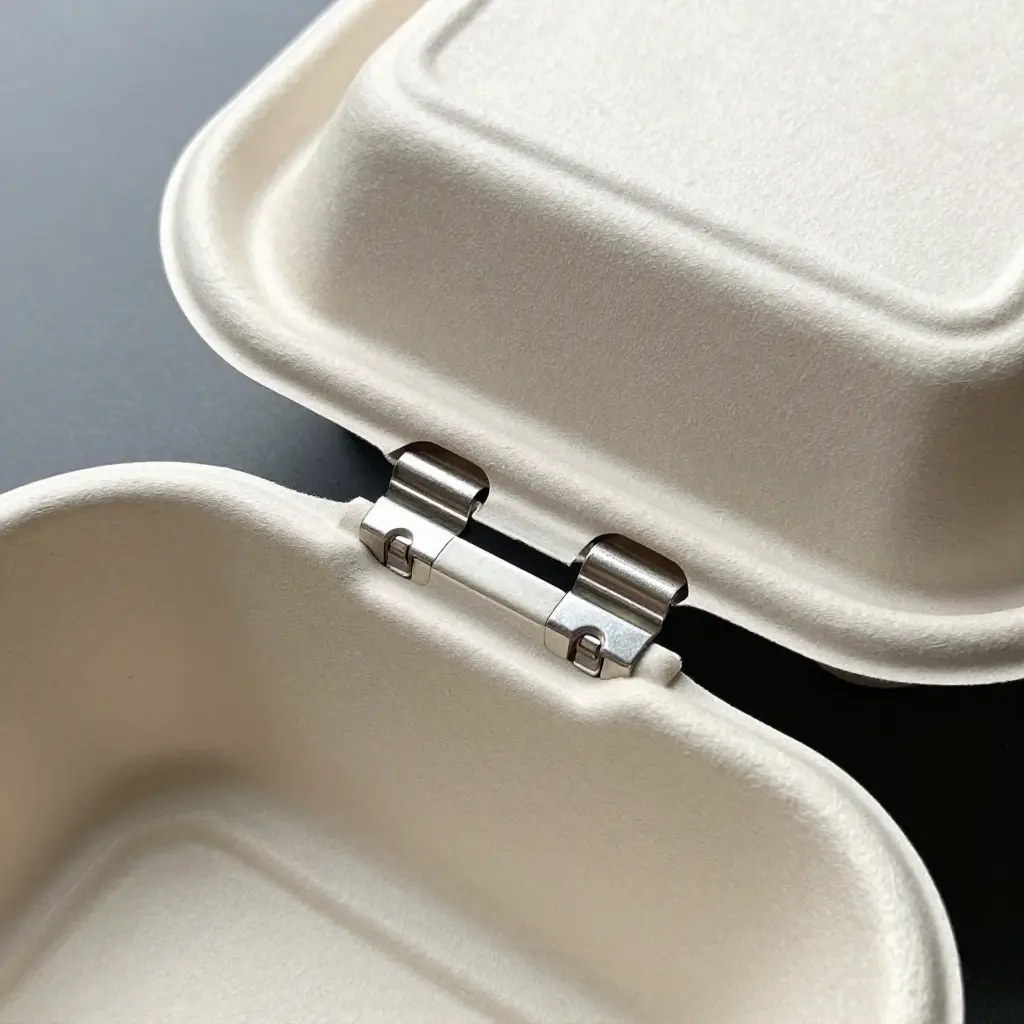
Why Compostable Hamburger Box Lids Pop Open: A Hinge Score Depth vs. Board Moisture Diagnosis
Compostable hamburger box lids are the hinged closures on molded-fiber and PLA-coated clamshells. They have to stay shut from the packing line to the customer’s handoff. Two variables decide whether they do: hinge score depth, the crease pressed or cut into the hinge line to make the fold repeatable, and board moisture, the water still in the fiber or coated substrate when that fold bends under load. Push either one outside its tolerance window and the lid reopens on the counter instead of in the trash.
The failure modes below apply to compostable clamshell lids and containers made from molded fiber and PLA-coated board. What follows is the mechanical cause behind each one, how to measure enough to isolate the real root cause, and the process windows that bring lid retention back.
Three complaints come up most often from the line and the field:
- Lids spring open after packing. An over-scored or under-dried hinge holds elastic energy, and once the box is loaded and stacked that energy beats the closure geometry.
- Hinge fatigue cracking. Open-close cycles propagate microcracks along the score until the hinge tears or loses its hinge-force memory.
- Closure varies from lot to lot. Moisture and score depth drift batch to batch, so closure force leaves the specified range and field performance becomes hard to predict.
All three come back to the same tension: score depth sets how stiff the fold is, board moisture sets how brittle it is. Get both right and the lid latches. Miss either and it pops.
How Hinge Score Depth Governs Lid Closure Performance
Every compostable clamshell has one crease doing most of the work: the hinge score. Hinge score depth, the amount of material removed or compressed along that crease, decides whether a lid snaps shut and stays shut. Miss it by a few thousandths of an inch and you get popping lids, cracked hinges, or both.
The geometry of the score line
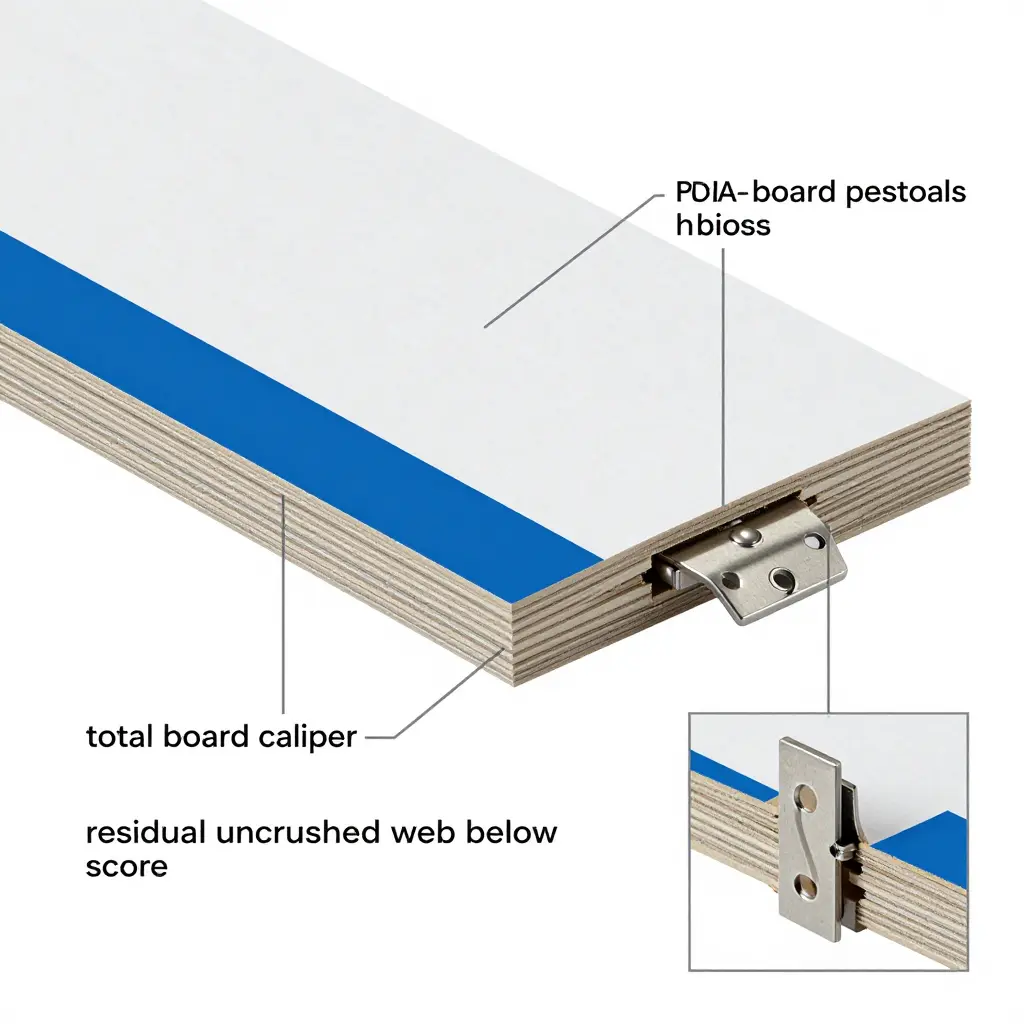
A score line is a controlled indentation, or cut, that forms a living hinge. The material left intact beneath the crease, the residual web, is the pivot the lid turns on. Score depth is measured from the board surface to the base of the crease, and it is quoted as a ratio against total board caliper rather than as an absolute number.
Depth versus board thickness
Everything depends on the depth-to-caliper ratio. A shallow score leaves a thick, stiff residual web; a deep score leaves a thin, flexible one. The ratio, not the raw depth, is what carries from one material lot to the next, so that is the number your spec sheet should control.
Too shallow: folding resistance and rebound
When the score is too shallow, the residual web still has most of its fibers intact. They resist bending, and the hinge stores elastic energy as the lid closes. Let go and that energy drives the lid straight back open. This is the classic rebound behind popping lids on the line and in the customer’s hands.
Too deep: hinge weakening and fatigue cracking
An over-deep score thins the residual web until it can no longer carry repeated flexing. Every open-close cycle strains the fibers that are left, and cracks begin along the crease. The lid may close perfectly on the first fold and fail after a handful more. That is fatigue, not fit.
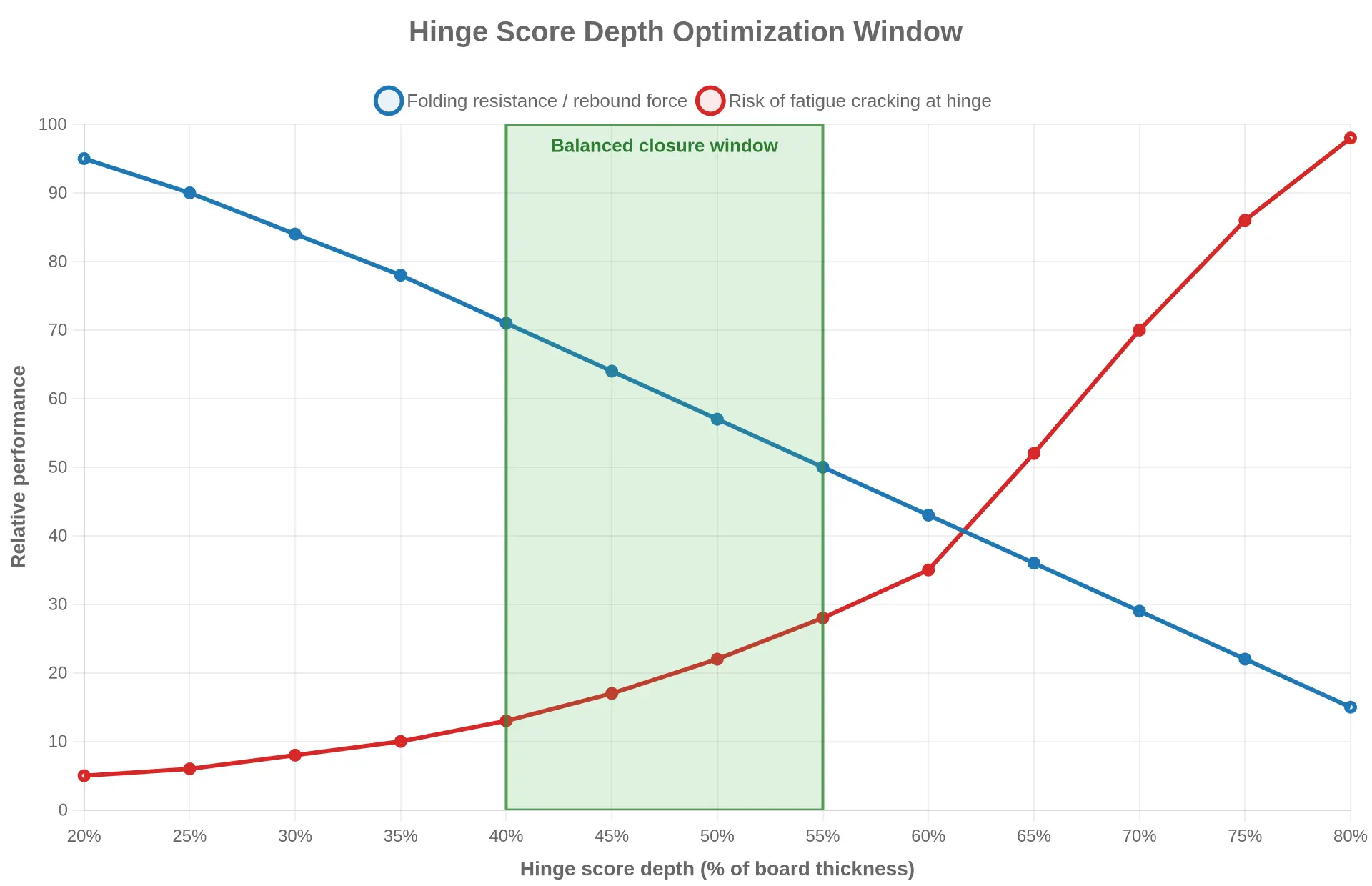
The two forces pull against each other: as score depth climbs, rebound drops and fatigue-cracking risk rises. The shaded band is where both stay low.
Typical hinge score depth ranges
| Substrate | Typical hinge score depth | Design note |
|---|---|---|
| PLA-coated board | 45-55% of caliper | Leaves 45-55% residual web for flex life |
| Molded fiber | 30-50% of effective wall thickness | Often a coined/compressed hinge rather than a cut |
Treat these as starting points. Board moisture, fiber furnish, and the score-line geometry all move the optimum, so confirm the range with your own fold-and-fatigue testing. If you are sourcing precision-lidded clamshell containers, check that the supplier controls score depth as a percentage of caliper rather than a fixed tool dimension.
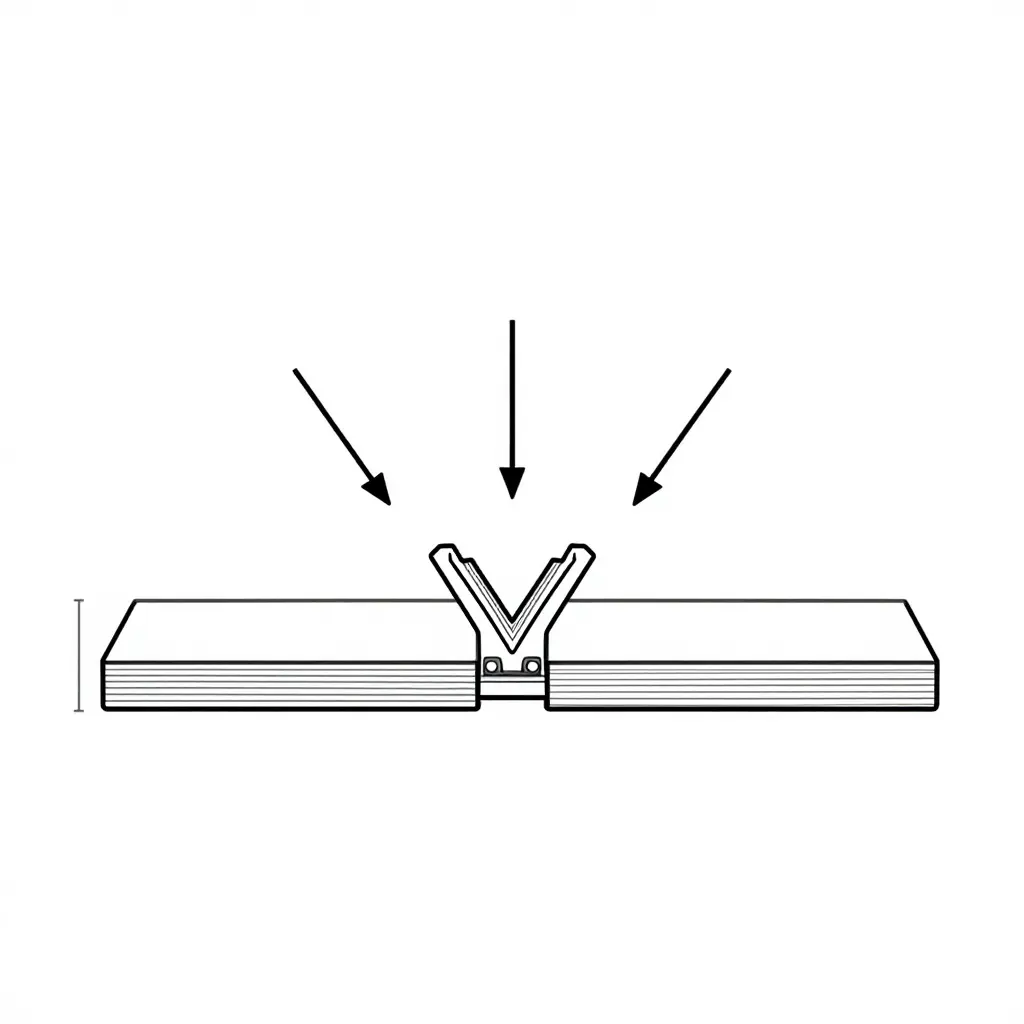
Figure: Hinge score depth variants in a compostable board lid cross-section.
The schematic isolates one variable, how far the score penetrates the board, and shows the same board thickness with three score profiles:
- Shallow score. The channel barely breaks the surface, the board resists bending, and the lid springs back toward open.
- Optimal score. The channel reaches the correct residual thickness, giving a clean, repeatable 90-degree fold that stays closed.
- Over-deep score. The channel cuts too far into what is left, and the hinge cracks, fatigues, or collapses under repeated cycling.
When you are chasing a pop-open complaint, measure the residual thickness under the score, not just the depth, and compare it with the fold angle the lid geometry actually needs.
How Board Moisture Content Governs Hinge Behavior
Board moisture content (MC) is the water held inside the paperboard or molded-fiber substrate, measured as a percentage of its oven-dry weight. In a compostable burger box it decides whether the lid snaps shut, sags open, or cracks along the score. Get the score depth right and ignore moisture, and the lid still pops open in the field.
Equilibrium Moisture Content Sets the Baseline
Fiber-based board constantly exchanges water with the air around it, absorbing or releasing moisture until it reaches equilibrium moisture content (EMC) with the surrounding relative humidity (RH) and temperature. That equilibrium value, not the spec sheet, is what the hinge actually sees when the box reaches the customer.
| Material | Typical equilibrium MC at 50% RH | Practical operating window |
|---|---|---|
| Molded fiber (bagasse) | 8 – 12% | 7 – 11% |
| PLA-coated paperboard | 5 – 8% | 4 – 7% |
| Uncoated virgin paperboard | 6 – 9% | 5 – 8% |
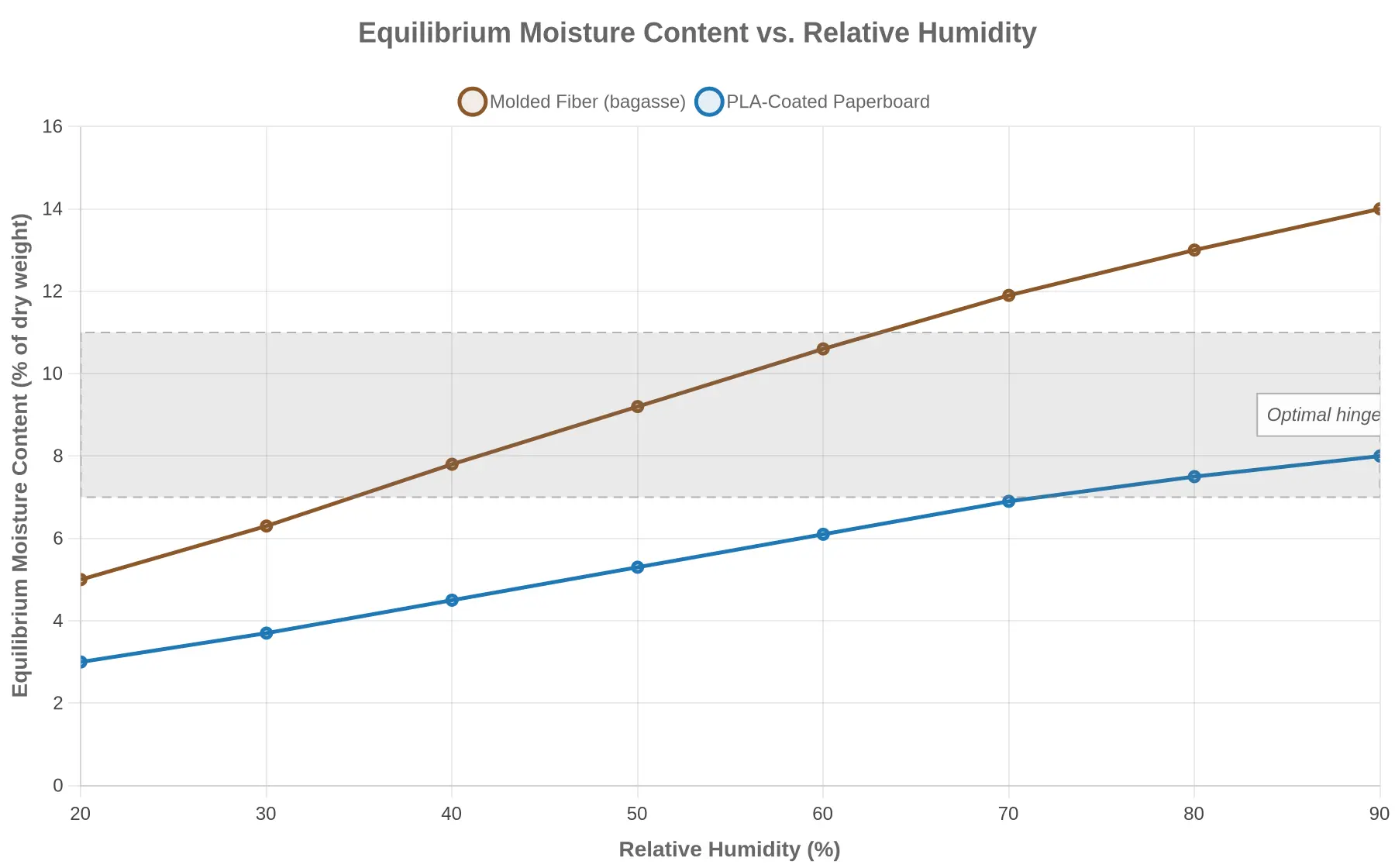
Equilibrium moisture rises with ambient humidity; stay inside the shaded band and the hinge keeps working as designed.
Excess Moisture: Soft, Swollen, and Sagging Lids
High board moisture softens molded fiber. Water plasticizes the cellulose-lignin network and acts like a built-in lubricant between fibers. Stiffness drops, the score region yields instead of holding a crisp fold, and the hinge loses its memory, so lids go limp, stay shut, or sag.
PLA-coated board swells asymmetrically. The fiber core swells while the PLA skin holds it back, which builds stress at the score line and leaves a wavy, cupped lid with reduced hinge memory. A pallet stored at 80% RH in a humid warehouse can push molded fiber above 13% MC within days, well outside the working window.
Low Moisture: Brittle Springs and Cracked Scores
Too little moisture makes board brittle. Below roughly 5 – 6% MC, fibers lose their flexibility, the score turns glassy, and the hinge behaves like a spring. Lids pop open, and repeated flexing concentrates stress until the board cracks clean through at the score. Cold, dry air-conditioned trucks and winter distribution are the usual culprits, routinely pulling board under 4% MC.
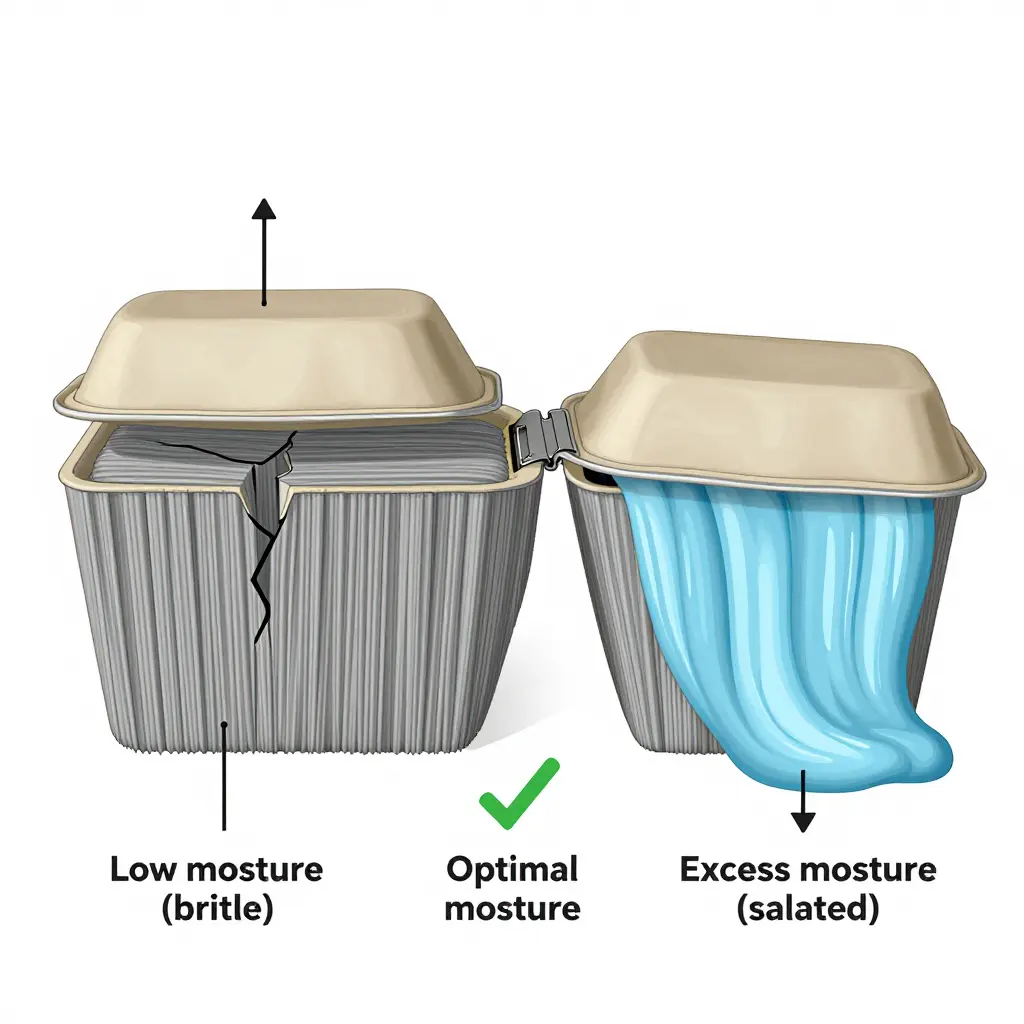
One hinge, three failure modes: brittle board cracks, saturated board sags, and only the middle holds a set.
Why Storage and Transport Matter So Much
Board moisture is not fixed at the factory. Ambient humidity during warehousing and shipping shifts EMC continuously, and a swing from 30% to 80% RH can move molded fiber by 8 points or more. A hinge that passes in a dry lab can still fail at a coastal QSR or in a humid delivery van.
Actionable steps: specify incoming board at 8 – 10% MC for molded fiber, seal pallets in moisture-barrier film, and hold warehouse RH between 40% and 60%. For the finished container, a stable paper box construction built around a defined moisture window keeps hinge performance intact from kitchen to doorstep.
The Takeaway
Score depth and moisture have to be tuned together. Set the score for a mid-range 8 – 10% MC, then manage humidity so the board stays there. The lid will close crisply, hold its memory, and neither sag nor spring open.
Score Depth vs. Board Moisture: Troubleshooting Matrix
Most lid closure failures in compostable hamburger boxes trace back to the interaction between two variables: how deeply the hinge is scored and how much moisture the board carries at the moment of scoring. Neither acts alone. A score depth that performs flawlessly on a 9% moisture board will pop open on a 5% board and tear out on a 14% board. The matrix below maps the failure you are seeing to the corrective action.
| Score Depth | Board Moisture | Observed Lid Behavior | Root Cause | Recommended Fix |
|---|---|---|---|---|
| Shallow (under 40% of caliper) | Low (below 6%) | Lid springs open instantly; audible crack at the hinge | Brittle, under-scored fiber cannot fold without fracturing | Deepen score to 50-60% of caliper; recondition board to 8-10% MC |
| Shallow | Balanced (8-10%) | Lid pops open after 1-2 seconds (classic spring-back) | Residual bending stress never relieved at the hinge | Increase score depth by 0.1-0.15 mm |
| Shallow | High (above 12%) | Lid pops open; score line delaminates and pills | Soft, swollen fibers tear instead of creasing on a shallow score | Deepen score; reduce moisture to 8-10% before scoring |
| Optimal (50-60% of caliper) | Low (below 6%) | Intermittent popping; hairline cracks along the hinge | Correct geometry, but dry board is too brittle to hold a crease | Condition board to 8-10% MC; add humidified storage |
| Optimal | Balanced | Clean, consistent snap-shut; lid stays closed | Reference condition – no defect present | Maintain current spec; retain as the control sample |
| Optimal | High (above 12%) | Lid closes, then creeps open under load | Over-moisturized board loses stiffness; hinge fatigues | Cut moisture to 8-10%; verify drying line and sealing |
| Over-deep (above 70% of caliper) | Low (below 6%) | Lid flops loosely; hinge tears through | Excess material removed combined with brittle fibers | Reduce depth to 50-60%; raise moisture to 8-10% |
| Over-deep | Balanced | Lid closes but splits along the hinge line | Hinge over-weakened by too much fiber removal | Reduce score depth; inspect scoring die for wear |
| Over-deep | High (above 12%) | Hinge tears fully; lid detaches or will not hold | Over-scored soft board fails under minimal flex | Reduce depth; drop moisture to 8-10%; re-tool the die |
How to Read This Matrix
- Start with the center cell. "Optimal depth + balanced moisture" is the one combination that reliably snaps shut and stays shut. Every other cell is a deviation you can now name.
- Score depth drives spring-back; moisture drives tear strength. A shallow score leaves bending stress in the fiber and the lid pushes back open. An over-deep score removes the material that gives the hinge its memory and the hinge tears. Moisture sits under both effects, hardening the fiber until it cracks or softening it until it creases.
- Measure moisture before you touch the die. A single moisture swing can mimic either a shallow score or an over-deep one, so read board MC first. Retooling a die to fix a drying problem is the most expensive mistake in this workflow.
If you are sourcing compatible board and hinge geometry across a compostable line, pairing this diagnostic with a vetted paper packaging supplier keeps spec drift out of the next run.
Diagnosing Lid Pop-Open in Compostable Clamshell Containers
Pop-open failures in compostable clamshell containers trace back to hinge score depth or board moisture content. The two produce nearly identical field symptoms, which is why shotgun adjustments waste material, machine time, and yield. The sequence below gives packaging engineers a fast, repeatable way to isolate the actual culprit.
-
Establish a baseline. Close ten containers from the suspect lot and measure the lid-to-base gap at the front centerline with a feeler gauge. A gap above your spec tolerance (typically 1.5-2.0 mm) confirms a genuine pop-open issue, so go to step 2. If every lid closes cleanly in the lab, the failure is environmental or load-related, not a hinge or moisture defect.
-
Measure hinge score depth. With a depth gauge or dial-indicator score probe, take five readings along each hinge. If the average score depth falls below the target range (commonly 0.35-0.50 mm for molded fiber), the score is too shallow and the fold resists closure, so the root cause is geometry. If depth is within spec, continue to step 3.
-
Check board moisture content. Press a calibrated moisture meter against the hinge and sidewall in three locations. Readings above 8-9% point to excess moisture as the culprit, since saturated fiber swells, softens the score, and rebounds after compression. Readings below 7% mean score depth, not moisture, is driving the failure.
-
Evaluate hinge rebound time. Fold the lid fully 180 degrees, release it, and time the spring-back to a resting angle. Rapid rebound (under roughly 0.5 seconds) signals a shallow score or embrittled, over-dried fiber. A slow, sluggish rebound points back to high moisture.
-
Inspect the score line for fiber fracture. Under 10x magnification, check whether fibers are cleanly compressed or torn. Cracked, broken fibers mean the score is over-penetrated and weakening the hinge; a continuous, intact line confirms correct scoring.
-
Cross-check against controlled samples. Condition suspect and known-good samples at 30% and 70% relative humidity for 24 hours, then re-test closure. If the failure follows humidity, moisture is the driver; if it follows the tooling, score depth is the driver.
-
Apply and verify the fix. Adjust the scoring rule or dry the board accordingly, then re-run steps 1-4 on a fresh sample. Sign off only when gap, depth, and rebound all fall inside spec.
Interpreting the Results
Score depth and moisture interact, so a board that is borderline dry can mask a shallow score for weeks before field humidity exposes it. Measure both before changing tooling, and log readings by lot to catch drift early.
Results also depend on starting from consistent substrate and matched closures. Vetted molded fiber and hinged lid components keep baseline variation low, so the diagnostic data reflects the process rather than incoming material noise.
The Moisture Sweet Spot: Pop-Open Rate by Board Moisture Band
At a fixed hinge score depth, board moisture drives almost the entire pop-open failure rate. The chart and table below summarize representative quality-control sampling data from a production run of compostable hamburger box lids, across five moisture bands.
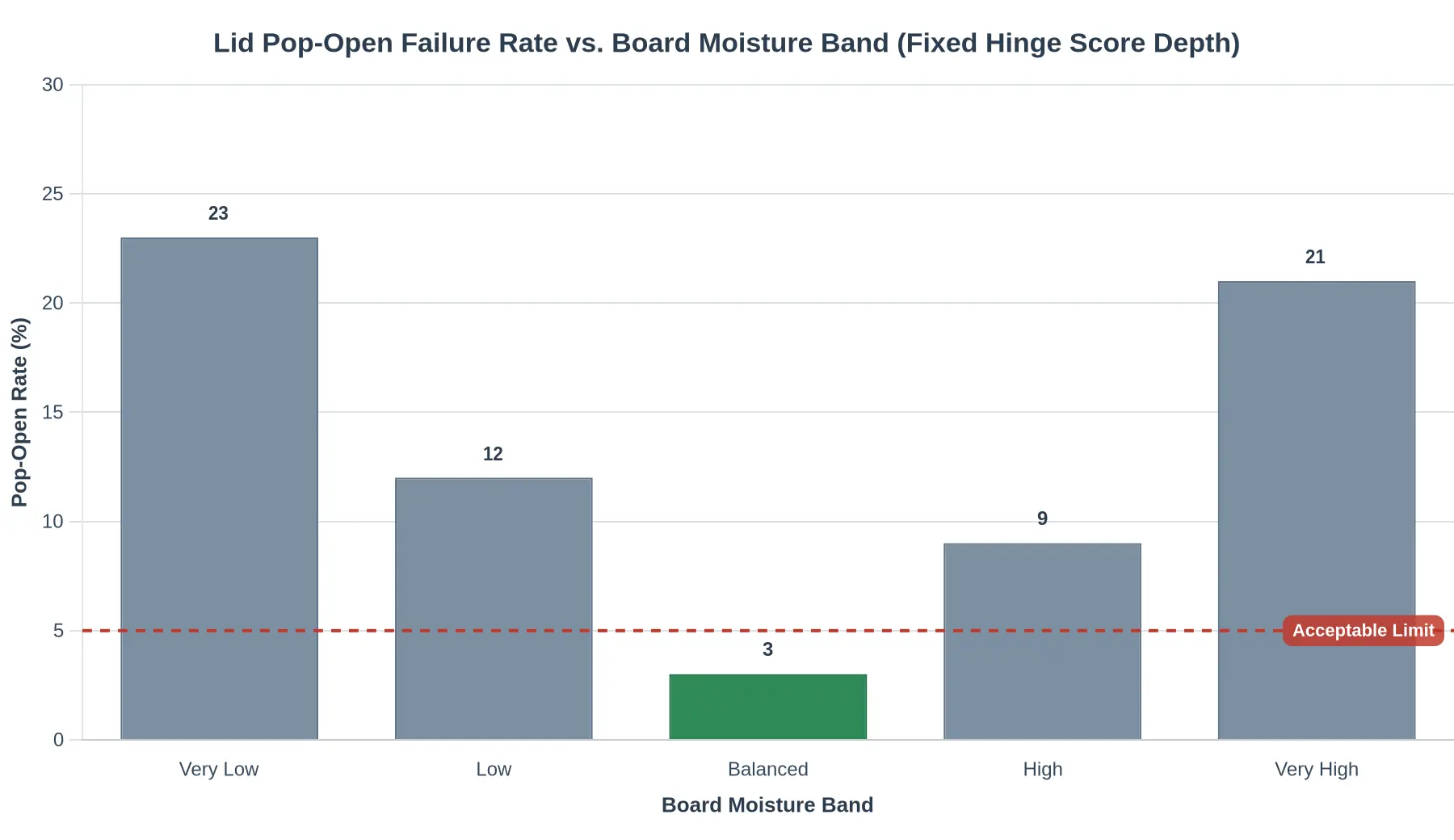
| Board Moisture Band | Pop-Open Rate (%) | QC Interpretation |
|---|---|---|
| Very Low | 23 | Brittle score, hinge cracks, lid springs open |
| Low | 12 | Marginal flexibility, inconsistent closure |
| Balanced | 3 | Optimal fiber-plasticization, reliable snap-shut |
| High | 9 | Soft hinge, creep and slow pop-open |
| Very High | 21 | Soggy score, no hinge memory, lid will not hold |
The failure curve is U-shaped, not linear. Balanced board moisture delivers a pop-open rate of just 3%, well under the 5% acceptable limit, while both moisture extremes push failures past 20%. Dry board makes the hinge brittle and it cracks; wet board makes it soft and memoryless. Matching reliable compostable lids to a target moisture window is the highest-leverage fix before touching hinge score geometry.
Hinge Score Depth and Board Moisture Are Not Independent Variables
On most converting lines, hinge score depth is locked in during tooling setup and then treated as a fixed specification, while board moisture is handled upstream as a raw-material tolerance. Keeping them separate is the most common reason compostable hamburger box lids pop open in the field even though both parameters passed their individual checks.
Closure retention is a system property. It comes from the interaction of score geometry and the fiber’s moisture state at forming, filling, and service. Change either one and you have changed the hinge.
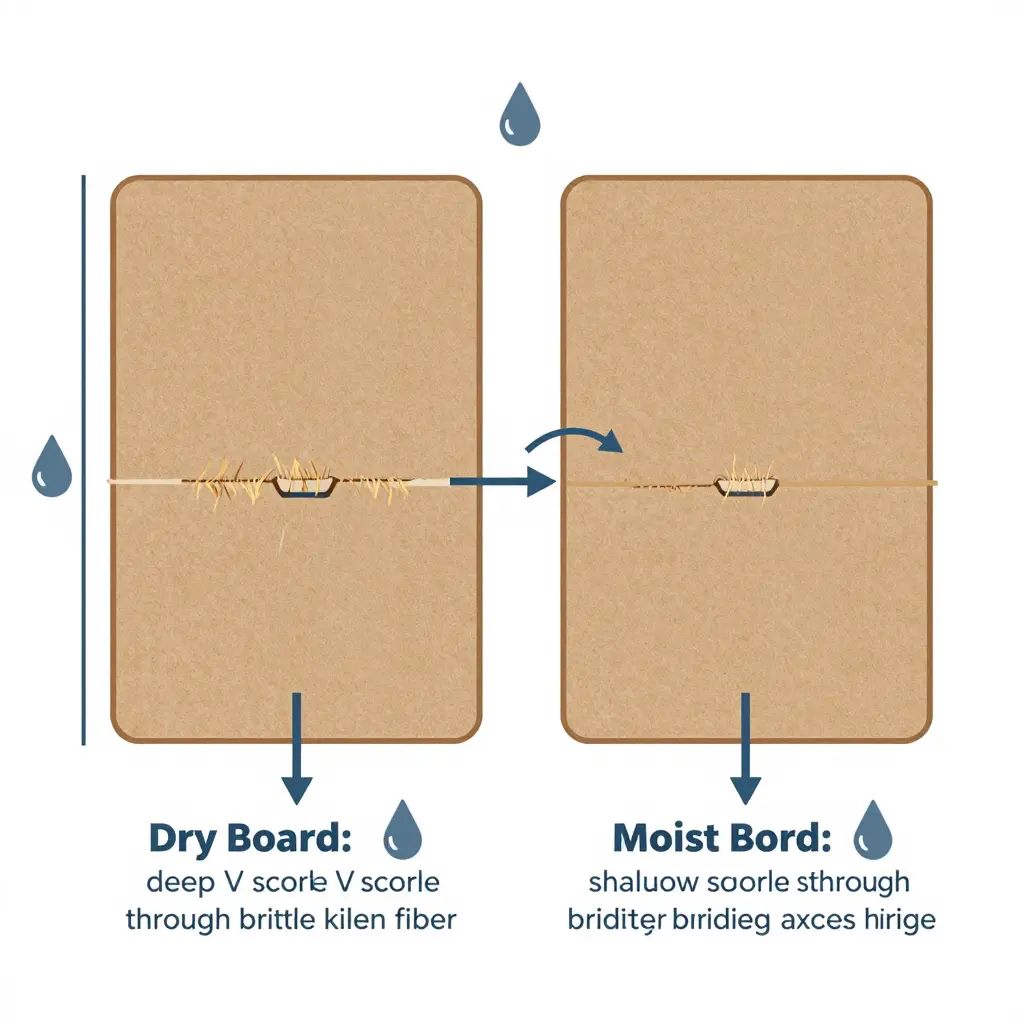
The Combined Mechanism: Stiffness, Fiber Tearing, and Elastic Rebound
Three mechanisms act at once at the score line, and moisture shifts the balance between them:
- Residual bending stiffness. A score that tears fewer fibers leaves more load-bearing material across the hinge. Dry fiber (3-5% MC) has a much higher modulus, so residual stiffness is high and the lid springs past the latch geometry.
- Fiber tearing efficiency. Moisture plasticizes the fiber cell walls. Wet, compliant fibers tear cleanly and need a shallower score; dry fibers fracture and dust instead of delaminating, so they demand more depth to reach the same separation.
- Elastic rebound. Intact, correctly plasticized fiber bridges act as small torsion springs that return the lid into the latch. Score too deep and the spring is gone; score too shallow and stiffness overpowers it.
Why a Dry-Board Score Fails on Moist Board – and Vice Versa
A depth optimized at 4% MC sits above the viable window once the board equilibrates to 11% MC in a humid kitchen. The mechanism inverts: the fiber bridges that once carried closure force have been severed, so the hinge has no rebound memory and the lid sags open under its own weight plus steam load. The reverse happens just as predictably. A shallow, moist-tuned score on brittle dry board leaves too much high-modulus fiber intact, and the lid springs open immediately.
| Board moisture state | Practical hinge score depth window | Dominant failure when paired with the wrong depth |
|---|---|---|
| Dry, 3-5% MC | 55-62% of caliper | Too shallow: stiffness-driven pop-open. Too deep: brittle fracture, dust, jagged hinge edge |
| Nominal, 6-8% MC | 42-48% of caliper | Stable, widest process window; best closure retention |
| Moist, 10-13% MC | 30-36% of caliper | Dry-tuned depth severs rebound fibers: sag and pop-open after steam exposure |
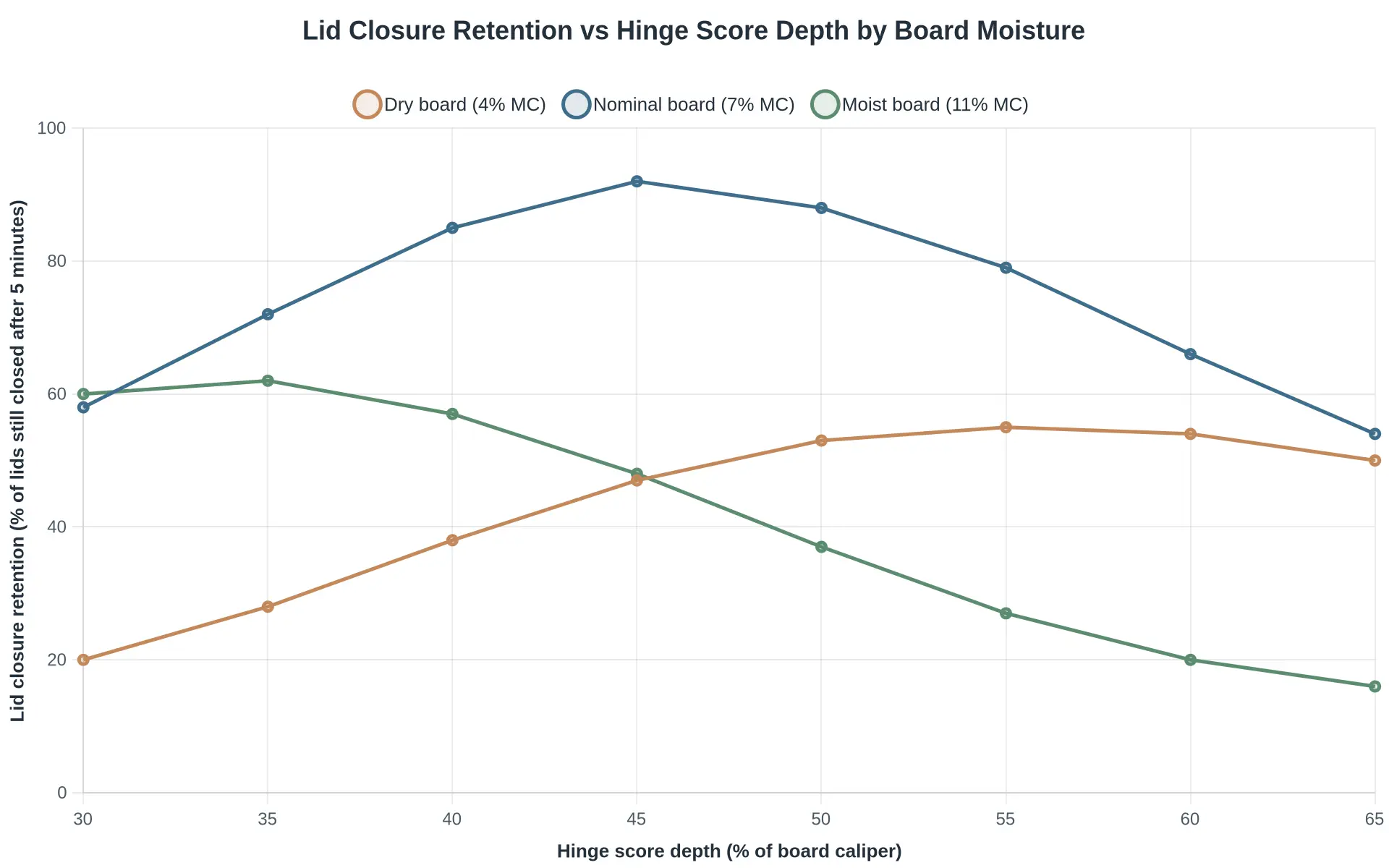
Reading the Retention Curves
Bench trials across three moisture states make the coupling explicit. At 4% MC, closure retention peaks at roughly 55% just above 55% of caliper depth. At a nominal 7% MC, the optimum moves to about 45% depth, where retention reaches roughly 92%. At 11% MC, the optimum shifts again to roughly 35% depth, and a depth that scored 92% on nominal board drops below 20% on moist board. The peak moves shallower as moisture rises, and ignore that shift and you get a lid that closes on the assembly line and opens in the delivery bag.
Engineering the System, Not the Parameter
Specify hinge score depth as a function of equilibrium board moisture, not as a single fixed number. Lock the incoming moisture specification first, then tune score rule height, blade thickness, and die pressure against that band. PLA-coated stock takes up moisture more slowly, which widens the window but does not remove the coupling. Condition retention testing at the humidity the package will actually see (70-90% RH and entrained steam) rather than in a dry lab. Proven compostable clamshell lids and closure systems are a useful reference point for score depth setpoints matched to specific board calipers and moisture grades.
FAQ: Compostable Hamburger Box Lids Popping Open
Getting a compostable clamshell to snap shut and stay shut is one of the harder problems in foodservice packaging engineering. These are the questions our team hears most often from converters, QSR quality managers, and product developers chasing lid recoil.
What hinge score depth is optimal for compostable hamburger box lids?
Aim for a score depth of roughly 45-55% of board caliper. That range produces a defined fold line that lets the hinge bend without cracking the surface or coating. Scores shallower than about 40% leave too much fiber stiffness, so the lid "remembers" its flat position and springs open. Scores deeper than about 60% weaken the hinge, trigger fiber tear at the crease, and cut the number of reliable open/close cycles. Molded fiber lids have no knife score at all, since closure depends on formed hinge geometry, so target a hinge web thickness of roughly 0.6-1.0 mm instead.
Which matters more – board moisture or hinge score depth?
They are coupled, not competing. Score depth sets the hinge’s geometry; board moisture determines how that geometry behaves once it is folded. Board conditioned to 6-8% moisture content folds cleanly and holds its set. Overly dry board (below ~5%) turns brittle and springs back aggressively, while over-wet board (above ~10%) folds easily but creeps and sags, so lids pop open under stacking load. Fix the score first, then hold moisture within spec. Both have to be right.
How do I test lid closure performance?
Condition samples at 23°C / 50% RH before testing, then run a springback test: fold the hinge 90° and measure the recoil angle after 60 seconds. Under ~15° of springback is generally acceptable. Follow that with 20+ open/close cycles, a loaded drop test, and a 30-minute filled-hold test to confirm the lid stays closed under real-world load.
Do PLA-coated board lids behave differently from molded fiber?
Yes, and the failure modes diverge sharply.
| Property | PLA-coated board | Molded fiber |
|---|---|---|
| Hinge mechanism | Knife score | Formed fiber web |
| Typical failure | Coating crack / delamination | Fiber tear, creep |
| Moisture sensitivity | Moderate (film barrier) | High (hygroscopic) |
| Target moisture content | 6-8% | 7-9% |
PLA-coated board resists moisture, but an over-scored crease can crack the film and let the lid lift. Molded fiber hinges rely on interlocking fibers and are far more moisture-sensitive, so they creep open in humid conditions.
How do storage conditions affect lid closure?
Stored board equilibrates with ambient air, so warehouse climate drives lid performance directly. Keep pallets sealed and condition stock at 45-55% RH to hold that 6-8% moisture window. Avoid freeze-thaw swings and prolonged stacking pressure; both cause hinge creep that shows up as popping lids on the line.
Can popping lids be fixed without re-tooling?
Often, yes. Re-check score depth on the die, tighten incoming board moisture to spec, and recondition stock before converting. If recoil persists, try a slightly deeper score or a beveled crease rule. For consistent closure performance out of the box, our range of compostable hamburger boxes is built for stable hinges and reliable lid fit.
Quick takeaway
Popping lids are rarely a single-cause defect. Treat hinge score depth and board moisture as one system: score for geometry, condition for behavior, and verify with springback and cycle testing.
Conclusion: Match the Score to the Moisture, Then Lock It Down
Reliable lid closure in compostable hamburger boxes is not a function of hinge geometry alone. It depends on matching score depth to the board’s moisture state at forming and throughout end use. When score depth is calibrated to a defined moisture window, the hinge keeps the crease memory required to hold the lid shut through stacking, transport, and delivery. When that match breaks (a score too shallow for a dry board, or too deep for a damp one), lids pop open and returns climb.
The corrective levers are practical and measurable:
- Set explicit score depth tolerance bands and verify them with depth gauges per production lot.
- Control board moisture with incoming conditioning and in-line monitoring, not ambient assumptions.
- Specify coating type and basis weight consistently so crease stiffness stays predictable.
- Qualify performance through closure-retention and drop testing that mirrors real stacking and delivery loads.
The teams that protect brand experience are the ones that specify consistent materials and enforce measurement controls upfront. A lid that stays closed is a quiet quality signal to every QSR guest and delivery customer; a lid that springs open is a visible failure. Standardizing board grade, moisture spec, and score tolerances turns closure from a variable into a controlled process.
Our proven compostable lids and dependable paper packaging are engineered for consistent hinge performance. Close every run the same way: measure the score, confirm the moisture, and let the data decide whether the lid stays shut.