
Introduction: The Core Engineering Trade-Off in Sugarcane Plate Wholesale
Bagasse tableware used to be the token sustainable item on a price list. It is now a standing purchase line for distributors, QSR operators, and catering suppliers. A bagasse plate is molded from the fiber left after sugarcane is crushed for juice, and whether it works in high-volume foodservice comes down to one trade-off: how stiff the rim stays once hot food sits on it.
Rim rigidity is the stiffness of the plate’s outer lip, the edge that carries the load. It decides whether a full plate resists flex, whether plates stack and de-nest predictably in transport and storage, and whether staff can carry one one-handed during a rush. When hot food contacts a bagasse plate, heat and moisture migrate into the fiber matrix and act as a plasticizer, lowering stiffness and letting the rim deform under load.
Those two requirements pull against each other, so specifiers need to know how material density, moisture content, and rim geometry interact. Anyone comparing formats across paper plates and bowls and disposable plates should be working from measured performance rather than assumptions. This article covers how rim rigidity is engineered, what heat and moisture do to the fiber over a service window, and which specification points to verify before committing to volume.
The Material Science Behind Molded Sugarcane Plates
A molded sugarcane plate is an engineered composite, not a single material. The feedstock is bagasse, the fibrous residue left after sugarcane stalks are crushed for juice. Bagasse is lignocellulosic – roughly 40-50% cellulose, 20-30% hemicellulose, and 20-25% lignin, with the balance water and extractives. That mix is why a bagasse plate material behaves less like a loose pile of fibers and more like a natural thermoset.
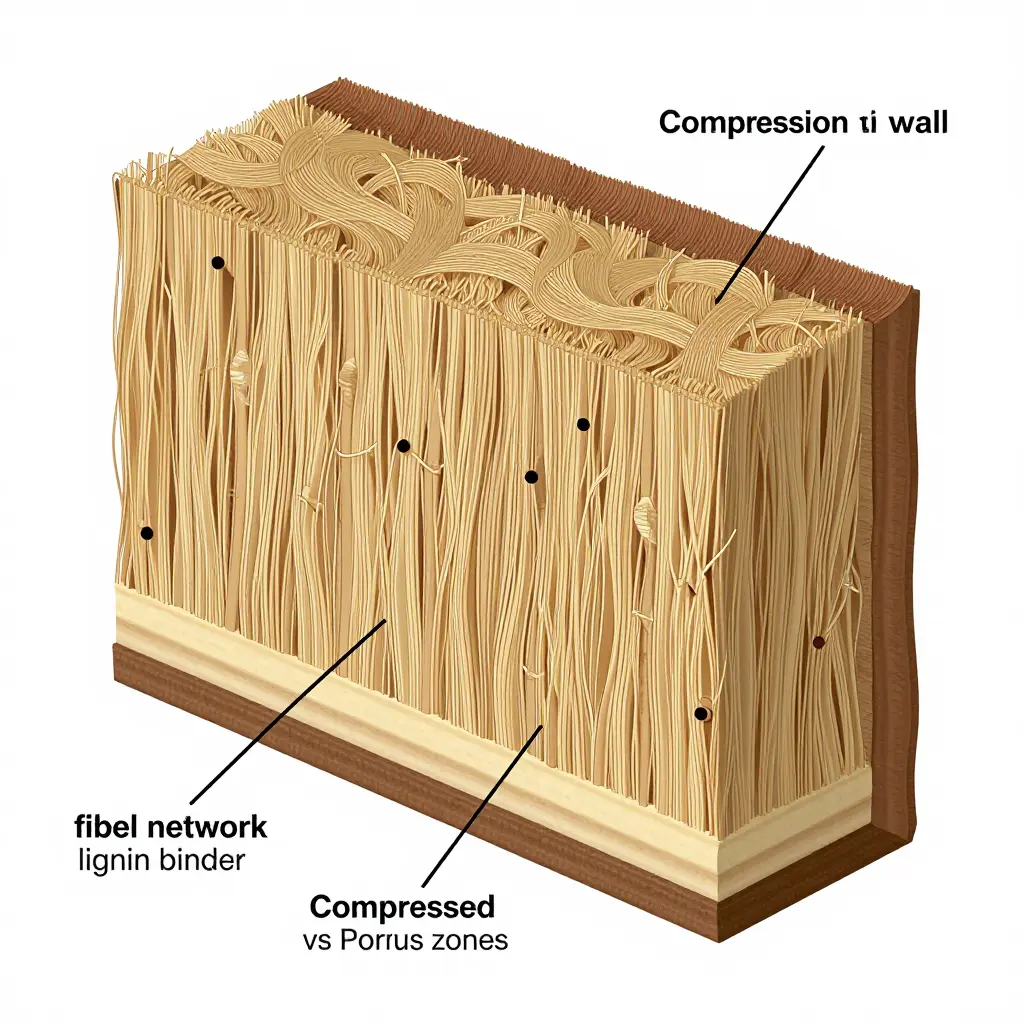
During sugarcane plate manufacturing, residual lignin is the binder. Heat and pressure soften it so it flows around the cellulose fibers; on cooling it re-solidifies and locks the network into a dense, rigid matrix. Four variables decide the outcome:
- Fiber length and orientation. Longer fibers raise the aspect ratio and improve load transfer. In a compression molded plate, fibers tend to lie in the plane of the part, so stiffness is anisotropic – higher in-plane than through-thickness.
- Moisture content. Fibers are conditioned to roughly 8-12% moisture. Water plasticizes the lignin and helps heat transfer, but excess moisture flashes to steam and leaves voids that lower density.
- Pressing pressure. Pressure, typically 5-15 MPa, collapses the porous web and forces fiber-to-fiber contact. As the figure below shows, density and stiffness climb steeply at low pressure and level off once the network is fully compacted.
- Temperature. Tooling at roughly 150-200 degrees Celsius softens the lignin enough to flow without charring the cellulose.
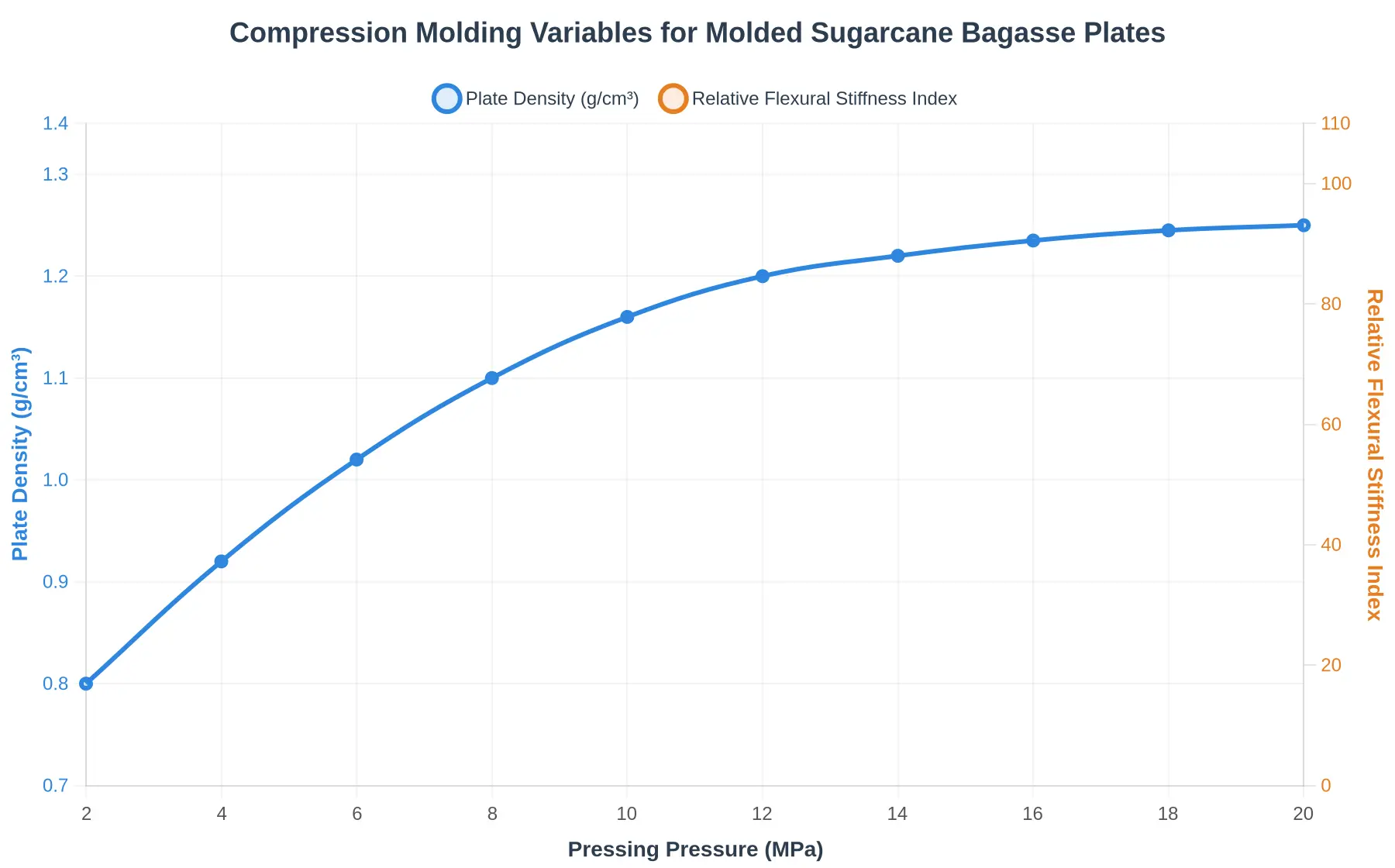
Those four settings decide the two properties buyers measure first: initial stiffness and density. A well-compacted plate lands around 0.6-0.9 g/cm3, and that density is what resists rim flex before any food is added. For specifiers sourcing bulk disposable plates, it also explains why two products that look identical on a shelf behave very differently once loaded.
What the rim cross-section shows
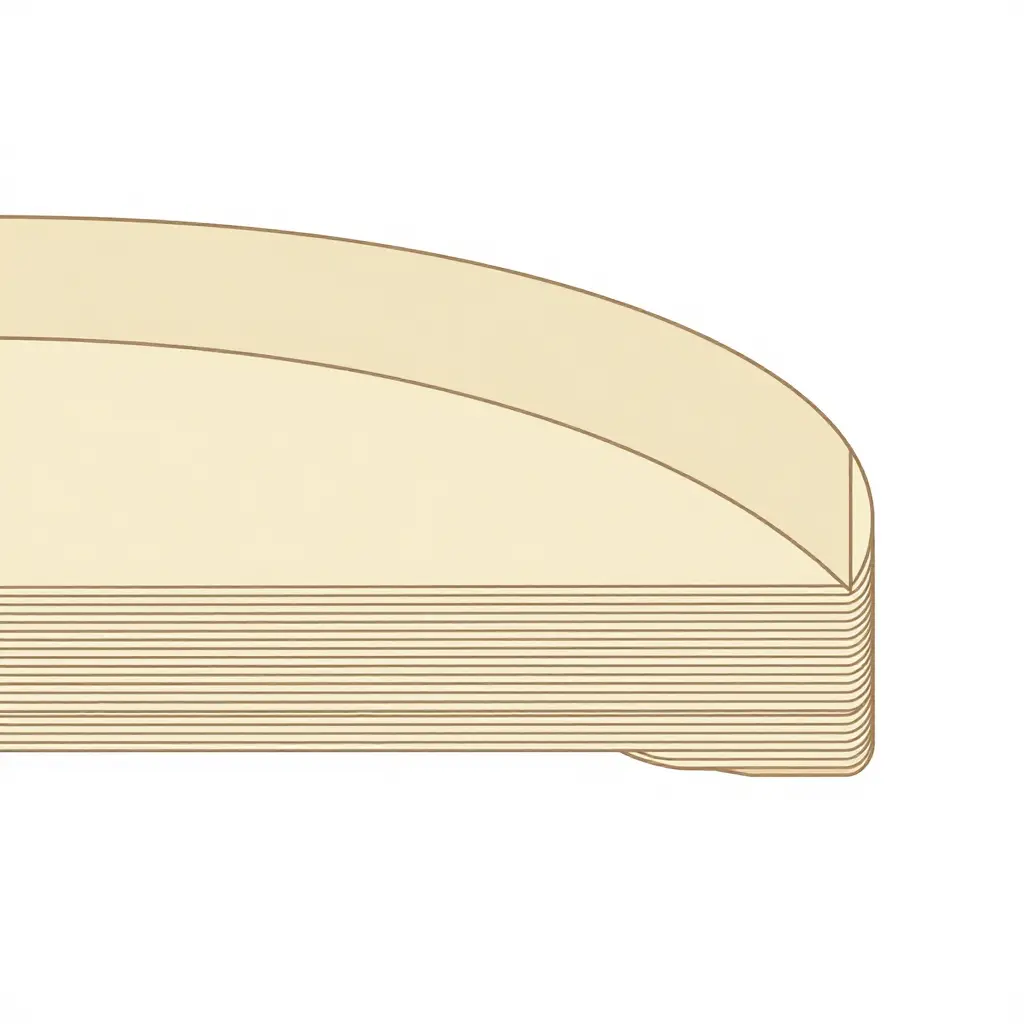
The schematic above shows the rim of a molded sugarcane (bagasse) plate in side section. Two features drive the mechanical behavior that matters most for hot foodservice:
- The raised rim geometry. The upward-curved lip acts as a continuous structural ridge, much like the folded edge of a paper beam. It resists bending far better than a flat disc, which is why a well-formed rim keeps its shape under load before fiber chemistry is even considered.
- The layered compressed fiber structure. The stacked contour lines are the densified bagasse fibers packed together during high-pressure molding. The tighter and more uniform that compression, the higher the density at the rim, and the more stiffness the plate keeps as heat and moisture move through the material.
Both features point the same way: for hot, heavy, or sauced dishes, rim design comes before wall thickness. Buyers can compare the full range of compression-molded plates and licensed party platters to match rim rigidity to their serving conditions.
Engineering Rim Rigidity in Sugarcane Plates
Sugarcane plate rim rigidity is set in the mold, not added later. Bagasse pulp flows into a heated tool, and the rim’s cross-section does most of the structural work. A taller rim raises the section’s second moment of area, so it resists bending better than a flat disc of equal mass. Curvature helps again: a convex or rolled rim turns a tension-prone edge into a compressive hoop and moves load off the plate floor. Beading, a rolled and thickened lip, stiffens the edge, slows crack growth, and resists buckling under vertical load. Fluting, the radial ribs running up the wall, does the job corrugation does in sheet metal, letting a designer hit a target stiffness with less raw material.
Thickness and density are the second design lever. Higher-density pressed pulp packs more fiber per unit volume and raises flexural modulus; concentrating that thickness at the rim and floor rather than spreading it across the whole wall keeps a load-bearing plate light. Thicker sections resist buckling but add weight and cure time, so engineers balance the two deliberately.
Rigid and flexible rims behave very differently in service. A rigid rim holds its shape when a server grips a loaded plate one-handed, and it stacks predictably: consistent rim height creates stable vertical columns with little nesting variation. Flexible rims deflect under a knife or a hot load, feel flimsy, and stack unevenly, which raises crate height and toppling risk. For high-volume buyers, rim rigidity is a direct predictor of both handling confidence and stack stability.
Plate Specification Comparison: Rim Rigidity and Hot-Food Softening
The table compares sugarcane (bagasse) plates with the disposable formats most often specified alongside them in bulk procurement. The figures are typical manufacturer ranges; exact values move with mold design, fiber blend, coating, and forming pressure. Treat it as a specification anchor, then confirm tolerances with each supplier under your own hot-fill and load-testing conditions.
| Material Type | Typical Rim Construction | Thickness / Density | Heat Resistance Range | Moisture Resistance | Load Capacity | Compostability |
|---|---|---|---|---|---|---|
| Sugarcane (bagasse) | Molded fiber, pressed rigid rim | 1.0-1.5 mm; 0.6-0.9 g/cm3 | -20 C to 100 C (to 120 C coated) | High (naturally hydrophobic fiber) | High (5-8 kg, stiff rim) | Home and industrial compostable |
| Wheat straw molded fiber | Molded fiber, rolled rim | 0.9-1.3 mm; 0.5-0.7 g/cm3 | -20 C to 100 C | Moderate to high | Moderate (3-5 kg) | Home and industrial compostable |
| CPLA / PLA | Thermoformed, thin flanged rim | 0.4-0.7 mm | 40 C to 85 C (CPLA to 100 C) | High | Moderate (2-4 kg) | Industrial compostable |
| Coated paperboard | Folded or rolled rim, clay or PE coat | 0.3-0.5 mm | -10 C to 100 C (softens when wet) | Moderate (coating dependent) | Moderate (2-4 kg) | Industrial compostable (coating permitting) |
| EPS foam | Molded bead foam, thick rim | 2-4 mm; low density | 60 C to 90 C (softens) | High | Low to moderate (1-3 kg) | Not compostable |
| Polypropylene (PP) | Thermoformed or injection molded, rigid rim | 0.5-1.0 mm | 0 C to 120 C | High | Moderate to high (4-6 kg) | Not compostable |
The trade-off is visible in the comparison. Bagasse pairs a high rigidity-to-weight ratio and a pressed rigid rim with full home and industrial compostability, while polymer and foam formats give up compostability for different thermal ceilings. Match rim construction to the intended food application, hot-fill temperature, and required stacking depth before fixing a specification; the disposable plate product range can be reviewed with those three factors in hand.
The Physics of Hot Food Softening in Sugarcane Plates
Rim rigidity is only half the performance story. A molded rim resists bending from the outside; hot food softening works from the inside, undoing the same stiffness. Four mechanisms matter, and each one points to a different specification lever.
Heat transfer into the fiber matrix
Heat reaches the compressed bagasse matrix by conduction. Bagasse conducts poorly and is porous, so the heat front travels slowly but does not stop, warming the cellulose and hemicellulose fibers that carry the structural load.
Moisture and steam
Bagasse absorbs water. Moisture from gravies, sauces, and steam migrates into the fiber cell walls, plasticizing them and raising internal vapor pressure. The wetter the fiber, the lower the temperature at which it starts to lose stiffness.
Softening of the lignin-fiber bond
Lignin is the natural adhesive that binds the fiber network together. Above roughly 70-80 degrees C it starts to soften, the lignin-fiber bonds slip, and the plate’s internal scaffolding weakens.
Reduced flexural modulus
Between 25 and 90 degrees C, the plate’s flexural modulus falls by roughly 30-50%. Loads the plate carried without complaint while cool now produce visible plate deformation.
What accelerates the rate
The food itself matters as much as its temperature:
| Factor | Influence on softening rate | Dominant mechanism |
|---|---|---|
| Food temperature | High impact | Above 70-80 degrees C, lignin softening and plasticization accelerate together |
| Contact time | Cumulative | Longer dwell time deepens moisture penetration into the fiber wall |
| Fat content | Strong accelerator | Lipids transfer heat rapidly and wet fiber surfaces |
| Free liquid / moisture | Strong accelerator | Plasticizes fibers and drives internal steam pressure |
A lipid-rich curry served at 90 degrees C can visibly soften a plate within minutes, while a dry, warm item barely changes it. In service, that difference – not the plate on its own – defines the practical heat resistance of bagasse plates. Buyers specifying for hot, wet menus should prioritize heavier gauge and higher forming density; verified options are listed under bulk sugarcane and disposable plates.
Flexural Rigidity vs. Surface Temperature: What the Data Shows
For anyone specifying sugarcane (bagasse) plates for hot foodservice, the practical question is how much rim stiffness survives as the food-surface temperature climbs. The chart below plots rigidity retention across a typical serving range, with 40°C set as the 100% baseline.
Bagasse is a lignocellulosic fiber composite, and its mechanical integrity depends partly on residual moisture and fiber bonding, both of which respond to heat. Across the range from 40°C to 90°C, retained stiffness falls from 100% to roughly 61% – a 39-point loss driven almost entirely by moisture migration and fiber plasticization inside the rim.
Three points follow for wholesale specifiers:
- Below 60°C, rigidity is effectively unchanged. Cold and warm dishes ask almost nothing of the rim.
- The 60-80°C band is the transition. Thin-gauge or low-density plates start to soften visibly under a loaded rim here.
- Above 80°C, density and rim geometry decide the outcome. Heavier, press-formed, higher-density plates hold their shape far longer than lightweight economy stock.
For hot, saucy, or oil-heavy menus the answer is not to give up bagasse but to specify the right gauge. Higher-density disposable plates engineered for hot-food loading can be matched to the temperature profile of an actual service.
Rim Rigidity vs Hot Food Softening Over Time
The chart below tracks a sugarcane (bagasse) plate’s rim rigidity index as it holds hot food across a 60-minute service window. Two series compare a moderate serving temperature of 70°C against a demanding 90°C – the range typical of freshly plated curries, grilled proteins, and soups in QSR, catering, and food-truck settings.
Both plates start at a rigidity index of 100% when the food is first placed. From there, moisture vapor and conductive heat migrate into the molded fiber rim, plasticizing the lignin-fiber matrix and reducing its resistance to flex.
| Elapsed Time (min) | 70°C Rigidity Index (%) | 90°C Rigidity Index (%) |
|---|---|---|
| 0 | 100 | 100 |
| 10 | 98 | 95 |
| 20 | 96 | 90 |
| 30 | 94 | 85 |
| 40 | 92 | 81 |
| 50 | 91 | 78 |
| 60 | 90 | 75 |
What the data tells specifiers:
- The 70°C series declines shallowly and near-linearly, losing about 10 index points over the hour – inside a comfortable handling margin for most plated hot-food service.
- The 90°C series loses rigidity roughly twice as fast early on, reaching 85% by 30 minutes. That first half-hour is where rim deflection and two-handed lifting start to show up.
- The gap widens to about 15 points at 60 minutes, which puts the emphasis on serving temperature, not just soak duration, as the dominant driver of rim softening. Buyers specifying for high-heat menus should size up gram weight or select a denser press profile.
Where those heat-load figures matter, comparing stronger-pressed molded fiber options helps match plate thickness to actual serving temperatures.
Practical Selection and Specification Guidance
Turn the rigidity and softening data into a sourcing decision by matching rim performance to the conditions your customers actually serve in. Three variables drive it: food type, serving temperature, and holding time.
Match rim rigidity to the load. For light, dry applications such as pastries, salads, or cold deli items served below 40°F (4°C), a standard-rigidity rim is sufficient and costs less. For heavy, wet, or high-fat hot dishes such as curries, stews, or grilled proteins above 160°F (71°C), specify a reinforced or rolled-edge rim that resists sagging under moisture and heat. Where plates hold food for extended periods, 30 minutes or more, on buffets or catering lines, prioritize maximum rigidity: steam and sustained load accelerate softening.
Read the plate specification carefully. When evaluating any sugarcane plate wholesale supplier, request four data points:
- Thickness (gauge): Thicker walls add bending resistance but raise unit cost and weight.
- Density (grams per unit or GSM): Higher density signals stronger fiber bonding and better moisture resistance.
- Heat resistance rating: Confirm the stated maximum temperature, and verify whether it covers short-term contact or prolonged holding.
- Rim geometry: Note whether the rim is straight, rolled, or reinforced.
A genuinely heat resistant disposable plate pairs a realistic temperature rating with sufficient density and a supportive rim profile, not one impressive number. Cross-check claims against samples tested with your own menu items. A plate specification built on those four data points is what prevents field failures and returns, so favor suppliers who publish the metrics and hold them batch to batch.
What a Sugarcane Plate Is Actually Made Of
A molded sugarcane (bagasse) plate is a composite, not a single substance. It starts as the fibrous residue left behind after sugarcane juice is extracted, which is then pressed, heat-formed, and dried into the dense, rigid tableware that B2B buyers source by the container.
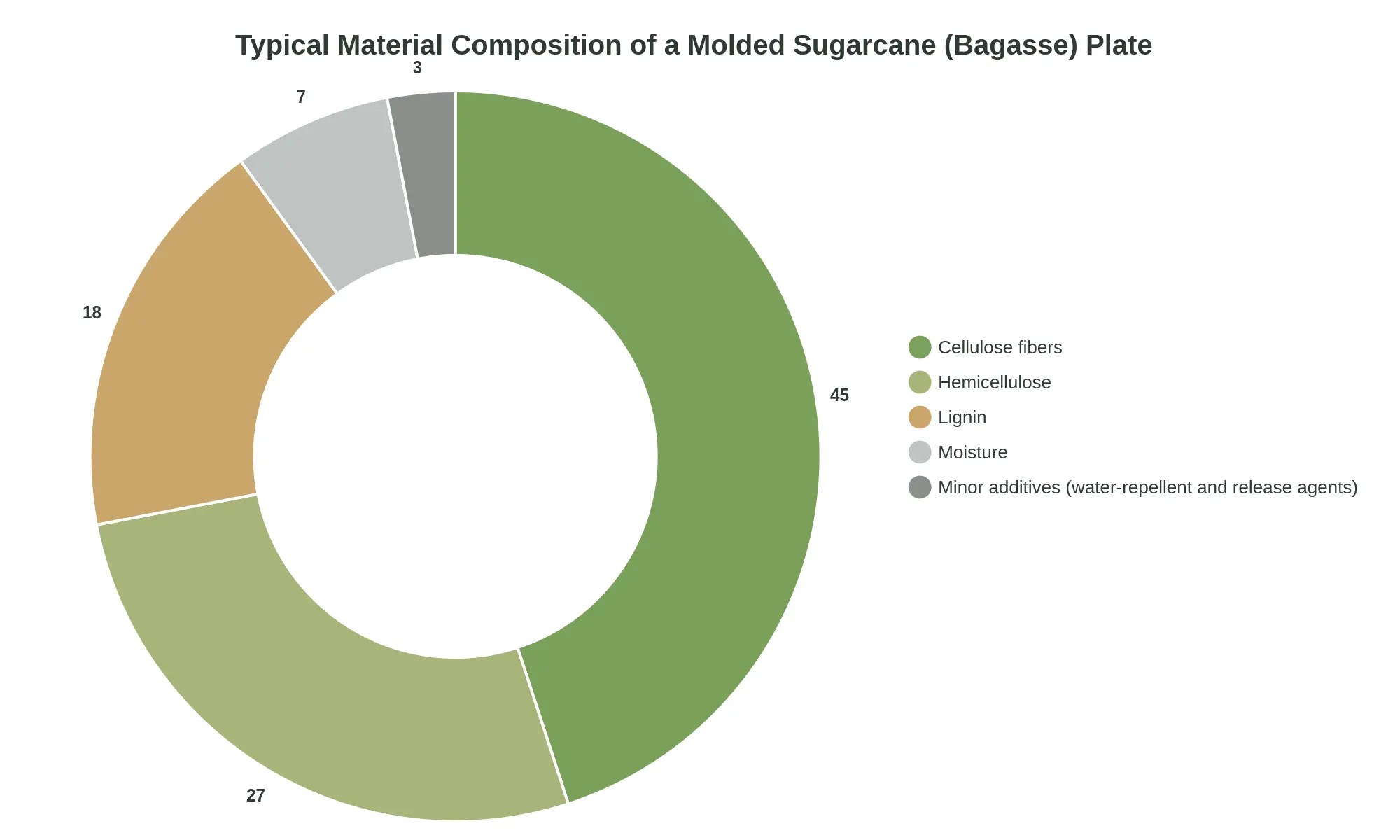
The chart above gives a representative breakdown. Each fraction does a specific job in the finished plate:
| Component | Typical Share | Function in the Finished Plate |
|---|---|---|
| Cellulose fibers | ~45% | Primary structural network; delivers tensile strength and rim stiffness |
| Hemicellulose | ~27% | Binds fibers and aids moldability during heat pressing |
| Lignin | ~18% | Natural binder; contributes water resistance and rigidity |
| Moisture | ~7% | Residual moisture; must be controlled to avoid warping and softening |
| Minor additives | ~3% | Water-repellent and release agents that tune surface performance |
Why This Matters for Hot Food Performance
Cellulose and lignin, the two fractions behind stiffness, together account for roughly 63% of the mass, and they form the backbone that resists bending when a plate is loaded. The moisture fraction is the variable to watch: too much residual moisture accelerates softening when hot, moist food is added, while too little makes the fiber mat brittle. Minor additives at just ~3% may seem trivial, but they determine how quickly liquid wicks through the surface and whether the plate releases cleanly from the mold.
This composition profile is a useful benchmark when comparing suppliers. Ask your vendor how they control fiber-to-lignin ratios and final moisture content, because those two variables drive the rim rigidity you are paying for. Finished formats built on this material are listed under disposable plates.
Wholesale Sourcing Checklist: Rim Rigidity & Hot Food Performance
Use this checklist during your supplier evaluation to confirm that a sugarcane plate wholesale partner can deliver consistent rim rigidity and dependable hot food performance at scale. Before shortlisting vendors, a disposable plates range review gives you a clear format baseline.
1. Material Grade & Composition
- Confirm the bagasse pulp grade (food-grade, unbleached, or natural) and the fiber-to-binder ratio.
- Request the raw material safety certificate and verify the plate is PFAS-free and food-contact compliant.
- Ask whether virgin or recycled bagasse is used, since longer virgin fibers typically drive higher rim stiffness.
2. Molding Specifications
- Request pressing pressure (tonnage), mold temperature, and dwell time used during thermoforming.
- Confirm rim wall thickness and rolled-rim geometry, the two variables that most influence rigidity.
- Verify single vs. multi-cavity molding, as cavity count affects thickness uniformity across a batch.
3. Thermal & Structural Performance Data
- Ask for load-bearing data: maximum rim deflection under a standardized hot, wet load.
- Request the temperature threshold at which the rim begins to soften or lose shape.
- Request hold-time results showing how long the plate maintains form under hot gravies or oily foods.
4. Batch Consistency
- Ask for variance limits on weight, diameter, and rim height across production lots.
- Request samples from at least three separate production batches to test rigidity firsthand.
- Verify QC sampling frequency and historical reject rates.
5. Testing Documentation
- Request third-party lab reports for heat resistance, oil/water resistance, and migration testing.
- Confirm compliance certificates (FDA, LFGB, EN 13432, BPI).
- Ask for a written stability spec sheet you can attach to your bulk disposable plates purchase order.
Five checks turn a vague concern about “softening” into measurable, contract-ready criteria. Reputable suppliers welcome the scrutiny: it protects both parties, reduces return rates, and keeps bulk disposable plates performing from the loading dock to the dinner plate.
Where the Money Actually Goes: Cost Distribution of a Sugarcane Plate
A unit price is only the visible part of what a plate costs. Understanding how the total delivered cost breaks down across the production chain helps procurement teams benchmark suppliers, spot padded margins, and negotiate from technical knowledge rather than guesswork.
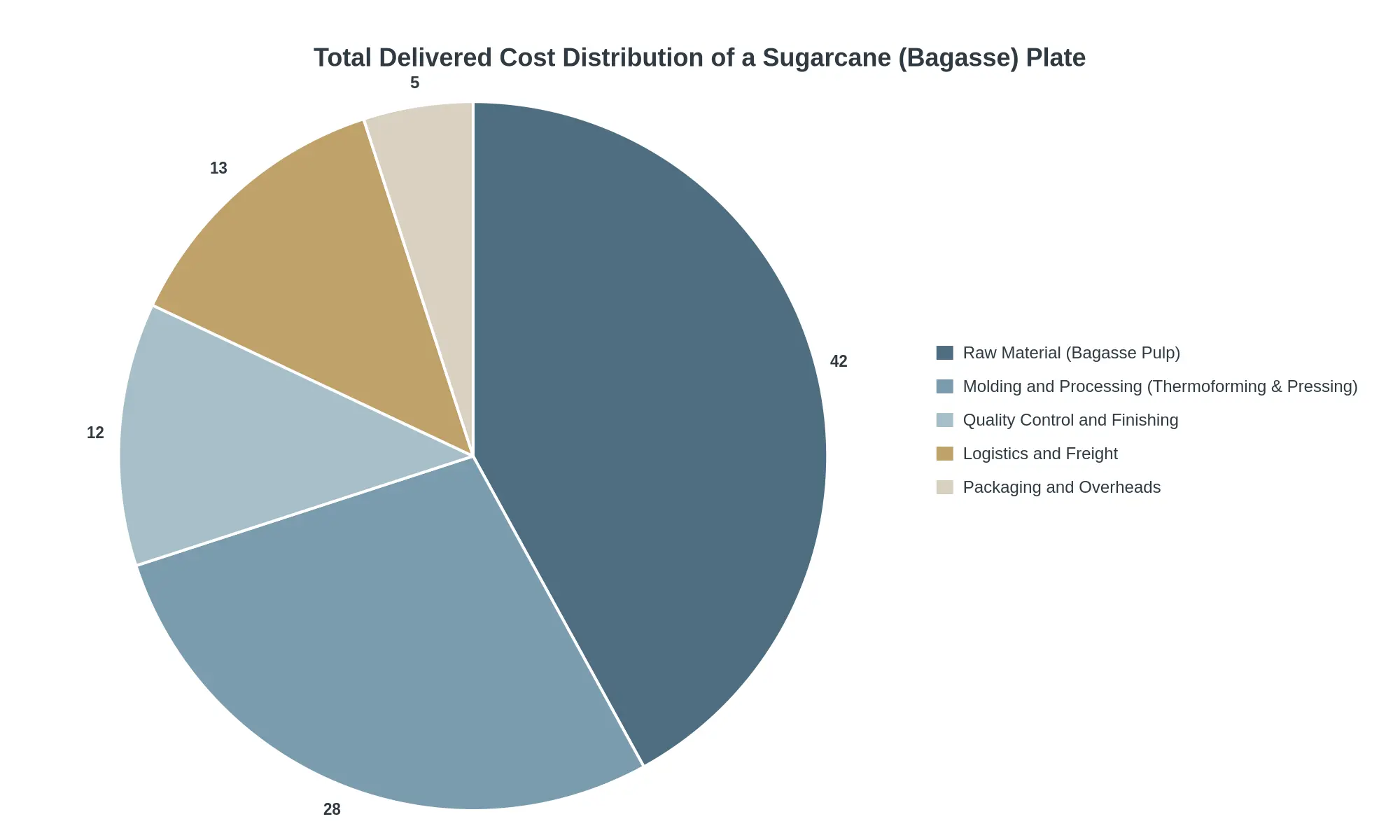
The pie chart below maps the typical cost structure of a single thermoformed sugarcane plate, from pulp sourcing through to your loading dock.
Reading the Breakdown
| Cost Category | Share | What Drives It |
|---|---|---|
| Raw Material (Bagasse Pulp) | 42% | Pulp grade, fiber purity, moisture content, and bagasse availability |
| Molding & Processing | 28% | Thermoforming cycle time, tooling, pressing pressure, energy use |
| Quality Control & Finishing | 12% | Rim rigidity testing, edge trimming, oil/water barrier treatment |
| Logistics & Freight | 13% | Distance, mode of transport, container fill rate, pallet efficiency |
| Packaging & Overheads | 5% | Secondary cartons, pallets, shrink wrap, warehousing |
Why Raw Material Dominates
At 42% of delivered cost, bagasse pulp is the single largest lever on your total landed price. It is also where the science of rim rigidity begins. Higher-grade pulp with longer, more consistent fibers delivers stiffer rims and better resistance to hot-food softening, but it raises the baseline cost. A supplier who cuts corners on pulp quality can pass the saving to buyers, but the plate tends to fail hot-load performance testing later.
The Processing Trade-Off
Molding and processing accounts for 28% and feeds straight into rim rigidity. Longer press cycles and higher forming pressure improve fiber bonding and dimensional stability, which matters when a plate carries hot, dense food. That rigidity costs energy and tooling time, so it shows up in the price – and compression is usually the first thing a supplier trims when a buyer pushes for the lowest quote.
Quality Control Protects the Specification
At 12%, quality control and finishing is a smaller slice, but it is the one that safeguards your brand. Rim stiffness testing, edge finishing, and barrier treatments keep a plate from buckling or leaking. For bulk volumes, you can compare sugarcane disposable plates built for hot-food performance on those finishes.
Logistics Scales with Volume
Logistics and freight sit at 13% and are highly sensitive to order size. Filling a container efficiently and shipping dense, flat-packed plates lowers per-unit delivery cost sharply, which is one reason bulk wholesale pricing behaves so differently from small-lot orders.
The Takeaway for B2B Buyers
A sugarcane plate quote is a bundle of engineering decisions, not a commodity number. Once you know that nearly 70% of cost sits in raw material and molding, the useful questions get specific: What pulp grade is used? What press cycle time applies? How is rim rigidity verified? Those answers separate a plate that performs under a pile of hot biryani from one that collapses in your customer’s hands.
Durability and Quality Assurance: Consistency Across Every Batch
For volume buyers, bagasse plate durability is only worth as much as its consistency. A rim that stays rigid in one shipment and flexes in the next is an operational risk, especially when plates carry hot, weighted foods. Manufacturers who control that variation run quality assurance as a continuous, measurable process at three points.
Incoming Fiber Inspection
Bagasse pulp is screened for moisture content, fiber length distribution, and residual non-fibrous content before it enters the line. Because moisture and fiber uniformity govern how evenly a plate densifies under heat, out-of-spec pulp is rejected before it can weaken rim rigidity downstream.
Molding Parameter Control
Thermoforming is where rigidity is actually made. Press temperature, dwell time, and pressure are locked to tight tolerances and logged per batch so each plate reaches the target wall density that keeps a rim sharp and load-bearing. Small drifts in these parameters produce soft or warped rims, so they are monitored in real time.
Finished-Goods Testing
Before release, sugarcane plate testing measures performance rather than assuming it. Representative samples go through load tests and thermal tests that simulate hot, heavy meals.
| QA Stage | Test | Typ. Target Range |
|---|---|---|
| Incoming | Fiber moisture content | 8-12% |
| Incoming | Fiber length uniformity | Consistent grade |
| In-process | Mold temp / pressure | Within set tolerance |
| Finished | Rim load test | No deformation |
| Finished | Thermal soak (hot food) | Retained rigidity |
The point of the three stages is that the rim rigidity and heat performance you approve in a sample are the values you receive at scale. Buyers sourcing at volume can check the disposable tableware range, where batch-to-batch reliability is documented rather than assumed.
Sugarcane Plate Performance Profile Across Key Dimensions
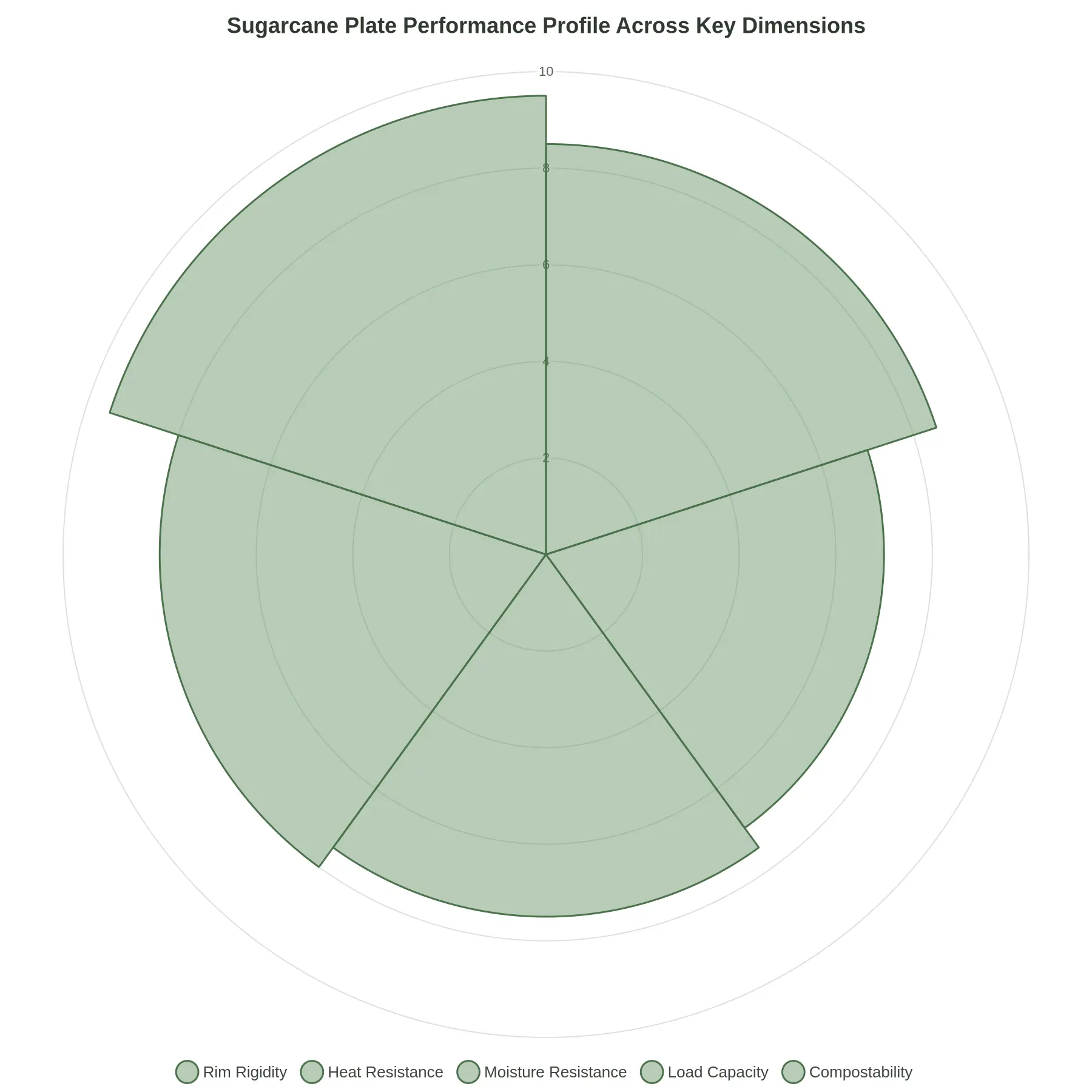
Scoring each material property on one shared 0-10 scale makes sugarcane (bagasse) plates easier to compare. The polar area chart below maps five dimensions that matter most to B2B specifiers – rim rigidity, heat resistance, moisture resistance, load capacity and compostability – so buyers can see the trade-offs together rather than one at a time.
Reading the Chart
Distance from the center is score. The profile is exceptionally strong on sustainability and structural integrity, and comparatively softer on hot-food thermal performance – the tension behind most sourcing decisions.
| Performance Dimension | Score (0-10) | What It Reflects |
|---|---|---|
| Rim Rigidity | 8.5 | Resistance of the rim to flex and collapse under handling |
| Heat Resistance | 7.0 | Ability to hold shape and stiffness as food temperature rises |
| Moisture Resistance | 7.5 | Stability against sauces, oils and condensation |
| Load Capacity | 8.0 | Weight support without rim roll or base sag |
| Compostability | 9.5 | Speed and completeness of breakdown in commercial composting |
Why the Shape Matters for Wholesale Buyers
The rim rigidity score (8.5) reflects what well-pressed bagasse gives a plate: a stiff, self-supporting edge that holds up in buffet lines and stacked service. The heat resistance score (7.0) is the softest point on the chart, which is why hot, high-moisture foods are the decisive test for any sugarcane plate – steam and heat migrate into the rim and gradually reduce the very stiffness the material is prized for.
Compostability sits highest at 9.5, which is the core commercial case for bagasse over coated fiber or plastic alternatives. Load capacity (8.0) and moisture resistance (7.5) occupy the middle band, meaning the material performs reliably for standard portions and still benefits from good rim geometry and controlled dwell times.
Used as a checklist, the chart suggests what to ask each vendor: how is the product engineered against the two weak spots, heat and moisture? The disposable plates range maps to these dimensions and can be reviewed before finalizing bulk quantities.
Frequently Asked Questions
Do sugarcane plates soften under hot food?
Some softening is expected, because bagasse fiber is hygroscopic and absorbs moisture and heat from food. A well-engineered plate still maintains its structural shape under typical serving conditions and normal meal durations. The degree of hot food softening depends far more on moisture content, wall thickness, and rim architecture than on temperature alone. Plates that feel flimsy usually reflect poor densification, not an inherent weakness of the material.
How is rim rigidity tested?
Suppliers quantify rim rigidity using flexural and compression tests: a controlled downward force is applied to the rim while deflection and load-at-failure are recorded in newtons and millimeters. Reputable manufacturers also run drop and hot-load tests, stacking a filled plate and measuring sag over time. Asking for those data points is the fastest way to separate consistent production from inconsistent batches.
What temperatures can bagasse plates tolerate?
Most quality sugarcane plates handle hot foods up to roughly 100°C (212°F) for short serving windows and are commonly microwave-safe. Prolonged exposure, high-fat sauces, or long holding times accelerate moisture migration and softening, so operators should match plate grade to their actual serving scenario rather than to a single headline rating.
How does thickness affect performance?
Greater thickness generally improves rigidity and slows moisture uptake, but it also raises weight, material cost, and shipping expense. The optimal specification balances these trade-offs against your menu, average hold time, and price target, which is why blanket “thicker is better” advice rarely fits bulk buyers.
How should I compare suppliers?
Evaluate sugarcane plate wholesale vendors on measurable criteria: fiber grade, moisture content, rim rigidity data, certified food-contact compliance, and batch consistency. The disposable plates range can be compared against those benchmarks – and always test a sample with your own hot menu items before committing to volume.
Does wholesale pricing reflect quality?
Not reliably. Low pricing often signals thinner rims or higher moisture content, which shows up as hot food softening onsite. Prioritize documented performance and repeatable quality over the lowest quote.
Conclusion
The performance of a sugarcane plate wholesale program comes down to one relationship: bagasse material engineering sets how rigid a rim can be, and hot food takes some of that rigidity back. Fiber density, fiber length, and the pressure and heat applied during pressing determine the initial stiffness; the same heat and moisture the plate is designed to resist then soften the matrix that provides it. A stiff, tightly pressed rim improves load-bearing strength but can degrade faster under heat, while a denser, moisture-resistant formulation may trade some initial stiffness for greater stability under hot, wet foods.
The practical implication for wholesale buyers is straightforward. As the discussion of rim geometry, fiber processing, and heat exposure shows, there is no universally optimal sugarcane plate. The balance between rigidity and heat performance depends on specification and application, so buyers should match fiber density, rim thickness, and coating or pressing parameters to the food types, serving temperatures, and holding times their operation demands. Product selection should begin with a clear use case, not a single headline metric. The paper plates and bowls range is a place to align those specifications with real-world performance.