
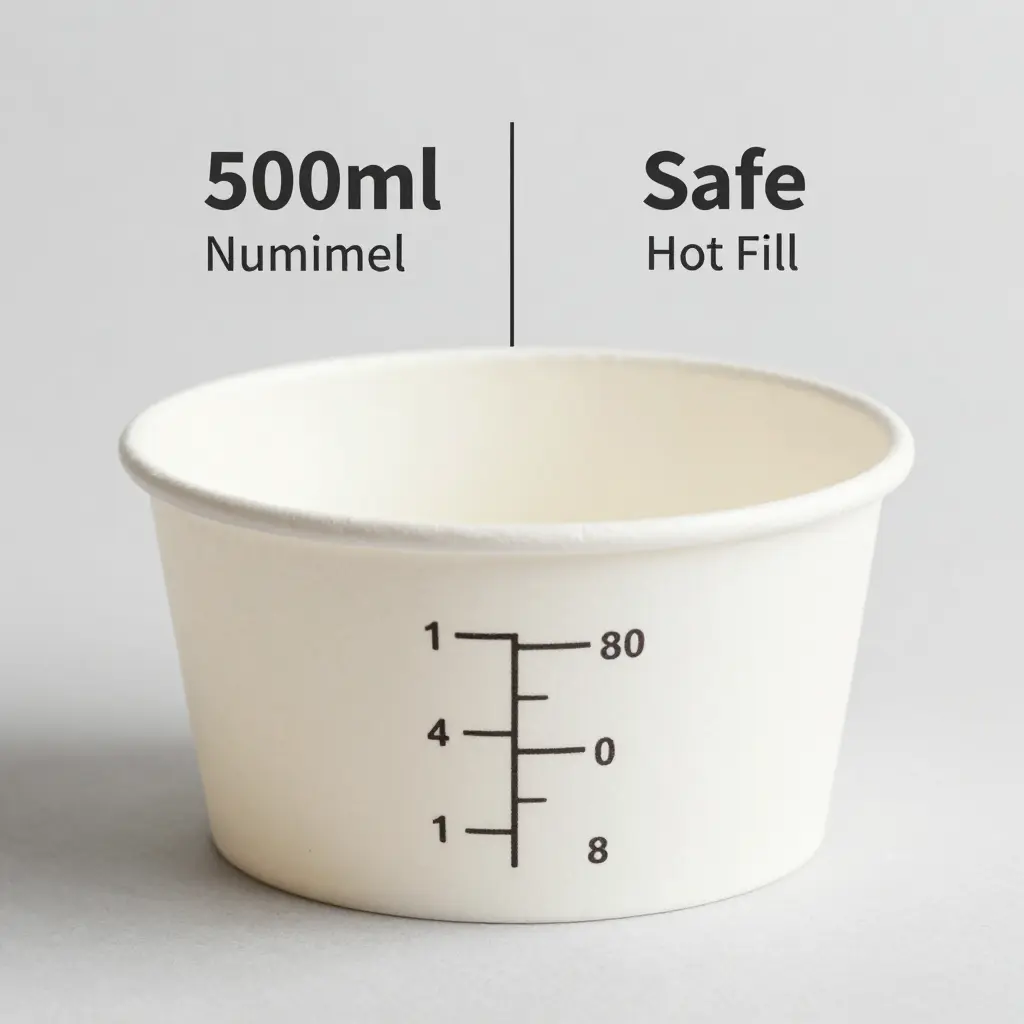
500ml Paper Bowl Wholesale: Nominal Volume vs Safe Hot Fill Line
Buyers comparing paper bowls in bulk often treat two specifications as interchangeable: nominal volume and the safe hot fill line. They measure different things. Nominal volume is the rounded capacity figure a manufacturer assigns to a bowl, usually in milliliters, based on the total geometric space inside the rim. The safe hot fill line is the maximum level recommended when hot or dense food goes into the bowl. It sits below the rim to leave headspace for thermal expansion, lid closure, and handling.
Defining Nominal Volume
Nominal volume is a design specification. A “500ml” bowl is engineered to hold approximately 500ml when filled to a defined reference point, typically the brim or a marked fill line. The number works as a sizing benchmark, but it is a theoretical maximum rather than a serving target. Bowl geometry, taper, and rim thickness all shift how that volume measures from one production run to the next.
Defining the Safe Hot Fill Line
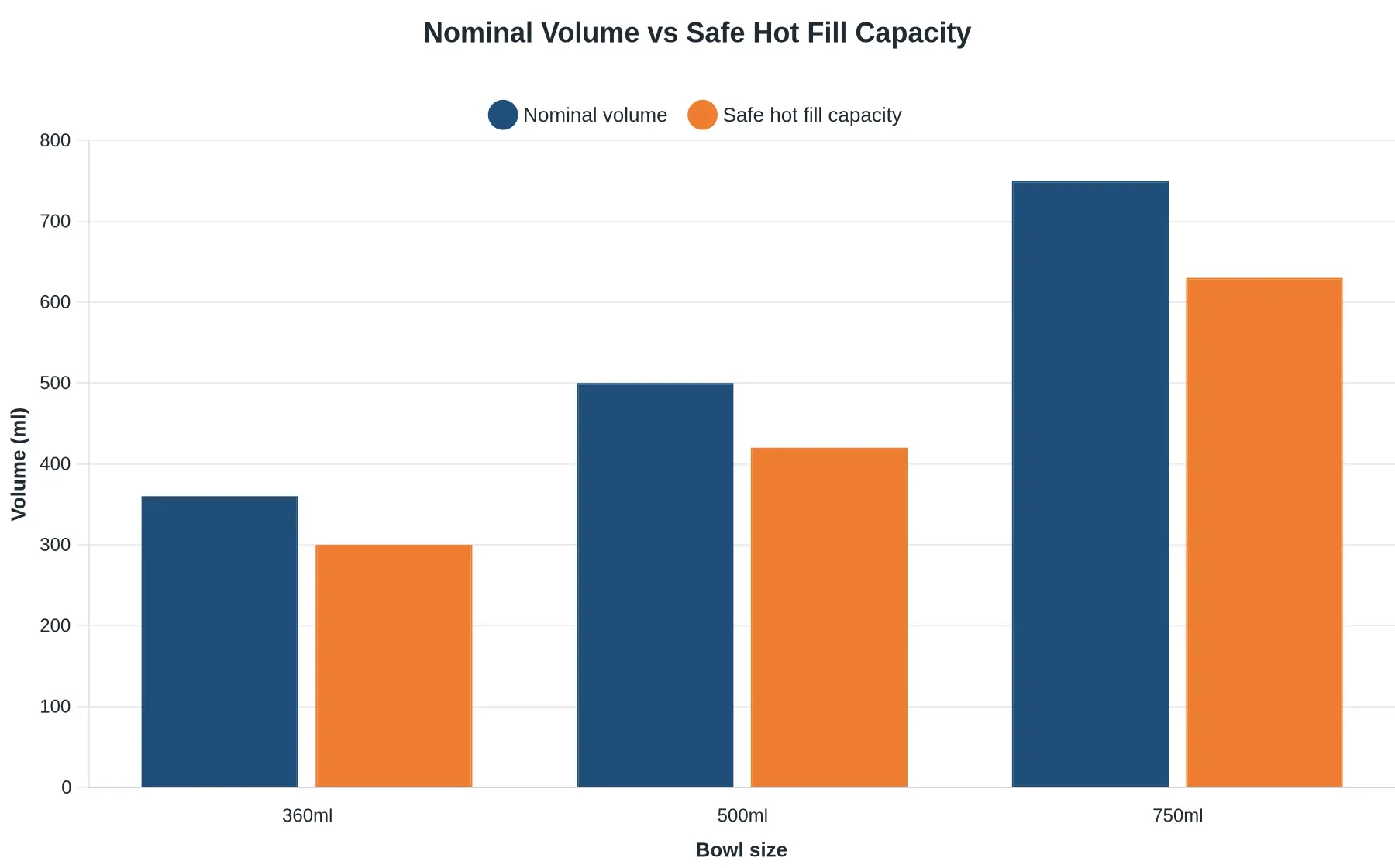
The safe hot fill line is an operational specification. It marks the level a bowl can be filled with hot, expanding, or viscous contents without overflow, leakage, lid misalignment, or deformation. Hot food expands and can splash in transit, so the safe hot fill line sits below nominal volume, often by 10 to 20 percent depending on material stiffness and lid design.
Why the Distinction Matters for B2B Buyers
Procurement teams, distributors, and takeout operators who confuse the two figures run into concrete problems. Plan 500ml servings from nominal volume and a safe hot fill of soup, chili, or stew may come out closer to 400ml once headspace is reserved. That gap hits portion control, menu costing, and customer satisfaction, and it also drives format selection: sturdier shapes such as deep paper bowls for business offer more usable capacity for hot, heavy food. Sourcing 500ml paper bowl wholesale therefore means matching nominal volume to the safe hot fill line your menu actually needs, not reading a single number off a catalog page.
What Is Nominal Volume in a Paper Bowl?
Nominal volume is the geometrically rated capacity of a paper bowl: the interior volume it would hold if filled to a defined reference plane. Manufacturers calculate it from the bowl’s top diameter, base diameter, and height using a truncated-cone (frustum) formula rather than filling it with liquid and measuring.
Because the reference plane varies, suppliers report nominal volume under one of two conventions:
- Flat-fill convention – capacity measured to the lowest point of the rim, which gives a flatter surface and the smaller figure.
- Brim-fill convention – capacity measured to the top edge of the rim, which gives the larger figure.
A 500 ml bowl, for example, may hold roughly 500 ml flat-fill and noticeably more brim-fill. Confirm which convention a supplier uses before comparing two specs.
Nominal volume is a specification and marketing figure, not a practical fill limit. A bowl rated at 500 ml nominal volume cannot safely take 500 ml of hot food, because expansion, headspace, and overflow risk all cut into the usable amount. For real-world portioning, the deep paper bowls for business guide shows how nominal capacity and safe fill diverge.
![2D cross-section diagram of a 500ml paper bowl showing the nominal volume level at the top and the safe hot fill line below it, with an empty headspace gap between the two levels]
How to Specify 500ml Paper Bowls for Wholesale Orders
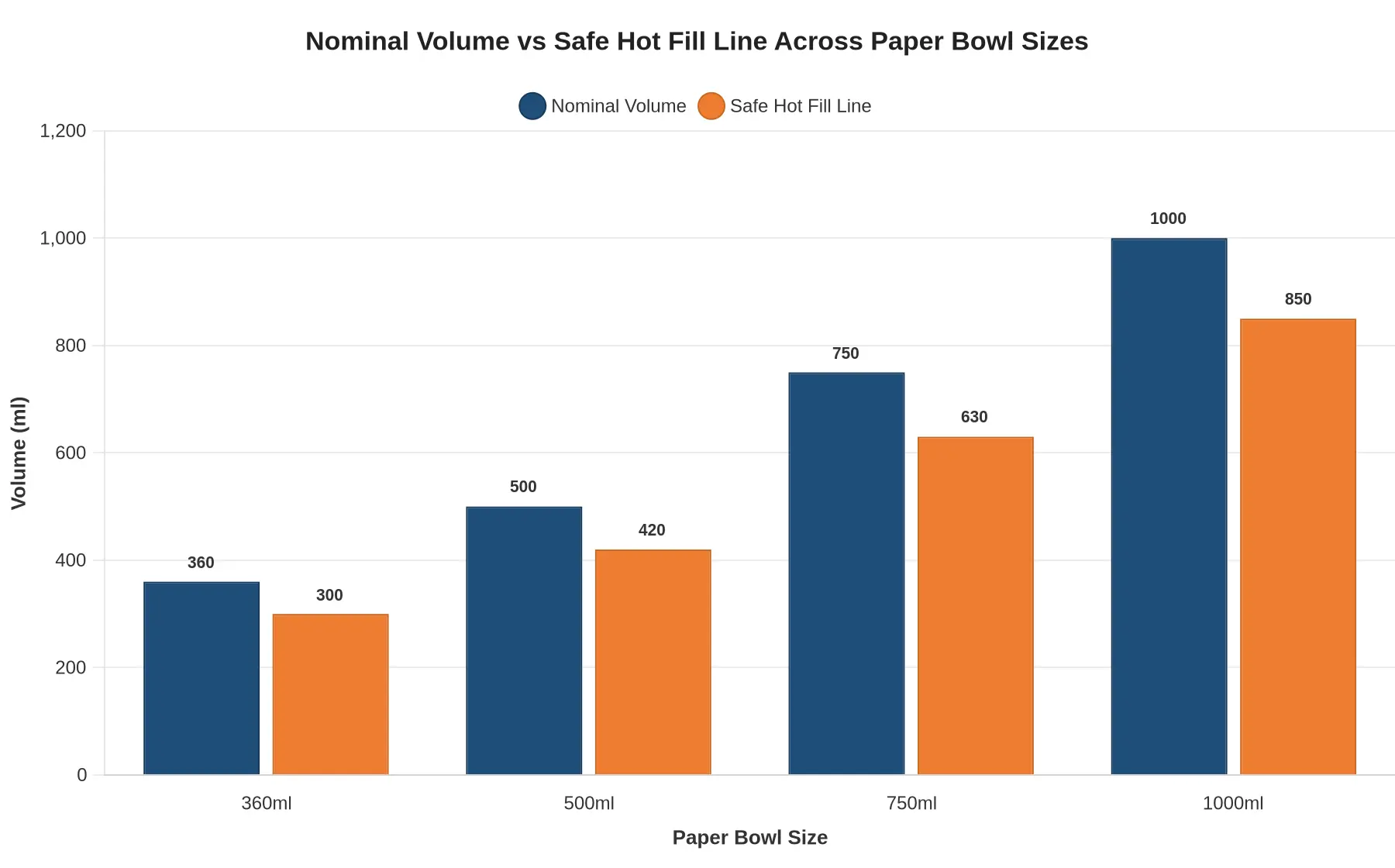
When you buy a 500ml paper bowl wholesale, the stated 500ml is the nominal figure, not a working capacity. Usable hot fill capacity is lower, typically 80-90% of nominal, to leave headspace for thermal expansion and prevent lid pop-off or overflow. Treat the two numbers as separate specifications.
1. Verify safe hot fill capacity in the spec sheet
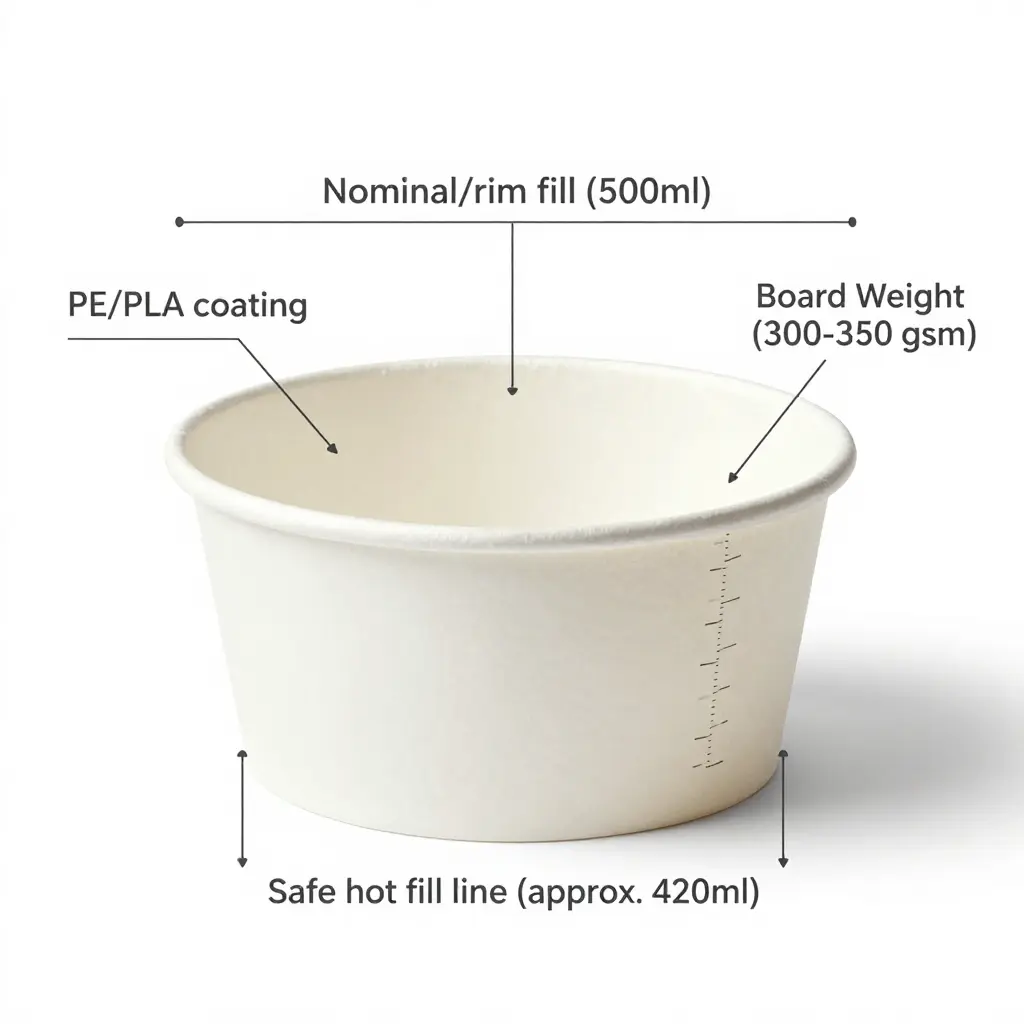
Ask your paper bowl supplier to state hot fill capacity in millilitres and the recommended fill temperature. Request the maximum fill line, measured in millimetres from the rim. A reliable spec confirms performance at a specific temperature (90 degrees C, for example), not a vague “hot liquid safe” claim.
2. Request physical test data
Ask for evidence rather than adjectives. Useful documents include:
- A 30-minute hot-water hold test result for leak resistance.
- Seam and base integrity checks at fill temperature.
- Stack compression data for warehouse and transit loads.
- Coating adhesion results after heat exposure.
3. Evaluate coating and board weight
Confirm the coating type – PE, PLA, or water-based – because it drives heat resistance, grease barrier, and recyclability. Then check board weight in gsm. Higher gsm resists bulging under hot loads but raises unit cost.
4. Match bowl specs to menu items
Match rim diameter, depth, and lid format to what you actually serve. Over-specifying wastes budget; under-specifying causes leaks. For depth and stacking performance, see these deep paper bowls for high-volume food service.
| Bowl format | Nominal volume | Safe hot fill | Typical coating | Best-fit menu items |
|---|---|---|---|---|
| Single-wall | 500 ml | ~420 ml | Water-based / PLA | Cold salads, ice cream |
| Single-wall PE | 500 ml | ~420 ml | PE | Noodle bowls, hot soups |
| Double-wall | 500 ml | ~430 ml | PE | Broth, ramen, delivery |
| Double-wall + lid | 500 ml | ~430 ml | PE | Hot takeout and delivery |
Final tip: request a physical sample lot, fill it to your intended hot line, and seal it before committing to a container load. Test data plus a hands-on trial protects your margins.
Cost and Performance Trade-Offs of a Larger Safe Hot Fill Margin
Building a generous safe hot fill margin into a 500 ml paper bowl is an engineering and procurement decision, not just a matter of ordering a bigger container. Every extra millimeter of headroom costs something. For B2B buyers the balance comes down to three variables: material weight, coating choice, and packaging reliability at wholesale scale.
Material Weight: Strength You Pay For by the Gram
Raising a board’s grammage (GSM) is the most direct way to protect the safe hot fill margin. Heavier stock resists the bulging and rim distortion that hot, dense food causes, which keeps the practical fill line safely below the top. The penalty is straightforward: a bowl weighing 15 percent more uses more raw material and adds shipping weight across a full ocean container. With nominal volume fixed at 500 ml, a lighter bowl can meet the fill target on paper while giving up the structural reserve needed for gravies, soups, and oil-based dishes.
Coating Choice: Where Heat Meets Chemistry
The coating decides how reliably a bowl performs against hot, fatty, or acidic contents. PE film is inexpensive and remains the proven barrier for hot fill, though it is not compostable and is harder to repulp. Water-based and compostable options – PLA and PHA among them – meet sustainability requirements, but their heat tolerance is generally lower and varies by formulation: standard PLA softens well below the temperature of near-boiling liquid, while newer water-based coatings can handle hot fill. Expect a premium and a narrower processing window.
Packaging Reliability: The Hidden Cost of Leaks
In wholesale quantities, reliability multiplies cost. A larger margin usually means deeper bowls and tight-fitting lids; a lid that fits inconsistently, or a wall that flexes under heat, produces leaks, returns, and damaged pallets. That is why deep paper bowls for business specifications should always be validated through transit testing, and why sourcing from a qualified paper bowl with lid supplier matters far more than shaving a fraction of a cent per unit.
| Variable | Lower-cost choice | Higher-cost choice | Impact on safe hot fill margin |
|---|---|---|---|
| Board weight | 260-280 GSM | 300-350 GSM | Higher GSM resists buckling and preserves margin |
| Coating | PE film | Water-based, PLA, or PHA | Recyclability or compostability; heat tolerance varies |
| Lid fit | Loose tolerance | Precision-sealed | Fewer leaks at high fill temperatures |
| Wholesale unit cost | Lowest | Premium | Extra margin cuts failure and return costs |
Taken together, these levers show that the cheapest bowl rarely has the lowest total cost of ownership. Paying a little more for heavier board, a heat-stable coating, and dependable lid sealing usually pays for itself by preventing leaks, returns, and production downtime. That trade-off is what separates a low quote from a reliable supply partner.
Frequently Asked Questions
These are the questions buyers ask most often when comparing 500ml paper bowls in bulk.
Is the 500ml bowl actually 500ml?
It depends on the convention the supplier quotes. Nominal volume is the geometric maximum the bowl can hold, normally measured to a defined reference such as the brim. It is not the serving size you would use in practice.
Can a 500ml bowl be filled to the brim with hot soup?
No. Filling to the brim with hot soup risks overflow, spills, and burns. The safe hot fill line sits below the rim, leaving room for thermal expansion and preventing leakage during transport.
How much headspace is required?
Most manufacturers recommend leaving 10 to 15 percent of the bowl’s volume as headspace. This allowance accommodates the thermal expansion of hot liquids and reduces the risk of lid failure or overflow.
Does the coating type affect hot fill capacity?
Yes. PE coating handles hot liquids best; PLA and many water-based coatings tolerate less heat. The coating therefore sets the maximum safe hot fill line and the temperature range the bowl can handle.
How can I verify specs before a wholesale order?
Request technical datasheets, samples, and a written specification confirming nominal volume and the safe hot fill line. For 500ml paper bowl wholesale orders, always test samples with your actual hot product first. See our guide to deep paper bowls for business for further selection tips.
Conclusion
Understanding the difference between nominal volume and the safe hot fill line matters to anyone sourcing food-service packaging. Nominal volume is the bowl’s full geometric capacity at the brim; it serves mainly as a labeling and comparison reference. The safe hot fill line marks the maximum level a bowl can be filled with hot food while still leaving headspace for thermal expansion, secure lid placement, and safe transport. Filling to the nominal mark with hot contents invites overflow, leakage, and structural failure.
For 500ml paper bowl wholesale buyers, the practical takeaway is to treat the safe hot fill line as your real working capacity, not the nominal figure. Compare suppliers on that specification, confirm wall thickness, coating quality, and rim strength, and match the bowl to your actual portions. A supplier that publishes both figures, and explains headspace requirements, is more reliable than one that advertises only a nominal number. Reviewing options such as these deep paper bowls for business helps procurement teams verify genuine capacity before committing to bulk orders. Choosing accurately cuts waste, reduces complaints, and keeps every order performing the same way across hot and cold applications.