
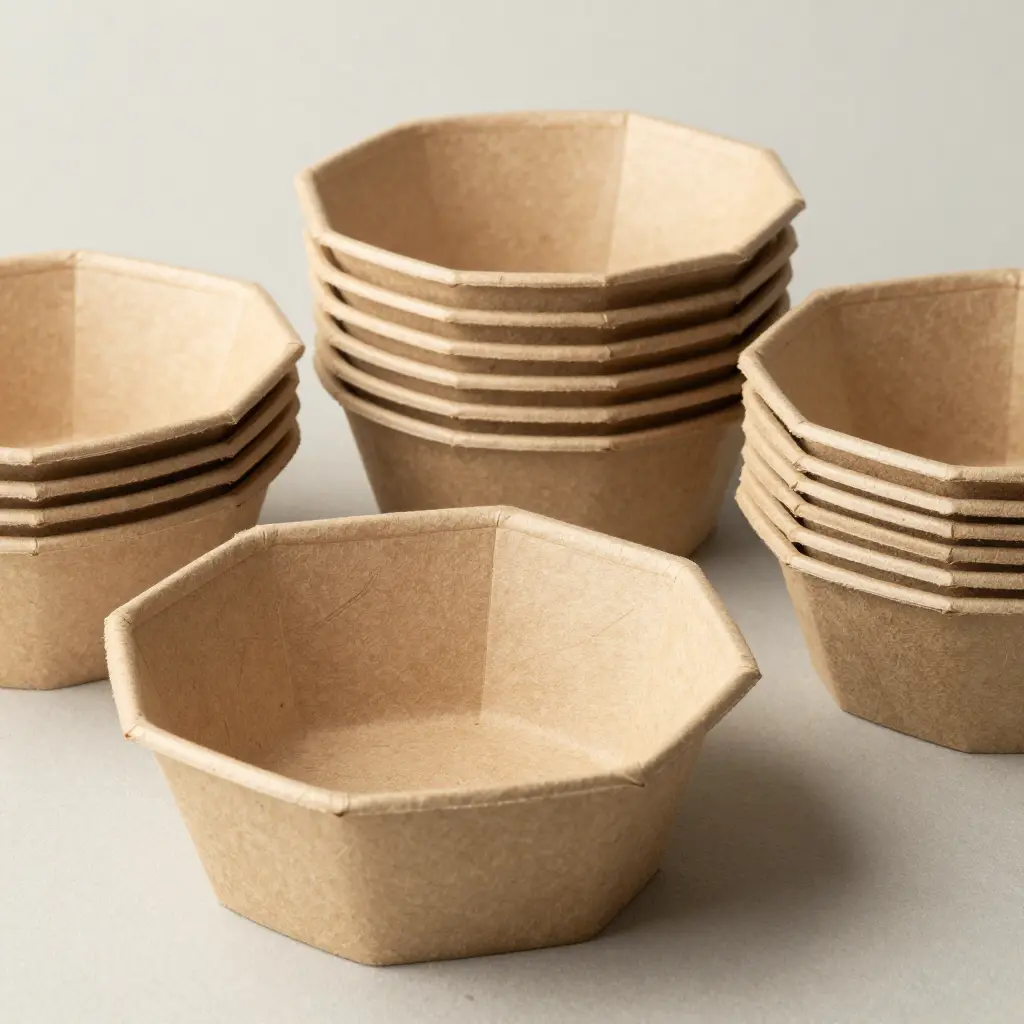
Cheap octagonal paper bowls give B2B foodservice buyers a low-cost option for high-volume takeaway, catering, and concession programs. The eight-sided shape and sturdy walls set them apart from plain round stock, and the per-unit price stays inside tight budgets. That mix of presentation and price is why buyers across the disposable tableware supply chain keep asking for these octagonal and round bowl formats.
For procurement and sourcing managers, the pitch is simple. Spend less on packaging and still get a premium look. Sourcing them, though, brings up the tension that runs through this whole category: cheaper recycled board versus food contact compliance.
Food contact compliance is the legal and safety framework for materials that touch food directly. Paper and board have to avoid transferring harmful substances, such as mineral oils, heavy metals, or chemical residues, into the food they hold. Recycled board costs less to produce, but it can carry higher migration risk unless the grade is chosen and processed carefully.
This article covers material grades, the standards that apply to paper bowls, and what each sourcing path really costs.
What “Recycled Board Grade” Means for Octagonal Paper Bowls
Every octagonal paper bowl begins as a flat sheet of paperboard. The recycled board grade tells you what that sheet contains, how heavy it is, and how its surface is finished. When you compare low-cost bowls, this is the first thing that separates a genuinely economical product from one that only looks cheap.
Fiber source comes first. Virgin fiber board is milled from new wood pulp, so the fibers are long, strong, and uniform. Post-consumer recycled fiber comes from paper that has already been used and reprocessed, which shortens the fibers and introduces some variability. Mixed recycled board blends recovered fiber with mineral fillers and offcuts, lowering raw-material cost and structural consistency at the same time. Because the fiber mix drives everything downstream, it is the most important input when you source recycled fiber bowls.
Basis weight, thickness, and coating come next. Basis weight, measured in grams per square meter (gsm), tells you how much fiber sits in each sheet. Caliper, or thickness, tells you how thick the sheet is. Coating matters too: a polyethylene (PE) or water-based barrier layer resists grease and moisture, clay coatings improve print, and uncoated stock can wick liquid. Two bowls can share a recycled board grade and still perform very differently once those three specifications change.
Grade tiers at a glance
- Tier 1 – Virgin fiber board: highest basis weight and caliper, dense fiber, smooth coating; best stiffness, moisture resistance, and print quality; highest cost.
- Tier 2 – Post-consumer recycled board: medium basis weight and caliper, shorter fibers, usually PE or water-based coated; balanced performance at a moderate cost.
- Tier 3 – Mixed recycled board: lowest basis weight, thin caliper, high filler content, often uncoated; lowest cost, but the weakest stiffness, moisture resistance, and print resolution.
| Grade tier | Fiber source | Typical basis weight | Typical coating | Relative cost |
|---|---|---|---|---|
| Virgin fiber board | New wood pulp | 250-300 gsm | PE or water-based | Highest |
| Post-consumer recycled board | Recovered consumer paper | 220-280 gsm | PE or water-based | Medium |
| Mixed recycled board | Recycled fiber plus fillers | 180-240 gsm | Light or none | Lowest |
Why lower grades cost less. Recovered fiber and mineral fillers cost less to source than virgin pulp, and thin, lightly coated sheets use less material and run faster on the converting line. That saving shows up as a trade-off. Lower-grade recycled fiber bowls flex more under hot, heavy, or saucy food, absorb moisture along the seams faster, and hold crisp print less reliably. For many buyers, choosing deep paper bowls built for business use is the practical way to match grade to load without overpaying. Matching fiber, weight, and coating to the food and the handling it will face matters more than finding the cheapest sheet.
Recycled Board Grade Comparison for Octagonal Paper Bowls
| Grade Tier | Typical Cost Index | Stiffness / Rigidity | Moisture & Grease Resistance | Virgin-Fiber Barrier Layer | Direct Food Contact | Compliance Risk |
|---|---|---|---|---|---|---|
| Post-Consumer Recycled (PCR) | Low cost index | Moderate rigidity | Moderate resistance | No | Conditional; liner advised | Moderate to high |
| Mixed Recycled Board | Lowest cost index | Low rigidity | Low resistance | No | Not suitable unlined | High risk |
| Virgin-Fiber-Lined Recycled | Mid-to-high cost index | High rigidity | High resistance | Yes | Fully suitable | Low risk |
What Food Contact Compliance Really Means for Paper Bowls
“Food-safe” is a feeling. Food contact compliance is a legal, testable standard. A paper bowl is compliant only when every layer that touches food, along with its coatings, inks, and adhesives, meets the rules of the market where it is sold. Cheap bowls often skip that step, and the risk sits right there.
The Two Frameworks Buyers Meet Most
In the United States, paper and board food packaging falls under FDA oversight. The key references are 21 CFR Part 176 (indirect food additives for paper and paperboard components) and 21 CFR Part 177 (polymers and coatings). New substances usually need a Food Contact Notification (FCN) before they can legally be used. An FCN is specific to a substance and a use, so a valid notification for one bowl does not automatically cover another.
In the European Union, Framework Regulation (EC) No 1935/2004 sets the core rule: materials must not transfer components to food in quantities that endanger health or change food composition. GMP Regulation (EC) No 2023/2006 then requires documented good manufacturing practice. Specific Migration Limits (SML) cap how much of a given substance may move into food.
Recycled Fiber: Handle With Care
Recycled board lowers cost, but recycled pulp can carry mineral oil, printing inks, or other contaminants. Some markets restrict or ban recycled fiber for direct food contact, especially with fatty or hot foods. Genuine food-safe paper bowls therefore usually specify virgin or food-grade board with a compliant barrier coating.
Compliant vs. Cheap
A “cheap” bowl may look identical but lack an FCN, rely on unverified recycled stock, or use an untested coating. Compliant means documented materials, tested migration, and traceable suppliers. For teams comparing suppliers, understanding food packaging sourcing helps separate real compliance from marketing claims.
Paper Bowl Compliance Checklist
- Confirm the board grade is approved for direct food contact in your target market.
- Verify FDA status (FCN or 21 CFR listing) or EU 1935/2004 plus 2023/2006 documentation.
- Request migration test reports against applicable SML values.
- Check barriers, inks, and adhesives, not just the paper.
- Ensure recycled content meets local restrictions for direct contact.
- Obtain declarations of compliance and traceability from the manufacturer.
Compliance is a documented chain, not a single certificate. Verify each link before you buy.
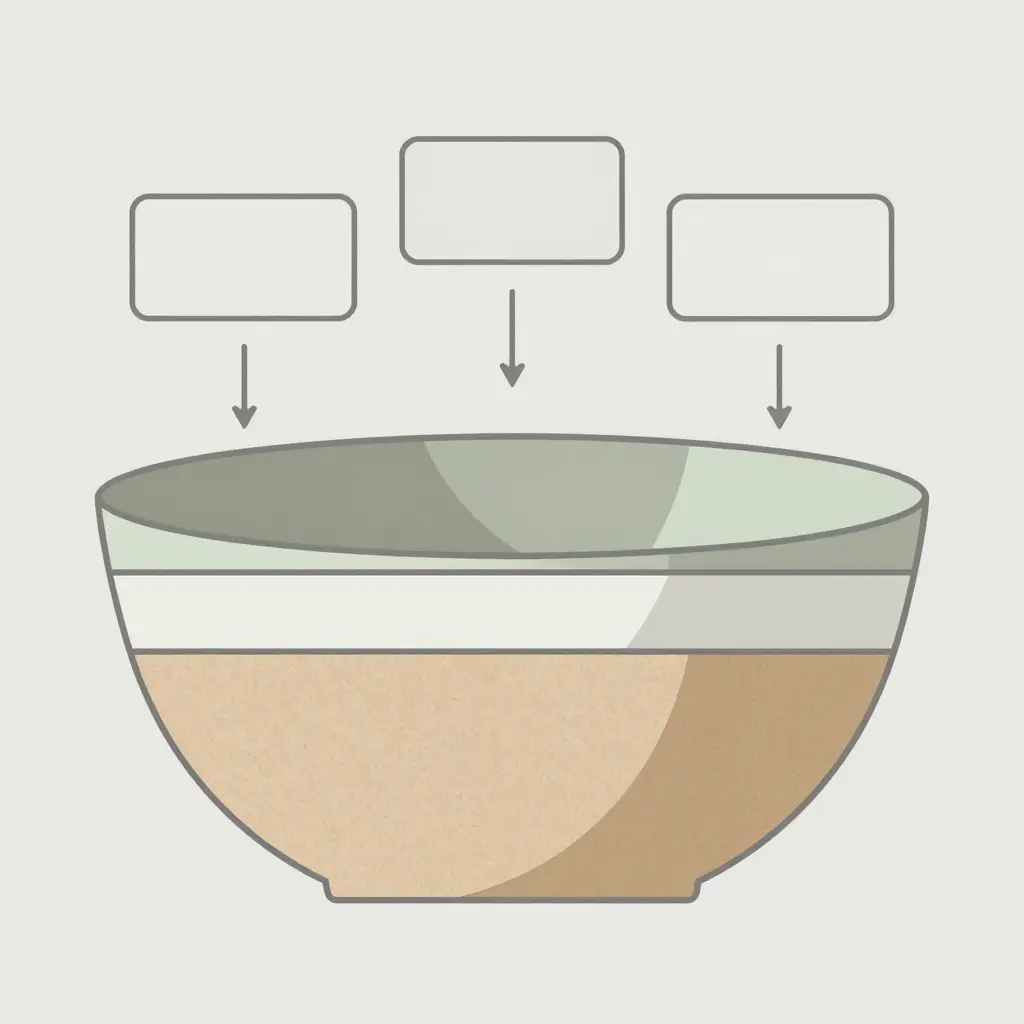
Reading the Layers at a Glance
The diagram cuts the bowl in half so you can see what a single sheet of a food bowl is actually made of. A compliant bowl is not one uniform material but a sandwich of functional layers, each solving a different problem:
| Layer | Position | Primary Job | Typical Material |
|---|---|---|---|
| Outer structural layer | Outside (load-bearing) | Rigidity, stacking strength, print surface | Recycled board grade |
| Optional barrier/coating layer | Middle | Grease, moisture, and heat resistance | Dispersion coating or PE/PLA film |
| Food-contact liner | Inside (touches food) | Food-safety compliance, taste neutrality | Virgin fiber or approved coated layer |
In short: the cheapest recycled board can sit in the outer wall, but it should never be the surface that touches your food. That is why the food-contact liner is often a separate, higher-grade material bonded to a recycled structural base. If you source for a restaurant or delivery operation, review how deep paper bowls for business are specified across wall thickness and liner grades before you commit to a low-cost board. The diagram is meant to travel with your spec sheet, so buyers, QA, and suppliers share one picture of where cost is saved and where it must not be.
A non-compliant grade can come in 15-25% below the unit price of a certified food-safe alternative. Across thousands of units, that gap looks like easy money. Unit price, though, is one line in the equation. Order volume and compliance risk move together, and ignoring that link is how margins disappear.
How Unit Price, Volume, and Compliance Risk Interact
The larger the order, the more a small per-unit saving adds up, and the more you have riding on a single sourcing decision. One non-compliant batch across a full container can turn a modest margin gain into a large write-off.
| Cost Factor | Cheaper Recycled Grade | Compliant Food-Safe Grade |
|---|---|---|
| Unit price | Lower (15-25% less) | Higher upfront |
| Shipment rejection risk | High | Low |
| Relabeling / repacking | Frequent | Rare |
| Market acceptance | Limited | Broad |
| Liability exposure | Elevated | Managed |
| True cost at scale | Often higher | Predictable |
The Hidden Costs Buyers Rarely Budget For
- Rejected shipments. Customs holds or QA failures on non-compliant stock can strand inventory you have already paid for.
- Relabeling and repacking. Correcting compliance marks and documentation costs labor, time, and often new packaging.
- Market rejection. Retailers and foodservice clients increasingly demand food-contact certification before they will range your disposable paper bowls.
- Liability. If a non-compliant bowl fails, the brand, not the factory, absorbs the reputational and legal weight.
The Smarter Calculation
The real metric is total cost of ownership, not unit price. A compliant grade that clears customs and satisfies buyers on the first pass usually costs less once you price in avoided rework and lost sales.
For buyers sourcing at scale, the dependable route is certified stock from a partner who documents compliance up front. Explore how leading operators approach it with the right bulk disposable bowls.
The Cost-to-Compliance Curve: What the Numbers Show
Before you compare quotes from three different suppliers, it helps to see the relationship you are actually shopping for. The grouped bar chart below plots three common octagonal paper bowl board options against two metrics at once: their Relative Unit Cost (indexed from 0-10, where higher means more expensive per bowl) and their Compliance Confidence Score (a practical 0-10 rating of how reliably the board can support food-contact compliance documentation).
The pattern is hard to miss. Move from left to right and both bars rise together. Compliance confidence tends to track with cost, not because cheap options are automatically illegal, but because verifying and defending food-safety compliance costs money.
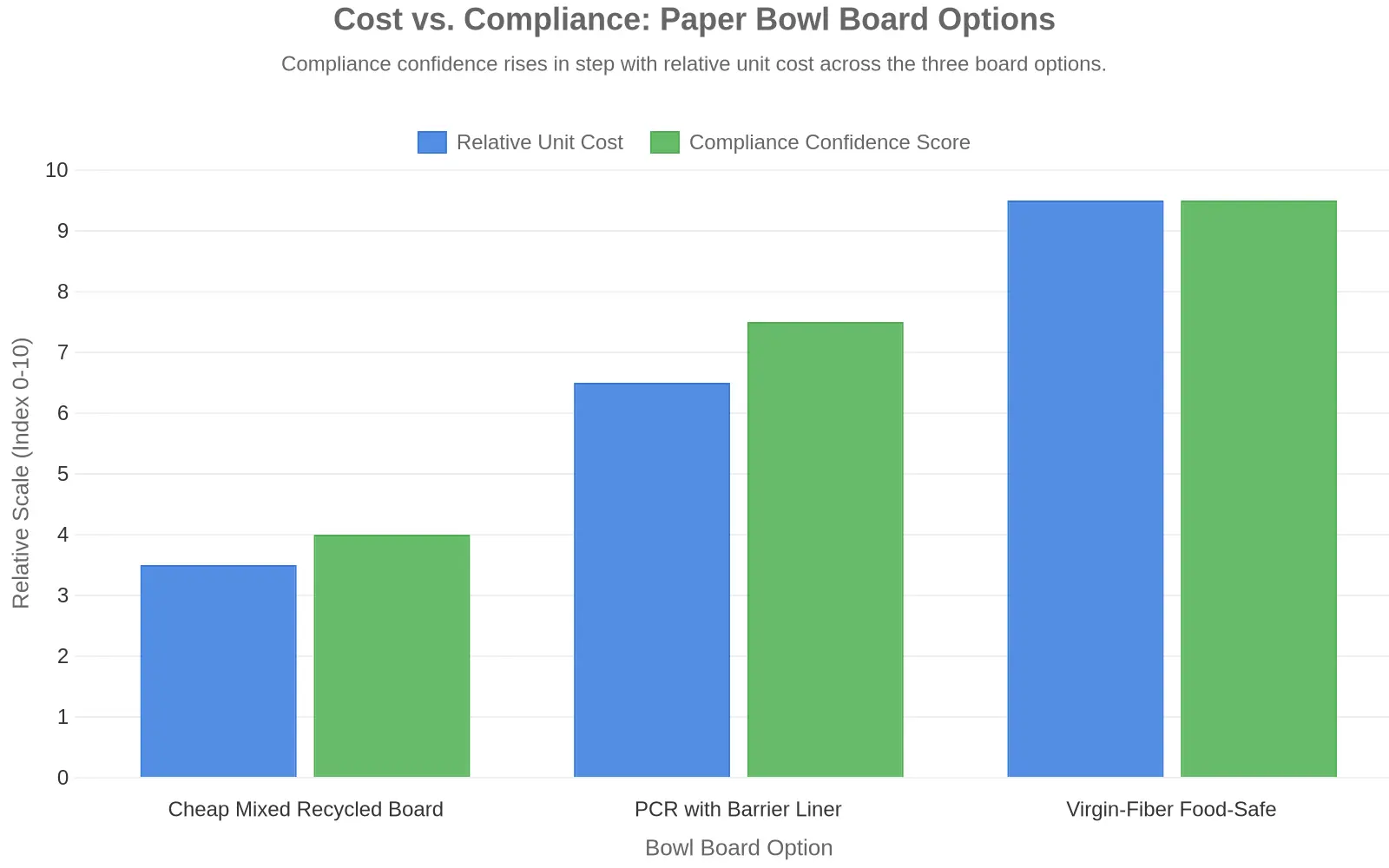
Chart caption: Compliance confidence rises in step with relative unit cost across the three board options, illustrating the core cost-versus-compliance trade-off.
Reading the Three Options
| Board Option | Relative Unit Cost | Compliance Confidence Score |
|---|---|---|
| Cheap Mixed Recycled Board | 3.5 | 4.0 |
| PCR with Barrier Liner | 6.5 | 7.5 |
| Virgin-Fiber Food-Safe | 9.5 | 9.5 |
The Cheap Mixed Recycled Board sits in the low-cost, high-risk quadrant. It triggers the most sourcing headaches, since mixed feedstock makes fiber origin hard to trace and contaminant absence hard to confirm. The PCR with Barrier Liner option sits in the middle: a functional barrier layer isolates the food from the recycled substrate, which lifts confidence without pushing you into premium territory. The Virgin-Fiber Food-Safe board anchors the top of both scales, with the clearest compliance story at the highest per-unit cost.
Why This Matters for Your Sourcing Decision
The chart is not telling you to always buy the most expensive board. It is telling you that compliance is a cost you either pay up front in materials or pay later in testing, rejected shipments, and liability exposure. Match the board to the application: a dry bakery item and a hot, oily noodle dish do not carry the same risk profile. If you want to see how board grades perform in real octagonal bowl applications, look at how a standard 360ml paper bowl is built to balance wall strength against food-contact requirements.
Buyers who chase the lowest line-item price on mixed recycled board often find that the “savings” evaporate the moment a compliance test comes back non-conforming. Mapping cost against confidence, as this chart does, turns that hidden risk into a visible line on the page.
Key Factors When Choosing a Recycled Paper Bowl Supplier
Selecting a recycled paper bowl supplier takes more than comparing unit prices. Whether you are sourcing paper bowl suppliers for the first time or renegotiating an existing contract, the checklist below separates a compliant, audit-ready partner from a low-cost but high-risk vendor. Treat each point as a verification step before confirming any order.
- Verified compliance documentation – Confirm the supplier provides current food contact compliance declarations aligned with FDA, EU 1935/2004, or your target market’s regulations.
- Recycled board grade transparency – Require written disclosure of the recycled board grade, including fiber source, virgin/recycled ratio, and any post-consumer content.
- Barrier and coating specification – Clarify whether the bowl uses PE, PLA, or water-based coatings, since the coating determines grease resistance, heat tolerance, and recyclability.
- Minimum order quantity vs. cost – Weigh MOQ thresholds against per-unit pricing, as aggressive low MOQs often carry higher rates and reduced specification flexibility.
- Supplier certifications – Validate third-party certifications such as FSC, BRC, ISO 22000, or BPI compostability to support claims and audits.
- Testing documentation – Request migration, heavy metals, and food-contact test reports from accredited laboratories for each production batch.
- Sample and batch consistency – Evaluate physical samples across multiple production runs to confirm wall thickness, sealing integrity, and print quality remain stable.
- Traceability and recall support – Check the supplier’s lot-tracking and traceability systems to ensure rapid identification if a compliance issue arises.
Procurement Guidance: Balancing Cost and Safety
Cheap octagonal paper bowls do not have to mean cutting corners on safety. The skill in sourcing is knowing where to save and where never to compromise. Get that balance right and you protect both your margins and your customers.
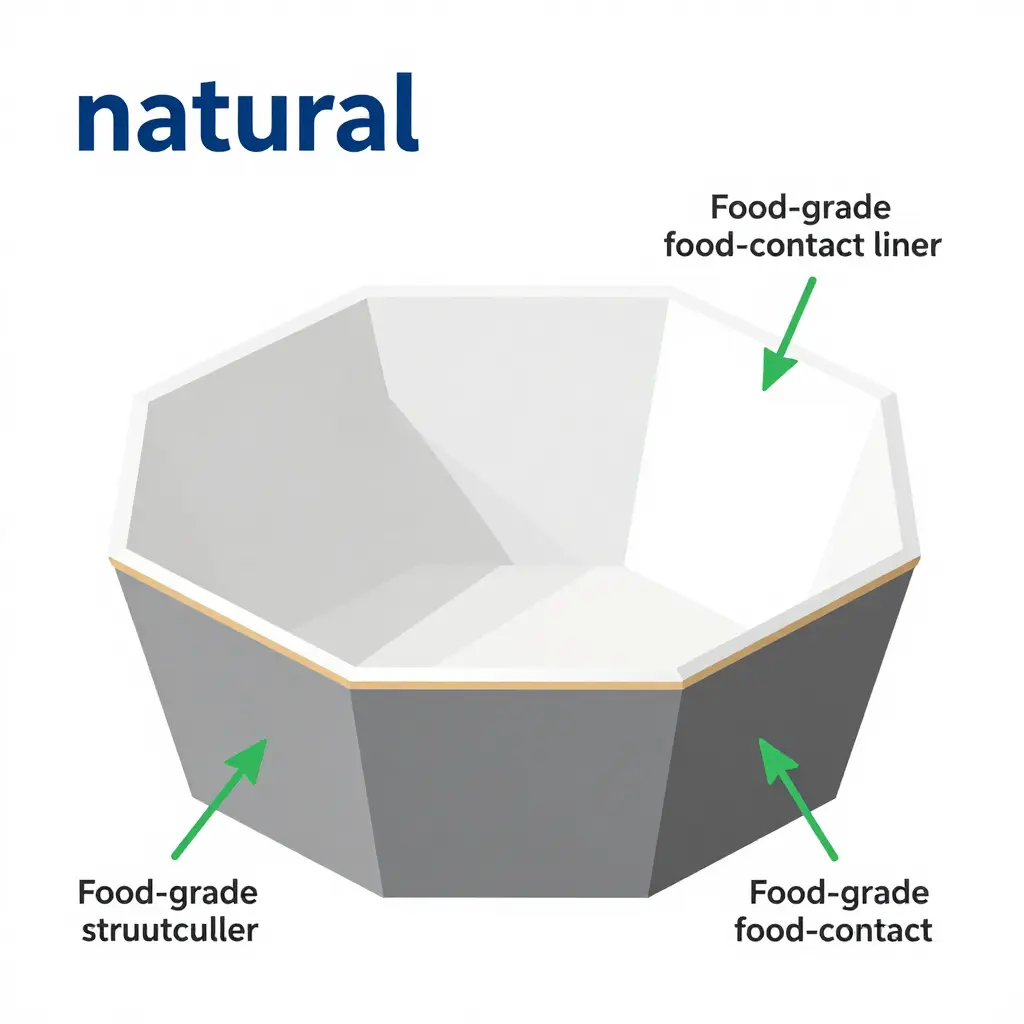
The strongest approach separates structure from surface. Use recycled board for the structural body of the bowl, then pair it with a thin, certified food-contact liner. The recycled board delivers rigidity and stacking strength at a low material cost. The liner does the one job regulation actually cares about: it is the only layer that touches food. This hybrid build keeps unit prices down while keeping compliance intact.
How to structure the spec and verify it:
- Specify the liner, not the whole bowl. Require a virgin or food-grade material for the inner food-contact layer, and state its grammage and grade explicitly.
- Require documented food contact compliance. Ask for migration and food-safety test reports tied to the exact liner material, not a generic certificate.
- Validate every batch against a fixed spec. Sample incoming lots, retain reference samples, and audit suppliers on a schedule so recycled board quality never drifts into the food layer.
Done well, food-safe paper bowls let you compete on price without gambling on liability. Treat food contact compliance as the non-negotiable floor of every quote, and negotiate everything else.
Once your spec is locked, you can apply the same discipline to complementary paper packaging solutions and build a consistent, compliant packaging program across your whole menu line.
Frequently Asked Questions About Cheap Octagonal Paper Bowls
Are recycled board bowls safe for food contact?
Yes, recycled fiber bowls can be safe for food contact, provided the recycled board grade is intended for direct food use and the inner coating is approved for greasy or wet foods. The risk is not the recycled fiber itself but contamination such as mineral oils or heavy metals from mixed waste streams. When the grade is properly sorted and the lining meets food contact compliance standards, cheap octagonal paper bowls can safely hold hot, cold, and oily dishes.
What certifications should I request?
Request test reports and declarations covering FDA 21 CFR 176.170/176.180, EU 1935/2004, and Germany’s LFGB (or BfR Recommendation XXXVI), plus a migration test summary. You should also ask for ISO 22000 or BRC food-safety certificates for the factory and documentation of the recycled board grade used. These documents show that your cheap octagonal paper bowls meet food contact compliance, rather than only claiming to.
Why are cheap recycled bowls sometimes non-compliant?
Low-cost bowls are frequently non-compliant because suppliers cut corners on the recycled board grade, using board from unknown or unsorted waste and cheap linings that migrate into food. Since cheap octagonal paper bowls are priced on volume, some factories skip the testing and documentation that true food contact compliance requires. The result is a product that looks the same but fails regulatory limits in the destination market.
Can recycled board bowls be compliant in some markets but not others?
Yes. Food contact compliance rules differ by region: the EU and US apply strict migration limits, while other markets may allow certain inks or coatings that are banned elsewhere. A recycled board grade accepted in one country can be rejected at another border because of different recyclate-input and chemical restrictions. That is why cheap octagonal paper bowls must be validated against the regulations of the market where they will be sold.
How do I verify a supplier’s food contact compliance claims?
Ask for lab test reports from accredited third parties, and confirm the certificate matches the actual recycled board grade and SKU you are buying, not a generic sample. Request a sample batch for your own independent testing, and audit the factory or review its latest inspection records. For broader sourcing context, see our guide to deep paper bowls for business before finalizing any bulk order of cheap octagonal paper bowls.
Conclusion
Cheap octagonal paper bowls can be genuinely cost-effective, but only when you weigh recycled board grade and food contact compliance together. A low unit price means little if the board cannot withstand grease, heat, or moisture, or if it fails the regulatory requirements for direct food contact.
The reliable sourcing strategy treats the two as one decision. Buyers who check board specifications against compliance documentation protect themselves on both fronts and avoid rejected shipments, recalls, and damaged customer trust.
Compliant sourcing is not just a technical checkbox. It protects brand reputation and legal standing, and it gives foodservice operators and distributors the confidence to scale with paper bowl solutions for businesses that hold up in practice.
As demand for affordable, food-safe takeaway packaging keeps growing, the buyers who succeed will be the ones who weigh cost against compliance from the first purchase order. That discipline turns a budget decision into a durable one.