
Why Octagonal Paper Bowls Bulge at the Side Panels: Board Caliper vs. Hot Fill Depth
Octagonal paper bowls made for hot-fill service develop the same defect again and again: outward bulging along the side panels. It shows up after filling, once a bowl of hot product is sealed and left to cool, and it is worst on the flat faces between the fold lines rather than at the corners. For paper packaging manufacturers, converters, and foodservice procurement teams, the bulge is not just cosmetic. It throws off lid fit, makes stacks unstable, distorts print registration, and produces customer complaints that get blamed on handling when the real cause is dimensional instability.
Two variables govern side-panel deflection: board caliper and hot fill depth. Board caliper sets the bending stiffness and moisture resistance of the wall; hot fill depth sets the thermal load and the volume of entrapped vapor the panel has to withstand. Holding secondary factors constant, this analysis weighs board thickness directly against thermal fill load to establish which one controls bulge onset and where each reaches its design limit. The engineering assumptions here match the performance targets in deep paper bowls engineered for hot-fill service.
Why Octagonal Geometry Concentrates Stress at the Side Panels
An octagonal bowl is not a round bowl with corners. It is eight flat walls joined by folded creases, and that one choice changes how internal pressure moves through the board.
Push outward on a round wall and the force turns into balanced hoop tension carried around the full circumference. Nothing concentrates, because there is no discontinuity to break the ring.
Flat Panels Carry Less Hoop Strength Than a Round Wall
An octagonal format breaks that ring into eight independent segments. Each side panel acts as a flat plate spanning between two crease lines, and a plate resists outward pressure by bending rather than by hoop tension. Bending is the weaker mechanism: the panel moves first, and it moves in the middle, where nothing supports it.
That is why an initial side panel bulge appears as a gentle outward bow centered on each flat face. The crease lines act as hinges. Folded paper has already been stressed and thinned along the fold, so under load each crease gives a little and lets the neighboring panels lean outward instead of holding the wall rigid.
So the geometry hands deformation eight places to start: eight plates and eight hinge lines where paper bowl deformation begins. A round wall spreads the same force around an unbroken loop; an octagon concentrates it where stiffness is lowest.
In an octagonal bowl, internal pressure reaches the flat panel center before the crease line, so the question is where the panel deforms, not whether it will. Converters designing deeper hot-fill formats can review deep bowl design considerations to match board caliper with the fill depth a given geometry tolerates.
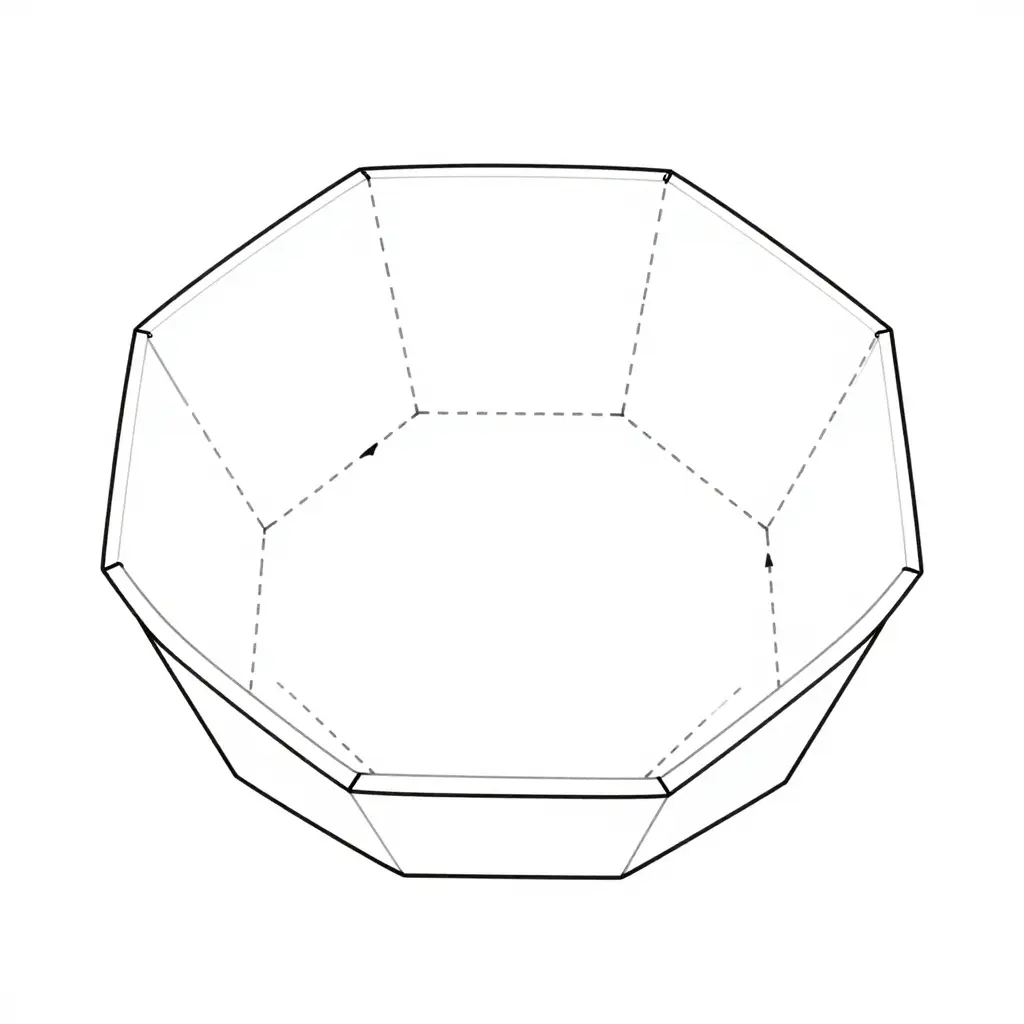
Figure 1 – Octagonal bowl geometry, viewed from above. Eight flat trapezoidal side panels meet along eight folded crease lines that act as the bowl’s structural hinges. A flat panel offers no hoop stiffness of its own, so the crease lines are the only load path resisting outward movement.
Hot product and steam raise internal vapor pressure, which pushes perpendicular to every surface. On a round bowl the pressure resolves evenly around the circumference. On an octagon, the midpoint of each flat panel is the furthest point from the supporting creases, making it the least restrained spot in the structure. The arrows mark where the bulge starts: maximum bending moment, minimum lateral support, and the shortest path to a heat-softened wall whose stiffness depends on caliper.
The format is sensitive to two variables at once: board caliper, which sets the panel’s resistance to bending, and hot-fill depth, which sets the temperature and pressure the panel must survive while wet. Thin board or a deep fill lowers the deformation threshold until the mid-panel deflects before the creases can spread the load.
Board Caliper: The First Root-Cause Variable
Board caliper, the formed wall thickness of the paperboard stock, is the material variable that decides whether an octagonal paper bowl bulges at its side panels under hot fill. It sets the stiffness budget the container has to work within; fill depth, seal geometry, and lid fit only matter after that.
Bending stiffness is what resists outward panel movement. In paperboard, flexural rigidity scales roughly with the cube of caliper, so small thickness changes have outsized effects: going from 0.30 mm to 0.45 mm does not raise stiffness by 50 percent, it multiplies it by about 3.4x, since (0.45 / 0.30)^3 = 3.375. Thin board therefore buckles under internal load far sooner, and the octagonal flat faces bow outward first.
Beam strength follows the same pattern. Under the hoop and vertical compression from a hot, dense fill, a thin side panel acts as a shallow beam spanning between score lines. Its section modulus is low, so local buckling starts at lower stress. Thicker board raises both bending stiffness and beam strength, which pushes the failure threshold higher.
Fiber orientation and ply count matter too. Fibers aligned with the load path stiffen a panel most; cross-machine fibers bend more easily. Adding a ply, say from two plies to three, adds interply shear resistance and lifts effective stiffness without a proportional increase in caliper.
Moisture absorption softens the fiber matrix. Steam and condensate from the fill penetrate the sheet and plasticize the hydrogen bonds between cellulose fibers, lowering the board’s modulus. Thin board that has taken on moisture loses stiffness quickly and bulges early; thick, dry board keeps its rigidity through the fill cycle.
For a deeper look at how these bowls are specified for demanding service, see deep paper bowls engineered for business use.
Board Caliper vs Side-Panel Bulge Resistance
| Board Caliper (mm / pt) | Typical Bending Stiffness Behavior | Observed Side-Panel Bulge Risk under Hot Fill |
|---|---|---|
| 0.45 mm / ~18 pt (light) | High flexibility, low rigidity; bends easily under stress | Severe – side-panel deflection > 3 mm, visible bulging at all hot-fill depths |
| 0.60 mm / ~24 pt (light) | Moderate flexibility; yields under sustained hoop stress | High – 2-3 mm deflection, bulging on deep fills > 45 mm |
| 0.75 mm / ~30 pt (medium) | Balanced stiffness; partial resistance to hoop load | Moderate – 1-2 mm deflection, onset of bulge at fills > 55 mm |
| 0.90 mm / ~35 pt (medium-heavy) | Stiff; resists hoop stress across typical fill depths | Low – < 1 mm deflection, bulge rarely observed |
| 1.10 mm / ~43 pt (heavy) | Rigid; minimal flex under thermal and load stress | Negligible – < 0.5 mm deflection, stable side panels |
| 1.30 mm / ~51 pt (heavy) | Very rigid; essentially no measurable flex | None – no measurable bulge, geometry holds through fill and cooling |
Note: Deflection values are indicative side-panel measurements at a 90 C hot fill and assumed 60-70 mm fill depth on octagonal geometries.
Hot Fill Depth and Thermal Load: The Second Root-Cause Variable
Hot fill depth is the level to which hot contents are filled, measured from the interior base to the free surface of the product. In an octagonal bowl it has direct structural consequences: it sets how much of each side panel is exposed to the thermal load of the contents and to the moisture vapor rising against the board. Board caliper governs a section’s inherent stiffness; hot fill depth governs the load that stiffness has to resist.
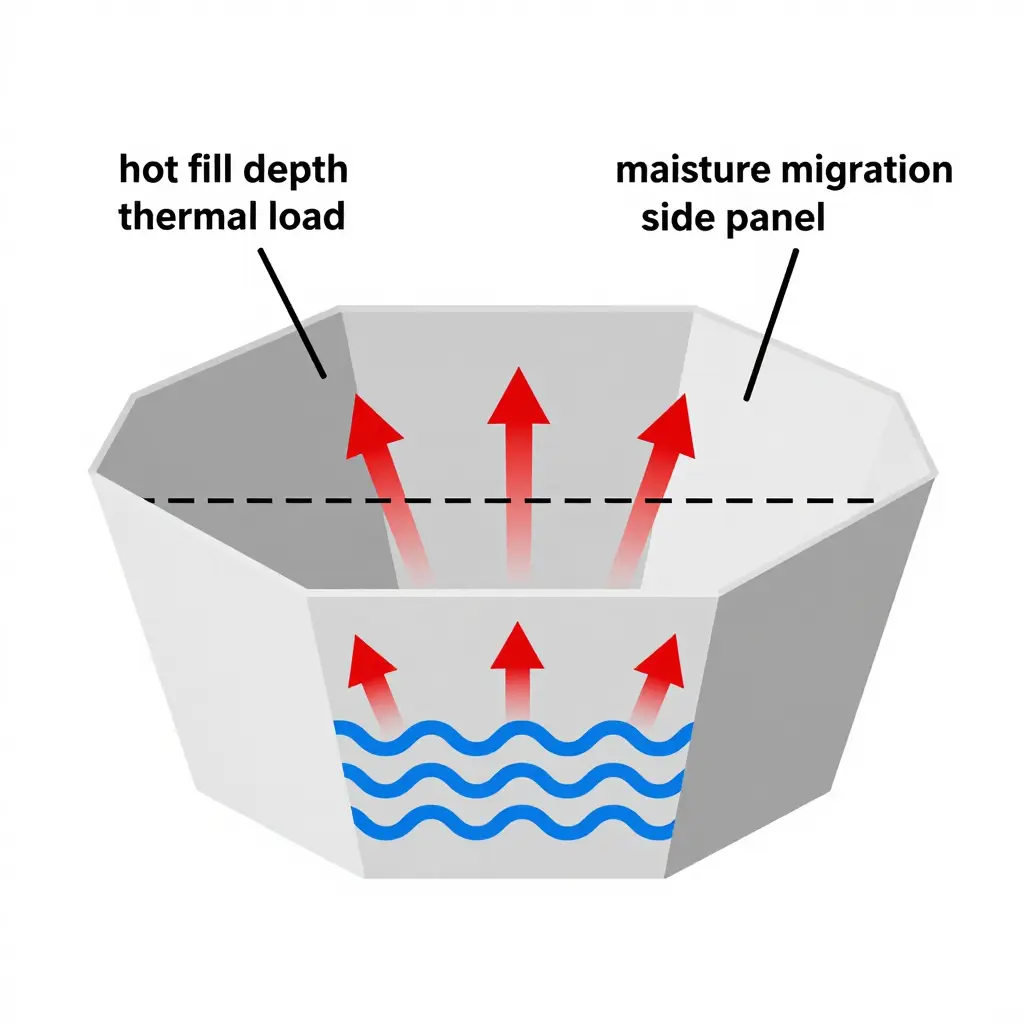
The mechanism is thermal and hygroscopic. Hot contents act as a reservoir of thermal mass that keeps feeding heat through the inner liner into the paperboard. A deeper fill raises the panel’s equilibrium temperature, because more panel area sits against the contents and the vapor-rich headspace above them. As the temperature climbs, moisture migration speeds up: water vapor drives into the fiber network and weakens the hydrogen bonds holding cellulose fibers together. Stiffness drops at the side panels, which is exactly where the bowl is weakest.
The result is a localized mechanical failure. Side panels are already the least constrained part of an octagon, bending along the facet corners. Once moisture softens the fibers and heat lowers the board’s modulus, they can no longer resist the internal forces of the fill and bow outward. Two bowls from identical board stock can fail differently for the same reason: the deeper-filled one takes on more heat and moisture across a larger panel area.
Managing the variable means controlling the fill line, leaving adequate headspace for vapor, and choosing board that keeps its stiffness under combined heat and moisture. Manufacturers specifying deep paper bowls for business should treat fill depth as a design parameter, not a downstream filling instruction.
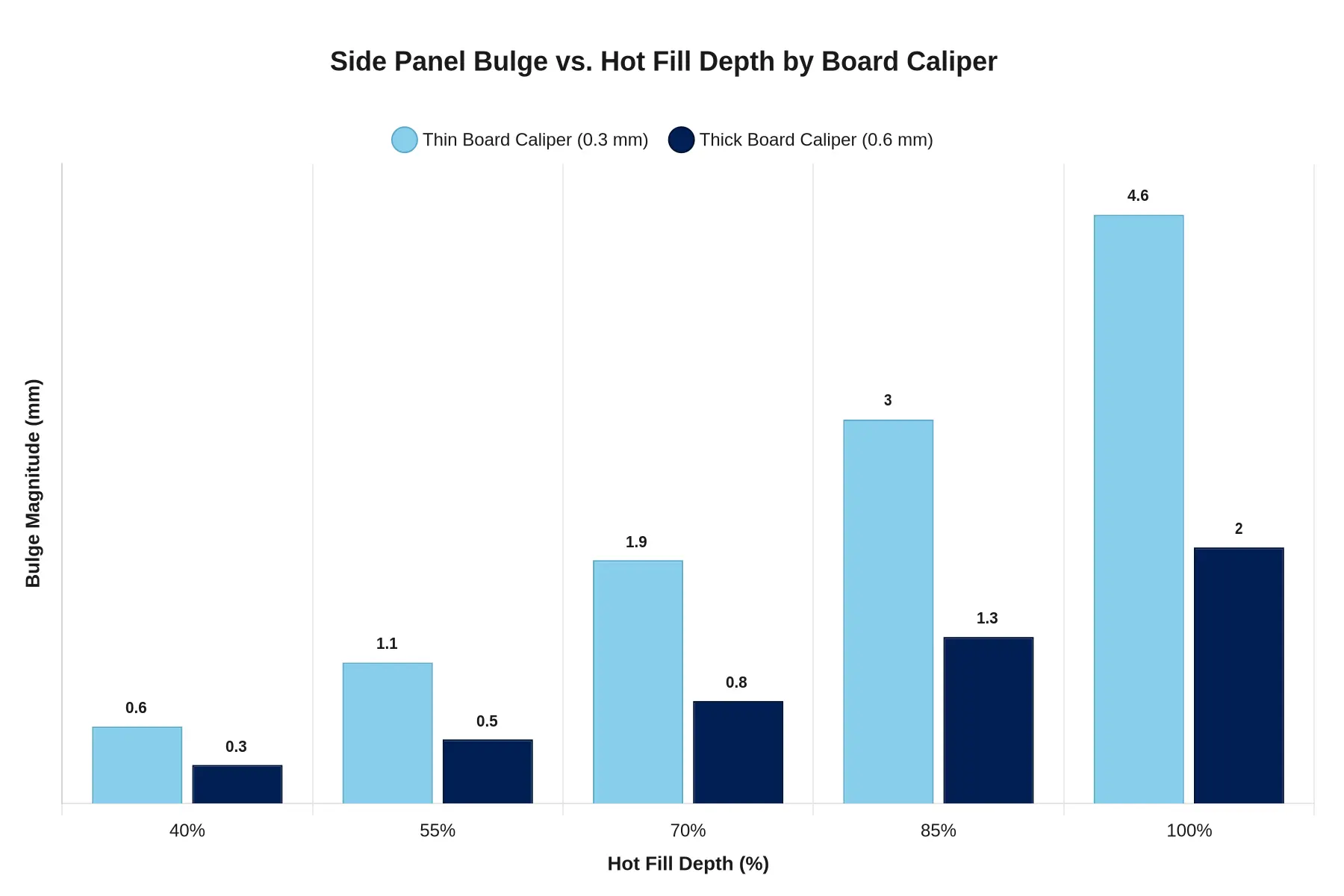
Figure 2. Side panel bulge (outward deflection, mm) versus hot fill depth for thin (0.3 mm) and thick (0.6 mm) board caliper. Grouped bars compare the two calipers across five fill levels from 40% to 100%. In both constructions bulge grows faster than fill depth, but the thin 0.3 mm caliper degrades far sooner, reaching roughly 4.6 mm of outward deflection at full fill against 2.0 mm for the 0.6 mm board.
For teams specifying bowls for hot-fill service, the useful question is how much headspace and rigidity a design can take. See engineering guidance on deep paper bowls for commercial hot-fill use to match fill depth with caliper selection and avoid side panel failures.
Diagnostic Root-Cause Checklist: Side-Panel Bulge in Octagonal Paper Bowls
Before you touch the tooling or scrap the run, walk the line and check each condition in order. The checklist separates bulges that come from the board specification, the forming process, and the fill-and-cool cycle, so you fix the cause rather than the symptom. For how geometry and caliper should be specified up front, see our notes on deep paper bowls engineered for hot-fill duty.
- Board caliper below specification – measure incoming stock with a micrometer; anything under the minimum design caliper loses hoop stiffness fast under load.
- Hot fill depth exceeding design limits – confirm fill volume and temperature against the bowl’s rated capacity; overfilling raises hydrostatic pressure against the side panel.
- Insufficient moisture barrier – check coating weight, distribution, and coverage; a thin or pin-holed barrier lets steam migrate straight into the fiber layer.
- Crease-line weakness – inspect crease depth and width; over-crushed or shallow creases create hinge points that buckle when the wall is stressed.
- Inadequate cooling time – verify dwell time before stacking or lidding; still-warm panels deform under their own trapped heat.
- Excess or depleted forming moisture – confirm board moisture content sits within range; too-dry board cracks at the crease, too-wet board swells and softens.
- Uneven heat-seal pressure – audit side-seam pressure and temperature; inconsistent sealing concentrates stress at the panel edges.
- Poor lid or rim fit – check for gaps between bowl and lid; a loose fit lets steam vent sideways into the panel instead of out the top.
- Stacking compression – review pallet and case loading; stacked weight on hot, soft panels flattens or bulges walls over time.
Work down the list until one condition fails. That failure is your root cause, and fixing it normally clears the bulge without touching the rest of the process.
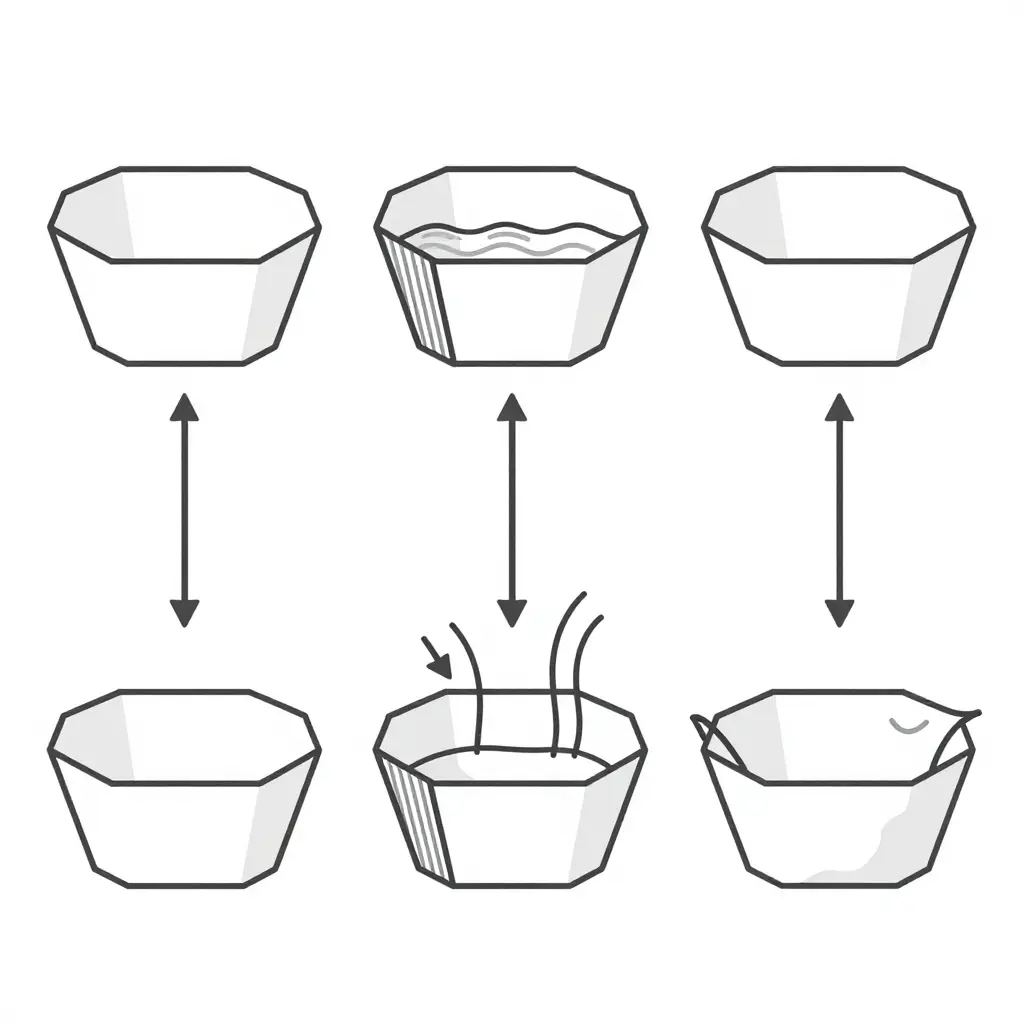
Reading the Diagram: The Moisture Migration Mechanism
The schematic traces the failure in five stages, left to right:
- Empty bowl – a rigid octagonal geometry with a still, uniform side panel.
- Board wall – the side panel shown as a layered fiber structure whose caliper defines its stiffness.
- Hot fill line – hot contents raise the internal vapor pressure and wet the headspace.
- Vapor migration – directional arrows show moisture vapor traveling outward, drawn into the side panel fiber network.
- Panel softening – absorbed moisture plasticizes the fiber matrix, and the side panel bulges and loses dimensional stability.
The point is that bulge is a sequence, not a single defect. Lowering fill temperature, matching fill depth to caliper, or strengthening the barrier between liquid and board breaks the chain before stage five. For related bowl formats built for high-temperature service, explore our guide to deep paper bowls for business.
Caliper vs. Hot Fill Depth: Treat Them as One Balanced System
A common mistake in root-cause analysis is treating board caliper and hot fill depth as independent variables. In an octagonal paper bowl they behave as one coupled mechanical system, and failure is best described as a threshold effect rather than a linear proportionality.
Why the Effect Is Threshold-Based
Below a certain combination of fill depth and fill temperature, the side panels of an octagonal paper bowl deform almost imperceptibly. Cross that threshold and internal vapor pressure and moisture plasticization overwhelm the cohesive strength of the paperboard, and the panel deflects rapidly. The consequences are asymmetric:
- A deep hot fill can overwhelm even adequate boards. A 260 gsm wall performs cleanly at a 35 mm fill line but approaches visible buckle at 50 mm, because the additional hydrostatic and steam load exceeds the remaining structural reserve.
- A heavier board can offset moderate fill depth. Moving to 300 gsm restores stiffness through the cube-of-thickness term, pushing the onset of visible bulge several millimeters deeper.
Designing With an Explicit Margin
The engineering fix is to stop specifying caliper in isolation. Instead, specify board caliper against the expected maximum fill depth, not the nominal or average fill. The governing rule can be written as:
| Design Parameter | Specification Logic |
|---|---|
| Board caliper | Sized for maximum expected fill depth, not average |
| Hot fill depth | Treated as the load case, including fill-line tolerance |
| Design margin | Residual stiffness above the bulge threshold (target 15-25%) |
In practice this means the chosen caliper should keep predicted side-panel deflection below the cosmetic rejection limit even at the worst-case fill and temperature. A 260-280 gsm wall with disciplined fill-line control clears most bulge complaints in deep paper bowls for business applications; 300 gsm and above is reserved for high-volume servings near the bowl rim.
For production engineers the sequence is operational: lock the fill depth first, then pick a caliper that clears it with margin. Specified together instead of separately, the two keep octagonal paper bowls dimensionally stable across the full hot-fill envelope.
FAQ: Octagonal Paper Bowls and Hot-Fill Deformation
Does a thicker board always prevent side-panel bulge in octagonal paper bowls?
No. More board caliper raises a panel’s bending stiffness, which helps resist out-of-plane deflection, but it is not a cure by itself. Because the octagonal geometry concentrates hoop stress at the eight corner creases, a heavier board can still bulge once the hot fill depth surpasses the height the panel can support. What governs is the ratio of board caliper to unsupported fill height, not caliper in isolation.
How are hot fill depth limits determined?
By balancing the hydrostatic pressure of a hot product against the bending resistance of the side panel. Engineers calculate the pressure at the maximum fill line, then compare it with panel stiffness as a function of board caliper and the unsupported span between structural folds. The highest fill level that keeps panel deflection within tolerance becomes the hot fill depth limit. For products built around deeper serving volumes, deep paper bowls for hot-fill service explains how fill height and wall stiffness interact.
Do coatings or moisture barriers help reduce bulge?
Only indirectly. A coating slows moisture migration into the fiber, which delays the stiffness loss that occurs when board softens under a hot, moist load, so it postpones bulge rather than eliminating it. No coating can compensate for insufficient board caliper or an excessive fill depth.
How can I test bulge resistance before mass production?
Run a controlled fill trial at the maximum intended temperature and fill depth, then measure side-panel deflection at fixed intervals. Use the same board caliper, forming pressure, and tooling as production, and repeat across several samples to catch batch variation. If deflection exceeds tolerance, raise caliper or lower the hot fill depth.
How do octagonal bowls compare to round bowls for hot fill?
A round bowl spreads hoop stress evenly around a continuous circumference, so one uniform wall resists bulge consistently. An octagonal bowl concentrates stress at its corner folds, creating localized weak points that need higher board caliper or a shallower hot fill depth to stay stable. That is why octagonal formats bulge sooner under identical filling conditions.
Conclusion and Manufacturing Recommendations
Side-panel bulging in octagonal paper bowls is a predictable structural outcome, not a cosmetic nuisance. As hot fill depth rises, so do hydrostatic pressure and thermal softening, while the effective stiffness of the side panels depends directly on board caliper. When caliper is undersized for the fill depth, the walls cannot resist the combined radial load and moisture-driven weakening, and they deflect outward. Caliper and fill depth therefore belong together as a coupled design pair, not as variables specified apart.
For manufacturers and procurement teams, the finding translates into three practices:
- Specify caliper against maximum fill depth. Define board thickness using the deepest intended hot fill, plus a defined safety margin, rather than the nominal or average fill volume.
- Validate with hot-fill trials. Run physical fill trials at production temperature before locking specifications, testing worst-case volumes, dwell times, and stacking loads.
- Monitor moisture barriers. Coating and barrier integrity degrade with heat and time; verify them across the full fill cycle to preserve panel stiffness.
Sourcing teams should also confirm lid and closure compatibility, since panel deflection interacts directly with fit and seal integrity. Reviewing a dependable paper bowl with lid supplier helps ensure the closure system matches the specified caliper. For hot applications specifically, operators can benchmark proven designs among to-go soup bowls best disposable bulk to align caliper with real-world fill depths. Material specification and reliable hot-fill performance are inseparable: the correct caliper, validated against maximum fill depth and protected by an intact moisture barrier, is what keeps octagonal side panels dimensionally stable under hot fill.