
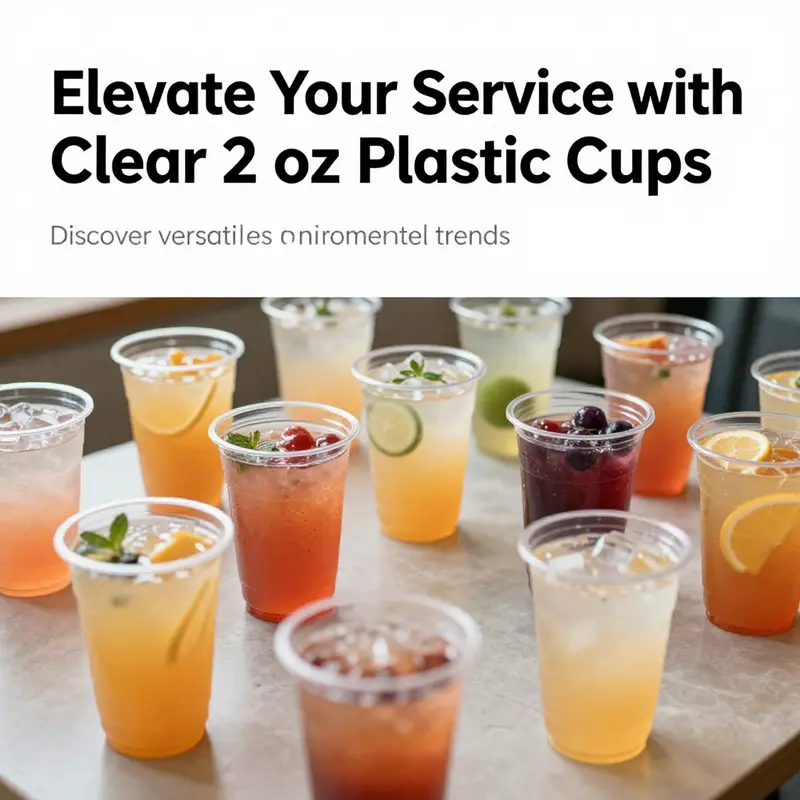
Clear 2 oz plastic cups are an essential element in the food and beverage industry, particularly for bubble tea shops, restaurants, catering services, and event planners. Their lightweight design, crystal-clear visibility, and low-cost structure make them perfect for various applications—from food service to promotional giveaways. Understanding how these cups can serve your business needs is vital in today’s market, where sustainability considerations and branding opportunities are paramount. Explore the diverse roles of these cups in different settings, the impact of environmental trends, and the manufacturing processes that ensure quality and cost-effectiveness as we dig deeper into this indispensable product.
Clear Confidence: How 2 oz Plastic Cups Shape the Food Industry’s Small-Serve Moments

The unassuming clarity of a small, two-ounce cup can feel almost noble in a busy kitchen or bustling event space. Yet its significance runs deep. Clear 2 oz plastic cups may be diminutive in stature, but they carry a quietly influential burden: they are the vessels that translate choice into portion, display into temptation, and preparation into predictable service. In the world of food service, where margins tighten and consistency is prized, these cups perform a careful balancing act. They are light enough to be stacked and moved with ease, translucent enough to reveal contents without distortion, and inexpensive enough to be disposed of after each shift. This combination makes them a practical backbone for precision portioning, quick-service efficiency, and imaginative presentation. When seen as part of a broader system rather than as a single item, the cups become a lens through which the industry values hygiene, speed, visibility, and cost management, all without sacrificing the sensory cues that influence a customer’s decision at the point of purchase.
The visual appeal of clear cups is not merely a matter of aesthetics. In food service, appearance is a proxy for freshness, cleanliness, and quality. The crystal-clear plastic invites a direct gaze into the product—whether a golden salad dressing, a glossy sauce, or a vivid dessert topping. That visibility reduces guesswork for both staff and guests. For staff, transparency helps ensure accurate portioning, which in turn supports cost control and consistency across dozens or hundreds of servings in a day. For guests, the sight of a well-presented condiment or sample can reinforce perceptions of care and attention from the vendor. In high-volume settings, where time is money and errors are costly, the ability to quickly identify contents minimizes mis-pours and mislabels. A cup that shows its contents clearly becomes a small but potent ally in speed and accuracy.
Portion control is perhaps the most straightforward application, yet it is also one of the most impactful. Condiments, dressings, dips, and small servings of sauces—whether in a bakery, a salad bar, or a tasting event—benefit from standardization. A consistent 2-ounce fill helps manage inventory, reduce waste, and align with dietary labeling. In a catering scenario, the predictable size supports buffet planning, ensures fair distribution, and simplifies maintenance of food safety protocols by limiting the amount of open food exposed at any given moment. For producers of samples or promotional bites, the 2-ounce measure becomes a reliable standard, enabling taste testing without overwhelming the palate or exhausting the product. In a busy climate, where staff switch between stations and rush orders flow from kitchen to front of house, a small, familiar vessel can make a measurable difference in reliability and service tempo.
Beyond portioning, the cups contribute to a sense of control and order. Their transparency helps staff spot potential issues—leakage, separation, or cloudiness in the liquid—that would otherwise require removing a product from circulation. When a guest reaches for a sample, the visual clarity reduces hesitation. The product’s color, texture, and viscosity are all on full display, allowing the guest to assess quality at a glance. This is particularly valuable in beverage tastings or flight-style presentations where color and clarity signal the drink’s character. Even in a setting that prizes speed, the cups’ honest appearance preserves consumer trust. The modest cup, in this sense, becomes a silent guardian of presentation standards in a fast-paced service environment.
The practical versatility of these cups extends into the realm of sampling and promotion. In retail aisles and at food fairs, small portions in clear cups invite impulse sampling without the commitment of a larger purchase. A bite-size, visually appealing sample lowers the barrier to trial and can drive larger sales down the line. The same logic translates to beverages and sauces in tasting rooms, where brands seek to demonstrate quality with minimal waste and maximum clarity. In promotional contexts, the cups become vehicles for branding and storytelling. Although the visual medium is transparent, the surrounding packaging, labeling, and display design can suggest a brand’s personality, from rustic to modern, while maintaining a clean, hygienic impression. The cup’s surface may be unobtrusive, but the surrounding context—lids, sleeves, and printed logos on the outer surface—amplifies its promotional potential without compromising the contents’ visual integrity.
Jello shots, dessert samples, and single-serving appetizers illustrate another facet of the cup’s utility. The small format is a natural fit for indulgent, post-meal treats at catered events, where portion control and hygienic handling are paramount. The cups’ low profile allows them to stack neatly on trays and in display cases, which reduces clutter and enhances accessibility for guests. The cups also facilitate clean, efficient cleanup—especially important when staff must manage dozens of food stations or a large crowd. The versatility to hold not only liquids but also semifluid desserts and layered treats expands their application beyond sauces and dressings, enabling creative, portable offerings that can travel from kitchen to table with minimal risk of spillage or cross-contamination.
Hygiene and convenience are two sides of the same coin in disposable tableware. The convenience of a discard-after-use mindset aligns with stringent hygiene standards—fewer shared implements, reduced risk of cross-contact, and simplified sanitation routines. In settings ranging from casual eateries to high-volume event kitchens, the disposable nature of 2 oz cups contributes to a clean, efficient workflow. They support a quick turnover between guests, a critical factor during peak hours, and reduce the complexity of dish management. This is particularly relevant when a service model emphasizes grab-and-go or self-serve stations, where staff must balance accuracy with the speed required by large crowds. The cup’s disposability also mitigates concerns about lingering odors or residue, provided the contents are managed within appropriate guidelines for storage and handling.
A broader narrative around sustainability and consumer expectations informs how these cups are perceived and used. The industry has shifted toward materials that are BPA-free and more readily recyclable, with growing attention to compostable and plant-based alternatives for eco-conscious segments. While traditional PET and PS cups still deliver strong performance in terms of clarity, rigidity, and cost, brands are exploring formats that align with evolving regulatory landscapes and consumer values. The clear cup thus sits at a crossroads: it represents the efficiency and practicality demanded by fast service, yet it also challenges designers and operators to consider end-of-life options for the packaging. In many operations, this tension spurs innovations such as integrating recycled content, exploring compostable liners or lids, and adopting codes that facilitate take-back or recycling programs at large events. The result is a more responsible approach to what is, by nature, a single-use item but one that remains deeply embedded in daily practice wherever small portions are shared.
This convergence of practicality and responsibility leads to a reevaluation of the cup’s role in branding and customer experience. Screen printing and label application offer durable, vibrant branding on disposable cups, transforming a simple vessel into a portable billboard. The ability to customize the outer surface with logos, catchphrases, or QR codes enables a direct line of interaction with guests. A QR code could link to a menu, allergen information, or a tasting note, adding a layer of interactivity that goes beyond the moment of purchase. In this sense, the cup becomes a platform for storytelling and data collection, where brands can engage with customers in real time and measure response through digital channels. The shift toward customization is not merely about aesthetics; it is a strategic alignment with how guests educate themselves about products and how vendors capture feedback and preferences.
From a logistical standpoint, clear 2 oz cups also reflect the efficiency and adaptability required by modern food operations. The production processes—whether injection molding or blow molding—are highly automated, designed to ensure uniform thickness, precise volume, and consistent clarity. Quality control checks for cloudiness, thickness variations, and structural defects help preserve performance across large batches. Finishing operations—cleaning, stacking, and bulk packaging—support rapid replenishment and minimize handling time for staff. As the market evolves toward just-in-time delivery for large events, manufacturers optimize lines to reduce waste and shorten lead times. This operational choreography matters because small-format cups must be reliable every shift, even when demand spikes unexpectedly. In an industry where a minute can tilt the balance between a satisfied guest and a missed sale, the reliability of these cups underpins the flow of service.
In the end, the value of clear 2 oz plastic cups lies in their capacity to translate a diverse set of requirements into a single, dependable instrument. They enable precise portioning, ensure visible quality, support hygienic handling, and accommodate branding and promotional activity without complicating the workflow. They are flexible enough to serve condiments, dressings, sauces, dips, samples, and tiny desserts, yet they are compact enough to be stored without consuming valuable space in a crowded kitchen. They are cost-effective, which matters for operators managing tight margins, and they are compatible with standard lids and accessories that extend their utility across different service models. The cups’ transparency keeps products front and center, where the sensory cues that drive consumption are strongest. And as regulatory and consumer expectations continue to push the industry toward sustainability and accountability, these cups will likely evolve rather than disappear, offering new materials, new finishing options, and new ways to engage customers while keeping the fundamental advantages intact.
For readers seeking a broader technical lens on plastic food containers, a comprehensive external resource provides insights into standards, properties, and industrial applications that shape products like these cups, particularly in how they balance visibility, safety, and performance under real-world conditions. External resource: https://www.plasticcontainerpros.com/understanding-22oz-plastic-food-container-complete-guide-to-standards-properties-and-industrial-applications/
Internal reference: for a broader look at eco-conscious and logo-enabled disposable formats that intersect with the world of small-serve cups, see the overview of eco-friendly printed-logo disposable cups. eco-friendly printed-logo disposable cups.
Small Vessels, Big Impressions: Clear 2 oz Cups in Events and Promotional Settings

Clear 2 oz cups are quiet workhorses at gatherings, tastings, and promotional moments where precision portioning and pristine presentation matter as much as the liquid inside. Their 2-ounce capacity is just enough for a measured sample, a bold shot, or a tiny pour of a dressing, sauce, or syrup, and their crystal-clear form makes every drop part of the show. In events where perception can make or break a brand moment, these cups do more than hold liquid; they reveal it. The transparency invites viewers to assess color, clarity, and texture at a glance, turning what might be a simple sample into a small showcase of quality. The effect is subtle but powerful: a well-lit, clear vessel allows the product to speak for itself without distracting embellishments. In such settings, the cup becomes a canvas, not a container, and the right choice of material and finish can amplify the story the brand wants to tell. The elegance of a clear cup contrasts with the sometimes chaotic environment of a trade show, a wedding reception, or a fund-raiser, where clutter and noise compete for attention. A clean, uniform appearance helps maintain a sense of professionalism; it signals that the event is organized, the sampling is controlled, and the sponsor cares about both hygiene and presentation. These cups are typically made from food-safe plastics like PET or BPA-free polypropylene, chosen for their rigidity, clarity, and ease of handling. PET, in particular, offers high clarity that resonates under stage lighting or ambient event illumination, ensuring the liquid’s color and viscosity are read accurately by guests and judges alike. Even when used for cold beverages or room-temperature samples, the form holds up without fogging or warping, which contributes to a consistent guest experience across dozens or hundreds of stations. The material choice also supports practical logistics: a cup that resists leaks under modest pressure and does not deform when stacked helps event teams move quickly from storage to service lanes to display tables without interrupting the flow of attendees. This practical reliability matters more at scale, where the speed of service and the ease of cleanup determine the overall event cost. In promotional settings, the clarity of the cup becomes part of the branding brief. The cup is not merely a vessel; it is a promotional surface that can carry logos, slogans, or event identifiers through full-color post-molding branding methods like screen printing. The ink sits on the exterior or is applied to labels, preserving the liquid’s appearance and ensuring that the cup remains visually impactful even after multiple uses or during long display times. For event planners who must balance aesthetics with logistics, the ease of branding on a 2 oz cup is a decisive factor. The ability to imprint a distinctive mark—whether a company emblem, a campaign message, or a seasonal motif—can elevate a simple sample into a tangible reminder of the brand long after the guest has moved on. In practice, screen printing remains a durable option for full-color designs, ensuring that logos stay crisp and legible through the handling and stacking that accompanies large events. This durability is crucial in busy environments where cups are passed from hand to hand, piled into trays, and transported across rooms or outdoor spaces. A well-branded cup catches the eye and strengthens recall as guests compare products, revisit flavors, or collect samples from several stations. The impact of a visually cohesive display is not merely aesthetic. It translates into perceived value and trust. A transparent cup that allows the product to shine, paired with clean typography and a color-coordinated branding scheme, projects a message of quality and care. It signals that the event takes the sampling seriously and that the product itself deserves close attention. For planners, the disposable nature of these cups offers a practical advantage. The reduced cleanup burden — no need to remit heavy, reusable glassware or manage elaborate dishwashing stations — translates into tangible savings in labor and time. The fact that the cups are light and compact also reduces storage and transport costs. In bulk procurement, 2 oz cups are typically available in multi-pack assortments, with options ranging from smaller 40-count samples to larger runs of hundreds or thousands. Such flexibility is indispensable for events of varying scales, from intimate tastings to large promotional premieres. It is here that the choice between PET and other plastics matters not just for cost, but for how the cups align with a broader sustainability narrative. Recyclability and the potential for BPA-free formulations are increasingly cited as essential considerations by brands aiming to reduce environmental impact. Some segments value plant-based or compostable alternatives, which can be integrated into marketing campaigns that emphasize responsible consumption. Yet even as this shift unfolds, the historical strength of clear PET and similar polymers remains compelling for many operations that require consistent clarity, reliable performance, and predictable behavior under a broad range of temperatures. Beyond material science, design details can influence the guest experience in meaningful ways. For instance, a smoothly tapered lip facilitates comfortable sipping, while a slightly textured exterior can improve grip for guests, especially in bustling venues or outdoor settings where condensation or sweat can cause slippery handling. Compatibility with lids or straw attachments is another practical dimension. The industry’s standardization around certain lid formats supports rapid service, easy stacking, and uniformity across multiple stations. When these cups pair with lids that seal securely, the combination helps maintain product integrity during transport, a common challenge at large events where stations are staffed by temporary teams and guests move between spaces. The security of the seal matters, not only to prevent leaks but also to preserve hygiene and confidence among attendees. The marketing value of a 2 oz clear cup goes beyond what happens at the sampling table. In many contexts, guests take a moment to appreciate the presentation while moving through a venue, which creates opportunities for secondary branding moments. A cup that carries a memorable color palette or a bold, legible messaging style can guide guests toward a particular product line or tasting track. Some organizers even incorporate color-coded cups to differentiate flavor profiles, dietary considerations, or sponsor zones, turning a single, seemingly simple container into a navigational tool that enhances the guest journey. The logistical convenience of these cups compounds their appeal. Their light weight, stackability, and uniform shape make storage straightforward and transport efficient. In the lead-up to a major event, planners can anticipate demand, place bulk orders, and stage stations with minimal downtime. The fact that these cups are designed to support standard lids and straws adds another layer of compatibility with existing service infrastructure. A single, well-considered packaging choice can streamline operations across a network of venues, vendors, and staff, eliminating the need for multiple cup designs or different stockkeeping units. As market dynamics evolve, so too do the sustainability conversations that surround these small vessels. The industry increasingly endorses BPA-free or BPA-free-equivalent formulations, recyclability, and the exploration of plant-based plastics like PLA for certain applications. Reusable alternatives are gaining traction in some cafes and event configurations, sparking innovation toward compostable or refillable systems that still rely on the familiar geometry of a 2 oz cup. This tension between disposables and sustainability has spurred manufacturers to experiment with clearer plastics that lend themselves to recycling streams and more sustainable end-of-life options. It also fuels a broader marketing narrative: brands can tell a story about responsible sampling that resonates with eco-conscious guests while preserving the low-cost, high-clarity advantages that make the cups so appealing for demonstrations and tastings. In the practical realm, event teams also think about odor management and odor transfer, a concern for samples with sauces or aromatic dressings. The smooth, non-porous surface of well-made PET or PS cups helps minimize odor retention, ensuring that the cup’s first use remains clean for subsequent samples. Yet every material has its caveats, and planners should remain mindful of the tradeoffs between cost, clarity, and environmental impact. The broader regulatory environment—particularly around single-use plastics in parts of the world—pressures brands and venues to investigate more sustainable alternatives, reuse programs where feasible, and end-of-life strategies that emphasize recycling or composting. This is not just a compliance exercise but a storytelling one; audiences increasingly expect brands to stand for more than product attributes. They want to see a coherent sustainability narrative across packaging, sampling, and event experiences. In the spirit of this narrative, one may consider linking the cup to a broader ecosystem of packaging options, including environmentally friendlier bowls, lids, and labeling strategies, to create a coherent display of care from production to disposal. For readers seeking practical examples of environmentally oriented packaging design, a related resource explores how low-waste, single-use components can be thoughtfully integrated into hospitality and retail settings, including how to brand and brand-closure strategies can align with sustainability goals. For a practical example of a close-to-category packaging option, see this bowls page. Senang05 food-grade disposable bowls page. As this landscape evolves, the chapter-boundary between a simple sampling cup and a strategic marketing tool continues to blur. The 2 oz clear cup remains a key access point for guests to engage with products in a controlled, observable way, while still offering room for brand storytelling through texture, color, and typography. Its role in events and promotions is not merely functional; it is a carefully choreographed moment where design, hygiene, cost, and impact converge to shape a memorable guest experience. External factors such as supply chain efficiency and rapid fulfillment avenues further empower event organizers to plan with confidence, ensuring that even last-minute or pivoted schedules can be accommodated without compromising the guest experience. In that sense, these cups do more than hold samples; they enable the choreography of a well-managed event, a poised tasting, and a consistent brand impression across diverse settings. External resource: https://www.amazon.com/dp/B08XZ6KJQH
Crystal Footprint: Environmental Realities and Emerging Trends in Clear 2 oz Cups

The transparent 2 oz cup sits at a quiet crossroads in the modern packaging landscape. On the one hand, it embodies precision and economy—an unobtrusive vessel that makes sauces, samples, dressings, and tiny tasting pours appear almost weightless, its clear walls offering a truthful window into the liquid it cradles. On the other hand, this same simplicity conceals a set of environmental trade-offs that ripple through kitchens, event spaces, and waste streams. The chapter that follows treats these cups not merely as a consumable accessory, but as a lens on how today’s food service and brand marketing reconcile convenience with responsibility. In that sense, the journey of a 2 oz clear cup maps a broader arc: the tension between functional performance and ecological accountability, the push toward smarter materials, smarter design, and smarter habits at scale, all while keeping the user experience clean, hygienic, and compelling.
From a lifecycle perspective, the story begins long before the cup ever leaves a factory floor. The raw materials chosen for clear cups—typically a solid feedstock in the form of a transparent polymer—are selected for clarity, chemical safety, and moldability. Production lines rely on automated processes that heat, refine, and shape resin into a moldable form capable of producing minute but dependable portions. When the cup is formed, thinned walls and crisp rims aim to minimize material use while maximizing stiffness and rigidity. The result is a product that feels almost invisible in use, which is precisely what many operators want: a vessel that does not alter the appearance of a condiment, wine sample, or dessert. Yet the invisibility of the cup should not mask the visibility of its environmental footprint. Every layer of the lifecycle—extraction, transport, molding, cooling, packaging, distribution—collects a small tally of energy, emissions, and waste that, when multiplied by millions of units, becomes significant.
Recycling emerges as both a beacon and a barrier. In theory, the most straightforward route to reducing waste is to reclaim the cups after use and reintroduce them into the production cycle. In practice, regional differences in recycling infrastructure determine the real-world impact. Some communities can process post-consumer PET or polystyrene with decent efficiency, while others lack the facilities to handle mixed streams or to sort items correctly. Contamination, sorting errors, and the presence of food residues can derail recycling streams, lowering the value of recovered material and increasing the chance that cups end up in landfills or incinerators. In this context, the environmental argument for clear cups hinges not only on the chemistry of the plastic but on the availability of robust collection and processing networks, as well as consumer willingness to separate and recycle properly.
A notable trend in response to these regional disparities is the shift toward recycled-content formulations. Manufacturers are increasingly packaging clear cups with post-consumer content, creating products that divert plastic from landfills and reduce reliance on virgin resin. This approach, however, introduces a new set of design considerations. The use of recycled content can influence cloudiness, color neutrality, and heat resistance, all of which matter in a category that prizes crystal clarity. Advances in purification and blending techniques have mitigated many of these concerns, enabling cups that retain the transparency required for display and evaluation while still delivering material savings. Even more ambitious are cups designed to be fully recyclable at end-of-life and labeled as BPA-free, signaling a commitment to consumer safety and environmental stewardship without sacrificing performance.
Beyond recycled content, the market is also exploring the broader spectrum of materials. Plant-based alternatives and compostable formulations promise to reduce the life-cycle footprint in theory, especially when systems exist to compost them responsibly. The appeal of compostable cups lies in the elimination of long-lived plastics at a time when public perception of single-use items is increasingly colored by questions about end-of-life. Yet the practical realities of compostability deserve careful attention. Industrial composting facilities, temperature controls, residence times, and feedstock compatibility all determine whether a compostable cup breaks down as intended. In many locales, home composting cannot achieve the conditions necessary for complete degradation, which means that the environmental benefits hinge on the availability of specialized infrastructure. This gap between ideal and real-world performance is a central challenge for those advocating for greener alternatives.
In response to these complexities, many producers are embracing stronger design-for-recycling principles. The objective is not merely to make cups easier to recycle but to reduce the likelihood of contamination and to improve compatibility with common packaging ecosystems. For instance, streamlining the cup’s design to minimize different polymers, adhesives, or coatings can simplify sorting and processing. Clear labeling also plays a crucial role, helping curb misinformed disposal and guiding users toward the most appropriate end-of-life pathway. The intersection of design, labeling, and consumer education becomes a pivotal site where environmental outcomes are determined, often with a surprisingly small set of deliberate decisions that yield outsized benefits in aggregate.
The shift toward sustainability intersects with renewed interest in reusability. In venues ranging from cafes to events, a growing number of operators are experimenting with reusable cup systems that can be collected, sanitized, and reissued. This path directly counters the single-use narrative and aligns with broader circular economy goals. For 2 oz servings, reusables present both opportunities and hurdles. The small size is convenient for sampling and condiment portions, yet it also adds logistical complexity: return logistics, cleaning cycles, and the need for reliable sanitization to maintain hygiene standards. When a reusable system is well designed, it can dramatically reduce waste over time, but its success hinges on consumer participation and a stable, scalable infrastructure that supports frequent turnover.
In the product-development arena, the environmental conversation has spurred a wave of design innovations that aim to balance performance with sustainability. Improvements in wall thickness uniformity, for example, help conserve material without compromising the cup’s functionality. Innovations in barrier properties, which influence odor retention and flavor interaction, support safer storage of sauces and specialty liquids while enabling longer shelf life. Innovations in lids and neck finishes, when matched with compatible dispensing systems, can reduce spill and waste, further curbing the environmental impact per serving. The goal of these advancements is not merely to sell a greener cup but to enable a more efficient, waste-minimizing workflow for operators who rely on precise portions and quick service.
Branding and consumer perception also play important roles in this environmental narrative. Consumers increasingly expect transparency about materials, safety, and end-of-life options. They also want to see evidence of impact, whether through clear recyclability indicators, recycled-content claims, or third-party certifications. The interplay between packaging aesthetics and sustainability can be delicate: a cup must stay visually appealing and functionally reliable while signaling responsible stewardship. A transparent, well-communicated sustainability story can strengthen brand trust, particularly for sampling campaigns where first impressions matter as much as flavor and aroma. Even when a cup serves a fleeting purpose, its piece of the narrative can reinforce a brand’s commitment to environmental values.
The regulatory and policy landscape adds another layer of influence. As jurisdictions intensify scrutiny of single-use plastics, producers face evolving standards around material choices, recyclability, and labeling. In many markets, bans or restrictions on certain single-use items push manufacturers toward recyclable formulations, certified compostability, or even the broader adoption of reusable systems. These policies create a dynamic environment in which product developers must anticipate regulatory shifts and align their materials, processes, and communications accordingly. For operators, staying ahead of policy changes can be as valuable as any technical improvement, because it reduces risk and ensures continuity of supply for large-scale events or frequent sampling programs.
When considering the practical implications for food service and marketing teams, the focus often returns to the balance between convenience and responsibility. Clear 2 oz cups excel at precision portioning and cost efficiency, two attributes that are hard to replace in high-volume contexts. Yet the environmental implications of disposability demand a thoughtful response. The most effective strategies typically weave together three threads: using recycled-content materials where feasible, maximizing reuse or recycling in the service chain, and investing in clear communication that helps consumers dispose of cups correctly. In many ways, these strategies resemble a collaborative choreography among manufacturers, distributors, retailers, waste handlers, and consumers. Each participant has a role, and the success of the overall system depends on shared commitment and reliable pathways for end-of-life management.
Within this broader tapestry, there is a continual opportunity to tie sustainability to tangible business outcomes. For instance, brands can differentiate themselves through eco-friendly branding that resonates in retail displays, sampling booths, and event stages. Screen printing and labeling—traditional methods for adding logos and messages—can be leveraged to communicate not just aesthetic branding but sustainability promises as well. The shift toward eco-conscious designs in even the smallest formats can reinforce a brand’s identity across channels, from in-store tastings to online campaigns. The emphasis on durable, vibrant, and legible branding remains critical, and it sits comfortably alongside environmental goals, proving that sustainability does not have to come at the expense of visibility or impact.
As this chapter draws toward a broader view, the central takeaway is clear: the environmental prospects of clear 2 oz cups hinge on a combination of material choice, end-of-life infrastructure, design-for-recycling principles, and deliberate consumer engagement. The cups themselves are simple, but the systems around them are complex. The best outcomes arise when manufacturers pursue recycled-content options without compromising clarity or safety, when municipalities invest in robust recycling and composting infrastructure, and when brands communicate honestly about what is possible given local conditions. In that convergence, small-format cups can still play a meaningful role in sustainable packaging ecosystems, serving critical functions in sampling programs, condiment stations, and tasting experiences while contributing to a more circular and resilient waste economy.
For readers seeking a deeper dive into the material science and lifecycle performance of plastic cups, a comprehensive guide published early in the year offers an extensive breakdown of grades, composition, and optimization strategies. It provides concrete data on resin choices, additives, and end-of-life scenarios that illuminate how even the most modest cup fits into larger sustainability frameworks. This resource can be a valuable reference as teams assess options for clear 2 oz cups, from the initial material selection to the final disposal decisions made by customers and waste services.
Internal link note: for readers interested in broader packaging sustainability discussions that touch on eco-friendly logo printing and cup design in related formats, see the related resource on eco-friendly printed logo cups with lids. It offers practical insights into branding approaches that align with green goals while preserving the visual appeal that drives sampling success. eco-friendly printed logo cups with lids.
External resource: a comprehensive overview of material science and lifecycle performance in plastic cups, including composition, grades, and optimization recommendations, is available to readers seeking technical context beyond the narrative presented here. https://www.abody.com/plastic-cups-guide-grades-composition-performance/
From Melt to Market: The Hidden Engineering Behind Clear 2 oz Cups and Their Industry Impact

The clear 2 oz plastic cup, though diminutive in size, sits at a critical intersection of engineering precision, logistical efficiency, and market dynamics. It is a product designed to disappear into the rhythm of a busy service environment while still delivering reliable performance, visibility, and hygiene. In settings from high-volume food service to minute sampler programs, the cup must achieve a careful balance: it must be light enough to be economical and easy to transport, yet sturdy enough to hold liquids without leaking, clouding, or warping. It must present liquids—salad dressings, syrups, sauces, and even small samples of beverages—in their true color and viscosity, reinforcing the trust of a consumer who is deciding what to eat, taste, or purchase. The manufacturing choices behind these tiny vessels, from material selection to molding technique, shape not just cost but the very shape of the market, influencing where and how these cups are used, how brands present themselves, and how the supply chain responds to the rising tempo of modern hospitality and events.
At the core of many clear 2 oz cups is a simple but robust chemistry: the choice between polyethylene terephthalate (PET) and high-impact polystyrene (HIPS) is more than a material preference. PET, favored for its clarity and rigidity, is a workhorse in cold applications and a poster child for recyclability in many regions. Its rigid walls hold their shape, preserving the drink’s appearance and ensuring that the surface tension of a dressing or sauce remains predictable enough for clean portion control. HIPS, meanwhile, brings impact resistance and a slightly different tactile feel, which can matter in fast-paced service lines where cups are stacked, handled, and discarded rapidly. The two materials, while sharing a family resemblance as thermoplastics, chart distinct paths in processing and end-of-life considerations. Their selection is rarely arbitrary; it is the result of a product brief that weighs clarity, safety, heat exposure, and the intended life cycle of the cup in a given market or event scenario.
The production sequence itself is a study in automation and precision. Raw pellets, whether PETE or HIPS, are first melted and purified to ensure consistent melt quality. The material preparation stage is not merely about melting; it is about achieving stability, removing volatile contaminants, and producing a melt with uniform viscosity. From there, two primary molding pathways converge on the same functional objective: a 2 oz cup with a consistent wall thickness, a transparent surface free of haze, and a profile that stacks neatly with minimal distortion. Injection molding excels at producing uniform, intricately shaped cups with precise rims and mouth openings. It is a high-velocity operation in which molten plastic is injected into hardened molds under pressure, followed by rapid cooling and ejection. This route is especially advantageous for smaller volumes or where design features—such as a very smooth inner surface or a specific lip geometry for a compatibility with lids—are essential to performance.
Blow molding, on the other hand, is the technique that shines when hollow, lightweight structures are needed in higher volumes. In this method, the warm plastic is inflated within a mold to form the hollow cup. The process leverages air pressure to shape the part inside the mold cavity, enabling high-throughput production with relatively thinner walls. For a 2 oz cup, the choice between blow molding and injection molding often comes down to the desired balance between wall uniformity and cycle time. Both methods require meticulous temperature control, mold design, and cooling strategies. Clarity, particularly for PET, demands an exacting approach to cooling, as uneven cooling can induce internal stresses, clouding, or thickness variations that undermine the cup’s visual appeal and structural integrity.
Quality control is not an afterthought but a core part of the manufacturing rhythm. In modern facilities, automated inspection lines screen for cloudiness, inconsistent thickness, flash, and surface defects. A single defect can ripple through a production run, triggering waste, rework, or even regulatory concerns about consumer safety. The shape and clarity of the cup depend on mold maintenance, resin quality, and process parameters that must stay within narrow tolerances. Even small deviations in thickness can alter how a cup interacts with a standard lid or how it tolerates heat exposure, which in turn affects customer satisfaction and brand equivalence across supply chains.
Automation plays a central role in scaling this seemingly small product to global levels. In a region known for its vast plastics manufacturing ecosystem, large-scale factories operate with a level of throughput that would be impractical in older plants. Robotic handling systems, automatic regrind loops, and in-line quality sensors keep millions of units flowing through per month. The economies of scale achieved through such automation are not only about lower unit costs; they are about the reliability and predictability of supply. In high-demand periods—such as major conventions, festivals, or seasonal promotions—these systems can adjust to just-in-time delivery requirements, helping retailers, distributors, and event planners minimize stockouts and optimize event logistics.
The market dynamics surrounding clear 2 oz cups are tightly coupled to the speed and efficiency of manufacturing. Their low unit cost, high transparency, and compatibility with standard lids and straws make them a staple in many portfolios. The versatility of these cups is a quiet influencer of menu design, sampling strategies, and promotional tactics. The same cup that holds a dollop of marinade in a buffet station can also serve as a tasting vehicle for a premium beverage, a small-batch syrup for a cocktail bar, or a sample container for a new personal care product at a retail demo. This duality—being both practical and visually neutral—allows these cups to function as blank canvases on which brands paint color, branding, and storytelling through labels, screen prints, and slogans.
The branding story rarely ends with the cup itself. Post-molding customization—whether through screen printing, labeling, or prime branding on the outer surface—transforms a plain vessel into a marketing instrument. Screen printing remains a preferred technique in many markets because it yields durable, vibrant designs that hold up under cold storage and wet conditions. The ability to apply logos, color codes, and messaging directly onto the cup elevates a simple sampling tool into a portable brand touchpoint. This is particularly meaningful for events and promotions where the cup is carried across venues, touched by diverse audiences, and disposed of with or without lids. The durability of the print, the permanence of the color, and the clarity of the cup’s own surface work together to sustain brand recognition long after the event has ended.
Beyond the factory floor, the supply chain network that serves clear 2 oz cups is a mosaic of regional hubs and global demand. In regions with dense industrial clusters, suppliers can source resin, pigments, and prints with remarkable speed, enabling bulk buyers to source millions of units in a single cycle. The geographic choreography matters: local producers in one belt may offer lower raw material costs or shorter lead times, while others may emphasize specialized packaging solutions, packaging integrity, or compliance with regional safety standards. The consequence for buyers is a spectrum of choice—pricing, lead times, and the flexibility to adjust orders to match event calendars, consumer trends, and evolving regulatory expectations.
Environmental considerations have become inseparable from production reality. In many markets, PETE remains the dominant material because of its clarity, strength, and established recycling streams linked to code #1. Yet growing consumer awareness and regulatory pressure push manufacturers to reimagine the lifecycle of the cup. The lure of plant-based plastics and compostable coatings tempts brands to explore PLA or bio-based alternatives, particularly in contexts where end-of-life options align with circular economy goals. However, the trade-offs are real: compatibility with existing recycling streams, performance in cold or warm conditions, and the cost delta between traditional PET and newer bioplastics all shape decision-making. The result is a bifurcated landscape in which PET remains code #1 for many applications, while a newer generation of eco-conscious formulations seeks to carve out space in sustainability-forward segments.
A parallel conversation centers on heat resistance and odor management. For a 2 oz cup intended for low-heat applications like dressings, sauces, or cold beverages, the material choice will emphasize clarity and rigidity rather than high-temperature tolerance. Yet for certain promotional samples or light beverages that might face warmer environments, the cup must resist deformation and maintain a clean, non-odorous profile over the product’s intended display period. These technical nuances influence the design of the cup’s mouth lip, the wall thickness distribution, and even the choice of coatings. In some markets, a water-based coating or a small polymeric layer is employed to enhance moisture barrier properties or to mitigate odor transfer over time. While such coatings can improve performance, they must be carefully chosen to avoid compromising recyclability or introducing additives that might raise safety concerns.
The manufacturing ecosystem that supports clear 2 oz cups is also evolving toward greater customization and smarter packaging ideas. The pursuit of eco-friendly formulations intersects with branding innovations, enabling brands to embed QR codes, callouts, or augmented-reality experiences on the cup surface. The cup becomes a seed for cross-channel engagement, linking a consumer’s sampling moment to a broader brand journey. At the same time, regulators in multiple regions are sharpening the focus on the environmental footprint of single-use plastics. The interplay between policy constraints and consumer expectations is pushing manufacturers to optimize every step of the process—from resin procurement to end-of-life handling. In some cases, this means refining resin formulations to reduce material usage without sacrificing performance, or adopting surface finishes that improve recyclability and reduce contamination risk in post-consumer streams. The result is a market where efficiency is not merely about speed and cost, but about responsible stewardship of resources, even within the constraints of a single-use product.
The supplier landscape underscores the global nature of this niche. Regions renowned for plastics processing—with clusters around high-volume injection molding and blow molding—provide the capacity to produce millions of cups per month, meeting the needs of event planners, retailers, and food service chains. While the exact geography can vary with supply chain disruptions or regional preferences, the core reality remains: buyers increasingly seek partners who can deliver consistent quality, transparent material choices, and a reliable waste-management or recycling story to accompany the cup’s life cycle. This expectation is shaping procurement strategies as much as the physical attributes of the cup itself. In practice, brands and distributors often balance price, lead time, and sustainability credentials when selecting suppliers, ensuring that a 2 oz cup does not just serve a momentary taste test but participates in a longer, if evolving, packaging narrative.
To illustrate how the broader packaging ecosystem complements the clear cup narrative, consider a cross-category perspective on branding and display. The cup’s role as a conduit for a tasting or sampling experience means the surrounding packaging—labeling, signage, and event collateral—must harmonize with the cup’s transparency. A well-executed screen-printed design on the cup can echo the color palette of a brand’s banners or the hues of a promotional ingredient, creating a cohesive memory point for attendees. In some programs, brands extend this visual language by pairing the cup with coordinated merchandising items, such as branded take-away containers or turnkey sampling kits, which extend the reach of the cup’s visual identity beyond a single service point. The net effect is a more immersive sampling experience, where the cup becomes a micro-brand ambassador rather than just a dispensing vessel.
For readers seeking a practical touchstone on the broader category of disposable cup packaging, an example of related product lines can be found in customized disposable options that blend convenience with eco-conscious design—such as single-wall paper ice-cream cups with lids, which showcase how branding and materials choices migrate across cup formats. This reference underscores that the cup—whether plastic or paper—serves as a platform for brand communication, while also highlighting the trade-offs that accompany different material families. As the market continues to evolve, the clear 2 oz cup remains a pivotal, if quiet, engine of scale. Its manufacturing precision, cost efficiency, and adaptability ensure it will continue to support a wide range of food service, sampling, and promotional activities, even as consumer expectations push for new materials and smarter packaging demonstrations. In other words, the melt, mold, and measure processes that bring these cups to life are more than technical steps; they are the quiet levers that shape how the industry delivers products, stories, and experiences to a global audience.
For readers who want a longer view on how global supply networks and regional manufacturing strengths influence the availability of these cups, broader sourcing considerations come into play. The ability to source resin, pigments, and printed finishes from a network of suppliers across regions can affect lead times, pricing, and the environmental profile of the final product. In this context, the choice of a PET-based clear cup with a transparent finish becomes not merely a material decision but a strategic one that aligns with a brand’s demand for reliability, recyclability, and scalable distribution across multiple channels. The capstone insight is that the chapters of a single, small cup—from resin to recycling—are tightly interwoven with the economy, policy environment, and consumer expectations that ultimately determine how often a company can run a tasting event, how many samples can be offered at a festival, and how a simple, clear cup can carry a message, a memory, and a moment of recognition across millions of hands.
In sum, the manufacturing story of the clear 2 oz cup is a story of disciplined engineering meeting expansive market demand. It is a reminder that even the smallest packaging choice can ripple through logistical decisions, branding strategies, and environmental conversations. The precision of material selection, molding technique, and quality assurance fuses with the broad market forces that call for scalability, cost discipline, and responsible stewardship. As producers refine processes and explore new materials, the cup remains a versatile, efficient, and visible tool in the packaging arsenal—one that quietly underpins the theater of hospitality, sampling, and promotional engineering. And as brands seek ways to connect with consumers through tangible, reusable, or recyclable pathways, the cup’s enduring role as a practical, affordable, and highly visible vehicle for taste, color, and story seems assured for the foreseeable future.
To explore related packaging options and branding ideas, you can learn more about customized disposable solutions that align with eco-friendly goals and branding needs, such as the customized disposable single-wall paper ice-cream cups with lid. customized disposable single-wall paper ice-cream cups with lid.
External resource for deeper sourcing context: for a broader view on supplier networks, production pacing, and market dynamics, see the official supplier profile. https://www.broadyoung.com/
Final thoughts
Clear 2 oz plastic cups are more than just lightweight, disposable containers; they serve crucial roles across various sectors, particularly in food and beverage service. With their adaptability for portion control and promotional use, combined with recent environmental considerations, they are shaping the future of how businesses approach both customer experience and sustainability. As these trends evolve, it’s clear that these cups are well-positioned within a market that demands innovation and environmentally responsible options.