
Introduction
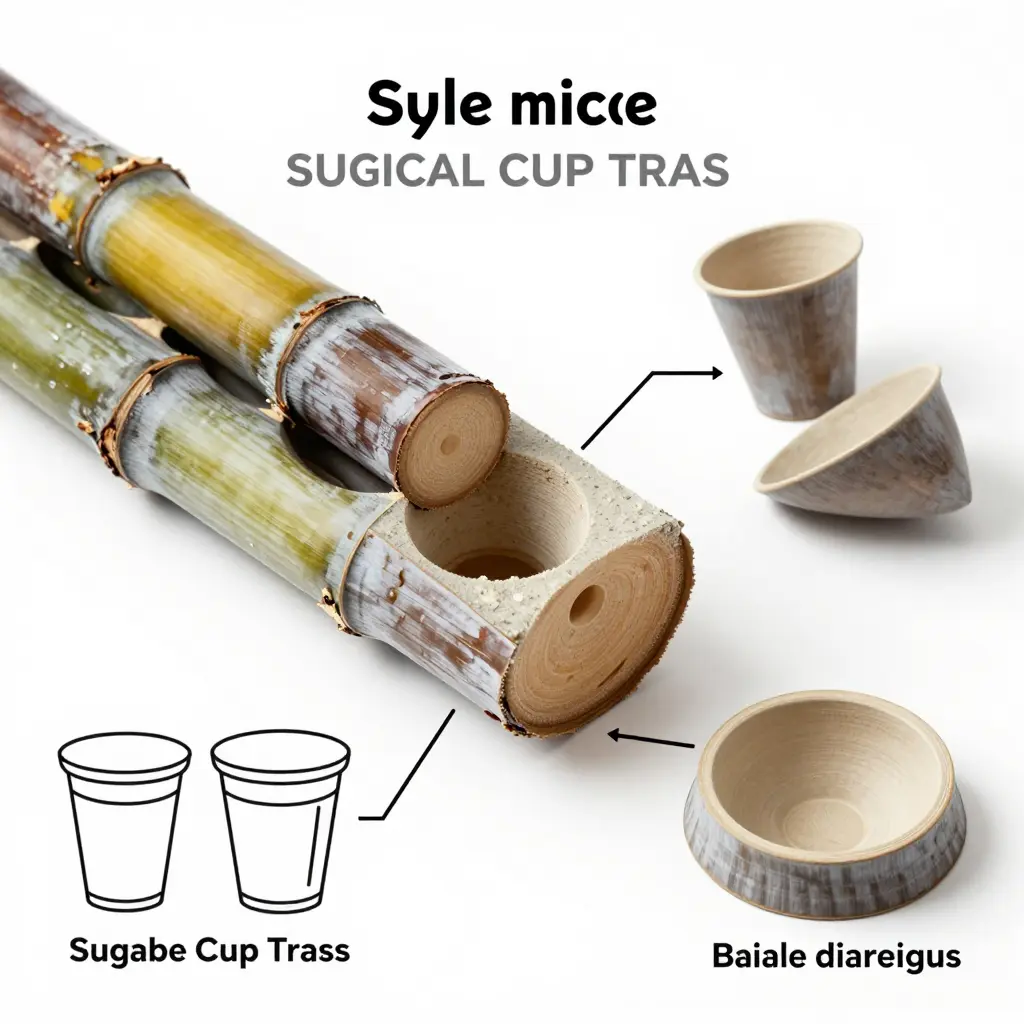
Sugarcane cup trays and bagasse cup trays are molded-fiber carriers: multi-cup trays pressed from sugarcane bagasse pulp that hold two to four drink cups for carry-out, delivery, and drive-thru service. Their job is to keep every cup upright from the counter to the customer’s hand. A busy operator runs thousands of orders a day through these disposable drinkware carriers, and a tray that fails even occasionally turns into a recurring cost.
Cups still tip. Solving why cups tip in sugarcane cup trays comes down to one mechanical fact: the tray has to grip each cup at its base while the cup body passes through a hole above it. When the hole and the base grip disagree, the cup leans, slides, or drops. The cause usually sits at the intersection of hole diameter and base grip, not in the molded fiber itself.
A tipped cup costs product, cups, lids, trays, a soaked bag, and sometimes a customer who does not come back. Across a shift, those losses add up. The rest of this piece covers the engineering trade-off behind a stable tray: how hole diameter and base grip interact, where one compensates for the other, and how to specify both so cups stay put.
How Cup Tipping Actually Happens
A tip-over is a chain of load transfers. It starts with the cup’s center of gravity (CG). An empty, centered cup has its CG low and directly over the base, so gravity pulls straight down through the tray floor. Fill it with a tall sugarcane drink and the CG rises. Add a lid and a straw and it shifts slightly sideways as well. The higher and more off-center the CG, the lower the tipping threshold, and the smaller the nudge needed to send the cup over.
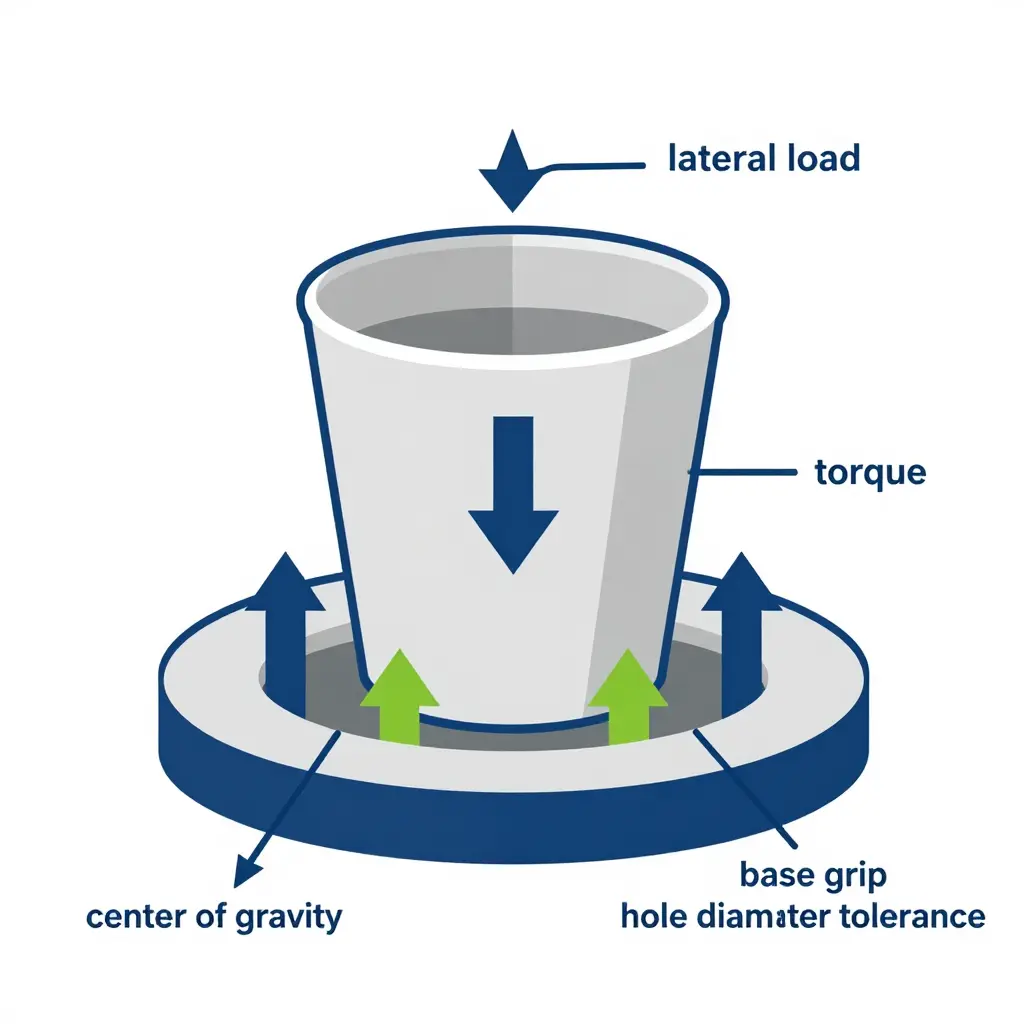
Lateral loads supply the nudge. In transit, every brake, turn, and pothole produces horizontal acceleration. That sideways force acts at the CG while friction at the bottom tries to hold the base in place, and the two produce torque: lateral force multiplied by the vertical distance between the CG and the base. A taller cup gives that force a longer lever arm, so the same corner or curb creates far more torque than it would on a squat cup.
The tray hole fights back on two fronts. Vertically it resists drop-through, so the cup does not push through the floor under its own weight and drink load. Horizontally it resists rocking, so the cup cannot rotate inside the hole and lift its rim past the support edge.
Two properties govern that fight. Base grip is the combined friction and containment holding the cup base: surface friction between cup and tray, plus the hole wall restraining the cup as it tries to slide or spin. Hole diameter is the tolerance that governs fit. An oversized hole lets the cup slide and cuts base grip; an undersized one can jam, crush, or deform the cup. How those two variables line up decides whether your disposable drinkware stays upright through a delivery run.
The failure modes form a spectrum. A tilting cup leans past vertical but keeps its base seated, and recovers once the load eases. A wobbling cup rocks inside an oversized hole, its base shifting until the CG drifts outside the footprint. A fully tipped cup has crossed the point where the CG moves beyond the base and gravity finishes the job.
The Mechanics of Base Grip and Hole Diameter
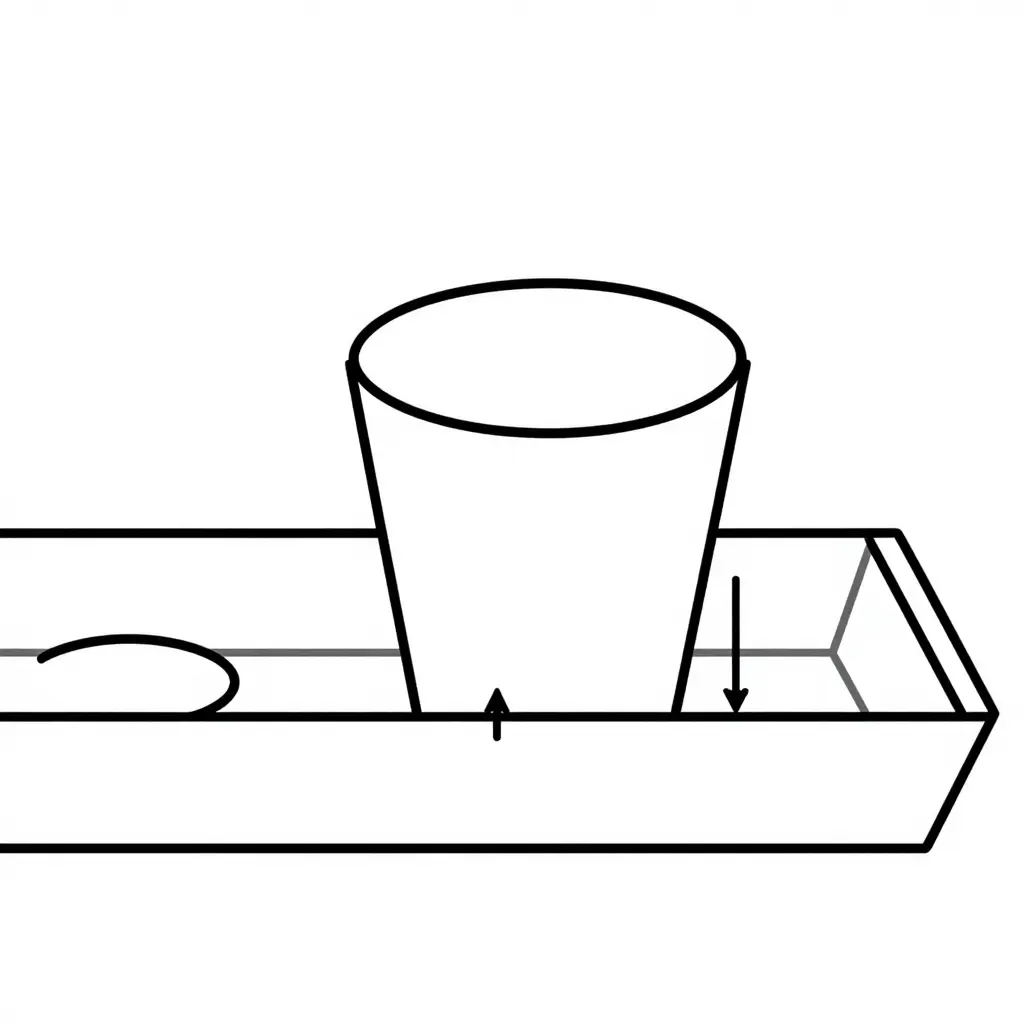
To fix a tipping problem, first look at where the cup and tray actually touch. The cross-section below reduces the geometry to four features.
Reading the Cross-Section
A tipping complaint usually comes down to four features in this slice:
- The tray surface – the flat deck that carries the load and sets the reference plane the cup must stay square to.
- The cup base – the tapered lower wall of the cup, which sits down into the hole instead of resting on top of the deck.
- The retaining contact points – the small line of contact where the cup wall presses against the rim of the hole. These arrows mark the only places where the tray can grip the base and resist a sideways nudge.
- The clearance gap – the free space between the cup base and the hole edge. This gap is the hole diameter tolerance made visible. Cups need some clearance to drop in without jamming; too much and the cup tips before the contact points can do their job.
The Trade-Off in One Table
| Diagram Element | What It Controls | Design Consequence |
|---|---|---|
| Tray surface | Load reference plane | Warping or flex here amplifies every wobble |
| Cup base | Seating depth and taper | Deeper seat means more grip and less lean |
| Contact points | Lateral retention | Small contact patch equals fast tipping |
| Clearance gap | Drop-in fit vs. stability | Wide gap is easy to load but easy to topple |
The Core Insight
The hole diameter sets the clearance gap, and the gap decides how far the cup can lean before the retaining contact points engage. Tighten the hole and you gain grip but risk cups that stick and crack; open it and loading gets easy while stability slips away. Base grip and hole diameter are two halves of the same fit, and the cross-section is where they meet.
A cup that looks stable on a flat table can still tip the moment it drops into a tray with a slightly oversized hole. If you are specifying trays and want the geometry on your side, look for cup and drinkware tray options built around consistent hole tolerances.
The Role of Hole Diameter
Of all the variables, hole diameter decides most often whether a sugarcane cup sits firm or tips – more than tray material or wall thickness. When the hole and the cup base agree, the fiber tray cradles the cup, spreads the load, and lets condensation drain. When they do not, stability collapses. The goal is contact without compression: a snug fit that bears the load and still releases cleanly.
When the hole is too large
- Excess clearance of only 2-3 mm lets the cup slide laterally within the opening.
- Wobble compounds with tray flex, so a 15-20 degree tilt can topple a full drink.
- Grip vanishes on tapered bases, sending spillage straight to the carrier floor.
When the hole is too small
- Loading jams, slowing packing lines and stressing operators.
- Radial pressure cracks brittle bases, especially on thin-wall cups.
- Trapped moisture cannot drain, softening the tray from the inside.
- Continued insertion force bows the fiber walls and deforms the whole grid.
The target band
For most bagasse trays, size each hole to the cup base diameter plus 0.5-1.5 mm. Tapered cups complicate this: measure the outer diameter at the seating depth, not the full base width. So a 50 mm espresso base and a 90 mm drink base need different tooling, not one opening that compromises both.
Measuring for procurement
- Use digital calipers at a fixed datum, typically 3 mm above the base.
- Check ovality, not just diameter – an out-of-round base needs the wider end of the band.
- Confirm a documented hole diameter tolerance with your supplier, then verify it against incoming samples.
Line up these three numbers and cup tipping mostly goes away. Matched bagasse cup and tray systems let buyers lock in a specification that holds up in real service.
The most controllable variable in tray stability is the fit between the punched hole and the cup’s base diameter. The table below maps that relationship against clearance, grip, tip risk, and the failure you will actually see on the counter. Beverage programs that mix and match lids, sleeves, and disposable drinkware can keep it as a reference sheet.
Hole Diameter vs Base Grip: Specification Comparison
| Hole Diameter Relative to Cup Base | Clearance | Base Grip Strength | Tipping Risk | Typical Failure Mode |
|---|---|---|---|---|
| Oversized: hole ID 2-4 mm larger than base OD | Positive radial clearance of 1-2 mm per side | Minimal; friction-only retention | High | Lateral wobble; cup slides and topples under modest lateral load |
| Matched: hole ID within +/-0.5 mm of base OD | Near-zero line-to-line fit | High; uniform 360-degree wall contact | Low | None in normal service; occasional bind during de-nesting |
| Undersized: hole ID 1-3 mm smaller than base OD | Negative (interference fit) | Very high; compressive radial grip | Low | Hoop-stress cracking of the hole wall; base distortion |
| Soft fiber compression: matched ID in low-density fiber (0.4-0.6 g/cm3) | Grows from 0 to 0.5-1.5 mm as fiber yields | Degrades; initial grip relaxes under sustained load | Moderate to high after loading cycles | Creep-induced loosening; cup base sinks and tilts |
| Hard-fiber high-grip: matched ID in high-density fiber (0.8-1.0 g/cm3) | Near-zero; minimal elastic give | Maximum; rigid compressive grip | Low | Edge chipping of the hole rim; brittle crush at base contact |
The Engineering Trade-off
On a sugarcane (bagasse) pulp tray, hole diameter and base grip are one setting, not two. The hole is the grip. You cannot tune them independently, so the engineering trade-off is a decision you make for each application, not a defect you fix once and forget.
The chain runs both ways. Tighten the hole and the molded fiber wall presses harder on the cup’s base ring, so retention climbs and the cup resists tipping – but insertion force rises with it. Staff push harder, seating slows, and jams spike whenever cups go in at an angle during a rush. Open the hole and the reverse happens: cups drop in with one hand and the looser fit absorbs normal cup-size variation, but the wall no longer bites the base, so retention falls and tip-overs return.
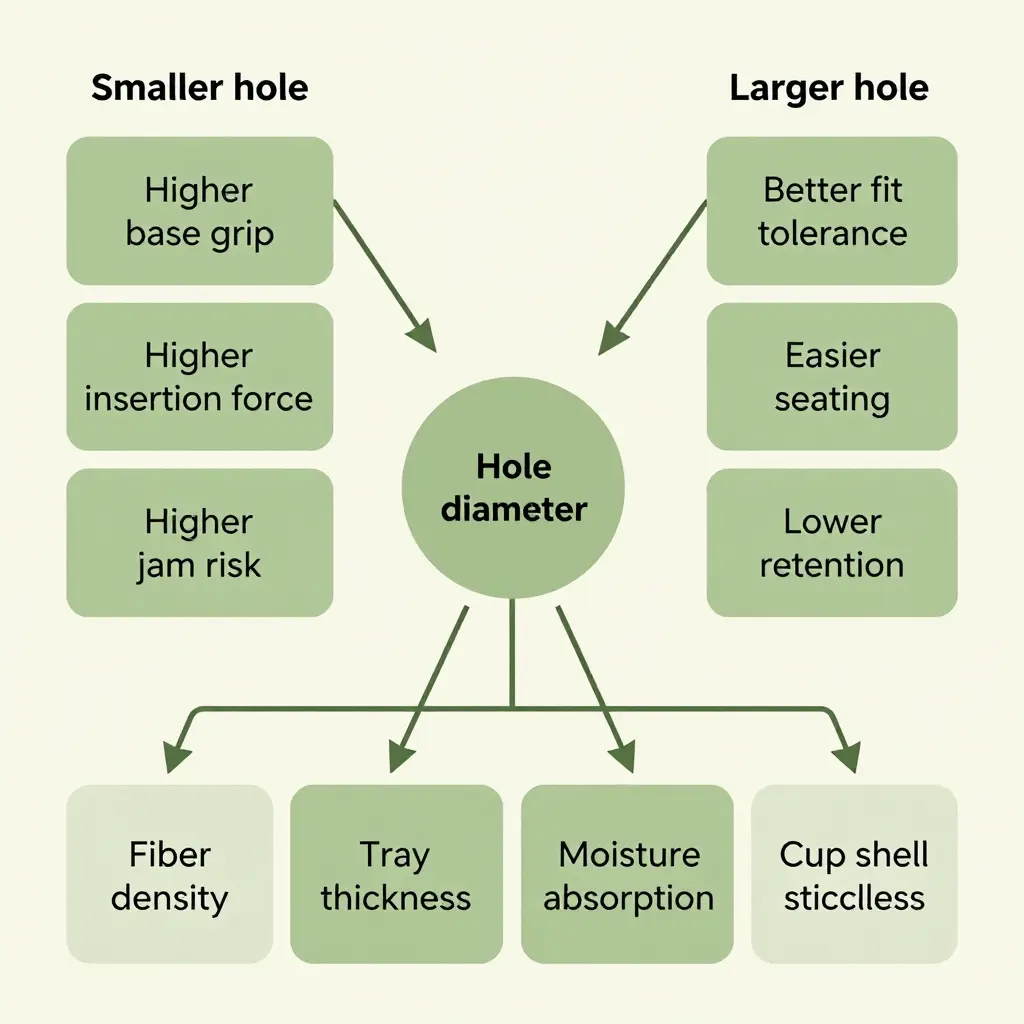
Four variables slide the balance point:
- Fiber density – denser pulp resists compression, so it grips hard but fights insertion.
- Tray thickness – a thicker wall stores more elastic force, adding grip and insertion effort together.
- Moisture absorption – humid trays swell, effectively shrinking the hole and pushing the balance toward jam risk.
- Cup shell stiffness – rigid cups seat cleanly at tighter diameters; soft or thin cups need more clearance.
Because these factors move the crossover, the “right” diameter is always application-specific:
| Application | Priority | Practical direction |
|---|---|---|
| Hot drinks (heavy, handled fast) | Grip | Tighter hole, accept higher insertion force |
| Cold drinks (condensation, light) | Fit tolerance | Slightly open hole |
| Large cups | Retention | Tighter hole, thicker base grip |
| Long transport distances | Anti-tip | Tighter hole, higher fiber density |
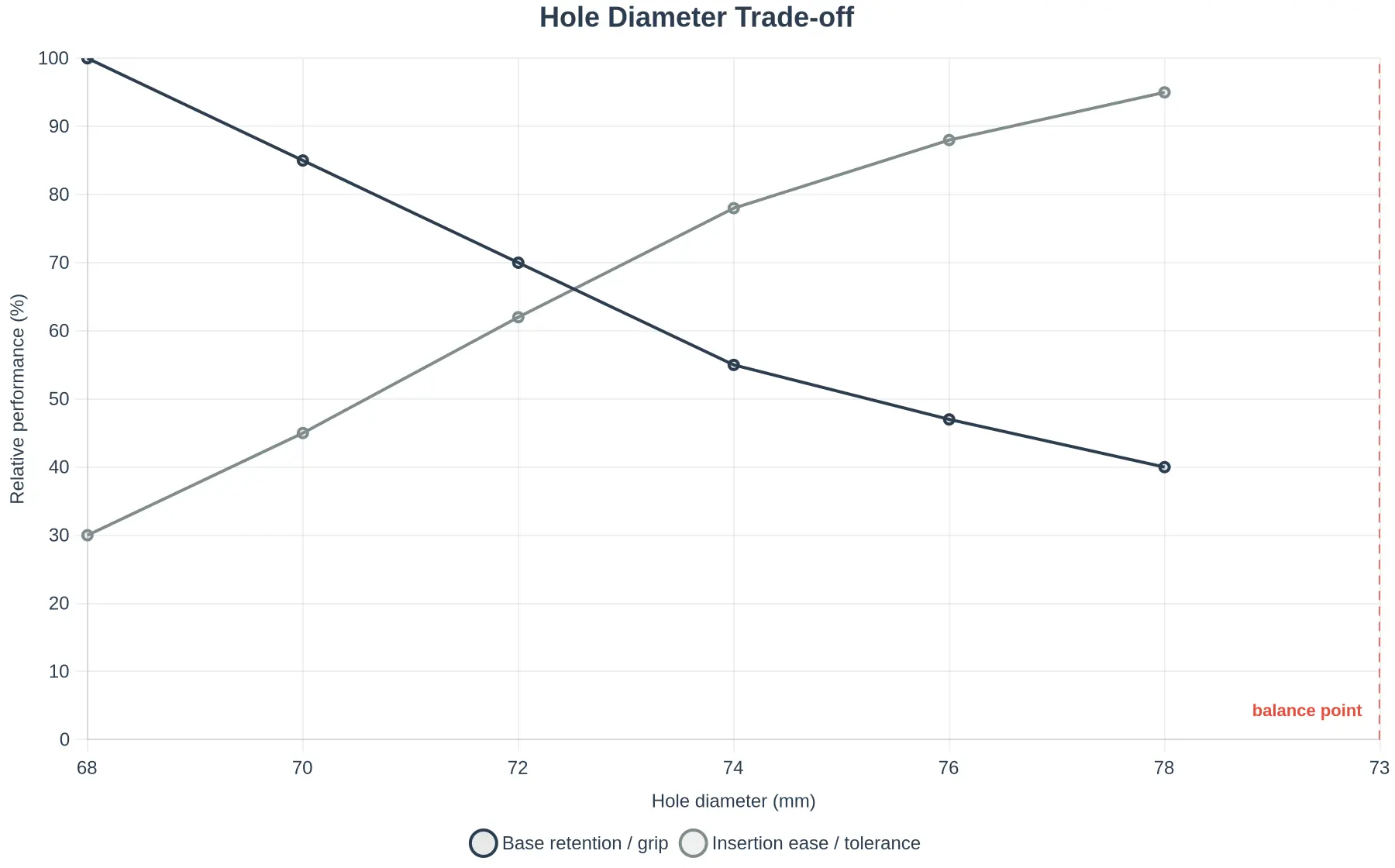
For a starting point, match diameter to your actual disposable drinkware and cup heights, then test the worst case: a rushed, one-handed insert in humidity. That field test tells you which side of the balance point you can afford.
Visualizing the Trade-off
The chart below plots tipping rate against how closely the tray hole matches the cup base diameter. Risk bottoms out where the two are evenly matched, then climbs steeply as the fit drifts either way. Too small a hole pinches the base and keeps it from seating flat; too large a hole leaves the cup nothing to grip, so it rocks and topples under load. This one dimension often separates a stable tray from a costly spill.
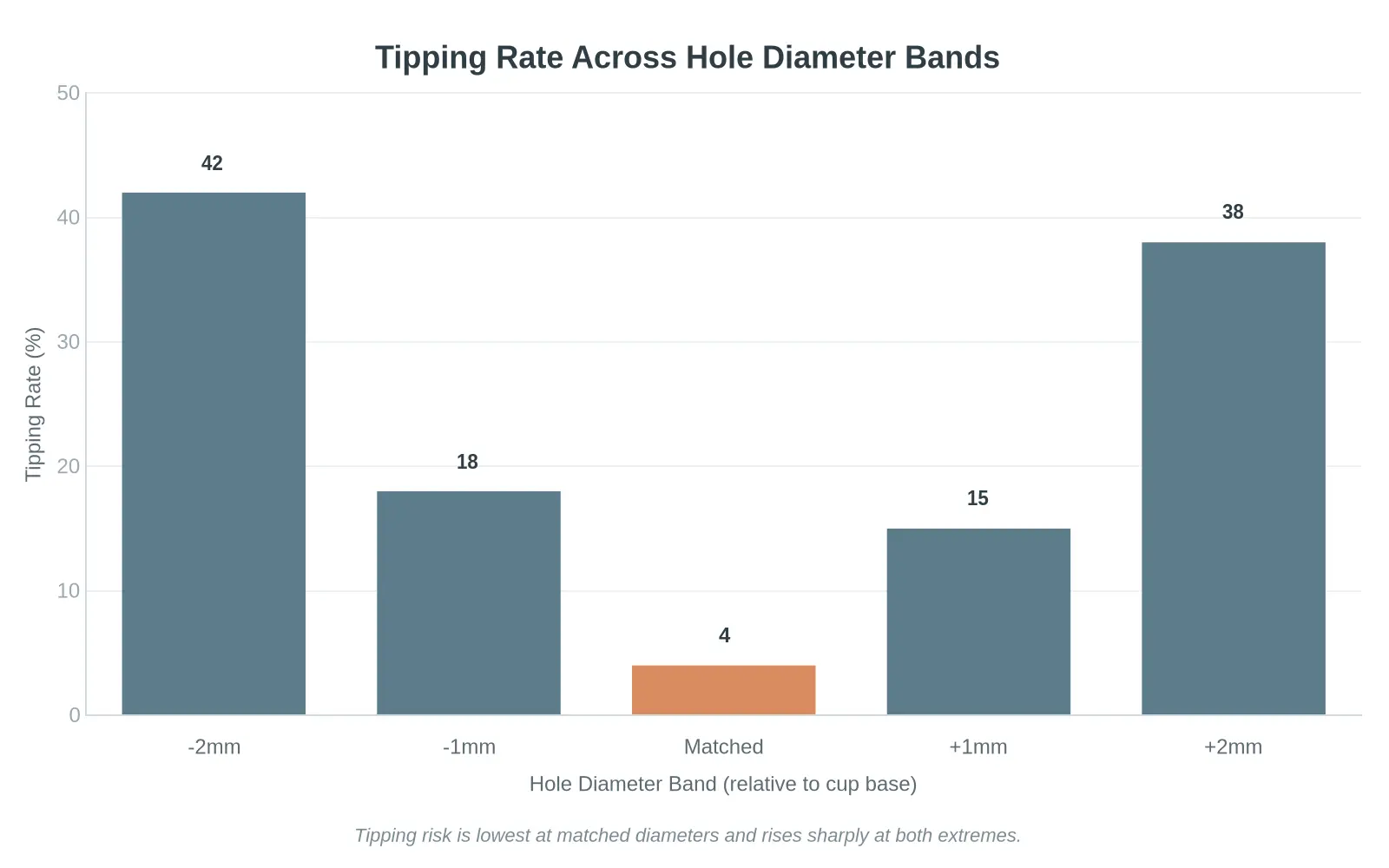
Figure 1: Tipping risk is lowest at matched diameters and rises sharply at both extremes.
If you are standardizing your beverage service around tapered paper cup formats, matching tray geometry to the real cup base measurement is the fastest way to cut tip-overs.
Base Grip: Design Principles That Keep Cups Upright
Hole diameter gets the blame when a cup tips, but the real variable is base grip strength – the friction and mechanical retention a molded fiber socket exerts on a cup’s base. In sugarcane and bagasse trays it is engineered across several interacting features. Get them wrong and a perfectly sized hole still releases its cup at the first nudge.
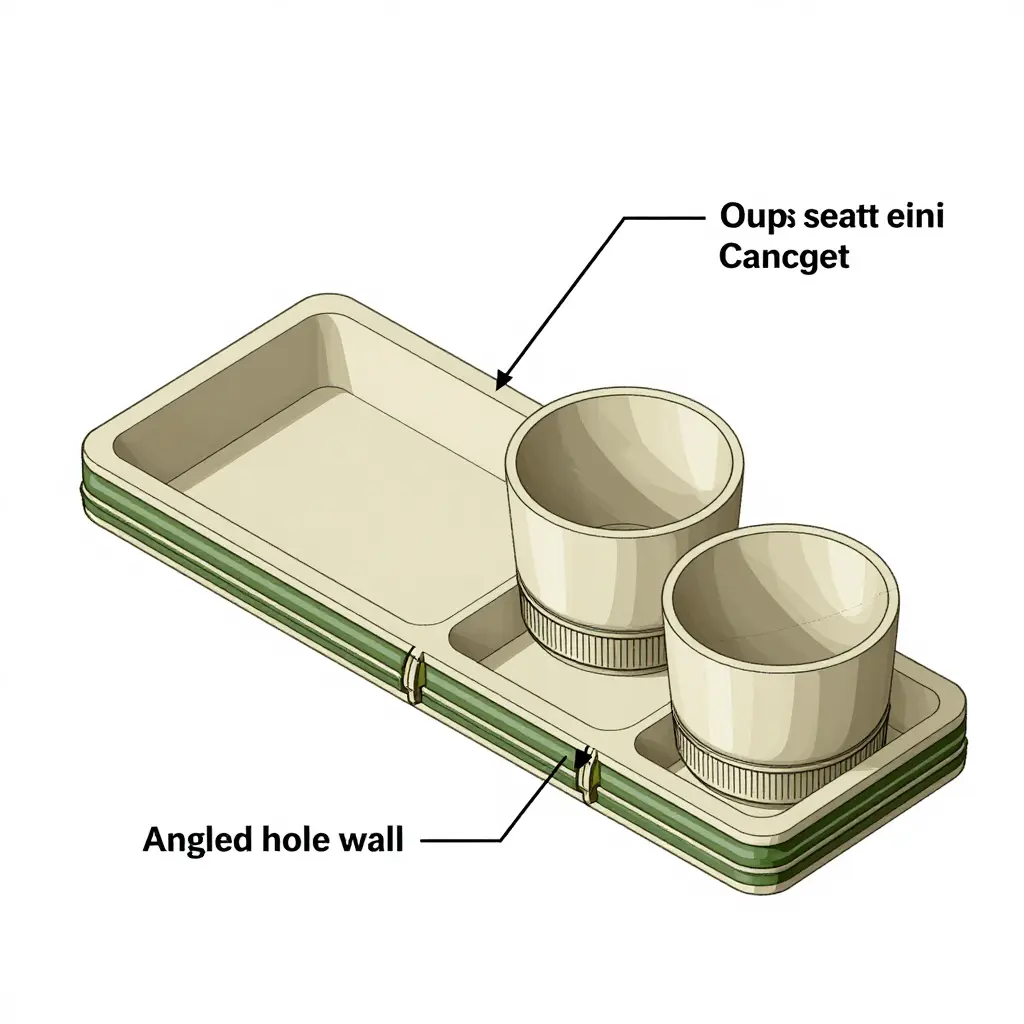
Hole wall angle
A hole is never a straight cylinder. Molded fiber needs draft to release from the tool, usually 3-8 degrees per side, so the cup contacts the wall progressively: light at the rim, full at the seat. A steeper angle raises the wedging force as the cup settles, which adds base grip strength under vertical load. Too steep and the cup jams rather than seats.
Cup seat depth
Depth governs how much of the cup’s sidewall is captured. Shallow seats (8-12 mm) grip only the base curve, where friction is lowest. Deeper seats (15-25 mm) engage the straight sidewall and create a longer contact band, which is why base grip strength scales more with depth than with diameter alone.
Textured and ribbed contact rings
Smooth molded fiber behaves like a low-friction surface once condensation forms. Concentric ribs, dimples, or radial flutes interrupt the contact interface and raise the effective coefficient of friction. Ribs also add local stiffness, so the ring resists ovalization when a full cup loads it.
Fiber compression under load
Sugarcane bagasse is a compressible, porous composite. Under a loaded cup, the seat walls compress elastically and then take a set. A well-designed socket tolerates roughly 0.5-1.5 mm of compression: enough to conform around minor cup taper variation, not so much that the socket relaxes and base grip strength fades after the first hot drink.
Drainage gaps versus retention
Condensate and spills must escape, or hydrostatic pressure and lubricity defeat the grip. Drainage slots, however, cut load-bearing material. The balance: keep gaps narrow (2-4 mm), position them low and radial, and leave continuous fiber at the highest stress points, so retention is not weakened by the very channels meant to protect it.
Rounded versus sharp rims
A rounded or chamfered hole rim spreads contact over a larger area and lets the cup self-center, producing predictable, moderate base grip strength with low abrasion on printed cup surfaces. A sharp rim concentrates stress on a thin line, generating high initial friction and strong anti-rock behavior – but it can shave ink, crack under repeated drops, and vary widely with tool wear.
Moisture and condensation
Wet molded fiber swells and softens. Water acts as a lubricant at the cup-to-tray interface, dropping friction even as the fiber expands into a tighter nominal fit. This is the classic cold-drink failure: the socket tightens dimensionally while base grip strength drops functionally. Hydrophobic surface treatment and ribbed contact rings are the countermeasures.
Selecting grip features by use case
| Use case | Recommended grip features |
|---|---|
| Hot coffee, single carrier | Moderate 4-6 degree wall angle, 15-20 mm seat, rounded rim, no large gaps |
| Iced drinks, condensation-heavy | Ribbed contact rings, hydrophobic finish, low radial drainage slots |
| Multi-cup takeaway trays | Deeper seats plus sharp-but-chamfered rims for anti-rock stability |
| Vending or automated handling | Uniform rounded rims and tight tolerances to reduce drop variance |
| Large volume / heavy cups | Thicker seat walls, high rib density, narrow drainage gaps |
Diameter decides whether a cup enters the hole; wall angle, seat depth, contact texture, and gap placement decide whether it stays. Engineers chasing fewer spills should tune base grip strength first and treat hole diameter as the final confirmation, not the starting point. For carriers built around these principles, see our sugarcane drinkware carriers.
Troubleshooting Checklist: Cups Tipping in Sugarcane Trays
Run this checklist before your next order or lineup audit to find the root cause of tipping and lock in a stable cup-and-tray pairing:
- Measure the actual cup base diameter with calipers at three points rather than trusting the catalog spec sheet, since ovality from molding or shipping distortion can exceed 1 mm.
- Check the tray’s hole diameter tolerance range against your cup spec, aiming for the tightest window the fiber pressing process can hold consistently rather than a nominal single value.
- Inspect the base grip contact rings on a sample tray for uniformity, because a shallow or broken ring reduces friction and lets cups slide and tip.
- Test insertion force with a simple push-pull gauge, since cups should seat with consistent resistance rather than drop in loosely or demand a hard shove that cracks the rim.
- Check the fiber moisture content of the tray using a moisture meter, because overly dry bagasse weakens grip rings while damp trays soften and lose dimensional accuracy.
- Test cups under lateral transport motion by simulating a full tray ride over a bumpy trolley or in-vehicle journey to see which positions tip first.
- Compare tray thickness across suppliers by measuring wall and base sections in millimeters, since thin walls flex and release the cup under load.
- Confirm cup-to-tray size match before ordering in bulk by test-fitting both the standard and rimmed cup variants you actually stock.
Run these checks consistently and a recurring packaging failure becomes a documented specification you can hand to any supplier. Start by reviewing your current disposable drinkware options against the list.
Frequently Asked Questions
What causes cups to tip in sugarcane cup trays?
Cups tip when the tray’s hole diameter and the cup’s base geometry are mismatched. If the hole is wider than the cup base, the cup has lateral play and shifts whenever the tray is tilted or carried unevenly. A shallow base grip and an over-sized hole let a top-heavy filled cup move its center of gravity past the base footprint, and it topples. Well-specified sugarcane cup trays hold the base snugly so the cup stays centered through normal handling.
Is hole diameter more important than base grip?
Neither factor works in isolation, because they function as a matched pair. Hole diameter controls lateral movement, while base grip controls vertical friction and how much the cup can rotate or slide. A perfectly sized hole paired with a slick, shallow base grip will still allow the cup to slide and tip. The reliable result comes from balancing both dimensions rather than optimizing either one alone.
How do I measure the correct hole diameter for a given cup?
Measure the cup’s base diameter where it actually contacts the tray, normally just above the bottom rim, using digital calipers. Then add a clearance of roughly 0.5 to 1.5 mm so the cup drops in and lifts out freely without binding. For tapered cups, measure at the height where the tray truly supports the cup instead of at the very bottom. Confirm the fit with a filled sample before committing to a production run.
Do bagasse trays behave differently from sugarcane trays?
Bagasse is sugarcane fiber, so bagasse trays and sugarcane trays are molded from essentially the same material and behave very similarly. Any differences come from wall thickness, density, and molding tolerances between individual suppliers rather than from the raw fiber itself. This is why tolerance testing on real cup samples matters more than the material label. You can review compatible disposable drinkware options to align tray and cup specifications.
How does moisture affect base grip?
Molded fiber absorbs moisture, which softens the surface and reduces friction between the cup base and the tray. As the fiber swells slightly, the hole can tighten or deform, changing the fit and grip over time. Keeping trays dry and using condensation-resistant cups helps maintain consistent base grip. In humid or iced-drink service, these effects accumulate faster and should be accounted for in your tolerances.
Procurement Checklist: Specifying Sugarcane Cup Trays with Confidence
Getting cup trays right is a sourcing problem as much as an engineering one. A tray that holds perfectly in the warehouse can tip the moment it rides a loaded delivery van, because the problem is usually not the tray but the drift between batches. Lock these variables down before you release a purchase order.
Specifications to request up front
Ask for a written spec sheet with tolerances and test conditions, not just nominal values; vague data sheets are where tipping incidents start.
| Specification | What to request from the supplier | Typical target range |
|---|---|---|
| Hole diameter & tolerance | Nominal bore plus permitted variance | +/-0.3 mm on a cup-matching hole |
| Base grip design | Geometry of the retention lip or ring | Stepped lip contacting the cup’s lower third |
| Fiber density | Grams per unit area of molded bagasse | Even density across the batch |
| Wall thickness | Minimum thickness at wall and ribs | Consistent thickness, no thin spots |
| Moisture resistance | Water absorption and warp after humid exposure | Low absorption, minimal warping |
To cover insert options, review a broad disposable tableware range so the tray geometry matches the cups you actually run.
How to compare samples with one shared test method
Do not let each supplier test to its own standard, or nothing compares. Define one method and run it on every sample:
- Load each tray with the exact cups and beverage weight you ship, including matching paper cups in each size you stock.
- Run a 30-degree tilt test on each loaded tray and record the angle at which the cup moves.
- Condition samples at high humidity for 24 hours, then repeat the tilt test to expose moisture-driven grip loss.
- Measure hole diameter on at least ten trays per carton with calipers, and log the spread, not just the average.
Why consistent tolerances cut tipping incidents
Tipping shows up across shipments, not in a single unit. When hole diameter drifts slightly wider, the cup shifts and base grip loses contact, so a tray that passed your sample test fails in transit. A tight tolerance band and one shared test method keep grip contact predictable from the first carton to the last, which is what turns a good sample into a reliable shipment.